


In the far east of Persia, on the high desert plateau near the border with Afghanistan, lies the city of Birjand. It is a place of saffron fields, barberry orchards, old citadels, and long traditions of craft, and it has been a center of rug weaving for generations. Birjand rugs are less well known in the West than the rugs of Mashhad or Kerman, but they share the elegance of the great Khorasan city tradition, usually at a more modest price.
This guide is written for buyers. It explains where Birjand rugs come from, how they are designed and built, what the famous jufti knot is and why it matters, how Birjand rugs compare with their neighbors, and how to choose and care for one. For the history of the city and its weaving, see our article on weaving in Birjand and our overview of weaving in Khorasan.
1
Birjand and South Khorasan
Birjand is the capital of South Khorasan province, which was separated from the larger province of Khorasan in 2004. The city lies at about 1,400 meters, in a dry landscape of mountains and plains, with hot summers and cold winters. The surrounding region, historically known as Qaenat, is famous for its saffron and barberries, which are among the most important crops of eastern Persia.
The region has many weaving towns and villages. Among the best known are Moud, a village near Birjand famous for fine rugs with Herati and medallion designs, and towns such as Qaen, Ferdows, Sarbisheh, and Darmian. Rugs from the city itself and from nearby workshops are sold under the Birjand name.
Birjand is the capital of South Khorasan, on the eastern edge of Persia. The region, historically called Qaenat, is famous for saffron, barberries, and rugs, including the fine rugs of nearby Moud.
2
The Khorasan City Tradition
Birjand rugs belong to the city tradition of Khorasan, whose great center is Mashhad. This tradition favors curvilinear designs drawn by professional designers, large medallions with matching corners, floral fields of palmettes and arabesques, and soft, lustrous wool. Khorasan city rugs are known for their deep reds, navies, and warm golds, and for a slightly softer handle than many western Persian rugs.
A study of the urban carpets of South Khorasan, published by researchers at the University of Birjand, identifies the main design types still woven in the province: the medallion and corner (lachak-toranj) layout, the framed (qabi) layout, the banded or sampler (vaghireh) layout, the striped (moharramat) layout, the garden panel (kheshti) layout, and allover (sartasari) designs. The study notes that the medallion and corner group often repeats the interlocking fish motif known as mahi dar-ham, the Herati, which is one of the signatures of the region.
3
The Six Design Types in Practice
The design types identified by the Birjand researchers are useful for buyers too, because each one behaves differently in a room.
•
Medallion and corner - The most formal layout. It gives a room a clear center and works best where the medallion can be seen, for example under a glass coffee table or in an open dining area.
•
Framed (qabi) - The field is enclosed in a large inner frame, like a picture in a frame. This layout looks orderly and suits rectangular rooms with symmetrical furniture.
•
Banded (vaghireh) - Sections of different borders and field patterns are combined, like a sampler. These rugs are lively and full of variety.
•
Striped (moharramat) - Parallel stripes, each filled with small motifs, run the length of the rug. Stripes make a narrow room look longer.
•
Garden panel (kheshti) - A grid of squares, each holding a plant or motif. A cheerful, decorative layout that rewards close looking.
•
Allover (sartasari) - Motifs repeated over the whole field without a center. The most forgiving under furniture.
Most Birjand rugs in the market belong to the medallion and allover groups, but the other types appear too and are worth looking for.
4
How to Recognize a Birjand Rug
•
Curvilinear design - Medallions, palmettes, and vines drawn with smooth curves.
•
Medallion and corners - A central medallion, often round or lobed, with matching corners.
•
Herati or floral field - Fields filled with the Herati repeat or with Shah Abbasi palmettes and arabesque vines.
•
Warm palette - Brick red and madder red, navy and indigo, cream and ivory, with gold and rust.
•
Soft wool - A soft, slightly velvety handle typical of Khorasan wool.
•
Persian knot - The asymmetric knot, often tied as a jufti knot (see below).
Birjand rugs look much like Mashhad rugs at first glance. The differences lie in the details: density, wool, and the way the design is drawn.
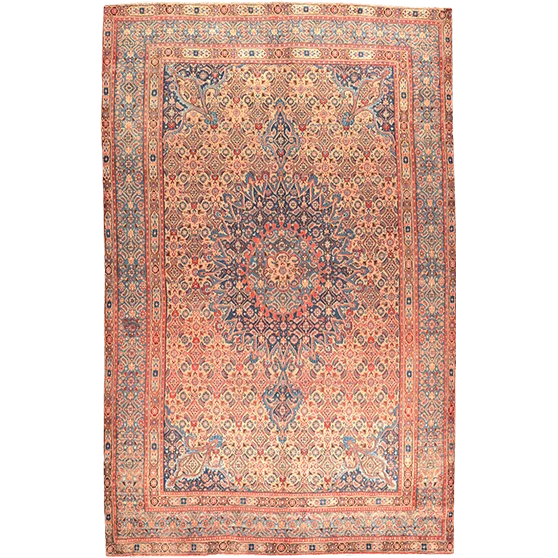
A Birjand rug of about 10 by 6.5 feet with a medallion on a brick red Herati field, framed by cream and navy - Birjand Persian Rug 10x6 ft - Medallion Semi Antique Wool Hand Knotted
5
The Jufti Knot: What It Is and Why It Matters
The jufti knot, from the Persian word for "pair," is a knot tied around four warp threads instead of the usual two. It is used with both the asymmetric and symmetric knots, and it is especially common in Khorasan. Because each jufti knot covers twice as many warps, a weaver can cover the same area with about half as many knots, which saves a great deal of time.
The jufti knot is not a fault in itself. Used in small areas, or in a well-packed rug with good wool, it produces a perfectly sound rug, and the drawing can still be crisp. Used across a whole rug, however, it reduces the density and can make the pile thinner and the rug less durable. In the market, rugs with extensive jufti knotting are generally valued lower than rugs knotted entirely in the standard way.
How to spot jufti knots
Turn the rug over and look at the back. With a standard asymmetric knot, each knot covers two warps and shows as a small, regular unit. With a jufti knot, each unit appears twice as wide, covering four warps. In areas of jufti knotting, the back looks coarser, and the rows of knots appear stretched sideways. On the front, the pile may look slightly thinner, and when you bend the rug, the base may show more easily between the tufts.
How much does it matter?
For most buyers, a few areas of jufti knotting are not a problem. What matters is the overall feel of the rug: does the pile feel full and springy, does the rug feel substantial, and is the drawing clear? A Birjand with good wool and a solid weave will give many years of service even if it contains some jufti knotting.
A jufti knot is tied around four warps instead of two. It saves weaving time but lowers density. Check the back of a Khorasan rug to see whether it was used, and judge the rug by its overall fullness and feel.
6
How Birjand Rugs Are Built
•
Knot - The asymmetric (Persian) knot, sometimes tied as a jufti.
•
Foundation - Cotton warps and wefts.
•
Wefts - Usually two wefts between rows of knots.
•
Pile - Soft local wool, clipped to a medium height.
•
Density - Medium in most rugs, varying with the use of jufti knots.
•
Sides and ends - Overcast sides and cotton fringes.
Because the designs are drawn by professional designers on squared cartoons, Birjand rugs are usually symmetrical and well balanced, with corners that mirror each other and borders that turn neatly.
Birjand rugs are lighter and softer than many western Persian rugs. They lie flat and have a comfortable, plush feel underfoot.
7
Designs in Our Birjand Collection
Medallion with Herati field
The classic Birjand layout: a central medallion, matching corners, and a field of Herati repeats. The Herati gives a fine, even texture that hides wear, while the medallion gives the rug a strong center. See our Herati designs.
Medallion with Shah Abbasi field
Another classic: a medallion on a field of Shah Abbasi palmettes and flowing arabesque vines, giving a rich, flowing look. See our Shah Abbasi designs.
Allover designs
Some Birjand rugs repeat the Herati or floral motifs across the whole field without a medallion. These are practical for rooms where furniture covers much of the rug.
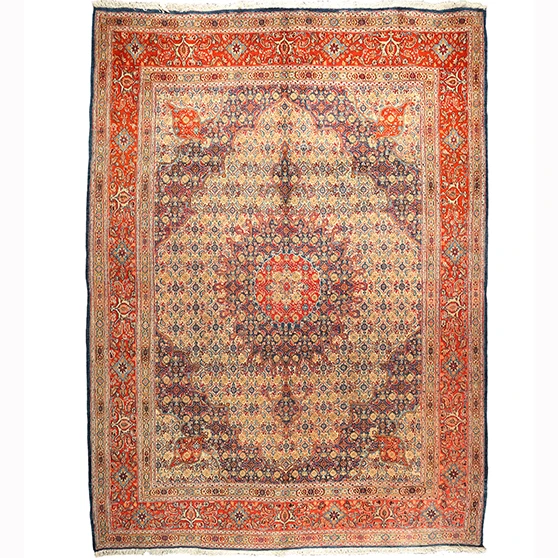
A Birjand rug of about 9.5 by 7 feet with a medallion and Shah Abbasi palmettes on a madder red field - Birjand Persian Rug 9x7 ft - Medallion Semi Antique Wool Hand Knotted
8
Birjand and Its Neighbors
Birjand and Mashhad
Mashhad rugs are the best-known Khorasan city rugs. They share the same design tradition as Birjand, and fine Mashhads are often more densely knotted and more elaborately drawn. Birjand rugs can be slightly coarser and less expensive. See our Mashhad collection and our article on weaving in Mashhad.
Birjand and Moud
Moud rugs, from a village near Birjand, are famous for fine knotting, short pile, and Herati designs, often with silk highlights. They are generally finer than Birjand rugs. See our Moud collection.
Birjand and Kashmar
Kashmar rugs, from western Khorasan, are known for dense, detailed floral designs, often with many small motifs. Birjand rugs tend to have simpler, more open designs. See our Kashmar collection.
Birjand and Ferdows
Ferdows, also in South Khorasan, produces rugs with a more village and tribal character, often geometric. Birjand rugs are classic city rugs. See our Ferdows collection.
Birjand and Kerman
Kerman rugs, from the south-east, are also curvilinear and floral, but often softer in color, with pastel palettes and a different structure. See our Kerman collection.
9
Colors of Birjand
The Birjand palette is warm and harmonious. Brick red and madder red fields are common, with navy and indigo medallions and borders, cream and ivory corners and outlines, and accents of gold, rust, beige, and brown. Some rugs use crimson and burgundy for a deeper look.
In semi-antique rugs, these colors have softened into a gentle, warm harmony. The reds have mellowed toward rose and rust, and the creams have warmed. This makes Birjand rugs easy to live with in many kinds of room.
10
Grades and How to Judge Them
•
Fullness - The pile should feel full and springy, not thin or papery.
•
Back - Check for jufti knotting and its extent.
•
Drawing - Smooth, symmetrical curves and well-matched corners.
•
Wool - Soft, lustrous wool; avoid dry, brittle wool.
•
Color - Clear colors without bleeding.
•
Flatness - The rug should lie flat with straight sides.
•
Condition - Even wear, intact sides and ends.
11
Sizes and Placement
Birjand rugs are woven in many sizes. Our pieces, around 10 by 6.5 and 9.5 by 7 feet, are versatile medium-large sizes.
•
Living room - Under a coffee table with the front legs of the sofa and chairs on the rug.
•
Dining room - Under a table for four to six, with room for chairs.
•
Bedroom - Under a queen bed, extending on both sides.
•
Study - As the main rug of a library or home office.
12
Birjand Rugs in Your Home
The classic design and warm colors of a Birjand rug make it a natural choice for traditional interiors, with wood furniture, bookshelves, and rich fabrics. In modern rooms, a semi-antique Birjand with softened colors adds warmth and history without overwhelming the space.
Because Birjand wool is soft, these rugs are especially pleasant in rooms where people sit or walk barefoot: bedrooms, family rooms, and reading corners. In very busy areas, such as entrances, a harder-wearing rug may be a better choice.
13
Saffron, Barberries, and the Colors of the East
The landscape of South Khorasan is reflected in its crafts. Saffron, harvested each autumn from purple crocus flowers in the fields around Birjand and Qaen, has long been one of the region's treasures. Its golden threads have been used for flavor, for medicine, and in small amounts for dyeing. Barberry bushes, with their bright red berries, line the orchards. The warm reds and golds of Birjand rugs feel at home in this landscape, though most of their colors come from madder, indigo, and other classic dye plants. Read more in our articles on natural dyes and the principal sources of natural colors.
14
Combining a Birjand with Other Rugs
A Birjand rug pairs naturally with other Khorasan rugs. A Mashhad in the living room and a Birjand in the dining room share the same design language and similar colors, giving a home a unified look. For a more varied combination, a Birjand can sit alongside a tribal Baluch or Turkmen rug from the same province; the contrast between the curving city design and the geometric tribal design is attractive, and their shared reds and blues tie them together.
With rugs from western Persia, choose pieces whose reds are in a similar range. A brick red Birjand next to a bright crimson rug can look slightly off, while two warm, softened reds sit happily together.
15
Semi-Antique Birjand Rugs
Our Birjand rugs are semi-antique, woven roughly forty to sixty years ago. They show the classic Khorasan city style of the mid twentieth century, with settled colors and soft, lustrous wool, and they have many years of life ahead. See our semi-antique rugs.
16
What Affects the Price of a Birjand Rug
•
Density and knotting - Rugs without extensive jufti knotting are more valued.
•
Size - Larger rugs cost more.
•
Design - Well-drawn, balanced designs add value.
•
Wool - Soft, lustrous wool is prized.
•
Condition - Even pile, intact sides and ends.
Birjand rugs offer the elegance of the Khorasan city tradition at accessible prices, making them a good choice for buyers who want a classic look.
17
Caring for a Birjand Rug
Vacuum regularly without a beater bar, in the direction of the pile. Rotate the rug every six months. Blot spills at once. Use a good pad to reduce wear and keep the rug flat. Keep it out of strong direct sunlight. Have it professionally washed every few years. See our care instructions and our guide to professional washing.
18
Soft Wool and Comfort Underfoot
Much of the pleasure of a Khorasan rug lies in how it feels. The wool of the region is soft and fine, and Birjand rugs are clipped to a comfortable medium height. Walking on one barefoot is a pleasure, and the rug absorbs sound, making a room quieter and warmer.
Soft wool does need a little more care than the tough wool of the north-west. Furniture with narrow legs can leave deep marks; use furniture cups or move pieces slightly from time to time. In front of a favorite chair, where feet rest every day, the pile will wear first; rotating the rug spreads this wear evenly. With these small habits, a Birjand will stay soft and handsome for decades.
19
Questions to Ask Before You Buy
•
Does it contain jufti knots? - And if so, how much of the rug do they cover?
•
What is the knot density? - Ask for an estimate, and check the back yourself.
•
Has it been repaired? - Small repairs are normal; you should know where they are.
•
Has it been washed recently? - A clean rug shows its true colors.
•
What are the exact measurements? - Check both length and width at each end.
20
Common Buying Mistakes
•
Ignoring the back - Check for jufti knots and repairs.
•
Judging only by design - Two rugs with similar designs can differ greatly in density and wool.
•
Placing in very high traffic - Soft wool is best in moderate-traffic rooms.
•
Skipping the pad - A pad protects soft wool and extends the rug's life.
21
Frequently Asked Questions
Where is Birjand?
In eastern Persia, the capital of South Khorasan province, near the border with Afghanistan.
What is the Qaenat region?
The historic name of the region around Birjand and Qaen, famous for saffron, barberries, and rugs.
What style are Birjand rugs?
Classic Khorasan city rugs, with curvilinear medallions and floral or Herati fields.
What is a jufti knot?
A knot tied around four warps instead of two, which saves time but lowers density.
Is a rug with jufti knots a bad rug?
Not necessarily. Judge it by the fullness of the pile, the wool, and the drawing.
How do Birjand rugs differ from Mashhad rugs?
They share the same tradition; fine Mashhads are often denser and more elaborate.
What is Moud?
A village near Birjand famous for fine rugs with Herati designs.
What design types are woven in South Khorasan?
Medallion and corner, framed, banded, striped, garden panel, and allover designs.
What colors are typical?
Brick red, madder red, navy, cream, with gold and rust accents.
Are Birjand rugs soft?
Yes. Khorasan wool gives them a soft, plush handle.
Where should I place a Birjand rug?
In living rooms, dining rooms, bedrooms, and studies with moderate traffic.
Does a Birjand go with a Baluch rug?
Yes. Both come from Khorasan and share reds and blues, while their city and tribal designs contrast nicely.
What is a moharramat design?
A striped layout, with parallel bands of small motifs running the length of the rug.
How do I protect soft wool from furniture marks?
Use furniture cups and move pieces slightly from time to time.
How should I clean a Birjand rug?
Vacuum regularly, blot spills, and have it professionally washed every few years.
22
Choose Your Birjand Rug
Each Birjand rug in our collection is hand-knotted, one of a kind, and inspected before it is listed. Browse our Birjand collection, compare it with our Mashhad, Moud, and Kashmar rugs, or ask our experts for help.