


On the road between Hamadan and the mountains of Lorestan lies the old town of Borujerd, set in a broad, fertile valley beneath high peaks. The villages around it have long woven rugs for their own homes and for the market. These Borujerd rugs are not famous names in the Western trade, but they have a loyal following among dealers who value their tough wool, honest construction, and warm, glowing colors.
This guide explains where Borujerd rugs come from, how they relate to their better-known neighbors, how they are built and designed, and how to choose and care for one, especially in the long formats and runners that make up most of our collection. For the wider weaving of western Persia, see our articles on weaving in Hamadan and Kurdish rugs.
1
Borujerd and Its Valleys
Borujerd is a town in the north of Lorestan province, close to the borders of Hamadan and Markazi provinces. It lies in a green valley at around 1,600 meters, ringed by mountains, with the high ranges of Oshtorankuh to the south. The land is good for farming and grazing: wheat, fruit, and pastures for sheep and goats.
Most Borujerd rugs are not woven in the town itself but by rural families in the surrounding districts, especially Oshtorinan to the north and Silakhor, the broad plain to the south. Here, weaving has long been a household craft, practiced by women at upright looms through the winter.
Borujerd rugs are woven mainly by village families in Oshtorinan and Silakhor, around the town of Borujerd in northern Lorestan.
2
Between Hamadan and the Lurs
Borujerd sits at a meeting point of cultures. To the north are the Turkic and Persian villages of the Hamadan region, with their sturdy single-wefted rugs. To the south and west are the Lur tribes of Lorestan, with their bold tribal rugs and flat-weaves. To the east is the Arak region, with its great village carpet tradition.
Borujerd rugs show this position clearly. Though woven in Lorestan, they are generally closer in structure and style to Hamadan village rugs than to tribal Lur rugs: they use cotton foundations, the symmetric knot, and village designs such as Herati networks and geometric medallions. Yet they also have a tribal liveliness in their drawing and colors that recalls the Lur weavings of the mountains.
3
The Ziegler Connection
Borujerd's position close to the Arak region brought it into the great carpet trade of the late nineteenth century. After Ziegler and Company, the Manchester firm with Swiss roots, established itself in Sultanabad, today's Arak, in the 1880s, it took an interest in the Borujerd area, which was close by and known for good wool and durable rugs. The region became a source of wool and natural dyestuffs as well as rugs. Read more about this period in our Arak collection guide and our article on Sultanabad rugs.
4
How to Recognize a Borujerd Rug
•
Geometric drawing - Stepped medallions, diamonds, and angular motifs.
•
Herati networks - Fields filled with an angular Herati repeat, sometimes mixed with scattered small motifs.
•
Warm, glowing colors - Crimson, madder red, rust, orange, and terracotta, with navy and ivory.
•
Symmetric knot - The Turkish knot.
•
Cotton foundation - Cotton warps and wefts.
•
Thick local wool - Resilient, lustrous wool from local flocks.
•
Smaller sizes - Many rugs are small to medium, and long rugs and runners are common.
A Borujerd often looks like a lively Hamadan village rug with an extra warmth of oranges and rusts.
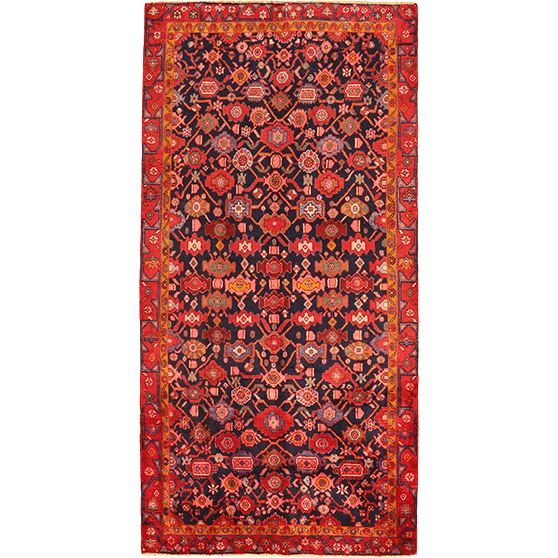
A Borujerd rug of about 9 by 4.5 feet with an angular Herati field in crimson, navy, and rust orange - Borujerd Persian Rug 9x4 ft - Geometric Semi Antique Wool Hand Knotted
5
Designs of Borujerd
Herati with scattered motifs
A favorite Borujerd design combines a Herati network with small scattered motifs, sometimes called afshan, which means "scattered." The result is a field that is both regular and lively. See our Herati designs and afshan designs.
Geometric medallions
Many rugs have one or more stepped or hooked medallions along the center line, with corners and a field of small motifs. In runners, the medallions form a rhythmic chain.
Allover geometric patterns
Diamonds, stars, and small polygons repeated across the field create a strong graphic look.
Borders
Borujerd borders are often bold, with angular vines, rosettes, or repeating geometric motifs, framed by contrasting guard stripes.
6
How Borujerd Rugs Are Built
•
Knot - Symmetric (Turkish) knot.
•
Foundation - Cotton warps and wefts.
•
Wefts - Often single-wefted, like many Hamadan village rugs.
•
Pile - Thick local wool, clipped to a medium height.
•
Density - Coarse to medium.
•
Dyes - The region is known for natural dyes, especially in older rugs.
•
Sides and ends - Overcast sides and cotton fringes.
The result is a flexible, comfortable rug with good resilience. Its thick wool hides wear and recovers well.
7
The Runner Format
A large part of our Borujerd collection is made up of runners and long rugs, about 3.5 to 4.5 feet wide and 9 to 10 feet long. In village homes, such long, narrow rugs were placed along the sides of a room, where people sat on cushions against the wall. Today, they are ideal for:
•
Hallways - The classic use. Leave 4 to 6 inches of floor on each side.
•
Kitchens - In front of a counter or along an island.
•
Bedsides - Along the side of a bed.
•
Entrances - Leading from the door into the house.
•
Stairs landings - On a wide landing at the top of stairs.
See our runners for more long rugs.
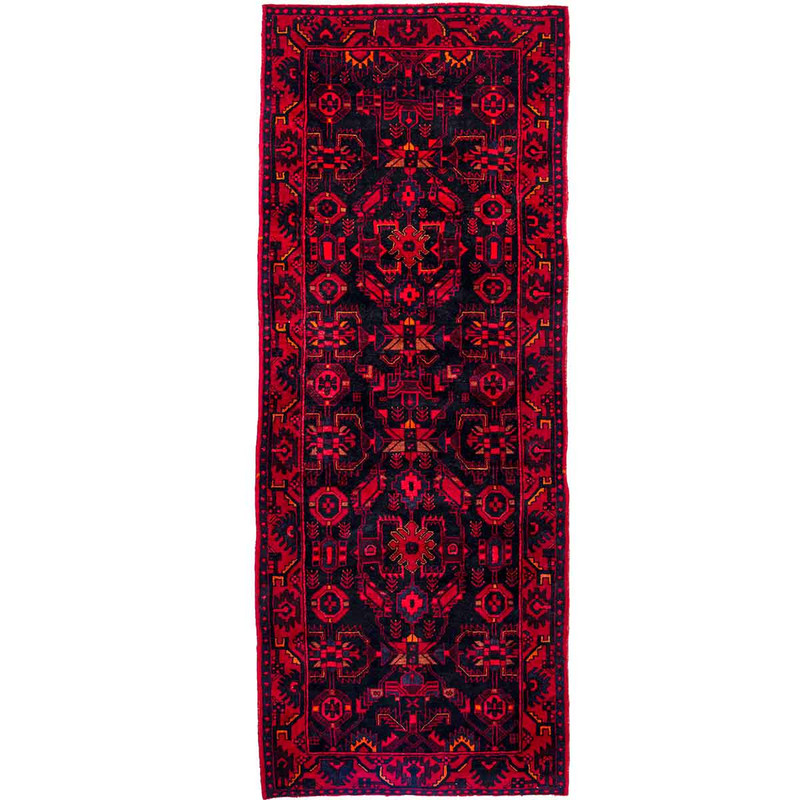
A Borujerd runner of about 10 by 3.5 feet with geometric motifs in madder red, navy, and crimson - Borujerd Persian Rug 9x3 ft - Geometric Semi Antique Wool Hand Knotted
8
Colors of Borujerd
Borujerd colors are warm and glowing. Crimson, madder red, and dark red are the main field colors. Rust, orange, burnt orange, and terracotta add warmth and are one of the region's signatures. Navy and black outline motifs, and ivory provides contrast. Some rugs have small touches of green or gold.
The oranges and rusts give Borujerd rugs a lively, sunny look that sets them apart from the cooler palettes of some Hamadan villages. In semi-antique pieces, these colors have softened into a warm, harmonious glow.
9
Borujerd and Its Neighbors
Borujerd and Hamadan
Borujerd rugs are close cousins of Hamadan village rugs, sharing structure and many designs. Borujerd rugs often have warmer oranges and rusts. See our Hamadan collection.
Borujerd and Lori rugs
Lori rugs, woven by the Lur tribes, are more tribal, often with wool foundations, coarser weaves, and bold, simple designs. Borujerd rugs are village rugs with cotton foundations. See our Lori collection.
Borujerd and Malayer
Malayer rugs, from just to the north, are often finer and double-wefted, with more refined drawing. See our Malayer collection.
Borujerd and Arak
Arak rugs are larger, room-size carpets with more curvilinear designs. Borujerd rugs are smaller and more geometric. See our Arak collection.
Borujerd and Nahavand
Nahavand rugs, from the Hamadan region to the north-west, are similar in structure and often in design. See our Nahavand collection.
10
Grades and How to Judge Them
•
Wool - Thick, lustrous, springy wool is the most important sign of quality.
•
Color - Clear, warm colors without bleeding.
•
Drawing - Balanced design and well-formed motifs.
•
Straightness - Runners should have straight, parallel sides.
•
Flatness - The rug should lie flat.
•
Condition - Even pile, intact sides and ends.
11
Reading the Back
On the back of a Borujerd, the knots are relatively large and the design clear. In single-wefted rugs, you will see a thin line of weft between rows of knots, and the knots appear slightly offset from row to row. Look for even rows and check the sides for secure overcasting.
Repairs are normal on semi-antique village rugs. Good repairs blend in and use matching wool; poor repairs show stiff patches or different colors. Ask about any repairs before you buy.
12
Choosing the Right Runner Length
Runners must fit their space precisely. Measure the length of the hallway and subtract about 12 to 24 inches, so that about 6 to 12 inches of floor show at each end. Measure the width and subtract about 8 to 12 inches, so that 4 to 6 inches of floor show on each side. If a single runner is too short, two runners of similar style can be placed end to end with a small gap.
Check also for doors along the hallway. A thick village runner may stop a door from opening; check the clearance before you buy.
13
The Warm Colors and Their Dyes
The oranges and rusts that give Borujerd rugs their warmth have deep roots in the natural dye traditions of western Persia. Madder root, grown in the region and traded widely, gives the whole range of reds, from crimson to rust, depending on the mordant and the length of dyeing. Combined with yellow dyes from plants such as weld or from the skins of pomegranates, madder can produce oranges and terracottas. Indigo gives the navies and blues, and walnut husks give browns. In mid-twentieth-century rugs, synthetic dyes were also used alongside natural ones, often skillfully.
When you look closely at a semi-antique Borujerd, you may see slight changes of shade within a single color, called abrash, caused by wool dyed in different batches. These bands are a sign of handwork and add life to the field. Read more about traditional dyes in our articles on natural dyes and other color plants.
14
Weaving a Runner Straight
A runner is one of the hardest formats to weave well. Over 10 feet or more, the weaver must keep the tension of the warps even, beat each row down with the same force, and keep the width constant. Any small difference adds up: a rug can become wider at one end, or its sides can curve.
Good village weavers use simple techniques to keep a runner straight: they check the width with a measuring stick as they go, adjust the beating, and keep the warps evenly tensioned. When you choose a runner, lay it flat and look along its length. Slight variations are normal in village work, but a runner that is much wider at one end or that curves noticeably will be harder to place.
15
Two Runners in One Hall
In a long hallway, or one with a turn, two runners often work better than one. Choose two rugs of similar width, color, and style; they do not need to be identical. Leave a small gap of about 6 to 12 inches between them, or place one at each end of the hall with the floor visible in the middle. If the hall has a turn, place one runner in each straight section rather than trying to fit a single rug around the corner.
16
Questions to Ask Before You Buy
•
What are the measurements at both ends? - Checks that the runner is straight.
•
Has it been repaired? - Especially the sides and ends.
•
Is it single or double-wefted? - Most Borujerd rugs are single-wefted.
•
Has it been washed? - A fresh wash shows the true colors.
•
How thick is the pile? - Important for door clearance.
17
Borujerd Rugs in Your Home
The warm colors of a Borujerd make it a welcoming rug for halls and entrances, where they greet you as you come home. In kitchens, the oranges and reds bring energy to the space and hide small spills. In bedrooms, a runner along the bed adds color and warmth underfoot.
Borujerd rugs suit rustic and farmhouse interiors especially well, with wood, stone, and natural textiles. In modern interiors, a semi-antique Borujerd runner can add a single strong note of color to a neutral space.
18
Combining a Borujerd with Other Rugs
A Borujerd runner makes a natural companion for a larger rug from western Persia. In a house with a Hamadan, Heriz, or Bakhtiari rug in the living room, a Borujerd in the hall picks up the reds and adds its own warm oranges. With a cooler, navy-dominated rug, a Borujerd adds contrast and energy. If you use several runners in one house, they need not match, but keeping a common color, such as madder red, ties them together.
Borujerd rugs also pair well with modern flat-woven rugs and neutral sisal or jute. A runner laid on top of a larger jute rug, for example in a wide entrance hall, gives texture and a strong focal point.
19
Small Borujerd Rugs
Besides runners, Borujerd weavers make many small rugs, about one to two square meters, roughly 3 by 5 to 4 by 7 feet. These are ideal for entrances, bedsides, studies, and bathrooms with good ventilation. Their thick wool makes them comfortable underfoot, and their warm colors brighten small spaces. See our 3x5 rugs and 4x6 rugs.
20
Village Life and the Winter Loom
In the villages of Silakhor and Oshtorinan, as in much of western Persia, weaving has traditionally been a winter occupation. When the fields are bare and snow covers the mountains, women set up their looms in the main room of the house and weave through the cold months. A small rug or runner might be finished in a few weeks; a larger piece could take the whole winter.
Village weavers usually worked without paper cartoons, weaving familiar designs from memory or from an older rug. This is why Borujerd rugs show small irregularities and variations: a motif slightly larger than its neighbor, a color that changes mid-row. These details are signs of handwork and part of the rug's character. Read more about the people behind rugs in our article on the craft from shepherd to dealer.
21
Living with a Busy Hallway Rug
A hallway runner works harder than almost any other rug in the house. It is walked on many times a day, often in shoes, and it collects dust and grit from outside. Borujerd rugs are well suited to this job: their thick wool hides dirt and wear, and their warm colors stay cheerful even when the rug is not freshly cleaned. A doormat outside the front door and a habit of shaking or vacuuming the runner weekly will keep it in good shape. Every year or two, a professional wash removes deep grit that can cut the wool fibers over time.
22
Semi-Antique Borujerd Rugs
Our Borujerd rugs are semi-antique, woven roughly forty to sixty years ago. They show the warm palette and lively drawing of the region, with settled colors and sturdy construction, and they have many years of life ahead. See our semi-antique rugs.
23
What Affects the Price
•
Size - Longer rugs cost more.
•
Wool - Lustrous, thick wool adds value.
•
Color - Harmonious, warm colors are sought after.
•
Condition - Even pile, intact sides and ends.
Borujerd rugs are among the most affordable genuine Persian village rugs, offering excellent value for halls and everyday spaces.
24
Caring for a Borujerd Rug
Vacuum regularly without a beater bar. Turn runners end to end every few months to even out wear. Use a non-slip pad, especially in halls. Blot spills at once. Have the rug professionally washed every year or two in busy areas. Keep the sides and ends in good repair. See our care instructions and our guide to maintaining rug fringes.
25
Common Buying Mistakes
•
Choosing the wrong length - Measure the space carefully.
•
Ignoring door clearance - Thick runners can block doors.
•
Skipping the pad - Runners slip without one.
•
Expecting city-rug fineness - Borujerd rugs are village rugs, valued for their wool and warmth.
26
Frequently Asked Questions
Where is Borujerd?
In the north of Lorestan province, western Persia, near the borders of Hamadan and Markazi provinces.
Who weaves Borujerd rugs?
Mainly village families in the districts of Oshtorinan and Silakhor.
Are Borujerd rugs Lur rugs?
They are woven in Lorestan but are closer in structure and style to Hamadan village rugs.
What knot is used?
The symmetric or Turkish knot.
What designs are typical?
Herati networks with scattered motifs, geometric medallions, and allover geometric patterns.
What colors are typical?
Crimson, madder red, rust, orange, terracotta, navy, and ivory.
Why did Ziegler and Company take interest in Borujerd?
Because the area was close to Arak and known for good wool, natural dyes, and durable rugs.
What sizes are common?
Small to medium rugs, long rugs, and runners.
How do I choose a runner length?
Leave about 6 to 12 inches of floor at each end of the hallway.
Are Borujerd rugs durable?
Yes. Their thick wool and sturdy structure make them very durable.
Where do the orange tones come from?
Traditionally from madder combined with yellow dyes, and in mid-century rugs sometimes from synthetic dyes used alongside natural ones.
Are small Borujerd rugs available?
Yes. Many Borujerd rugs are about 3 by 5 to 4 by 7 feet, ideal for entrances and bedsides.
How often should a hallway runner be washed?
Every year or two in busy areas, with weekly vacuuming in between.
Can I use two runners in one hallway?
Yes. Choose two of similar width and color, with a small gap between them.
What is abrash?
Slight changes of shade within one color, caused by wool dyed in different batches.
How should I clean a Borujerd rug?
Vacuum regularly, turn it end to end, and have it professionally washed regularly.
27
Choose Your Borujerd Rug
Each Borujerd rug in our collection is hand-knotted, one of a kind, and inspected before it is listed. Browse our Borujerd collection, compare it with our Hamadan, Malayer, and Lori rugs, or ask our experts for help.