


Travelers on the old road from Yazd and Kerman to Mashhad pass through Ferdows, a town between desert and mountains in South Khorasan. For centuries it was a stop for caravans, a center of trade, and a place of gardens, saffron fields, and pomegranate orchards. The villages around it have also long woven rugs, and today their pieces reach the market under the name Ferdows or Ferdos.
Ferdows rugs are less well known than the rugs of Mashhad or Birjand, but they have a distinctive character: geometric designs drawn with a village hand, warm colors, and practical long formats. This guide explains where they come from, how to recognize them, how they relate to their neighbors, and how to choose, place, and care for one. For the wider weaving culture of the province, see our article on weaving in Khorasan.
1
Ferdows: The Old Town of Tun
Ferdows is a town in South Khorasan province, about 345 kilometers south of Mashhad, at an altitude of about 1,300 meters. Until 1929 it was called Tun. Together with the nearby town of Qaen, it gave its name to the region in older travel accounts: Marco Polo described this part of Khorasan as "Tonocain," apparently combining the names Tun and Qaen.
The town lies on the main route linking Yazd, Kerman, and Isfahan with Mashhad, and its position made it a busy crossroads for centuries. Its monuments include a Seljuk-era congregational mosque and a Safavid-era religious school. Nearby is a well-known hot mineral spring, and to the west lies the open desert.
In 1968, a powerful earthquake struck the region and caused great damage to the old town. Much of Ferdows was rebuilt in the following years. Today the town is known especially for its saffron and pomegranates, and its villages continue a long tradition of crafts, including weaving.
Ferdows, called Tun until 1929, is a town of South Khorasan on the old road from Yazd and Kerman to Mashhad. Marco Polo knew the region as "Tonocain," after Tun and Qaen.
2
A Meeting Place of Weaving Traditions
South Khorasan sits at a crossroads of weaving cultures. To the north are the city rugs of Mashhad and the fine workshop rugs of Birjand and Moud, with their curvilinear medallions. All around are the Baluch and other tribal groups of Khorasan, with their dark palettes and geometric designs. Further north and east are the Turkmen, with their repeated gul motifs.
Ferdows village rugs draw on all of these. Many have geometric medallions and borders that recall Baluch and other tribal rugs of the province. Some use gul-like octagons and lattices that recall Turkmen designs. Others borrow arabesque vines from the city tradition but draw them in a more angular way. The result is a varied family of rugs, united by village construction and warm, earthy colors.
3
How to Recognize a Ferdows Rug
•
Geometric drawing - Medallions, diamonds, octagons, and angular vines.
•
Long formats - Many rugs are long and narrow, about 3 to 5.5 feet wide and 8 to 14 feet long.
•
Warm palette - Madder red fields with navy, ivory, brown, ochre, and black.
•
Gul and lattice motifs - Octagonal gul-like forms set in a diamond lattice, in some rugs.
•
Prayer designs - Some rugs have a mihrab arch at one end.
•
Village construction - A sturdy, practical weave with good local wool.
A long rug from Khorasan with geometric designs and a warm madder red palette, less dark than a typical Baluch and less curvilinear than a Mashhad, may well be a Ferdows.
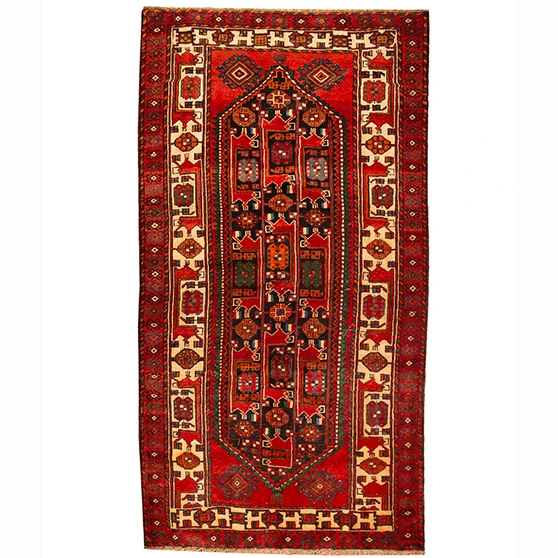
A Ferdows rug of about 10 by 5.5 feet with a geometric design on a madder red field, framed by cream borders - Ferdows Persian Rug 10x5 ft - Geometric Semi Antique Wool Hand Knotted
4
Designs of Ferdows
Geometric medallions
A column of stepped or hooked medallions down the center of the field, with small motifs around them. In long rugs, the medallions form a strong rhythm along the length.
Gul and lattice
Some Ferdows rugs use octagonal motifs, similar to the guls of Turkmen rugs, set within a diamond lattice. The lattice divides the field into compartments, each holding a gul. See our Turkmen gul designs and diamond lattice designs.
Angular arabesques
Rugs labeled with an Eslimi design use arabesque vines, borrowed from the city tradition, but drawn with steps and angles. See our Islimi designs.
Prayer rugs
Some Ferdows rugs have a mihrab or prayer arch at one end, a format also loved by the Baluch weavers of Khorasan. See our mihrab designs.
Borders
Borders are bold and geometric, often with a running zigzag, small rosettes, or a reciprocal pattern, framed by narrow guard stripes. Ivory or cream borders on a red field are common and give the rug a clear frame.
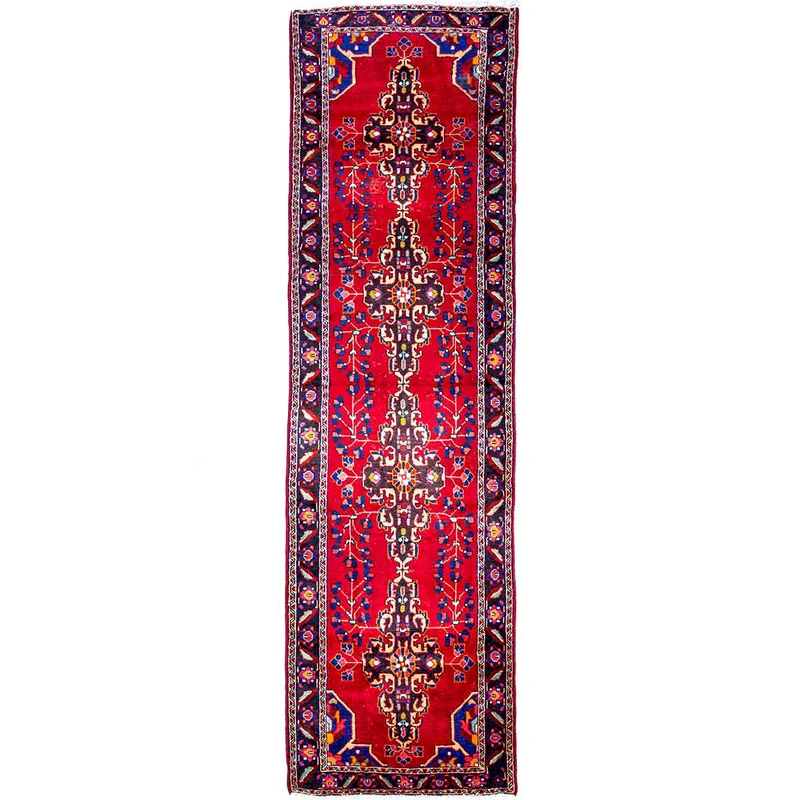
A long Ferdows runner of about 13.5 by 3.75 feet with angular arabesque designs in madder red, navy, and ivory - Ferdows Persian Rug 13x3 ft - Eslimi Semi Antique Wool Hand Knotted
5
How Ferdows Rugs Are Built
•
Knot - Village rugs of the region use both the asymmetric and symmetric knots, depending on the group and village.
•
Foundation - Cotton warps and wefts in most semi-antique rugs.
•
Pile - Local wool, clipped to a medium height.
•
Density - Coarse to medium.
•
Sides and ends - Overcast sides, often in dark wool, and cotton fringes or short kilim bands.
Because village looms in the region are often narrow, long rugs and runners are a natural product. A narrow loom fits against the wall of a village house and can be worked by one or two weavers through the winter.
Ferdows rugs are sturdy and practical, made for daily use in village homes. Their wool is soft but resilient, and their medium pile is comfortable underfoot.
6
Ferdows and Its Neighbors
Ferdows and Baluch
Baluch rugs share the geometric designs and some formats, but are usually darker, with more navy, aubergine, and brown, and softer, more lustrous wool. Ferdows rugs tend to be brighter, with more madder red and ivory. See our Baluch collection.
Ferdows and Turkmen
Turkmen rugs use repeated guls in strict rows on red fields. Ferdows rugs may borrow gul-like motifs but use them more freely, with lattices and varied borders. See our Turkmen collection.
Ferdows and Birjand
Birjand rugs, from the provincial capital, are city rugs with curvilinear medallions. Ferdows rugs are village rugs with geometric designs. See our Birjand collection.
Ferdows and Mashhad
Mashhad rugs are larger city rugs with classic floral designs. Ferdows rugs are smaller, longer, and geometric. See our Mashhad collection.
Ferdows and Kashmar
Kashmar rugs, from further north, are town rugs with dense floral designs. See our Kashmar collection.
7
Colors of Ferdows
The Ferdows palette is warm and earthy. Madder red is the most common field color. Navy and royal blue outline motifs; ivory and cream frame the field and light the design; brown, ochre, black, and rust add depth. Some rugs have touches of burgundy and gold.
In semi-antique rugs, these colors have softened into a gentle harmony. The madder reds glow, the ivories have warmed to cream, and the browns have mellowed.
8
The Ferdows Runner
Many of our Ferdows rugs are runners, about 3 to 3.75 feet wide and 8 to 14 feet long. Runners have a long history in Persian homes, where they were placed along the sides of a room, and Khorasan villages have woven them for generations.
•
Hallways - Leave about 4 to 6 inches of floor on each side and 6 to 12 inches at each end.
•
Kitchens - Along a counter or an island.
•
Bedsides - Along the side of a bed.
•
Stair landings - On a long landing at the top of the stairs.
•
Entrances - Leading guests into the home.
See our runners for more long rugs.
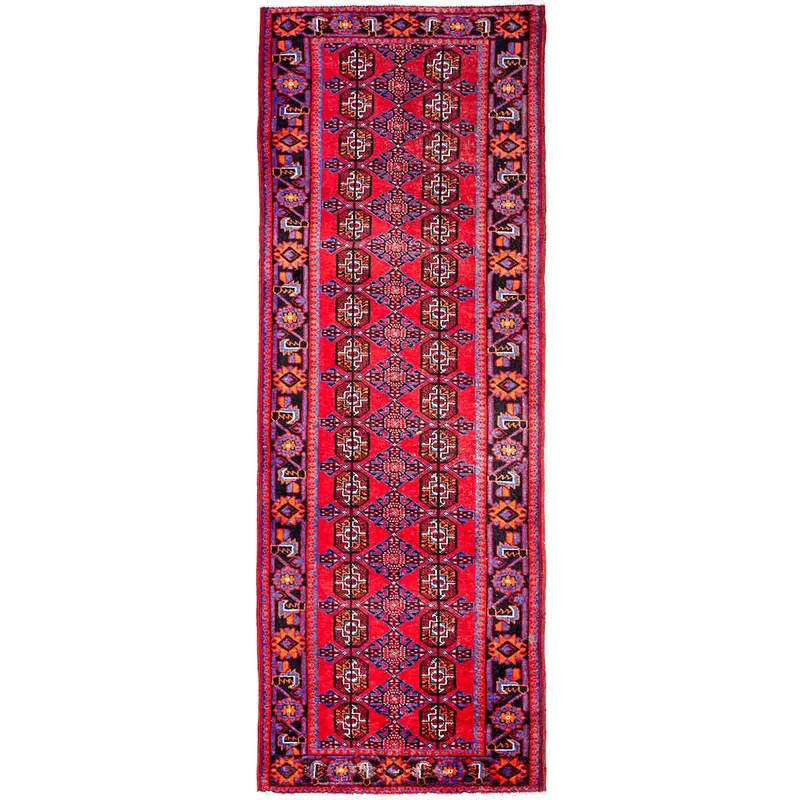
A Ferdows runner of about 10.5 by 3.5 feet with gul motifs in a diamond lattice, in madder red, navy, and ivory - Ferdows Persian Rug 10x3 ft - Geometric Semi Antique Wool Hand Knotted
9
Choosing the Right Runner
To choose a runner, measure the length of the hallway and subtract 12 to 24 inches for floor at each end. Measure the width and subtract 8 to 12 inches. If you need a longer rug than you can find, use two runners of similar style with a small gap between them. Check that doors along the hallway can open over the rug.
Lay a strip of painter's tape on the floor to mark the runner's outline before you buy. Walk along it and open the doors. This simple test prevents most mistakes.
10
Two Runners in One Hall
In long hallways, two runners often work better than one. They do not need to match exactly; two Ferdows runners, or a Ferdows and a Baluch, of similar width and color can sit at each end of the hall with a stretch of floor between them. In an L-shaped hall, place one runner in each straight section. This approach also lets you rotate the rugs between positions, spreading wear evenly.
11
Keeping a Hallway Runner Fresh
A hallway runner sees more traffic than almost any other rug. A doormat outside the front door catches much of the grit that would otherwise wear the wool. Vacuum the runner weekly, and once in a while lift it, vacuum the floor beneath, and turn the rug end to end. Every year or two, have it professionally washed to remove deep dirt. Check the sides and ends for wear, and have small problems repaired early before they grow.
12
Grades and How to Judge Them
•
Wool - Springy, lustrous wool is the main sign of quality.
•
Drawing - Balanced designs and well-formed motifs.
•
Straightness - Runners should have straight, parallel sides.
•
Color - Clear colors without bleeding, especially between red and ivory.
•
Flatness - The rug should lie flat.
•
Condition - Even pile, intact sides and ends.
13
Reading the Back
On the back of a Ferdows rug, the knots are of medium size and the design clearly visible. Look for even rows and straight sides. Check the overcasting along the sides and the ends for wear. Small, well-made repairs are normal on semi-antique village rugs; ask about any you see.
14
Small Ferdows Rugs
Besides runners, Ferdows weavers make smaller rugs of about 3 by 5 and 4 by 6 feet, often with a single medallion or a prayer arch. These are ideal for entrances, bedsides, and studies. A small Ferdows with a prayer arch can also become a striking wall hanging in a hallway or stairwell. See our 3x5 rugs and 4x6 rugs.
15
Ferdows Rugs in Your Home
The geometric designs and warm colors of Ferdows rugs suit many interiors. In rustic and farmhouse homes, they sit naturally with wood, stone, and natural textiles. In modern homes, a semi-antique Ferdows runner adds a strong line of color to a neutral hallway or kitchen. In traditional homes, they pair well with dark wood and other tribal rugs.
Because Ferdows rugs are sturdy and their designs forgiving, they are a good choice for busy areas. Their warm reds hide everyday dust, and their geometric patterns hide small marks.
16
Saffron and Pomegranates: The Colors of Ferdows
The countryside around Ferdows is famous for two crops that seem made for a rug palette. Every autumn, the saffron fields bloom with purple crocus flowers, whose red stigmas are harvested by hand at dawn. In the orchards, pomegranates ripen to a deep red. Pomegranate rind has long been used in Persian dyeing to give yellows and, with iron, darker tones. Read more about these colors in our articles on natural dyes and other color plants.
17
Weaving at the Edge of the Desert
Life in the villages around Ferdows has always been shaped by the desert. Water arrives through qanats, underground channels that carry it from the mountains to the fields, and the villages cluster where the water comes to the surface. Summers are hot and dry; winters are cold, with clear skies. As in much of rural Persia, weaving has been a winter craft, carried out by women at upright looms inside the house when there is less work in the fields and orchards.
Village weavers usually worked from memory or from a model rug rather than from a paper cartoon. This explains the freedom of many Ferdows designs: a medallion slightly larger than its neighbor, a border that changes rhythm, a color that appears unexpectedly. These details are signs of handwork, and they give each rug its own personality.
18
The Prayer Rug Format
Some Ferdows rugs have a mihrab, an arch or niche at one end of the field. In the Islamic world, the mihrab marks the direction of prayer in a mosque, and small rugs with this design were used for daily prayer at home. In Khorasan, the prayer rug format was especially loved by the Baluch and other tribal weavers, and village weavers of the region also adopted it.
A prayer design gives a rug a clear direction. In a hallway, place the arch at the far end, so it leads the eye forward. In a bedroom or study, a prayer rug can lie with the arch toward a window or a wall. Smaller prayer rugs also look beautiful displayed on a wall, supported by a sewn sleeve and a rod. See our mihrab designs.
19
Combining a Ferdows with Other Rugs
A Ferdows runner pairs naturally with other Khorasan rugs. In a home with a Mashhad or Birjand in the living room, a Ferdows in the hall adds a village and tribal note while sharing the same warm reds. With a dark Baluch rug, a Ferdows brings more light and color. With Turkmen rugs, it shares the gul and lattice vocabulary.
When combining rugs, keep one main color in common, usually madder red, and vary the scale of the patterns: a geometric runner next to a large floral carpet, rather than two busy geometric rugs side by side.
20
Questions to Ask Before You Buy
•
What are the measurements at both ends? - Checks that a runner is straight.
•
Has it been repaired? - Especially the sides and ends.
•
Has it been washed? - A fresh wash shows the true colors.
•
Is the red stable? - Check that red has not run into ivory areas.
•
How thick is the pile? - Important for door clearance.
21
Semi-Antique Ferdows Rugs
Our Ferdows rugs are semi-antique, woven roughly forty to sixty years ago. They carry the village style of South Khorasan, with settled colors and good condition, and they have many years of life ahead. See our semi-antique rugs.
22
What Affects the Price
•
Length - Longer runners cost more.
•
Wool - Lustrous wool adds value.
•
Design - Well-drawn, unusual designs are sought after.
•
Condition - Even pile and intact edges add value.
Ferdows rugs offer genuine Khorasan village weaving at accessible prices, especially in runner formats.
23
Caring for a Ferdows Rug
Vacuum regularly without a beater bar. Turn runners end to end every few months. Use a non-slip pad. Blot spills at once. Keep the rug out of strong direct sunlight. Have it professionally washed every year or two in busy areas. Keep the sides and ends in good repair. See our care instructions and our guide to maintaining rug fringes.
24
Common Buying Mistakes
•
Choosing the wrong length - Measure carefully and mark the floor.
•
Skipping the pad - Runners slip without one.
•
Ignoring door clearance - Check doors along the hallway.
•
Expecting city-rug fineness - Ferdows rugs are village rugs, valued for their character and warmth.
25
Frequently Asked Questions
Where is Ferdows?
In South Khorasan province, eastern Persia, about 345 kilometers south of Mashhad.
What was Ferdows called before?
Tun, until 1929.
Is it Ferdows or Ferdos?
Both spellings are used for the same town.
What did Marco Polo call the region?
Tonocain, apparently combining the names of Tun and Qaen.
What designs are typical?
Geometric medallions, gul-like motifs in lattices, angular arabesques, and prayer arches.
How do Ferdows rugs differ from Baluch rugs?
Ferdows rugs are usually brighter, with more madder red and ivory; Baluch rugs are darker.
What colors are typical?
Madder red, navy, ivory, brown, ochre, and black.
What sizes are common?
Many long rugs and runners, about 3 to 5.5 feet wide and 8 to 14 feet long.
Are Ferdows rugs durable?
Yes. They are sturdy village rugs made for daily use.
How should I choose a runner length?
Leave 6 to 12 inches of floor at each end of the hallway, and mark the outline with tape first.
Are small Ferdows rugs available?
Yes, rugs of about 3 by 5 and 4 by 6 feet are woven too, often with a medallion or prayer arch.
What is a mihrab?
An arch or niche, marking the direction of prayer, used as the design of prayer rugs.
Can I use two runners in one hallway?
Yes. Choose two of similar width and color, and leave a stretch of floor between them.
Why are so many Ferdows rugs long and narrow?
Village looms in the region are often narrow, and runners have long been used along the sides of Persian rooms.
Did Ferdows weavers use cartoons?
Village weavers usually worked from memory or from a model rug.
How should I clean a Ferdows rug?
Vacuum regularly, turn it end to end, and have it professionally washed regularly.
26
Choose Your Ferdows Rug
Each Ferdows rug in our collection is hand-knotted, one of a kind, and inspected before it is listed. Browse our Ferdows collection, compare it with our Baluch, Turkmen, and Birjand rugs, or ask our experts for help choosing the right length.