


South-east of Tabriz, the land rises into rolling hills and high plains, cut by valleys and dotted with villages. Here lies Hashtrood, a market town whose name is said to mean "eight rivers," after the streams that cross its district. It is a farming and herding country, and its villages have long woven rugs and flat-weaves for their own homes and for the market.
Hashtrood rugs are not well known outside Persia, but within the country they have a solid reputation. Persian accounts of East Azerbaijan crafts describe the district as well known for its carpets, valued in both domestic and foreign markets, and note that, although Hashtrood rugs share one style, they rarely look exactly alike. This guide explains where they come from, how to recognize them, how they are designed and built, and how to choose and care for one, especially in the long runner format of our piece. For the wider region, see our article on weaving in Azerbaijan.
1
Hashtrood and Its District
Hashtrood is a town in East Azerbaijan province, south-east of Tabriz, on the high country between the Tabriz plain and the Qezel Ozan river valley. The district is a landscape of hills, wheat fields, and pastures, with cold winters and mild summers. Its villages combine farming with herding, and the region has long been visited by the Shahsavan, a large Turkic-speaking herding confederation whose seasonal migrations cross north-western Persia.
This mix of village farmers and herders shapes Hashtrood weaving. Persian sources note that weavers of the district traditionally used wool from Shahsavan flocks, and that the Shahsavan of the Hashtrood area also wove kilims in soft colors such as green, pink, and light blue. Pile rugs, kilims, and other flat-weaves all form part of the district's textile culture. Read more about the Shahsavan and other herding peoples in our article on migrations of the Qashqai, Bakhtiari, and Shahsavan.
Hashtrood is a town of East Azerbaijan, south-east of Tabriz. Its weavers traditionally used wool from the flocks of the Shahsavan herders and wove designs from memory.
2
Designs Woven from Memory
One of the most interesting features of Hashtrood weaving is its tradition of named designs, woven from memory rather than from paper cartoons. Persian accounts of the district list historical designs such as Rahele, Afshan, Tajri, Samad Khani, Ali Aslan, Yadi Gol, Ashraf, and Esmail Beg, and they note that today's most common designs include Samad Khani, Tajri, Saburi, Yadi Gol, Ali Aslan, Esmail Beyk, Chelingar, Afshan, and blended designs.
Many of these names seem to recall people, perhaps the weavers or patrons who first made a design famous, while others describe the design itself: Afshan means "scattered," for designs with scattered flowers, and Yadi Gol suggests a flower motif. Because the designs were passed from weaver to weaver by memory, each rug interprets its design a little differently, which is why Hashtrood rugs rarely look identical even when they share a name.
This way of working gives Hashtrood rugs a special freshness. Without a cartoon to copy knot by knot, the weaver makes many small decisions as she works: how large to make a medallion, which color to use for a flower, how to fit a border around a corner. The result is a rug with the order of a known design and the spontaneity of handwork.
For buyers, these names are a reminder that each Hashtrood rug carries a living local tradition. Even if the name of a particular rug's design is not known, its motifs and layout belong to this shared village vocabulary.
3
How to Recognize a Hashtrood Rug
•
Village drawing - Geometric and semi-geometric motifs, with medallions, stars, and small flowers.
•
Medallions in rows - In long rugs, a series of medallions along the center line.
•
Warm, lively palette - Red, burgundy, orange, and burnt orange, with navy, black, ochre, and green.
•
Long formats - Runners and long rugs are common among village pieces.
•
Symmetric knot - The Turkish knot used throughout north-western Persia.
•
Sturdy structure - A cotton foundation and thick, resilient wool.
A long rug from north-western Persia with lively oranges and reds, a village hand, and medallions along its length may well be a Hashtrood.
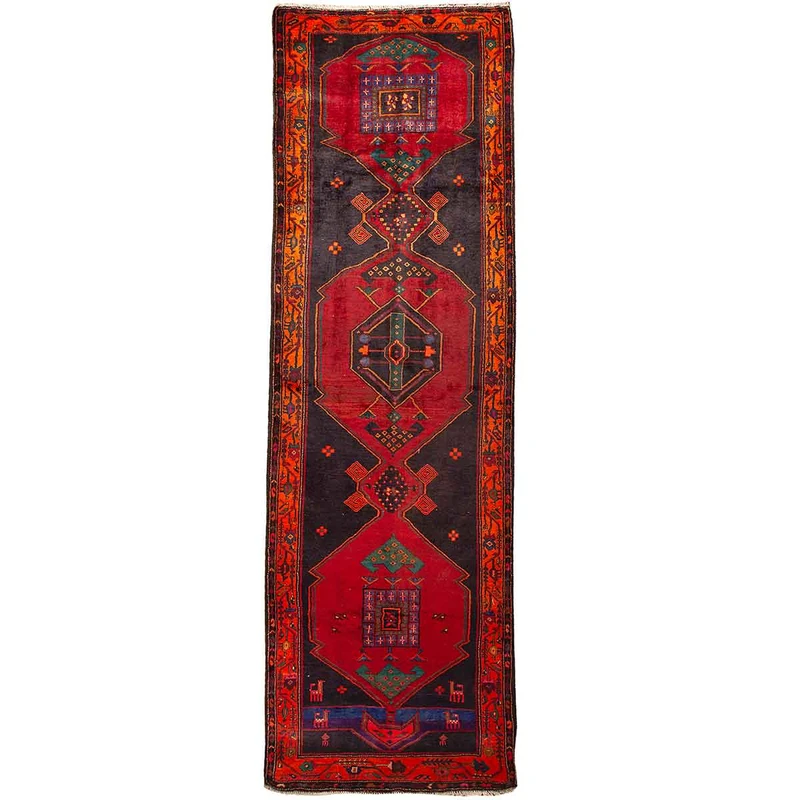
A Hashtrood runner of about 14 by 4 feet with medallions along its length in red, burgundy, orange, and navy - Hashtrood Persian Rug 14x3 ft - Geometric Semi Antique Wool Hand Knotted
4
How Hashtrood Rugs Are Built
•
Knot - Symmetric (Turkish) knot.
•
Foundation - Cotton warps and wefts in semi-antique rugs.
•
Pile - Thick wool, traditionally from Shahsavan flocks, clipped to a medium height.
•
Density - Coarse to medium, typical of village rugs.
•
Sides and ends - Overcast sides and cotton fringes.
The result is a sturdy, comfortable rug. The thick wool hides wear and recovers well from pressure, which makes Hashtrood runners well suited to busy halls.
5
Colors of Hashtrood
Our Hashtrood runner shows the district's lively palette: red and burgundy fields and medallions, orange and burnt orange accents, navy and black outlines, and touches of ochre and green. The oranges give it a warm, sunny character that sets it apart from many cooler rugs of the north-west.
In semi-antique rugs, these colors have mellowed. The oranges have softened toward amber, the reds toward rust and rose, and the overall effect is warm and harmonious.
6
Hashtrood and Its Neighbors
Hashtrood and Tabriz
Tabriz rugs are city rugs with fine, curvilinear designs drawn on cartoons. Hashtrood rugs are village rugs with designs woven from memory. See our Tabriz collection.
Hashtrood and Heriz
Heriz rugs, from east of Tabriz, share the geometric spirit but use larger, more angular medallions and come mostly in room sizes. See our Heriz collection.
Hashtrood and Shahsavan
Shahsavan weavings, especially flat-weaves and bags, share the wool and some of the motifs of Hashtrood rugs. See our Shahsavan collection.
Hashtrood and Sarab
Sarab rugs, north-east of Tabriz, are also famous for long runners, often with camel-colored fields and linked medallions. Hashtrood runners are usually warmer, with more red and orange. See our Sarab collection.
Hashtrood and Azerbaijan runners
Rugs sold under the regional name Azerbaijan come from the same broad area and include many runners. See our Azerbaijan collection.
7
The Long Runner
Our Hashtrood runner is about 14 feet long and nearly 4 feet wide. This generous format suits:
•
Long hallways - A 4 foot runner suits a hallway of about 4.5 to 5 feet wide.
•
Galleries and landings - Long, wide spaces where a narrow runner would look lost.
•
Kitchens - Along a long counter or an island.
•
Bedsides - Along the side of a king bed, extending beyond the foot.
•
Entrance halls - From the front door deep into the house.
See our runners for other long rugs.
8
Choosing the Right Runner
Measure the hallway carefully. For length, subtract about 12 to 24 inches from the length of the hall, so that 6 to 12 inches of floor show at each end. For width, subtract about 8 to 12 inches, so that 4 to 6 inches of floor show on each side. If the hallway has doors along its length, check that they can open over the rug. Mark the outline on the floor with painter's tape and walk along it before you buy.
9
Weaving a Long Runner
A 14 foot runner is a real achievement for a village weaver. Over such a length, the warps must be kept at even tension, each row beaten with the same force, and the width kept constant. Any small difference adds up, so a long, straight runner is a sign of skill. When you look at a long runner, lay it flat and look along it from one end; small variations are normal in village work.
Village looms for runners are narrow and fit against the wall of a house, where one weaver can work through the winter. In a traditional Persian room, long rugs lay along the sides of the room, where people sat on cushions against the wall. Today they serve halls and kitchens, but their shape still recalls that older way of life.
10
Placing a Lively Runner
The warm oranges and reds of a Hashtrood runner bring energy to a hallway, which is often the darkest and plainest space in a home. In a modern interior, a Hashtrood runner can be the one strong note of color in a neutral hall. In a traditional home, it pairs well with wood paneling, framed pictures, and other village rugs.
Because the runner has medallions along its length, it gives a hallway a gentle rhythm, like stepping stones leading the eye forward. Place it so that the medallions are evenly framed by the walls and the ends of the hall.
11
Two Runners in One Hall
In a long or L-shaped hallway, two runners often look better than one. They do not need to match: a Hashtrood runner and another village runner of similar width and color can sit at each end of a hall with a stretch of floor between them. In an L-shaped hall, place one runner in each straight section. Using two runners also lets you swap their positions, spreading the wear.
12
Keeping a Hallway Runner Fresh
A hallway runner works harder than almost any other rug in the house. A doormat outside the front door catches grit that would otherwise wear the wool. Vacuum the runner weekly, and once in a while lift it, clean the floor beneath, and turn the rug end to end. Every year or two, have it professionally washed. Check the long sides regularly; if the overcasting wears, have it renewed before the knots begin to loosen.
13
Grades and How to Judge Them
•
Straightness - Straight, parallel sides along the whole length.
•
Wool - Thick, springy, lustrous wool.
•
Drawing - Well-spaced medallions and balanced borders.
•
Color - Clear colors without bleeding.
•
Condition - Even pile, intact sides and ends.
14
Reading the Back
On the back of a Hashtrood rug, the knots are of medium size and the design shows clearly. Look for even rows and straight sides. Check the overcasting along the long sides and the fringes at the ends, which take the most wear in a runner. Small repairs are normal in semi-antique village rugs.
15
Village Life Around Hashtrood
In the villages of the Hashtrood district, as across north-western Persia, weaving has long been a winter craft. When the fields are bare and snow covers the hills, women set up their looms inside the house and weave through the cold months, often with daughters or neighbors working beside them. Designs are passed down by memory, and a girl learns them by sitting at the loom with her mother, first passing wefts and later tying knots.
The arrival of the Shahsavan with their flocks brought wool, and with it an exchange of motifs and techniques between herders and villagers. This exchange is one reason why Hashtrood rugs combine the order of village weaving with the lively spirit of tribal work. Read more about the people behind rugs in our article on the craft from shepherd to dealer.
16
Kilims and Flat-Weaves of the District
Pile rugs are only part of Hashtrood's textile story. The Shahsavan of the area are known for their kilims, flat-woven rugs without pile, often in soft colors such as green, pink, and light blue, and for other flat-weaves such as jajim, narrow woven strips sewn together into blankets and covers. Nearby Miyaneh is known for larger kilims with traditional stripes and big stepped medallions. Many motifs move between these flat-weaves and the pile rugs of the district, so a Hashtrood rug often shares its stars, hooks, and medallions with the kilims woven in the same villages. Read more about flat-weaves in our article on Persian kilims.
17
The Colors and Their Dyes
The warm oranges and reds of Hashtrood rugs rest on the dye traditions of north-western Persia. Madder root gives the reds, from crimson to burgundy; combined with yellow dyes from plants such as weld, it can give oranges and ambers. Indigo gives the navies, and walnut husks and iron give browns and blacks. In mid-twentieth-century village rugs, synthetic dyes were also used alongside natural ones, often with skill.
Look closely at a semi-antique Hashtrood and you may see abrash, slight changes of shade within one color, where the weaver moved from one batch of wool to the next. These bands give the field life and are a sign of hand-dyed wool. Read more in our articles on natural dyes and traditional dyeing.
18
Questions to Ask Before You Buy
•
What are the measurements at both ends? - This tells you whether a runner is straight.
•
Has it been repaired? - Especially along the sides and at the ends.
•
Has it been washed recently? - A fresh wash shows the true colors.
•
Are the oranges and reds stable? - Check the edges between bright and light areas for running.
•
How thick is the pile? - Important for door clearance.
19
A Runner Through the Seasons
A runner can move around the home as the seasons change. In winter, a warm Hashtrood brings color to a dark hallway or the side of a bed on cold mornings. In summer, it can move to a covered porch or a kitchen, out of strong sunlight. If you store a runner for a time, roll it with the pile facing outward, wrap it in cotton fabric, and keep it in a dry place off the floor, checking it now and then for moths.
20
Combining a Hashtrood with Other Rugs
A Hashtrood runner pairs well with larger rugs from north-western Persia. Next to a Heriz or a Tabriz in a living room, it shares the deep reds. Next to a navy-field rug, its oranges add warmth and contrast. Keep one color in common and vary the scale of the patterns: a runner with small medallions next to a large medallion carpet is a natural pairing.
21
Collecting Rugs from Lesser-Known Districts
Rugs from districts like Hashtrood are seldom seen in Western shops, and that is part of their appeal. They show how weaving traditions vary from place to place even within a single province, and they carry designs and color combinations that the more famous market names rarely offer. A Hashtrood runner placed alongside a Sarab, a Heriz, or an Azerbaijan runner invites comparison and conversation.
If you collect such rugs, keep a note of each one's origin, size, and design, along with a photograph. Over time, these records become part of the rug's story and help you understand your collection as a whole.
22
Semi-Antique Hashtrood Rugs
Our Hashtrood runner is semi-antique, woven roughly forty to sixty years ago. It has settled colors, good wool, and sturdy construction, with many years of life ahead. See our semi-antique rugs.
23
What Affects the Price
•
Length - Longer runners cost more.
•
Straightness - Straight runners are worth more.
•
Wool - Lustrous wool adds value.
•
Design - Well-drawn, balanced designs are attractive.
•
Condition - Intact sides and ends.
24
Caring for a Hashtrood Runner
Vacuum regularly without a beater bar. Turn the runner end to end every few months. Use a non-slip pad. Blot spills at once. Have it professionally washed every year or two in busy areas. Keep the sides and ends in good repair. See our care instructions and our guide to maintaining rug fringes.
25
Common Buying Mistakes
•
Choosing the wrong length - Measure carefully and mark the floor.
•
Skipping the pad - Runners slip easily.
•
Ignoring door clearance - Check doors along the hallway.
•
Neglecting the sides - The long edges of a runner need regular checks.
26
Frequently Asked Questions
Where is Hashtrood?
In East Azerbaijan province, in the hills south-east of Tabriz.
How do you spell Hashtrood?
It is also written Hashtrud.
What does Hashtrood mean?
It is said to mean "eight rivers," after the streams of its district.
Where did the wool come from?
Traditionally from the flocks of the Shahsavan herders.
Were Hashtrood designs drawn on paper?
Traditionally they were woven from memory and passed from weaver to weaver.
What are the traditional design names?
Names such as Samad Khani, Tajri, Afshan, Yadi Gol, Ali Aslan, and Esmail Beg.
Why do Hashtrood rugs rarely look identical?
Because each weaver interprets the shared designs from memory.
What colors are typical?
Red, burgundy, orange, navy, black, ochre, and green.
What size is your Hashtrood runner?
About 14 by 4 feet.
How wide a hallway suits a 4 foot runner?
About 4.5 to 5 feet.
Are Hashtrood rugs durable?
Yes. Their thick wool and sturdy construction make them very durable.
Are Hashtrood rugs common in the West?
No. They are seldom seen outside Persia, which makes them interesting for collectors.
Can I use two runners in one hallway?
Yes. Choose two of similar width and color, and leave a stretch of floor between them.
Does Hashtrood also produce kilims?
Yes. The Shahsavan of the area weave kilims, often in soft greens, pinks, and light blues.
Where do the orange tones come from?
Traditionally from madder combined with yellow dyes, and in mid-century rugs sometimes from synthetic dyes.
What is abrash?
Slight changes of shade within one color, caused by wool dyed in different batches.
How should I care for a runner?
Vacuum regularly, turn it end to end, use a pad, and have it professionally washed regularly.
27
Choose Your Hashtrood Rug
Each rug in our Hashtrood collection is hand-knotted, one of a kind, and inspected before it is listed. Browse our Hashtrood collection, see all our runners, compare with our Sarab and Azerbaijan rugs, or ask our experts for help.