


Between the great weaving regions of Hamadan and Arak lies the district of Malayer, a land of vineyards, orchards, and villages where rugs have been woven for generations. Among these villages, one name has long stood out to dealers and collectors: Jozan. Its rugs combine the robust materials of village weaving with a fineness and elegance usually associated with city workshops, and in the trade they are often called "Jozan Sarouks."
This guide explains where Jozan rugs come from, what makes them special, how they are built and designed, how they compare with their neighbors, and how to judge, place, and care for one. For the Malayer district and its museum, see our article on Malayer rugs.
1
Jozan in the Malayer District
Jozan is a village in the Malayer district of Hamadan province, in western Persia. Malayer itself is a town famous for its grapes and raisins, lying on the road between Hamadan and Arak. The district sits at a meeting point of two great weaving traditions: the sturdy village rugs of Hamadan to the north-west, and the refined Sarouk and Arak rugs to the east.
The district lies on a high plain ringed by mountains, with cold winters and warm, dry summers. Its villages combine farming with herding, and the sheep of the surrounding hills provide good, resilient wool for weaving.
Village weavers of the district have long drawn on both traditions. Many Malayer villages weave robust, single-wefted rugs in the Hamadan manner, but along the road toward Arak the weaving becomes finer and more often double-wefted, with curvilinear designs. Jozan represents the finest end of this spectrum.
Jozan is a village of the Malayer district, between Hamadan and Arak. Its fine, double-wefted rugs with floral medallions are known in the trade as Jozan Sarouks.
2
The Jozan Sarouk
Why are Jozan rugs called Sarouks? The name Sarouk comes from a village near Arak whose fine, dense rugs with floral medallions became famous in the late nineteenth and early twentieth centuries. The term soon came to describe a style as much as a place: a fine, double-wefted rug with a curvilinear medallion, rich reds and navies, and a firm, solid handle.
Jozan weavers adopted this style and wove it so well that their rugs were often sold as Jozan Sarouk or Malayer Sarouk. Reference sources note that in more recent labeling, the finer qualities from the area are sold as Jozan, while rugs with less fine knotting are labeled Malayer. For buyers, the Jozan name therefore signals one of the better grades of the district. See our Sarouk collection and our article on weaving in Sarouk.
3
The Sarouk Style in the American Market
The Sarouk style that Jozan weavers adopted has a fascinating history in the West. In the early twentieth century, Sarouk-type rugs with floral sprays on deep red fields became enormously popular in the United States. Many were chemically washed in New York to soften their colors and then had their red fields painted a deeper shade, creating the so-called "American Sarouk" look. These rugs furnished countless American homes in the decades between the World Wars.
Jozan rugs share the design roots of these Sarouks but come from a village tradition with its own character. A semi-antique Jozan, with natural mellowing rather than chemical treatment and paint, shows how the style looks when it ages on its own. Read more about the trade of this period in our article on weaving from 1722 to 1925.
4
Why Floral Drawing Needs a Finer Weave
Every motif in a hand-knotted rug is built from tiny squares of color, one per knot. Straight lines are easy at any density, but curves are made of small steps, and the smaller the knots, the smoother the curve. This is why coarse village rugs tend to be geometric, while finer rugs can show flowing flowers and vines. Jozan weavers use a finer, double-wefted weave precisely to draw the rounded medallions and curving floral sprays of the Sarouk style. Look closely at a Jozan flower and you can still see the tiny steps that form its curve.
5
How to Recognize a Jozan Rug
•
Floral medallion - A central medallion, often lobed or rounded, filled with flowers and outlined with curves.
•
Open or semi-open field - The field around the medallion often shows more ground than in many village rugs, with floral sprays and vines.
•
Corners - Quarter medallions echoing the central medallion.
•
Rich palette - Madder red, burgundy, and crimson with navy, indigo, ivory, and black.
•
Firm handle - Double-wefted on a cotton foundation, the rug feels solid and lies flat.
•
Fine drawing - Smoother curves than most Hamadan-area village rugs.
If a rug from western Persia has a Sarouk-like floral medallion, a firm double-wefted structure, and finer drawing than its neighbors, it may well be a Jozan.
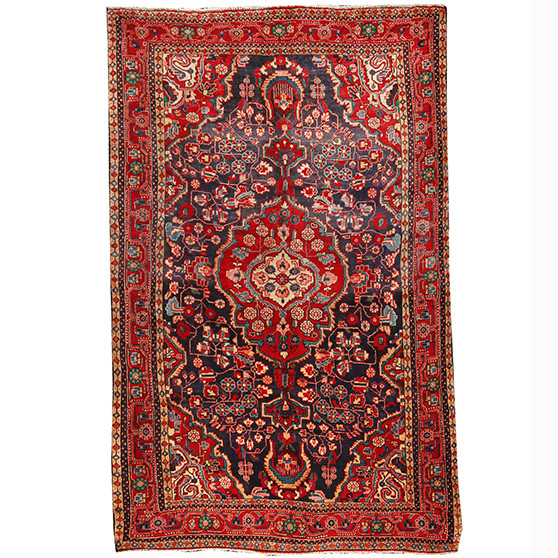
A Jozan rug of about 9.5 by 6 feet with a floral medallion in madder red, navy, burgundy, and ivory - Jozan Persian Rug 9x5 ft - Medallion Semi Antique Wool Hand Knotted
6
How Jozan Rugs Are Built
•
Knot - The symmetric (Turkish) knot, typical of the Hamadan and Malayer region.
•
Foundation - Cotton warps and wefts.
•
Wefts - Two wefts between each row of knots, the key structural difference from most Hamadan village rugs.
•
Pile - Good wool, clipped short to medium so the curves stay clear.
•
Density - Finer than most village rugs of the region.
•
Sides and ends - Overcast sides and cotton fringes.
The double wefts make a Jozan firm and flat, and they allow the weaver to pack the knots more tightly, which gives the floral drawing its clarity.
7
Single and Double Wefts: Why It Matters
Turn over a typical Hamadan village rug and you will see a single weft between each row of knots, with the knots appearing staggered from row to row. Turn over a Jozan and you will see two wefts between rows, with the knots aligned more regularly and the back looking tighter and smoother. The rug also feels different in the hand: firmer, flatter, and less flexible.
Neither structure is better in every way. Single-wefted rugs are quick to weave and pleasantly soft; double-wefted rugs are firmer and allow finer drawing. For buyers, the double weft is one of the simplest ways to recognize a Jozan and other finer rugs of the Malayer district.
Most Hamadan village rugs are single-wefted. Jozan rugs are double-wefted, which makes them firmer and allows finer, more curvilinear drawing.
8
Designs of Jozan
The floral medallion
The classic Jozan design is a medallion rug in the Sarouk manner. The medallion is often lobed, with smaller pendants above and below, and filled with flowers and leaves. The corners repeat its shape, and the field carries sprays of flowers on curving stems. See our medallion designs.
Allover floral designs
Some Jozan rugs repeat floral sprays across the whole field, without a medallion, in a style also known from later Sarouks. These rugs are calm and elegant, and they work well under furniture.
Herati and other designs
As in other villages of the district, weavers sometimes use the Herati or other classic repeats, drawn with Jozan finesse. See our Herati designs.
Borders
Borders usually carry a running floral vine or a sequence of rosettes and palmettes, framed by narrow guard stripes. In a fine Jozan, they turn the corners neatly.
9
Colors of Jozan
The Jozan palette is rich and warm. Madder red and crimson are the most common field colors, with dark red and burgundy for depth. Navy and indigo fill medallions and borders. Ivory lights the flowers and outlines. Black, rust red, and small touches of other colors complete the design.
In semi-antique rugs, these colors have mellowed into a deep, glowing harmony. The reds have softened toward rose and rust, and the ivories have warmed to cream.
10
Jozan and Its Neighbors
Jozan and Malayer
Malayer is the district name and also a label for rugs of the area. Finer pieces are often sold as Jozan; less fine pieces as Malayer. See our Malayer collection.
Jozan and Sarouk
Sarouk rugs from the Arak region are the model for the Jozan style. Classic Sarouks are often denser and heavier; Jozans have a village warmth while sharing the design. See our Sarouk collection.
Jozan and Hamadan
Most Hamadan village rugs are single-wefted and geometric. Jozans are double-wefted and curvilinear. See our Hamadan collection.
Jozan and Borchelu
Borchelu rugs, another floral style of the Hamadan region, are often looser and more relaxed in drawing. See our Borchelu collection.
Jozan and Lilihan
Lilihan rugs, from Armenian villages near Arak, share the floral spirit, often with salmon and rose tones. See our Lilihan collection.
11
Sizes and Placement
Our Jozan rug measures about 9.5 by 6 feet, a versatile size:
•
Living room - Under a coffee table, with the front legs of the sofa and chairs on the rug.
•
Bedroom - Under a queen bed, extending on both sides.
•
Dining room - Under a table for four.
•
Study - As the main rug of a library or home office.
Center the medallion on the main piece of furniture, and leave a border of floor around the rug. See our 6x9 rugs.
12
Placing a Fine Village Rug
A Jozan sits between the worlds of village and city rugs, and it is at home in both kinds of room. In a traditional interior, its floral medallion pairs well with dark wood, upholstered furniture, and warm lighting. In a modern interior, a semi-antique Jozan with softened colors adds elegance and history without overwhelming clean lines.
Because Jozans are firm and well made, they handle everyday use well, but their fine drawing is best appreciated where the rug is seen as a whole, for example in a living room or bedroom rather than under a large dining table.
13
Grades and How to Judge Them
•
Drawing - Smooth curves, a well-centered medallion, and mirror-image corners.
•
Double weft - Check the back to confirm the structure.
•
Density - Smaller knots mean finer drawing.
•
Wool - Lustrous, springy wool.
•
Color - Clear colors, no bleeding of red into ivory.
•
Condition - Even pile, intact sides and ends.
14
Reading the Back
On the back of a Jozan, the design shows clearly in small, regular knots. Because the rug is double-wefted, the back looks tight and smooth, and the warps lie on two levels. Look for straight rows and check for repairs near the ends and sides.
15
The Colors and Their Dyes
The deep reds of Jozan rugs come from the long Persian tradition of dyeing with madder root; the navies and indigos from indigo; browns and blacks from walnut husks and iron. In mid-twentieth-century rugs, synthetic dyes were also used alongside natural ones, often with skill. In semi-antique pieces, you may see abrash, slight changes of shade within one color where the weaver moved from one batch of wool to the next. Read more in our articles on natural dyes and traditional dyeing.
16
Village Weaving in Malayer
In the villages of the Malayer district, weaving has long been part of family life, especially in winter when the vineyards and fields are quiet. Women set up their looms inside the house, often working with daughters or neighbors. In finer villages such as Jozan, weavers often followed designs brought by merchants from Arak and Malayer, which is how the Sarouk style became established in the village. Read more about the people behind rugs in our article on the craft from shepherd to dealer.
17
The Vineyards of Malayer
Malayer is one of the great grape-growing districts of Persia, famous for its raisins and its green vineyards stretching across the plain. Life in villages like Jozan follows the rhythm of the vines: pruning in spring, tending through the summer, harvesting and drying the grapes in autumn. Winter, when the vineyards rest, is the season of the loom. The prosperity of the vineyards also helped support finer weaving, since families could invest the time that a fine double-wefted rug requires.
18
Combining a Jozan with Other Rugs
A Jozan pairs naturally with other floral rugs of western and central Persia. A Sarouk, Kashan, or Lilihan in a nearby room shares its floral language. With a geometric Heriz or Hamadan, it adds refinement and contrast. Keep one main color in common, usually madder red or navy, and vary the scale of the patterns.
19
Questions to Ask Before You Buy
•
Is it double-wefted? - A key sign of a Jozan.
•
What is the approximate density? - Ask for a close photo of the back.
•
Has it been repaired? - Ask where and how.
•
Has it been washed recently? - A fresh wash shows the true colors.
•
What are the exact measurements? - Check both ends.
20
Signs of a Well-Kept Semi-Antique Jozan
•
Even pile - No bald patches or deep furniture marks.
•
Supple foundation - Bends without cracking when a corner is gently folded.
•
Intact sides and ends - Overcasting and fringes in good condition.
•
Clean colors - No red running into ivory.
•
No moth damage - Check the back and under the edges.
21
A Jozan in the Bedroom
A Jozan of about 9.5 by 6 feet is a natural bedroom rug. Placed under a queen bed with the top third of the bed off the rug, it leaves generous borders of soft wool on both sides and at the foot. Its floral medallion sits just below the foot of the bed, where it greets you as you enter the room. The firm, flat weave also makes it easy for bedroom doors and furniture to move over it. In a calm bedroom with light walls and simple linens, the deep reds and navies of a Jozan bring warmth without clutter.
22
Storing and Rotating a Rug
If you rotate rugs between rooms or seasons, roll the resting rug with the pile facing outward, wrap it in cotton fabric, never plastic, and keep it in a dry place off the floor. Check it now and then for moths. Rotating a rug's position every six months also spreads wear and sun exposure, keeping the colors even.
23
Semi-Antique Jozan Rugs
Our Jozan rug is semi-antique, woven roughly forty to sixty years ago. It has settled colors, good wool, and a firm structure, with many years of life ahead. See our semi-antique rugs.
24
What Affects the Price
•
Fineness - Finer rugs, labeled Jozan rather than Malayer, are more valued.
•
Drawing - Smooth, balanced floral designs add value.
•
Size - Larger rugs cost more.
•
Condition - Even pile, intact sides and ends.
Jozan rugs offer the look of a classic Sarouk at village prices, making them excellent value for buyers who love floral designs.
25
Caring for a Jozan
Vacuum regularly without a beater bar. Rotate the rug every six months. Use a good pad. Blot spills at once. Keep it out of strong direct sunlight. Have it professionally washed every few years. See our care instructions and our guide to professional washing.
26
Common Buying Mistakes
•
Confusing Jozan with all Malayer rugs - Jozan usually denotes the finer grades.
•
Ignoring the back - The double weft and knot size tell the story.
•
Expecting Sarouk density - A Jozan has a village warmth of its own.
•
Skipping the pad - A pad protects the rug and keeps it in place.
27
Frequently Asked Questions
Where is Jozan?
In the Malayer district of Hamadan province, western Persia, between Hamadan and Arak.
How do you spell Jozan?
Also Josan and Jowzan.
What is a Jozan Sarouk?
A trade name for fine Jozan rugs woven in the style of classic Sarouk rugs.
How do Jozan rugs differ from Malayer rugs?
Finer pieces from the area are usually labeled Jozan; less fine pieces Malayer.
Are Jozan rugs single or double-wefted?
Double-wefted on a cotton foundation.
What knot is used?
The symmetric or Turkish knot.
What designs are typical?
Floral medallions in the Sarouk manner, allover floral sprays, and classic repeats.
What colors are typical?
Madder red, crimson, burgundy, navy, indigo, and ivory.
Are Jozan rugs durable?
Yes. Their firm double-wefted structure makes them durable.
Where should I place a Jozan?
In a living room, bedroom, or study, where its floral design can be seen as a whole.
What is abrash?
Slight changes of shade within one color, caused by wool dyed in different batches.
Is a Jozan a city rug or a village rug?
A village rug, but one of the finest of its district, with a city-style floral design.
What is Malayer known for besides rugs?
Its vineyards, grapes, and raisins.
How should I store a rug I am not using?
Roll it with the pile outward, wrap it in cotton fabric, and keep it dry and off the floor.
What was the American Sarouk?
A Sarouk-type rug that was chemically washed and had its red field painted in the United States in the early twentieth century.
Why are Jozan designs curved while many neighbors are geometric?
Because Jozan weavers use a finer, double-wefted weave that allows smooth curves.
Does a Jozan suit a bedroom?
Yes. A 9.5 by 6 foot Jozan fits well under a queen bed.
How should I clean a Jozan?
Vacuum regularly, blot spills, and have it professionally washed every few years.
28
Choose Your Jozan Rug
Each rug in our Jozan collection is hand-knotted, one of a kind, and inspected before it is listed. Browse our Jozan collection, compare it with our Malayer, Sarouk, and Hamadan rugs, or ask our experts for help.