


Malayer Rugs: Sarouk Echoes, Amanibaft, and Village Runners
Los Angeles Home of Rugs on Nov 19th 2026
In the green valleys south of Hamadan, among vineyards and orchards, lies the town of Malayer. To most people in Persia, Malayer means grapes, raisins, and finely carved wooden furniture. To rug lovers, it means something more: a family of village rugs that bridge two great weaving traditions, the sturdy rugs of Hamadan and the elegant rugs of the Arak region, home of the famous Sarouk and Farahan carpets.
Malayer rugs have a special charm. Older pieces, in particular, often have the soft colors and graceful designs of Farahan rugs combined with the honest, durable structure of village weaving. In this article we explore the town and its region, the history of its rugs, the Amanibaft rugs with their Caucasian look, the designs and sizes favored by Malayer weavers, and how to choose one for your home.
1
Where Is Malayer?
Malayer lies in the south of Hamadan province in western Persia, about 80 kilometers south of the city of Hamadan. The town sits on a fertile plain surrounded by mountains, at an altitude of about 1,750 meters. To the east lies the Arak region, to the west Nahavand and the Zagros, and to the north Hamadan and its many weaving villages.
The climate is cool and the soil rich. Snowmelt from the surrounding mountains feeds rivers and qanats that water vineyards, orchards, and wheat fields. The hills provide grazing for sheep and goats, the source of wool for local weavers.
2
Grapes, Raisins, and Carved Wood
Malayer is famous across Persia for its grapes. The vineyards around the town produce many varieties, and much of the harvest is dried into raisins, which are sold throughout the country and abroad. In late summer and autumn, the countryside is busy with picking, drying, and packing.
The town is also known for its woodworking. Malayer craftsmen make carved wooden furniture, from chairs and tables to elaborate cabinets, decorated with floral and geometric patterns. Many shops along the town's streets display their work, and furniture from Malayer is sold in markets across Persia.
Woodcarving and rug weaving share a common language of design. The same scrolling vines, palmettes, and rosettes that a woodcarver cuts into a cabinet door appear in the borders and fields of rugs woven in the villages nearby.
An Ancient Landscape
The Malayer region has a long history. Near the town lies Nush-i Jan, an archaeological site where excavations uncovered a fortified settlement and temple from the time of the Medes, in the first millennium BC. The site is one of the most important Median monuments ever found and shows that this green valley has been home to people for thousands of years.
Malayer, south of Hamadan, is famous for its grapes, raisins, and carved wooden furniture, and for village rugs that combine Hamadan structure with the elegance of Sarouk and Farahan designs.
3
A Popular Weaving Center
Rug weaving is very popular in Malayer and has a good market. Weaving takes place in the town and in many villages of the surrounding district, and the finished rugs are sold in Malayer, Hamadan, and Tehran.
Malayer rugs are often grouped with Hamadan rugs in the market, since the town lies in Hamadan province. But collectors recognize Malayer as a distinct group, with its own designs and a reputation for better quality than many Hamadan village rugs.
Between Hamadan and Arak
The designs of Malayer rugs, especially older ones, are similar to those of the Arak region, such as Sarouk and Farahan. Malayer lies close to the Arak region, and in the late nineteenth and early twentieth centuries, when the rug trade of Arak (then called Sultanabad) was booming, Malayer weavers learned many of its designs. You can read more about this period in our article on Sultanabad rugs.
At the same time, Malayer rugs often keep the structure of Hamadan village rugs. Some are woven with the symmetrical knot, like Hamadan rugs; others, especially in villages closer to Arak, use the asymmetrical knot. Some have one weft between rows of knots, like most Hamadan rugs, and others have two, like the finer rugs of Arak. This mix of features reflects Malayer's position between two worlds.
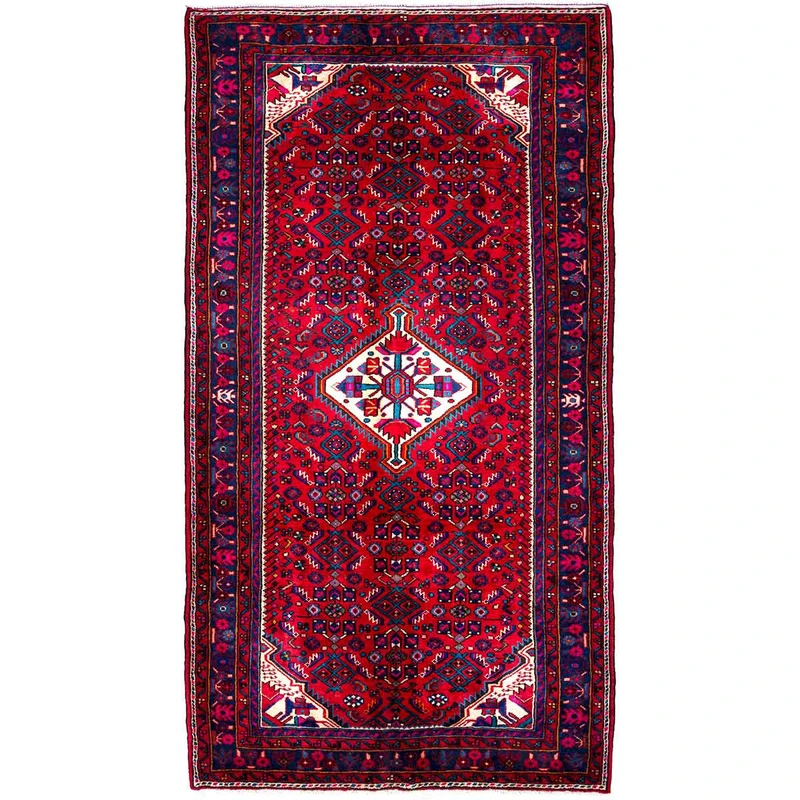
A Malayer rug with a central medallion and soft, harmonious colors - Malayer Persian Rug 9x5 ft - Medallion Semi Antique Wool Hand Knotted
4
Sarouk and Farahan Echoes
The Sarouk and Farahan influence gives many Malayer rugs their special elegance.
Farahan Designs
Farahan rugs are famous for small, repeating allover patterns, especially the herati, set on deep red or blue grounds, with soft, harmonious colors. Many older Malayer rugs use the same patterns, sometimes so closely that they are hard to tell from Farahan pieces. See our article on Farahan rugs.
Sarouk Designs
Sarouk rugs are known for their dense weave, rich colors, and medallion or floral designs. Some Malayer rugs adopt Sarouk medallions and floral sprays, giving them a more formal look. See our Sarouk collection.
Jozan
Among the villages of the Malayer district, Jozan is especially well known. Jozan weavers produced fine rugs with medallion designs in the Sarouk manner, often with a dense weave and a double weft. Old Jozan rugs are prized by collectors and are among the best rugs of the region.
5
Amanibaft: Rugs With a Caucasian Look
One of the most interesting names connected with Malayer is Amanibaft. Some rugs of the Malayer region are known by this name and have the same designs as Caucasian rugs.
The ancestors of these weavers emigrated from the Caucasus and Armenia in the seventeenth century. The Safavid period saw large movements of people from the Caucasus into Persia, including Armenians, Georgians, and others, many of whom were settled in central and western Persia. Communities of this kind brought their own crafts and designs, and some of their weaving traditions survived for generations.
Amanibaft rugs therefore stand apart from other Malayer rugs. Instead of Farahan or Sarouk patterns, they show the bold geometry of the Caucasus: stepped medallions, hooked motifs, and strong, clear colors. They are a reminder that Persian weaving is a meeting place of many peoples and traditions.
6
Stylized Patterns and Favorite Designs
Rugs woven in Malayer and its surrounding villages are in stylized patterns, mostly with medallion and Harati designs.
•
Medallion - a central medallion, often diamond-shaped or lobed, with corner pieces, on a red, blue, or ivory field.
•
Harati - the allover pattern of rosettes and curved leaves, the classic Farahan design. See our herati designs.
•
Boteh - paisley motifs in rows, sometimes in the boteh mir style.
•
Floral sprays - in the Sarouk manner, scattered across the field.
•
Caucasian geometric - in Amanibaft rugs, bold stepped medallions and hooked motifs.
The drawing in Malayer rugs is often slightly stylized, with curves softened into angles, giving the rugs a pleasing balance between city elegance and village spontaneity.
7
Sizes: Runners, Sajjadeh, and Do-Zar
The sizes most often requested from Malayer are wide and long runners, and the Sajjadeh and Do-Zar sizes.
Runners
Malayer runners are long and relatively wide, ideal for hallways and corridors. With a repeating herati or medallion design, they bring color and pattern to long spaces. See our runners.
Sajjadeh
Sajjadeh is the Persian word for a prayer rug, and in the rug trade it also names a size of rug, roughly 3.5 x 5.5 feet. It is a convenient size for many rooms, from bedrooms to entryways.
Do-Zar
Do-Zar means "two zar", the zar being a traditional Persian unit of length of about one meter. A Do-Zar rug measures roughly 4 x 6.5 feet, one of the most popular sizes in Persian village weaving. See our article on weaving for more about traditional measurements.
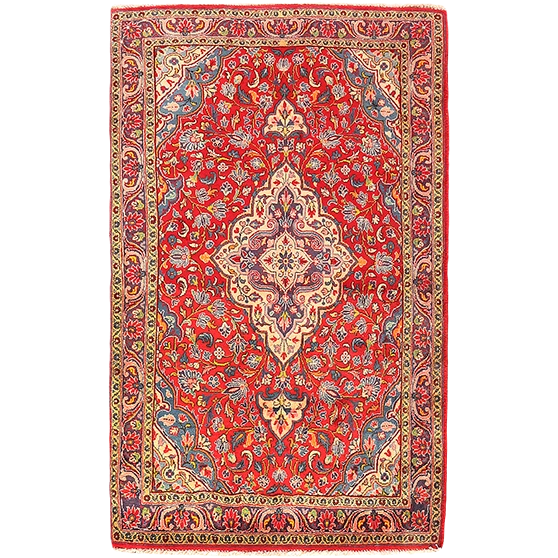
A small Malayer rug in a Sajjadeh size with a central medallion - Malayer Persian Rug 5x3 ft - Medallion Semi Antique Wool Hand Knotted
8
Colors of Malayer Rugs
Malayer rugs typically use deep red, navy, and ivory, with accents of green, gold, pink, and light blue. Older pieces, dyed with natural materials, often have soft, mellow tones similar to Farahan rugs, with an elegant balance of warm and cool colors.
Abrash, the gentle variation of color across the field, is common in older Malayer rugs and adds to their charm.
9
Mazlaghan and Other Neighbors
The Malayer region shares many features with nearby weaving areas. One of the most distinctive is Mazlaghan, whose rugs are famous for a field outlined by a bold zigzag, like a lightning bolt, around a central medallion. The colors are usually red, ivory, and navy, and the effect is striking and lively.
Other neighbors include Tuyserkan and Nahavand, to the west, and the many villages of the Hamadan plain to the north. Each has its own designs, but all share the practical, durable character of western Persian village weaving. See our article on Hamadan rugs.
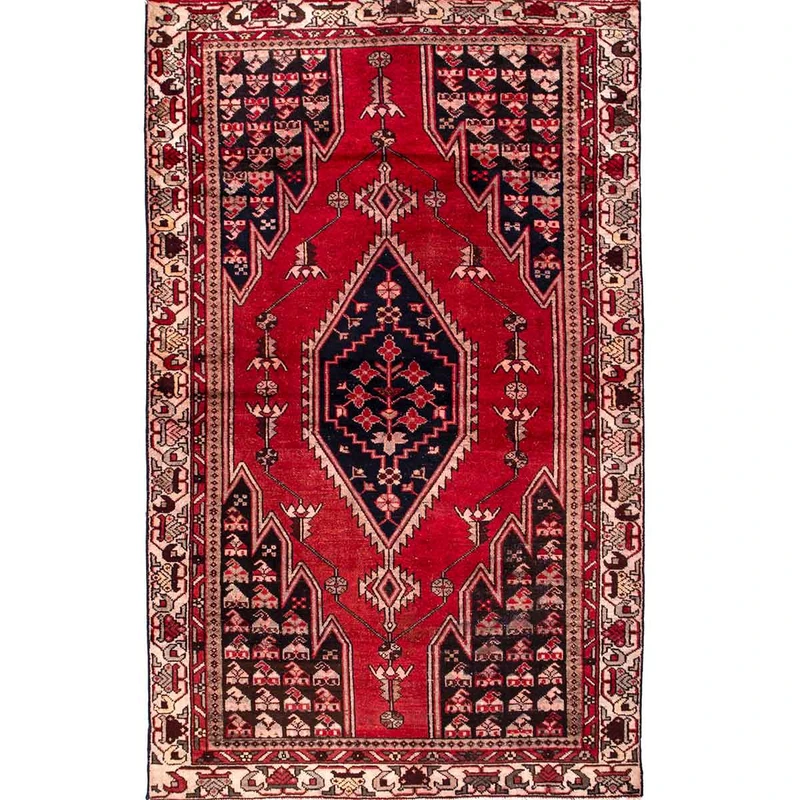
A Mazlaghan rug with the region's famous zigzag outline around the medallion - Mazlaghan Persian Rug 6x4 ft - Medallion Semi Antique Wool Hand Knotted
10
Structure and Quality
•
Knot - symmetrical or asymmetrical, depending on the village.
•
Weft - single or double; double-wefted rugs are often finer.
•
Foundation - usually cotton warps and wefts.
•
Pile - medium height, firm and durable.
•
Sides and ends - sides overcast with wool; ends finished with fringes.
Malayer rugs are generally of better quality than many Hamadan village rugs, though not as fine as top Sarouk pieces. They are well made rugs for everyday use, with a touch of elegance.
11
Old Malayer Rugs in the West
In the early twentieth century, Malayer rugs traveled abroad together with rugs from Hamadan and Arak. Western dealers liked them for their pleasing colors, practical sizes, and reliable quality. Many antique and semi-antique Malayer rugs found in Europe and America today were exported in this period.
Because Malayer rugs were sometimes sold under the names of better known centers, an old rug labeled Hamadan or even Farahan may in fact come from the Malayer district. Experienced dealers look closely at the structure on the back, the colors, and the drawing to place a rug correctly.
Why Older Pieces Are Admired
Older Malayer rugs are admired for several reasons. Their wool is often of excellent quality, soft and lustrous from hand spinning. Their natural dyes have mellowed into gentle tones that blend beautifully with one another. And their designs, borrowed from Farahan and Sarouk but woven with village freedom, have a warmth that many formal city rugs lack.
12
Dyes of the Malayer Region
Malayer weavers, like weavers across western Persia, traditionally used natural dyes. Madder root gave a wide range of reds, from bright scarlet to soft rose. Indigo gave blues, from pale sky to deep navy. Yellows came from plants such as weld, and greens from over-dyeing yellow with indigo. Walnut husks gave browns, and in this land of vineyards and orchards, other local plants and fruit rinds were also used.
In the twentieth century, synthetic dyes became widely available, and many later rugs combine natural and synthetic colors. Good dyers, natural or synthetic, produce colors that are stable and balanced. See our article on natural dyes.
13
From Cartoon to Memory
In the Arak region, many rugs were woven from a cartoon, a paper chart that shows each knot as a colored square. This allowed precise copies of popular designs. In Malayer villages, some weavers used cartoons, especially for Sarouk-style medallion rugs made for the market, while others wove from memory, following designs passed down in their families.
Rugs woven from memory often have small irregularities: a motif a little larger on one side, a border that changes as it turns a corner, a color that shifts unexpectedly. These details are part of the charm of village weaving and show the hand of the individual weaver.
14
Life and Weaving in Malayer
In Malayer, as in many Persian towns, weaving has been a part of family life for generations. Women weave in their homes, often in the winter months when work in the vineyards slows down. Rugs were woven for the family, for dowries, and for sale in the bazaar.
The Grape Harvest
Late summer is the busiest time of the year, when families harvest grapes and lay them out to dry into raisins. Weaving pauses during the harvest and resumes in the cool months, when the loom becomes the center of household work again.
Craft Traditions
Malayer's woodworkers, weavers, and other craftspeople form a lively community of makers. In the bazaar, rugs and carved furniture are often sold side by side, reflecting a shared love of pattern and fine handwork.
15
Malayer Compared With Other Rugs
•
Malayer vs Hamadan - Malayer rugs are often finer and more elegant, with Arak-style designs.
•
Malayer vs Sarouk - Sarouk rugs are denser and more formal; Malayer rugs are softer and more relaxed.
•
Malayer vs Farahan - many old Malayer rugs share Farahan's herati designs and soft colors, but usually with a slightly coarser weave.
•
Malayer vs Caucasian - Amanibaft rugs from Malayer look Caucasian but are woven in Persia, usually on cotton foundations.
16
How to Identify a Malayer Rug
•
Design - Farahan or Sarouk inspired, or Caucasian geometry in Amanibaft pieces.
•
Structure - mixed knots and wefts, often with a firmer, finer weave than Hamadan rugs.
•
Colors - red, navy, ivory, with soft accents.
•
Format - runners, Sajjadeh, and Do-Zar sizes.
17
Decorating With Malayer Rugs
•
Living rooms - a medallion Malayer rug adds elegance and warmth.
•
Hallways - wide Malayer runners bring life to corridors.
•
Bedrooms - a Do-Zar rug beside the bed is a classic choice.
•
Traditional interiors - Farahan-style Malayer rugs suit antique furniture.
•
Modern spaces - soft, faded tones blend with neutral palettes.
18
Caring for a Malayer Rug
•
Vacuum regularly - without a beater bar.
•
Rotate - every six months for even wear.
•
Use a pad - especially for runners.
•
Blot spills - with clean water and a white cloth.
•
Professional washing - every few years. See our guide to professional washing.
19
Buying a Malayer Rug
•
Ask about the village - Jozan and other fine villages command higher prices.
•
Check the back - double-wefted, finely knotted rugs are usually better quality.
•
Check the condition - pile, edges, and fringes.
•
Look at the colors - natural dyes and soft abrash add value.
•
Buy from a reputable dealer - who can confirm origin and age.
20
Common Myths
"Malayer rugs are just Hamadan rugs."
They are woven in Hamadan province, but many have finer structure and Arak-style designs that set them apart.
"Caucasian designs mean a rug is from the Caucasus."
Amanibaft rugs from Malayer use Caucasian designs but are Persian rugs, woven by communities with Caucasian roots.
"Old soft colors mean the rug has faded."
Many older Malayer rugs were woven with soft, harmonious colors in the Farahan manner.
21
Frequently Asked Questions
How can I tell a Malayer rug from a Hamadan rug?
Look at the back. Most Malayer rugs are double-wefted, while many Hamadan rugs are single-wefted, so the back of a Malayer looks more regular and tightly packed. Malayer designs also often follow the curvilinear medallions of Sarouk and Farahan more closely. Both come from the same broad region, so a specialist's eye is sometimes needed to be sure.
Where is Malayer?
In the south of Hamadan province, western Persia, about 80 kilometers south of Hamadan.
What is Malayer famous for?
Grapes, raisins, carved wooden furniture, and village rugs.
What are Amanibaft rugs?
Rugs from the Malayer region with Caucasian designs, woven by communities whose ancestors came from the Caucasus and Armenia.
What designs are common?
Medallion and Harati designs, in stylized patterns.
What is a Do-Zar rug?
A rug of about 4 x 6.5 feet, named after the traditional unit called the zar.
What is a Sajjadeh?
A prayer rug, and a size of about 3.5 x 5.5 feet.
How do Malayer rugs compare to Sarouk rugs?
Sarouk rugs are denser and more formal; Malayer rugs are softer and more relaxed.
What is Jozan?
A village near Malayer known for fine Sarouk-style rugs.
Are Malayer rugs durable?
Yes. They are well made village rugs suited to everyday use in busy family homes.
Are Malayer runners available?
Yes. Wide, long runners are one of the region's specialties.
What is Mazlaghan?
A weaving area near Malayer and Hamadan whose rugs are known for a bold zigzag outline around the field.
Were Malayer rugs sold under other names?
Yes. In the past, some Malayer rugs were sold as Hamadan or even Farahan rugs. A careful look at the structure helps place them correctly.
Do Malayer rugs use natural dyes?
Older rugs usually do, with madder reds, indigo blues, and plant yellows. Many later rugs combine natural and synthetic dyes, which is normal for village weaving of the twentieth century.
Is a Malayer rug a good choice for a hallway?
Yes. Wide Malayer runners are a classic choice for halls, with durable wool and elegant patterns.
22
A Valley of Vineyards and Looms
Malayer is a town of grapes and carved wood, of ancient Median ruins and lively bazaars. Its rugs carry the elegance of Sarouk and Farahan, the sturdiness of Hamadan, and, in the Amanibaft pieces, the memory of the Caucasus. A Malayer rug brings all of this into your home, in colors that grow more beautiful with every year. Whether you choose a wide runner for a long hall, a Do-Zar rug for a bedroom, or a bold Amanibaft piece for a modern living room, a Malayer rug is a companion for a lifetime.
At Los Angeles Home of Rugs, you can explore our Malayer collection, along with our Hamadan and Sarouk rugs. If you have questions about any rug, please contact us.