


In the green hills and valleys of Kermanshah province, in western Persia, live the Kolyai, a Kurdish people whose name is also spelled Koliai or Kolyaei. Their villages lie around the town of Songhor and the surrounding countryside, a region of farms, pastures, and mountain streams. Like many Kurdish communities, the Kolyai have a long tradition of weaving, and their rugs are among the most recognizable village rugs of the west.
This guide explains who the Kolyai are, how their rugs are made, how to read their designs and colors, and how to choose, place, and care for a Kolyai rug like the one in our collection. For the wider story of Kurdish weaving, see our article on Kurdish rugs and our Kurdish collection.
1
Who Are the Kolyai?
The Kolyai are one of the Kurdish communities of Kermanshah province. Many were once semi-nomadic, moving with their flocks between valleys and highland pastures, but most have long been settled in villages where they farm, raise sheep, and weave. Their weaving reflects both sides of that history: the bold geometry and strong color of tribal weaving, and the sturdy, practical construction of village rugs.
Rugs from the Songhor area are sometimes sold as Songhor or Songhor-Kolyai, and dealers may also group them with the rugs of Kermanshah or with Kurdish rugs in general. What they share is a thick, durable pile and a vigorous, geometric drawing.
Kolyai rugs are Kurdish village rugs from the Songhor area of Kermanshah province: thick, sturdy, and boldly geometric.
2
How to Recognize a Kolyai Rug
•
Geometric medallions - Stepped, hooked, or diamond medallions, often in a row down a long field.
•
Bold color - Deep red, navy, black, and cream, with touches of green, gold, or orange.
•
Long formats - Long rugs and runners are common.
•
Thick pile - A heavy, resilient wool pile.
•
Symmetric knot - The Turkish knot typical of Kurdish weaving.
•
Sturdy build - A firm, heavy handle.
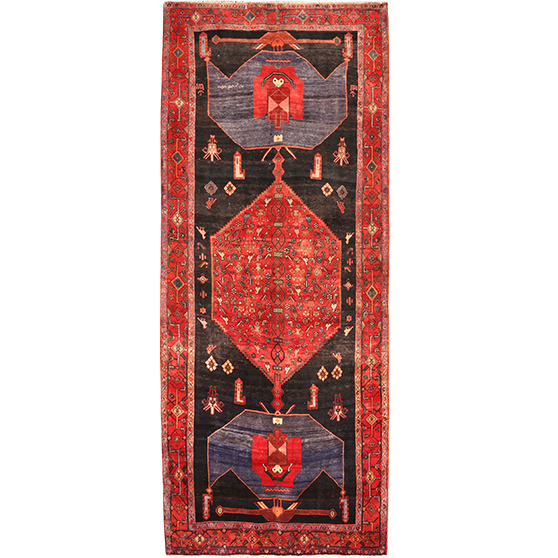
A Kolyai rug of about 13 by 5 feet with geometric medallions on a red field, with black and navy borders and details - Kolyai Persian Rug 12x5 ft - Geometric Semi Antique Wool Hand Knotted
3
Reading the Medallions
The heart of a Kolyai rug is usually a series of geometric medallions laid along the length of the field. They may be diamonds, hexagons, or stepped polygons, often with hooks along their outlines, and they sometimes alternate in color or shape. The space around them is filled with small motifs: stars, small diamonds, combs, rosettes, and stylized flowers. Large spandrels at the corners may echo the shape of the medallions.
Because these rugs are usually woven from memory, the medallions are rarely identical. One may be slightly larger, another shifted to one side, a color may change midway. These small differences are a sign of a living village tradition rather than of careless weaving.
4
The Long Rug Format
Our Kolyai rug measures about 13 by 5 feet. A long rug of this kind, wider than a runner but narrower than a room-size carpet, was traditionally laid at the head or along the side of a room in a Persian home. In a modern home, it is very versatile:
•
Wide hallways - A 5 foot rug suits a hallway about 6 to 7 feet wide.
•
Galleries and passages - Long open spaces between rooms.
•
Along a bed - Across the foot of a king bed or along one side.
•
Kitchens - Along a long kitchen island.
•
In front of a long sofa or bench - A long, narrow focal point.
See our runners for narrower long rugs.
5
How Kolyai Rugs Are Built
•
Knot - The symmetric (Turkish) knot.
•
Foundation - Usually cotton warps and wefts in later village rugs; older pieces may use wool.
•
Pile - Thick, resilient wool from local sheep.
•
Density - Coarse to medium.
•
Sides and ends - Overcast sides and fringes.
This construction gives Kolyai rugs their characteristic weight and spring. They lie firmly on the floor and stand up well to heavy foot traffic.
6
Colors of Kolyai
Our Kolyai rug uses a bold, warm palette: a red field, black and navy for outlines and borders, and cream highlights, with smaller touches of other colors in the medallions and filler motifs. Kolyai and other Kurdish weavers are known for confident, saturated colors, which give their rugs a strong presence in a room.
In semi-antique rugs, these colors have mellowed. The reds have softened, the navies have deepened, and the blacks, often made with iron-based dyes, may have worn slightly lower than the surrounding pile, giving the surface a gentle relief. Read more in our article on natural dyes.
7
Borders and Guard Stripes
The borders of a Kolyai rug frame the field like a picture frame. A typical rug has one wide main border, often with a repeating geometric flower, a hooked vine, or a series of stars, flanked by narrow guard stripes on each side. The guard stripes may carry small zigzags, reciprocal triangles, or running dog motifs. In a well-woven rug, the border turns the corners cleanly, though village weavers sometimes adjust the pattern at a corner by eye, giving it a charming irregularity. Look at the borders when you compare rugs: their drawing often tells you as much about the weaver's skill as the medallions do.
8
Why Kurdish Rugs Wear So Well
Kurdish rugs have a reputation as some of the most durable rugs of Persia. Several things contribute. The wool from mountain sheep is strong and springy, so the pile recovers after it is pressed down. The symmetric knot holds the pile firmly. The rugs are often woven with a full, dense pile that cushions wear. And village weavers made rugs for their own use, so they valued strength over speed. These qualities make a Kolyai rug a practical choice for the busiest parts of a modern home, such as hallways, kitchens, and family rooms.
9
The Ends and Fringes
The fringes of a Kolyai rug are the ends of its warp threads, tied off or knotted after the rug is cut from the loom. Many village rugs also have a narrow band of flat weave, called a kilim end, between the last row of knots and the fringe, which helps lock the knots in place. Fringes and kilim ends are among the first parts of a rug to wear, especially in a hallway where a vacuum passes over them often. Vacuum across the fringes gently or not at all, and have worn ends secured by a professional before the knots begin to come loose. See our guide to maintaining rug fringes.
10
Kolyai and Its Neighbors
Kolyai and Kurdish
Kolyai rugs belong to the broad family of Kurdish rugs. See our Kurdish collection.
Kolyai and Bijar
Bijar rugs, from Kurdistan province to the north, are among the densest and heaviest of Persian rugs. See our Bijar collection.
Kolyai and Senneh
Senneh rugs, from Sanandaj, are the finest Kurdish rugs, with very thin, flat pile. See our Senneh collection.
Kolyai and Hamadan
Hamadan village rugs, to the east, share the sturdy village construction. See our Hamadan collection.
Kolyai and Malayer
Malayer rugs, from the Hamadan region, share bold geometry and long formats. See our Malayer collection.
11
Choosing a Long Rug
Measure your space carefully. For a hallway, leave about 6 to 12 inches of floor at each end and 6 to 12 inches on each side. For a space beside a bed, the rug can extend beyond the bed at the foot. Check that doors can open over the rug. Mark the outline on the floor with painter's tape and live with it for a day before you decide.
12
Placing a Bold Geometric Rug
A bold Kolyai rug brings energy and warmth to a room. On a pale wood or stone floor, its reds and navies stand out. In a modern interior, it can be the one strong pattern in an otherwise quiet room. In a traditional or rustic home, it pairs naturally with wood, leather, and woven textiles. Keep other patterns small or plain so the rug can speak.
13
Grades and How to Judge Them
•
Straightness - Straight, parallel sides.
•
Drawing - Well-proportioned medallions.
•
Wool - Thick, springy, lustrous wool.
•
Color - Clear colors without bleeding.
•
Condition - Even pile, intact sides and ends.
14
Reading the Back
On the back of a Kolyai rug, the geometric design shows clearly in relatively large knots. Look at the foundation: cotton warps are typical of later village rugs, while wool warps suggest an older or more tribal piece. Check that the knots are even and that the sides and fringes are intact.
15
Questions to Ask Before You Buy
•
What is the foundation? - Cotton or wool.
•
What are the measurements at both ends? - Checks that the rug is straight.
•
Has it been repaired? - Especially along the sides and at the ends.
•
Are the dark colors worn? - Corroded blacks are normal in older rugs.
•
Has it been washed recently? - A fresh wash shows the true colors.
16
Semi-Antique Kolyai Rugs
Our Kolyai rug is semi-antique, woven roughly forty to sixty years ago. It has settled colors, good wool, and many years of life ahead. See our semi-antique rugs.
17
What Affects the Price
•
Size - Longer rugs cost more.
•
Straightness - Straight rugs are worth more.
•
Wool - Lustrous wool adds value.
•
Drawing - Well-proportioned designs add value.
•
Condition - Intact sides and ends.
18
Caring for a Kolyai Rug
Vacuum regularly without a beater bar. Turn the rug end to end every few months. Use a non-slip pad. Blot spills at once. Have it professionally washed every year or two in busy areas. Keep the sides and ends in good repair. See our care instructions and our article on professional washing.
19
Common Buying Mistakes
•
Choosing the wrong length - Measure carefully.
•
Skipping the pad - Long rugs slip easily.
•
Expecting perfect symmetry - Small variations are part of village weaving.
•
Neglecting the sides - The long edges need regular checks.
20
The Landscape of Kermanshah
Kermanshah province lies in the Zagros Mountains of western Persia, a land of high ridges, fertile valleys, rivers, and oak woods. Its winters can be cold and snowy in the hills, and its summers warm in the valleys. For centuries, this landscape supported a way of life based on sheep, goats, and farming. Sheep gave wool for weaving, the hills gave plants for dyes, and long winters gave time for work at the loom. The town of Songhor, in the north-east of the province, became a market for the rugs of the surrounding Kolyai villages.
Kermanshah was also a historic stop on the great road between the Persian plateau and Mesopotamia. Traders and pilgrims passed through it, and the city's bazaar was a meeting place for town and tribe. Village rugs from the surrounding districts were brought there to be sold, and from there many traveled on to Hamadan, Tehran, and the export markets.
21
Kurdish Weaving Traditions
Kurdish weavers live across a wide arc of western Persia, from Kurdistan and Kermanshah provinces to parts of Hamadan and beyond, as well as in north-eastern Khorasan. Their rugs vary from the very fine, flat-pile rugs of Senneh to the dense, heavy rugs of Bijar and the robust village rugs of Kermanshah. What unites them is a love of strong color, bold geometry, and durable wool. The Kolyai rug is one branch of this family, sturdy and vigorous, made for daily use in village homes.
In Kurdish homes, rugs were not only floor coverings. They were seats, beds, wall hangings, and part of a bride's dowry. A long rug of the kind in our collection would often be laid along the side of a room, where family and guests sat on cushions against the wall. Read more in our article on Kurdish rugs.
22
From Sheep to Loom
The wool of a Kolyai rug begins with local sheep grazing the hill pastures of Kermanshah. After shearing, the wool is washed, sorted, carded, and spun, traditionally by hand with a drop spindle. Hand-spun wool has a slight irregularity that gives the pile a lively texture and helps it take dye unevenly, which can create abrash, gentle changes of shade within one color. The wool is then dyed, dried, and wound into balls ready for the loom. Read more in our articles on Persian rug wool and the craft from shepherd to dealer.
23
Weaving from Memory
Village weavers in Kermanshah rarely work from paper cartoons. Instead, they weave designs they learned as girls, often from their mothers or grandmothers, keeping the whole pattern in their heads. A weaver may start with a familiar medallion and border, and then improvise the filler motifs as she goes. That is why Kolyai rugs have such a spontaneous, personal feel. Two rugs from the same village may share a layout yet differ in every detail.
24
Motifs in the Field
Around the main medallions of a Kolyai rug, you may find a whole vocabulary of small motifs:
•
Stars - Eight-pointed stars scattered in the field.
•
Combs - Small comb shapes, often said to represent the weaver's tools.
•
Small animals - Stylized dogs, goats, or birds.
•
Rosettes - Small, geometric flowers.
•
Running dog borders - A hooked, wave-like border motif.
Writers often attach meanings to these motifs, such as protection or good fortune. These readings vary from family to family, and it is best to enjoy them as part of a living tradition. Read more in our article on design motifs.
25
Abrash and Color Changes
Many Kolyai rugs show abrash, horizontal bands where one color shifts slightly in shade. This happens when the weaver runs out of one batch of dyed wool and starts another. In village rugs, abrash is a natural sign of hand-spun, hand-dyed wool and is often admired for the movement it gives the field. It is not a defect, and it usually adds to the character of a rug.
26
Living with a Long Rug
A long rug like our Kolyai can move around a home as needs change. It might start in a wide hallway, move to the foot of a bed, and later sit in front of a long sofa or along a dining bench. Its bold design reads well from a distance, and its thick pile is comfortable underfoot. With ordinary care, it will keep its beauty for many decades.
27
Combining a Kolyai with Other Rugs
A Kolyai rug pairs well with other village and tribal rugs, such as Hamadan, Heriz, Malayer, or Qashqai, that share its bold geometry and warm reds. With a finer city rug, it adds a rustic contrast. Keep one or two colors in common and vary the scale of the patterns, so that the rugs work together without competing. See our Heriz collection.
28
Keeping a Long Rug Flat and Safe
A long rug in a busy passage needs a good pad. A felt-and-rubber pad keeps it from slipping and helps it lie flat. If a corner curls, roll it gently in the opposite direction for a few hours, or place a heavy book on it overnight. Avoid taping the corners, which can damage the wool. Turn the rug end to end every few months so that wear and sunlight are spread evenly.
29
Photographs and Real Color
Reds, navies, and blacks can look different on screen depending on the light. Daylight from a north window shows the truest colors, while warm lamps make reds look deeper. If color matters for your room, ask us for extra photographs in daylight or close-ups of the pile. We are glad to describe how the rug looks in person.
30
Frequently Asked Questions
Who are the Kolyai?
A Kurdish people of Kermanshah province in western Persia.
Where are Kolyai rugs woven?
In villages around Songhor and the surrounding countryside.
What designs are typical?
Geometric medallions, often in a row along the field.
What colors are typical?
Red, navy, black, and cream, with touches of other colors.
What knot is used?
The symmetric (Turkish) knot.
What size is your Kolyai rug?
About 13 by 5 feet.
Where can a long rug go?
In a wide hallway, a gallery, along a bed, or along a kitchen island.
Are Kolyai rugs durable?
Yes. Their thick wool and sturdy construction make them very durable.
Why is the black pile lower?
Iron-based black dyes can wear the wool faster, leaving a gentle relief.
How should I care for a Kolyai rug?
Vacuum regularly, turn it end to end, use a pad, and have it professionally washed regularly.
Are Kolyai rugs the same as Songhor rugs?
Rugs from the Songhor area are often sold as Songhor or Songhor-Kolyai. The names overlap.
Is abrash a defect?
No. It is a natural sign of hand-dyed wool and often adds character.
Can a Kolyai rug go in a kitchen?
Yes. Its thick wool and bold colors hide everyday marks well. Use a non-slip pad and blot spills at once.
Do Kolyai weavers use paper designs?
Usually not. Most village weavers work from memory.
Is a Kolyai rug suitable for a home with children or pets?
Yes. Its thick wool, bold colors, and sturdy construction stand up well to daily life.
31
Choose Your Kolyai Rug
Each Kolyai rug in our collection is hand-knotted, one of a kind, and inspected before it is listed. Browse our Kolyai collection, compare with our Kurdish, Bijar, and Hamadan rugs, or ask our experts for help.