


In the hills of the Kamareh district, south-west of Arak in central Persia, lies the village of Lilihan. Its name is known to rug collectors far beyond Persia, because for generations its Armenian families wove rugs with a character all their own. They used the floral vocabulary of the Arak region, the same world that produced Sarouk, Farahan, and Mahal rugs, but drew it in their own way, with their own colors and their own construction.
This guide explains who wove Lilihan rugs, how to recognize them, how they compare with their neighbors, and how to choose, place, and care for a Lilihan rug like those in our collection. For the wider story, see our articles on Armenian rugs, weaving in Arak, and Sultanabad rugs.
1
Armenian Villages in Central Persia
In the early seventeenth century, under Shah Abbas, many Armenian families were brought from the Caucasus into Persia. Some settled in New Julfa, the Armenian quarter of Isfahan, while others were given land in the farming districts of central Persia, including Fereydan to the west of Isfahan and Kamareh near Khomein and Arak. Over time, these communities built churches, farmed the valleys, and took up weaving, which was already a strong tradition in the region.
Lilihan became one of the best known of these Armenian villages for rugs. Its weavers worked within the wider Arak weaving world, where merchants and workshops supplied rugs to Europe and America from the late nineteenth century onward. Yet Lilihan rugs kept a recognizable look. In the twentieth century, many Armenian families left these villages for cities and for other countries, and weaving in Lilihan declined. Semi-antique Lilihan rugs are therefore a link to a small and special chapter of Persian weaving.
Lilihan is an Armenian village in the Kamareh district near Arak. Its rugs use the floral world of the Arak region, drawn with their own style and built with their own structure.
2
How to Recognize a Lilihan Rug
•
Bold central medallion - Often a large, open medallion, sometimes with angular or spidery outlines.
•
Warm red fields - Madder red, rose red, or dark red grounds.
•
Navy medallions and borders - Deep navy for contrast.
•
Floral filler - Small flowers, sprays, and vines around the medallion.
•
Symmetric knot - Lilihan weavers are generally described as using the symmetric (Turkish) knot, unlike the asymmetric knot of Sarouk.
•
Firm, flat handle - A dense, well-packed rug that lies flat.
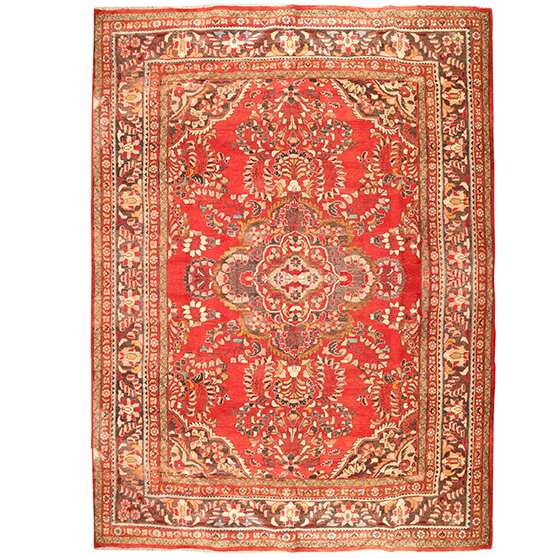
A Lilihan rug of about 13.5 by 9.5 feet with a central medallion on a red field, in navy, cream, and beige - Lilihan Persian Rug 13x9 ft - Medallion Semi Antique Wool Hand Knotted
3
The Lilihan Medallion
The medallion is the signature of a Lilihan rug. In many pieces, it is large and open, with outlines that break into points, hooks, or small spurs, so that it seems to spread across the field. Inside, smaller motifs and flowers fill the space. Corner pieces echo the medallion, and the field around it is filled with small flowers and sprays. Some Lilihan rugs use a more geometric version of this layout, with stepped outlines and angular flowers, closer to village weaving. Our rugs are of this more geometric kind, with strong medallions in navy and red.
4
Colors of Lilihan
Lilihan rugs are known for warm, clear palettes. Our rugs use madder red fields, navy medallions and borders, and cream and beige highlights, with touches of green, gold, and light blue. Older Lilihan rugs are often admired for a soft rose or raspberry red, which comes from madder dyed in a particular way. In semi-antique rugs, these colors have mellowed into a warm, harmonious whole. Read more in our articles on natural dyes and traditional dyeing.
5
How Lilihan Rugs Are Built
•
Knot - The symmetric (Turkish) knot.
•
Foundation - Cotton warps and wefts.
•
Pile - Good wool, clipped to a medium height.
•
Density - Medium, with a firm, well-packed structure.
•
Sides and ends - Overcast sides and fringes.
The result is a rug that lies flat, holds its shape, and wears well. Its firm structure gives it a pleasing weight underfoot.
6
Lilihan and Sarouk
Lilihan rugs are often compared with Sarouk rugs, woven in the same region. Both use floral motifs and warm colors, and both were popular in America in the twentieth century. The main differences are in structure and drawing. Sarouk rugs use the asymmetric knot and a double weft, which gives them a stiff, dense back and finer drawing. Lilihan rugs use the symmetric knot and usually have a more open, freer drawing. Many buyers find Lilihan rugs a charming alternative to Sarouks, with a little more spontaneity. See our Sarouk collection.
7
Lilihan and Its Neighbors
Lilihan and Arak
Arak, once called Sultanabad, is the market town for the whole region. See our Arak collection.
Lilihan and Farahan
Farahan rugs, from the plain north of Arak, are famous for fine Herati and Mina Khani designs. See our Farahan collection.
Lilihan and Mahal
Mahal rugs, from the same region, are room-size rugs with large floral designs. See our Mahal collection.
Lilihan and Borchelu
Borchelu rugs, from the Hamadan region, share floral medallions and warm reds. See our Borchelu collection.
Lilihan and Hamadan
Hamadan village rugs share the symmetric knot and sturdy build. See our Hamadan collection.
8
Sizes in Our Collection
Our Lilihan rugs range from a long runner to large room-size carpets:
•
About 13.5 by 9.5 feet - A large living room or a dining room for eight.
•
About 14 by 10.5 feet - A large living room or great room.
•
About 12.5 by 2.75 feet - A long, narrow runner for a hallway.
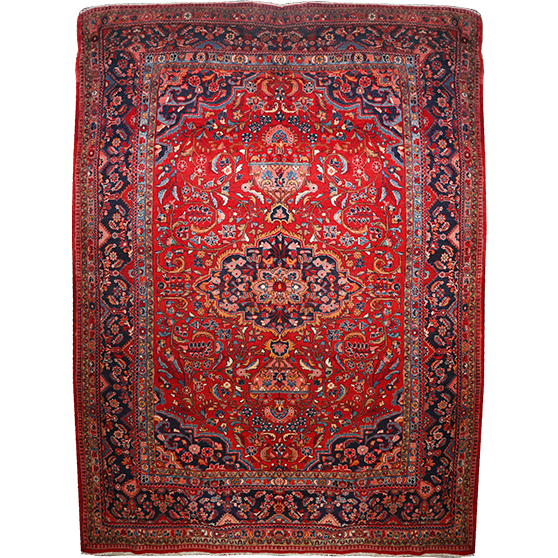
A Lilihan rug of about 14 by 10.5 feet with a medallion design in madder red and navy blue - Lilihan Persian Rug 14x10 ft - Medallion Semi Antique Wool Hand Knotted
9
Choosing a Room-Size Lilihan
A large Lilihan rug defines a room. Measure the space and leave about 12 to 18 inches of floor between the rug and the walls. In a living room, all the main furniture can sit on the rug, or at least the front legs. In a dining room, the rug should extend at least 24 inches beyond the edge of the table on every side, so that chairs stay on the rug when pulled out. Mark the outline on the floor with painter's tape before you decide.
10
Placing a Medallion Rug
A medallion rug looks best when the medallion is visible. In a living room, center the rug on the seating group, with a coffee table over or near the medallion. In a dining room, center it under the table. In a bedroom, place it so that the medallion sits at the foot of the bed. Because the field of a Lilihan is warm red, it brings richness to rooms with pale walls and wood floors.
11
The Lilihan Runner
Our narrow Lilihan runner, about 12.5 by 2.75 feet, suits a hallway about 3.5 to 4 feet wide. Leave about 6 to 12 inches of floor at each end. Its red field and navy medallions bring warmth to a passage that is often the plainest part of a home. See our runners.
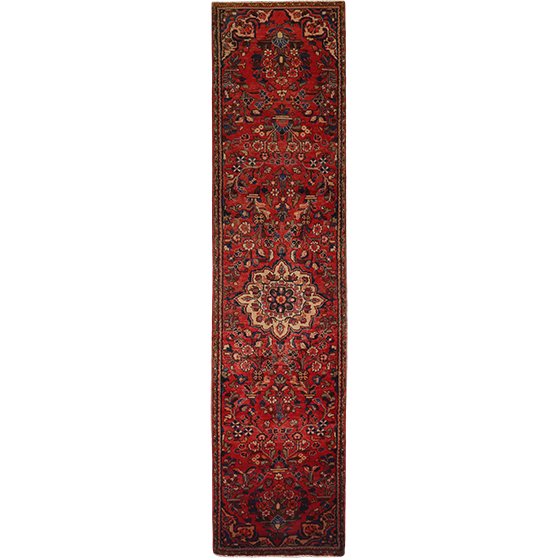
A Lilihan runner of about 12.5 by 2.75 feet with medallions in dark red, navy blue, and cream - Lilihan Persian Rug 12x2 ft - Medallion Semi Antique Wool Hand Knotted
12
The Arak Weaving World
The region around Arak was one of the great weaving centers of Persia in the late nineteenth and early twentieth centuries. Merchants based in Arak, then called Sultanabad, organized weaving in hundreds of villages, supplying wool and designs and buying the finished rugs for export. European and American firms opened offices there. Villages such as Lilihan wove within this system, but each kept something of its own style. Today, rugs from the Arak region are among the most popular semi-antique Persian rugs in America. Read more in our article on weaving in Arak.
13
Armenian Weaving Traditions
Armenian weavers have a long history in the Caucasus, in Anatolia, and in Persia. In Persia, Armenian villages in Fereydan and Kamareh adopted many local designs while keeping their own construction habits and color choices. Some Armenian rugs carry woven inscriptions or dates in Armenian script, though most village rugs carry none. Our article on Armenian rugs tells this story in more detail.
14
Reading the Back
Turn a Lilihan over and look at the knots. With the symmetric knot, each knot shows as two equal bumps on the back. Compare this with a Sarouk, whose asymmetric knots show one larger bump and one smaller. Look at the overall clarity of the design, the evenness of the rows, and the condition of the sides and fringes.
15
Grades and How to Judge Them
•
Drawing - A well-proportioned medallion and clear corners.
•
Wool - Soft, lustrous wool with a full pile.
•
Color - Clear colors without bleeding.
•
Straightness - Straight sides and square corners.
•
Condition - Even pile, intact sides and ends.
16
Questions to Ask Before You Buy
•
What knot is used? - A key clue to origin.
•
Is the pile even? - Check for worn areas.
•
Has it been repaired? - Especially along the sides and at the ends.
•
What are the measurements at both ends? - Checks that the rug is square.
•
Has it been washed recently? - A fresh wash shows the true colors.
17
Semi-Antique Lilihan Rugs
Our Lilihan rugs are semi-antique, woven roughly forty to sixty years ago. They have settled colors, good wool, and many years of life ahead. Because weaving in Lilihan declined in the twentieth century, good pieces are less common than Sarouks or Hamadans. See our semi-antique rugs.
18
What Affects the Price
•
Size - Room-size rugs cost more.
•
Drawing - Well-drawn medallions add value.
•
Wool - Soft, lustrous wool adds value.
•
Color - Clear, harmonious colors add value.
•
Condition - Intact sides and ends.
19
Combining a Lilihan with Other Rugs
A Lilihan pairs naturally with other rugs from the Arak region, such as Sarouk, Mahal, and Farahan, which share its floral vocabulary and warm reds. It also works with Hamadan village rugs, which share its symmetric knot and sturdy build. Keep one or two colors in common and vary the scale of the patterns.
20
Living with a Lilihan
A good Lilihan becomes part of the house. Its reds will mellow a little further, its pile will develop a soft sheen, and its medallion will become a familiar center to the room. Many families keep such a rug for decades, moving it from one room or home to another as their lives change.
21
Caring for a Lilihan Rug
Vacuum regularly without a beater bar. Rotate the rug every six months so that wear and sunlight are spread evenly. Use a non-slip pad. Blot spills at once with a clean, white cloth and cold water. Have it professionally washed every few years. Keep it out of strong direct sunlight. See our care instructions and our article on professional washing.
22
Photographs and Real Color
Reds and navies can look different on screen depending on the light. Daylight from a north window shows the truest colors, while warm lamps make the reds look deeper. If color matters for your room, ask us for extra photographs in daylight or close-ups of the pile. We are glad to describe how a rug looks in person.
23
Common Buying Mistakes
•
Confusing it with a Sarouk - Check the knot and the drawing.
•
Choosing the wrong size - Measure carefully.
•
Skipping the pad - Rugs slip without one.
•
Ignoring the ends - Fringes need regular checks.
24
Reading the Corners and Borders
After the medallion, look at the corners. In a Lilihan, the corner pieces usually repeat part of the medallion's shape or color, so that the field feels framed from all four sides. Then look at the main border. Lilihan borders often carry a chain of rosettes or palmettes linked by a vine, or a simplified, angular version of the classic turtle border. Narrow guard stripes on each side frame the main border. In a well-woven rug, the border turns each corner cleanly, and the four corners match. Small mismatches are common in village rugs and are part of their charm, but a clean, balanced frame is a sign of a careful weaver.
25
The Floral Filler
Around the medallion, the red field of a Lilihan is rarely empty. Small flowers, sprays, leaves, and stems are scattered across it, sometimes in loose rows, sometimes in a free pattern. In the more floral Lilihans, these sprays are curved and graceful, recalling the Sarouk rugs of the same region. In the more geometric pieces, like ours, they become small angular flowers and stars. Look closely at these filler motifs: they show how the weaver handled detail, and they give the rug much of its texture when seen from a few steps away.
26
Matching a Lilihan to Your Room
The warm red field of a Lilihan suits rooms with pale or neutral walls, where it becomes the main source of color. Pick up the navy of the medallion and border for cushions, curtains, or a painted wall to tie the room together. Cream and beige details pair well with linen upholstery and light wood. In a darker room, a Lilihan adds warmth without feeling heavy, because its reds are clear rather than brown. In a modern interior, a large Lilihan softens hard lines and brings a sense of history.
27
Large Rugs and Furniture
With a rug of about 14 by 10.5 feet, all the main furniture of a living room can sit on the rug. Leave a border of floor around the edges so the rug does not look cramped against the walls. Heavy furniture can leave dents in the pile; move pieces slightly every few months, and brush the pile back up with your fingers. Felt pads under furniture legs spread the weight. When you rotate the rug, which is easier with two people, the pile will wear evenly over the years.
28
Keeping a Runner Flat and Safe
A narrow runner in a busy hallway needs a good pad. A felt-and-rubber pad keeps it from slipping and helps it lie flat. If a corner curls, roll it gently in the opposite direction for a few hours. Turn the runner end to end every few months so that wear and sunlight are spread evenly. Vacuum across the fringes gently, or not at all, and have worn ends secured by a professional. See our guide to maintaining rug fringes.
29
The Wool of Lilihan
The wool of the Arak region comes from sheep raised on the plains and hills of central Persia. It is soft, with a good natural luster, and it takes dye well, which helps explain the clear reds and navies of Lilihan rugs. In semi-antique pieces, the wool has developed a gentle sheen. Good wool is one of the most important things to judge in any rug: rub the pile between your fingers and look for softness, spring, and shine. Read more in our article on Persian rug wool.
30
A Rug for Generations
Lilihan rugs were made to be used, not only admired. Their firm structure and good wool let them take daily foot traffic for decades, and many semi-antique pieces are now in their second or third household. When you buy a Lilihan, you are continuing that life. With regular vacuuming, rotation, and a professional wash every few years, it can pass on in good condition to the next generation.
31
Frequently Asked Questions
Where is Lilihan?
In the Kamareh district of central Persia, near Arak and Khomein.
Who wove Lilihan rugs?
Armenian families who settled in the village in the seventeenth century.
What knot is used?
Lilihan rugs are generally described as using the symmetric (Turkish) knot.
How is a Lilihan different from a Sarouk?
Sarouks use the asymmetric knot and a double weft, with finer drawing; Lilihans use the symmetric knot and a freer drawing.
What colors are typical?
Madder red, rose red, navy, and cream, with touches of green and gold.
What designs are typical?
Bold central medallions with floral filler.
What sizes do you have?
Room-size rugs of about 13.5 by 9.5 and 14 by 10.5 feet, and a runner of about 12.5 by 2.75 feet.
Are Lilihan rugs durable?
Yes. Their firm structure and good wool make them durable.
Are Lilihan rugs still woven?
Weaving in the village declined in the twentieth century, so most Lilihan rugs on the market are older pieces.
Can a large Lilihan go in a dining room?
Yes. Leave at least 24 inches of rug beyond the table on every side.
How should I care for a Lilihan rug?
Vacuum regularly, rotate it, use a pad, and have it professionally washed every few years.
Do Lilihan rugs carry Armenian inscriptions?
Some Armenian rugs do, but most village rugs, including most Lilihans, carry none.
Can a Lilihan go in a bedroom?
Yes. A room-size Lilihan can sit under a king bed with plenty of rug on each side, and the runner can sit beside the bed.
Will the reds fade further?
In a semi-antique rug the colors have largely settled. Keep it out of strong direct sunlight to protect them.
Is a Lilihan a good choice for a busy family room?
Yes. Its firm structure, good wool, and warm colors stand up well to daily life and hide small marks.
32
Choose Your Lilihan Rug
Each Lilihan rug in our collection is hand-knotted, one of a kind, and inspected before it is listed. Browse our Lilihan collection, compare with our Sarouk, Mahal, and Arak rugs, or ask our experts for help.