


The Hamadan region of western Persia is home to hundreds of weaving villages, and many of them give their names to the rugs they make. Mazlaghan is one of the most recognizable. Rugs sold under this name are village rugs from a district in the north-east of the Hamadan region, along the valley of the Mazlaghan river toward Saveh. Their signature is a medallion drawn with bold, stepped or zigzag outlines, so striking that once you have seen one, you will spot the next across a room.
This guide explains how to recognize a Mazlaghan rug, how it is made, how it compares with its neighbors, and how to choose, place, and care for a small Mazlaghan like those in our collection. For the wider story of the region, see our articles on weaving in Hamadan and weaving in Saveh, and our Hamadan rug guide.
1
A Village Name in the Hamadan Family
In the Hamadan rug trade, village names act like family names. Each village or district has its own habits of design, color, and construction, and experienced dealers can often name a rug's village from a glance at its front and back. Mazlaghan is one of these names. Its villages lie between the Hamadan plain and the Saveh region, in farming country where weaving has long been part of household life.
Like most Hamadan village rugs, Mazlaghans were woven at home by women, on upright looms, from designs kept in memory. They were made to be used: as floor rugs in village houses, as part of a bride's dowry, and as goods to sell at market.
Mazlaghan is a village name of the Hamadan region. Its rugs are known for medallions with bold zigzag outlines, deep reds and navies, and a sturdy single-weft build.
2
The Zigzag Medallion
What sets a Mazlaghan apart is the way its medallion and field are outlined. Instead of a smooth curve or a simple stepped edge, the outline is drawn as a bold, saw-tooth or zigzag line, sometimes doubled, so that the medallion seems to vibrate against the field. In many pieces, the same zigzag line also frames the inner field, creating a kind of echo between the medallion and the corners. Some writers call this a lightning outline.
Inside the medallion, you may find a smaller medallion, a star, or a cluster of geometric flowers. The field around it is often a solid or nearly solid color, which makes the zigzag outline stand out even more. This simple, bold layout is what gives Mazlaghan rugs their graphic, almost modern look.
3
How to Recognize a Mazlaghan Rug
•
Zigzag outlines - Bold, saw-tooth edges around the medallion and the field.
•
Strong central medallion - A diamond or hexagon with an inner motif.
•
Open field - Often a solid or nearly solid ground.
•
Deep colors - Crimson, dark red, navy, and ivory.
•
Symmetric knot - The Turkish knot typical of Hamadan village rugs.
•
Single weft - One thick cotton weft after each row of knots.
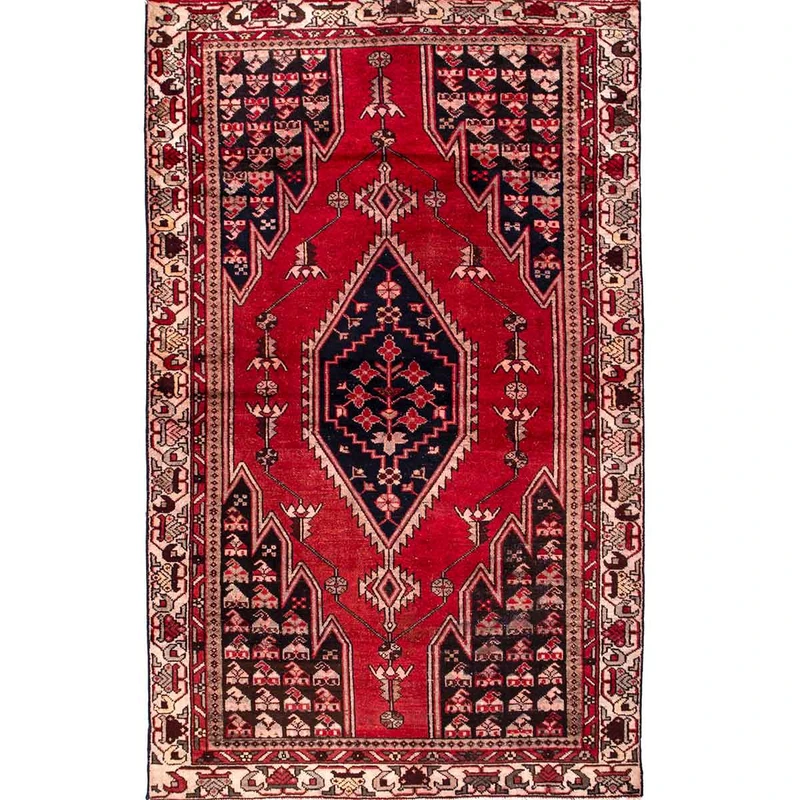
A Mazlaghan rug of about 7 by 4.25 feet with a central medallion in crimson, dark red, navy blue, and ivory - Mazlaghan Persian Rug 6x4 ft - Medallion Semi Antique Wool Hand Knotted
4
How Mazlaghan Rugs Are Built
•
Knot - The symmetric (Turkish) knot.
•
Foundation - Cotton warps and wefts.
•
Wefts - Single, the classic Hamadan structure.
•
Pile - Thick, resilient wool, clipped to a medium or slightly long height.
•
Density - Coarse to medium.
•
Sides and ends - Overcast sides and fringes.
The single weft is one of the defining features of Hamadan village rugs. On the back, you can see one thick weft thread between each row of knots, and the knots themselves appear in a slightly offset pattern. This construction makes a rug that is flexible, durable, and comfortable underfoot.
5
Colors of Mazlaghan
Our Mazlaghan rugs use deep, warm palettes: crimson and dark red for the field and medallion, navy blue for outlines and borders, and ivory for highlights and the zigzag lines, with smaller touches of other colors. The contrast between the dark field and the light zigzag outline is what gives these rugs their energy. In semi-antique rugs, the reds have softened and the navies deepened into a rich, harmonious whole. Read more in our articles on natural dyes and traditional dyeing.
6
Small Rugs in Our Collection
Our Mazlaghan rugs are small pieces, which is typical of the village: much of its weaving was in scatter and small rug sizes.
•
About 7 by 4.25 feet - An entrance, a study, a bedside, or the foot of a bed.
•
About 3.75 by 2.5 feet - A doorway, a bathroom, a kitchen sink, or a reading corner.
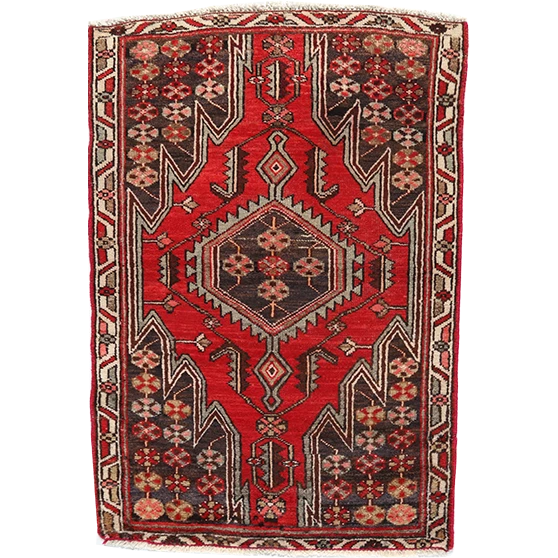
A small Mazlaghan rug of about 3.75 by 2.5 feet with a medallion in crimson, navy blue, and ivory - Mazlaghan Persian Rug 3x2 ft - Medallion Semi Antique Wool Hand Knotted
7
Placing a Small Rug
Small rugs are some of the most useful rugs in a home. They warm up a cold floor where you step out of bed, catch grit at an entrance, soften the space in front of a kitchen sink, and add color to a bathroom or a reading corner. A small Mazlaghan, with its bold graphic medallion, works especially well where it can be seen from above, such as at the foot of a staircase or in front of a fireplace.
Small rugs are also a good way to bring a piece of Persian weaving into a room that already has a larger rug. Choose a Mazlaghan that shares one color with the larger rug, and let the zigzag medallion add a lively accent.
8
Mazlaghan and Its Neighbors
Mazlaghan and Hamadan
Mazlaghan rugs are part of the Hamadan family, sharing the symmetric knot and single weft. See our Hamadan collection.
Mazlaghan and Saveh
Saveh, to the east, is a market town for village rugs of the region. See our Saveh collection.
Mazlaghan and Borchelu
Borchelu rugs, also from the Hamadan region, are more floral, with curved medallions. See our Borchelu collection.
Mazlaghan and Bibikabad
Bibikabad rugs, another Hamadan village name, are known for allover Herati and medallion designs. See our Bibikabad collection.
Mazlaghan and Nahavand
Nahavand rugs, from the south of the Hamadan region, share the single-weft build and medallion layouts. See our Nahavand collection.
9
Why the Zigzag Works
The zigzag outline is more than decoration. In weaving, a diagonal line is built from small steps, one knot at a time, and village weavers learned to use those steps for effect. By doubling the outline, alternating light and dark, and repeating it around the field, Mazlaghan weavers turned a technical necessity into a bold graphic language. The result reads clearly from across a room and keeps its energy even in a small rug. It is one of the reasons Mazlaghan rugs appeal to modern buyers who might not otherwise choose a traditional village rug.
10
The Borders
Mazlaghan borders are usually simpler than the field. A typical rug has a main border of repeating geometric flowers, small rosettes, or a hooked vine, flanked by narrow guard stripes. Because the medallion and its zigzag outline are so strong, a calm border lets them stand out. In some pieces, a narrow zigzag or reciprocal stripe in the guard border echoes the medallion. Look at how the border turns the corners: small irregularities are common in village rugs, but a balanced frame is a sign of a careful weaver.
11
Village Life and the Loom
In the villages of the Hamadan region, weaving was traditionally the work of women, done at home alongside farming and raising sheep. Girls learned by sitting beside their mothers, first passing yarn and then tying knots. Many designs were kept in memory rather than drawn on paper, which is why each Mazlaghan has small personal variations: a zigzag that changes rhythm, a color changed midway, a medallion slightly off center. These details are part of the charm of a village rug. Read more about the people behind rugs in our article on the craft from shepherd to dealer.
12
The Wool of the Hamadan Villages
The wool of Hamadan village rugs comes from sheep raised on the plains and hills of western Persia. It is strong and springy, with a good natural luster, and it takes dye well. In semi-antique rugs, the wool has developed a gentle sheen. Rub the pile between your fingers: good wool feels soft and springy, not dry or brittle. Read more in our article on Persian rug wool.
13
Abrash and Color Changes
Many Mazlaghan rugs show abrash, horizontal bands where one color shifts slightly in shade. This happens when the weaver runs out of one batch of dyed wool and starts another. In an open, nearly solid field, abrash is easy to see, and it gives the field a gentle movement. It is a natural sign of hand-dyed wool, not a defect.
14
Matching a Mazlaghan to Your Room
The graphic medallion of a Mazlaghan suits both traditional and modern interiors. In a modern room with plain walls and simple furniture, it reads almost like a piece of abstract art on the floor. In a traditional home, it pairs naturally with dark wood and warm textiles. Pick up the crimson or navy for a cushion or a throw nearby, and let the ivory zigzag tie in with pale walls or upholstery.
15
Combining Small Rugs
Small Mazlaghans can work in pairs or groups. Two similar rugs can sit on each side of a bed, at each end of a hallway, or in front of two facing chairs. A small Mazlaghan can also sit at the edge of a larger rug in a nearby room, carrying the color through the house. When combining rugs, keep one or two colors in common and vary the scale of the patterns.
16
Photographs and Real Color
Deep reds and navies can look different on screen depending on the light. Daylight from a north window shows the truest colors, while warm lamps make reds look deeper. If color matters for your room, ask us for extra photographs in daylight or close-ups of the pile.
17
Living with a Mazlaghan
A good Mazlaghan becomes part of the house. Its colors settle further, its pile develops a soft sheen, and its zigzag medallion becomes a familiar accent. Because small rugs are easy to move, many owners find that a Mazlaghan travels around the home over the years, from an entrance to a bedroom to a study, fitting each space in a different way.
18
Small Rugs, Big Character
It is easy to overlook small rugs when shopping for Persian weaving, because the eye is drawn to large room-size carpets. Yet small village rugs often show a weaver's personality most clearly. With less space to fill, a Mazlaghan weaver concentrated on one strong idea, the zigzag medallion, and carried it out with confidence. A small rug also lets you live with a style before committing to a larger piece, and it can move easily from room to room as your needs change. Many collectors began with a small village rug like this one.
19
Hamadan Village Rugs and Their Names
The Hamadan region has so many weaving villages that the trade developed a whole vocabulary of names to tell them apart. Some names refer to a single village, others to a district or a group of villages. Mazlaghan is a district name, used for rugs from several villages in the same valley that share a recognizable style. Other names in our collections, such as Bibikabad, Borchelu, Nahavand, Tuyserkan, and Malayer, each point to their own district and style. Our Hamadan rug guide gives a map of the whole family.
20
The Ends and Fringes
The fringes of a Mazlaghan are the ends of its cotton warp threads. On a small rug that is moved and shaken often, they take a lot of wear. Vacuum across them gently, or not at all, and have worn ends secured by a professional before the knots begin to come loose. Never pull a loose fringe thread; trim it instead.
21
Keeping a Small Rug Flat
Small rugs are light, so they move and curl more easily than large ones. A thin felt-and-rubber pad keeps a small Mazlaghan in place and helps it lie flat. If a corner curls, roll it gently in the opposite direction for a few hours, or place a heavy book on it overnight. Avoid taping the corners, which can damage the wool.
22
A Rug That Reads from Across the Room
Many fine city rugs reveal their beauty only up close, where you can follow the curves of every vine. A Mazlaghan works the other way. Its bold medallion and zigzag outline read clearly from the doorway, and its simple, open field lets the eye rest. Up close, you then discover the details: the small motifs inside the medallion, the slight changes of color, the texture of the hand-spun wool. That combination of strong first impression and quiet detail is what makes a good village rug so satisfying to live with.
23
Reading the Back
Turn a Mazlaghan over. You should see the symmetric knots as two equal bumps, and a single weft between each row of knots. The zigzag outline of the medallion will show clearly on the back, often even more sharply than on the front. Check the sides and fringes, which take the most wear on small rugs.
24
Grades and How to Judge Them
•
Wool - Thick, springy, lustrous wool.
•
Drawing - A crisp, balanced zigzag outline.
•
Color - Clear colors without bleeding.
•
Straightness - Straight sides and square corners.
•
Condition - Even pile, intact sides and ends.
25
Questions to Ask Before You Buy
•
Single or double weft? - Mazlaghans are usually single-wefted.
•
What are the measurements at both ends? - Checks that the rug is square.
•
Is the pile even? - Check for worn areas.
•
Has it been repaired? - Especially along the sides and at the ends.
•
Has it been washed recently? - A fresh wash shows the true colors.
26
Semi-Antique Mazlaghan Rugs
Our Mazlaghan rugs are semi-antique, woven roughly forty to sixty years ago. They have settled colors, good wool, and many years of life ahead. See our semi-antique rugs.
27
What Affects the Price
•
Size - Larger rugs cost more, but small rugs are an affordable way to own a village piece.
•
Drawing - A crisp, balanced zigzag adds value.
•
Wool - Lustrous wool adds value.
•
Color - Clear, harmonious colors add value.
•
Condition - Intact sides and ends.
28
Small Rugs in Busy Places
A small rug works hard. In an entrance, it catches grit from shoes; in a kitchen, it catches spills. Shake or vacuum it often, and turn it regularly so that one end does not wear faster than the other. A good pad keeps it from sliding on smooth floors. Because a small rug is light, it is also easy to take outside, air in the shade, and bring back in.
29
Caring for a Mazlaghan Rug
Vacuum regularly without a beater bar. Turn the rug every few months. Use a non-slip pad. Blot spills at once with a clean, white cloth and cold water. Have it professionally washed every year or two in busy areas and every few years elsewhere. Keep it out of strong direct sunlight. See our care instructions, our article on washing at home, and our guide to maintaining rug fringes.
30
Common Buying Mistakes
•
Overlooking small rugs - They are some of the most useful rugs in a home.
•
Skipping the pad - Small rugs slip easily.
•
Ignoring the ends - Fringes need regular checks.
•
Expecting perfect symmetry - Small variations are part of village weaving.
31
Frequently Asked Questions
Where is Mazlaghan?
In the north-east of the Hamadan weaving region of western Persia, toward Saveh.
What makes a Mazlaghan recognizable?
A medallion drawn with bold, zigzag outlines, often echoed around the field.
What knot is used?
The symmetric (Turkish) knot.
What is a single weft?
One thick weft thread after each row of knots, the classic Hamadan structure.
What colors are typical?
Crimson, dark red, navy, and ivory.
What sizes do you have?
About 7 by 4.25 feet and about 3.75 by 2.5 feet.
Are Mazlaghan rugs durable?
Yes. Their thick wool and sturdy construction make them very durable.
Where can a small rug go?
In an entrance, a bathroom, beside a bed, in front of a kitchen sink, or in a reading corner.
How should I care for a Mazlaghan rug?
Vacuum regularly, turn it, use a pad, and have it professionally washed regularly.
Is a Mazlaghan a good choice for a modern home?
Yes. Its graphic zigzag medallion reads almost like abstract art and suits modern interiors well.
Is abrash a defect?
No. It is a natural sign of hand-dyed wool and often adds character.
Can two small Mazlaghans be used together?
Yes. They can sit on each side of a bed or at each end of a hallway.
Can a small rug go in a bathroom?
Yes. Use a non-slip pad and let the rug dry fully if it gets wet.
Will the colors fade further?
In a semi-antique rug the colors have largely settled. Keep it out of strong direct sunlight to protect them.
32
Choose Your Mazlaghan Rug
Each Mazlaghan rug in our collection is hand-knotted, one of a kind, and inspected before it is listed. Browse our Mazlaghan collection, compare with our Hamadan, Borchelu, and Nahavand rugs, or ask our experts for help.