


In the late nineteenth and early twentieth centuries, the region around Arak, then called Sultanabad, became one of the busiest weaving areas in the world. Merchants and foreign firms organized weaving in hundreds of villages and sorted the finished rugs by quality. In that system, Meshkabad, often spelled Mushkabad, became the name for the most robust, boldly drawn carpets of the region, with Mahal in the middle and the finest pieces sold as Sultanabad.
This guide explains what the Meshkabad name means today, how to recognize a Meshkabad rug, how it compares with its neighbors, and how to choose, place, and care for one like those in our collection. For the history of the region, see our articles on weaving in Arak and Sultanabad rugs, and our Mahal rug guide.
1
The Meshkabad Name
Meshkabad is the name of a district of the Arak region, and in the trade it came to describe a type as much as a place. Writers on Persian carpets describe Meshkabad carpets as the coarsest of the three traditional grades of the region, with a lower knot count, a thicker pile, and large-scale drawing. That does not make them lesser rugs. Their big, confident designs read beautifully across a large room, their thick wool wears well, and their colors are often especially rich.
Today, dealers use the name for rugs of the region with this robust character, and many buyers seek them out precisely for their bold scale and relaxed, painterly drawing.
Meshkabad, or Mushkabad, is a name from the Arak region. It stands for the most robust, boldly drawn carpets of the region, next to Mahal and the finest Sultanabad rugs.
2
How to Recognize a Meshkabad Rug
•
Large-scale floral drawing - Big palmettes, vines, and rosettes that read from across a room.
•
Medallion or allover designs - Shah Abbasi medallions, Islimi arabesques, and Herati patterns.
•
Thick pile - A full, resilient wool pile.
•
Lower knot count - Coarser than Mahal or Sarouk.
•
Cotton foundation - Cotton warps and wefts.
•
Generous sizes - Room-size carpets and long runners.
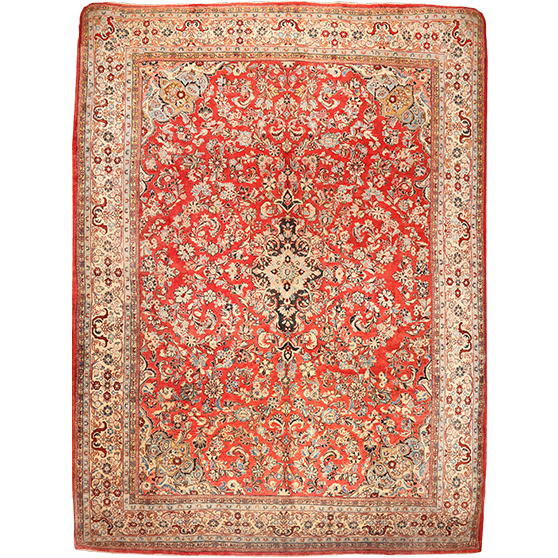
A Meshkabad rug of about 13.75 by 10 feet with a Shah Abbasi medallion design - Meshkabad Persian Rug 13x9 ft - Medallion Semi Antique Wool Hand Knotted
3
Large-Scale Drawing
The most important thing to understand about a Meshkabad is scale. Because the knot count is lower, each motif must be drawn larger to keep its shape, and weavers responded with bold palmettes, wide vines, and generous medallions. Up close, the drawing can look simple; from across the room, it comes together into a strong, rhythmic pattern. That is why Meshkabad carpets were so popular for large rooms in Europe and America: their designs are made to be seen from a distance.
4
The Shah Abbasi Medallion
Our room-size Meshkabad uses a Shah Abbasi medallion design. The name comes from the large, many-petalled palmettes that became popular in Persian art under Shah Abbas in the Safavid period. A central medallion sits on a field of these palmettes linked by scrolling vines, with corner pieces that echo the medallion. In a Meshkabad, the palmettes are drawn at a large scale, which gives the field a bold, open rhythm. See our Shah Abbasi design page.
5
The Islimi Runner
Our antique Meshkabad runner uses an Islimi design, the scrolling arabesque of curling, split-leaf vines that runs through Persian art from tilework to manuscripts. In a runner, the Islimi creates a flowing pattern along the length, leading the eye down the hallway. See our Islimi design page.
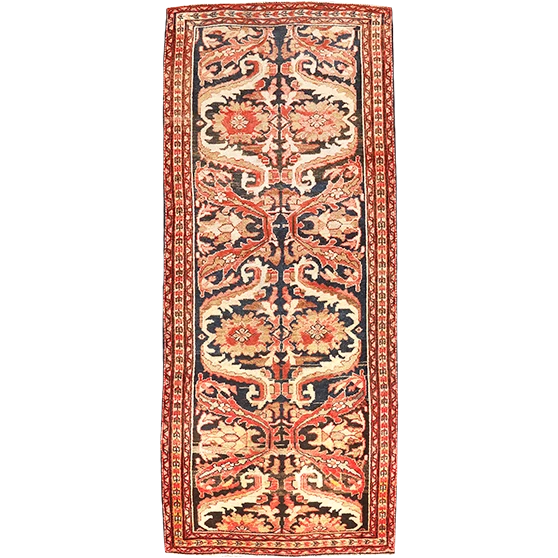
An antique Meshkabad runner of about 9.5 by 3.75 feet with an Islimi arabesque design - Meshkabad Persian Rug 9x3 ft - Eslimi Antique Wool Hand Knotted
6
How Meshkabad Rugs Are Built
•
Knot - The asymmetric (Persian) knot, typical of the Arak region.
•
Foundation - Cotton warps and wefts.
•
Pile - Thick wool, clipped to a medium or slightly long height.
•
Density - Coarse to medium.
•
Sides and ends - Overcast sides and fringes.
This construction makes a rug that is comfortable underfoot, with a thick pile that wears well.
7
Meshkabad, Mahal, and Sultanabad
The three traditional names of the Arak region are easiest to understand side by side:
•
Meshkabad - The most robust grade: lower knot count, thick pile, large-scale drawing.
•
Mahal - The middle grade: medium density, large floral designs, soft wool.
•
Sultanabad - The finest grade: higher density and more refined drawing.
These are trade categories rather than strict rules, and individual rugs vary. But knowing them helps you understand what you are looking at. See our Mahal and Arak collections.
8
Colors of Meshkabad
Meshkabad rugs often use warm, rich palettes: madder reds, deep blues, ivories, and golds, sometimes with greens and soft browns. Because the pile is thick, colors appear deep and saturated. In older pieces, the colors have mellowed into a warm, harmonious whole, and you may see abrash, gentle changes of shade within one color, which give the field movement. Read more in our articles on natural dyes and traditional dyeing.
9
Sizes in Our Collection
•
About 13.75 by 10 feet - A large living room, a great room, or a dining room for eight or more.
•
About 9.5 by 3.75 feet - A runner for a hallway, a kitchen, or the side of a bed.
See our 10x13 rugs and runners.
10
Choosing a Large Meshkabad
A large Meshkabad needs a large room. Measure the space and leave about 12 to 18 inches of floor between the rug and the walls. In a living room, all the main furniture can sit on the rug. In a dining room, let the rug extend at least 24 inches beyond the table on every side. Because its drawing is large in scale, a Meshkabad looks best where it can be seen from a distance, in an open room rather than one crowded with furniture.
11
Owning an Antique Runner
Our antique Meshkabad runner is more than sixty years old. An antique rug carries the marks of its life: a slightly lower pile in places, colors softened by time, perhaps small old repairs. These are not defects but part of its character. When you own an antique, treat it a little more gently than a newer rug: use a good pad, rotate it often, keep it out of strong sunlight, and have it cleaned by a specialist who knows older rugs. See our antique rugs.
12
Placing a Meshkabad
A Meshkabad suits both traditional and modern interiors. In a traditional home, it pairs naturally with dark wood, upholstered furniture, and framed pictures. In a modern interior, its large-scale drawing softens clean lines and brings warmth to open plans. In a long hallway, an antique Islimi runner adds history and movement.
13
Meshkabad and Its Neighbors
Meshkabad and Mahal
Mahal rugs are a step finer, with medium density. See our Mahal collection.
Meshkabad and Sarouk
Sarouk rugs, from the same region, are much finer and denser, with a double weft. See our Sarouk collection.
Meshkabad and Farahan
Farahan rugs, from the plain north of Arak, are known for fine Herati and Mina Khani designs. See our Farahan collection.
Meshkabad and Lilihan
Lilihan rugs, woven by Armenian villagers of the region, use the symmetric knot. See our Lilihan collection.
14
The Sultanabad Export Trade
From the late nineteenth century, Arak was the center of a large export trade. Merchants and foreign firms, among them the Manchester company Ziegler and Co., organized weaving in hundreds of villages around the town, supplying wool, dyes, and designs and buying the finished rugs. They adapted traditional Persian designs to Western rooms, with larger scale, more open fields, and softer colors. Meshkabad carpets, with their bold drawing and practical price, were an important part of this trade, and many of the large Persian carpets in older European and American homes are of this type. Our article on Sultanabad rugs tells this story in more detail.
15
Village Weaving for a World Market
Behind every Meshkabad stands a village weaver. In the Arak region, women wove at home on upright looms, often following a design and color scheme supplied by a merchant. A large carpet could take one or more weavers many months. This system combined the skill of village weavers with the reach of city merchants, and it produced rugs that suited homes far from Persia while keeping the strong wool and warm colors of the region. Read more about the people behind rugs in our article on the craft from shepherd to dealer.
16
Reading the Borders
The borders of a Meshkabad frame its large-scale field. A typical piece has a wide main border with a chain of palmettes and rosettes linked by a scrolling vine, flanked by narrow guard stripes. Because the field is large in scale, the border is usually generous too, so the rug looks balanced from across the room. Look at how the border turns the corners: in a well-planned rug, the pattern resolves cleanly at all four corners, though small adjustments by eye are common in village pieces.
17
The Wool of the Arak Region
The wool of the Arak region comes from sheep raised on the plains and hills of central Persia. It is strong, with a good natural luster, and it takes dye well. In a Meshkabad, the thick pile shows this wool to advantage. In older rugs, the wool has developed a gentle sheen. Rub the pile between your fingers: good wool feels soft and springy, not dry or brittle. Read more in our article on Persian rug wool.
18
Open Plans and Large Rooms
In an open-plan home, a large Meshkabad can define a living area within a bigger space. Place it so that the sofa and chairs sit on it, creating a room within the room. Its bold, large-scale drawing holds its own in a big space where a finer rug might look lost. An antique runner along a connecting passage can then carry the warm palette through the house.
19
Combining a Meshkabad with Other Rugs
A Meshkabad pairs naturally with other rugs from the Arak region, such as Mahal, Sarouk, Farahan, and Lilihan, which share its floral vocabulary and warm colors. It also works with Hamadan village rugs and with Persian city rugs such as Kashan or Isfahan. Keep one or two colors in common and vary the scale of the patterns, so that the rugs work together without competing.
20
Large Rugs and Furniture
Heavy furniture can leave dents in the pile. Move pieces slightly every few months, and brush the pile back up with your fingers. Felt pads under furniture legs spread the weight. Rotate a large Meshkabad every six months or so, which is easier with two people, so that wear and sunlight are spread evenly.
21
Photographs and Real Color
Large rugs are hard to photograph evenly, and colors can look different on screen depending on the light. Daylight from a north window shows the truest colors. If color matters for your room, ask us for extra photographs in daylight or close-ups of the pile and the design.
22
Living with a Meshkabad
A good Meshkabad becomes the heart of a room. Its colors settle further, its thick pile develops a soft sheen, and its bold design becomes a familiar backdrop to family life. Many families keep such a rug for decades, moving it from one home to the next. With ordinary care, it can stay in daily use for many more years and pass on to the next generation.
23
Keeping an Antique Runner Safe
An antique runner in a hallway faces more wear than almost any other rug. Choose a good felt-and-rubber pad, which cushions the old foundation and keeps the runner from slipping. Turn it end to end every few months, and vacuum across the fringes gently, or not at all. If you notice a loose side cord or a worn end, have it secured by a professional before the damage spreads. A small repair done early is much cheaper than a large one later. If the hallway is very busy, consider placing the antique where it is seen more than walked on, such as along the side of a bed or in front of a sideboard.
24
Abrash and Color Changes
Many Meshkabad rugs show abrash, gentle bands where one color shifts slightly in shade, caused by wool dyed in different batches. In a large field, abrash can give a pleasing movement, and in older rugs it becomes part of the character. It is a natural sign of hand-dyed wool, not a defect.
25
Motifs in the Field
Around the main design of a Meshkabad, you may find large palmettes, rosettes, leaves, and flowering branches, sometimes with smaller cloud bands or arabesques. Because the scale is large, each motif is clearly visible, and you can follow the vines across the field. Read more in our article on design motifs.
26
Matching a Meshkabad to Your Room
A large Meshkabad sets the tone for a room. Pick up one or two of its main colors, such as a red from the field or a blue from the border, for cushions, curtains, or a painted wall, and let the rest of the room stay calm. In a traditional room, wood, brass, and leather complement its warm palette. In a modern room, a single large Meshkabad on a pale floor can be the main source of pattern and history, with simple furniture around it.
27
Why Bold Rugs Suit Busy Homes
A Meshkabad's large-scale pattern and thick pile make it forgiving in daily life. Small marks disappear into the design, footsteps are cushioned, and the wool springs back after it is pressed down. For a family room or a dining room that sees heavy use, a bold Arak-region carpet is often a wiser choice than a very fine rug.
28
Reading the Back
Turn a Meshkabad over and look at the knots. With the asymmetric knot, each knot shows as one larger loop and one smaller loop. The knots will be relatively large, and the design will show clearly. Compare it with a Sarouk, whose back is much finer and stiffer. Check the sides and fringes, which take the most wear.
29
Grades and How to Judge Them
•
Wool - Thick, lustrous wool with a full pile.
•
Drawing - Bold, balanced design that reads well from a distance.
•
Color - Rich colors without bleeding.
•
Straightness - Straight sides and square corners.
•
Condition - Even pile, intact sides and ends.
30
Questions to Ask Before You Buy
•
How old is it? - Semi-antique or antique.
•
Is the pile even? - Check for worn areas, especially in older pieces.
•
Has it been repaired? - Old repairs are normal in antiques; ask where they are.
•
What are the measurements at both ends? - Checks that the rug is square.
•
Has it been washed recently? - A fresh wash shows the true colors.
31
What Affects the Price
•
Size - Larger rugs cost more.
•
Age - Antique pieces in good condition are often worth more.
•
Wool - Lustrous wool adds value.
•
Color - Rich, harmonious colors add value.
•
Condition - Even pile, intact sides and ends.
32
Caring for a Meshkabad Rug
Vacuum regularly without a beater bar. Rotate the rug every six months. Use a non-slip pad. Blot spills at once with a clean, white cloth and cold water. Have it professionally washed every few years by a specialist, especially an antique. Keep it out of strong direct sunlight. See our care instructions, our article on professional washing, and our guide to maintaining antique rug fringes.
33
Common Buying Mistakes
•
Judging it up close only - Meshkabad designs are made to be seen from a distance.
•
Choosing too small a room - A large Meshkabad needs space.
•
Skipping the pad - Rugs slip without one.
•
Treating an antique like a new rug - Older rugs need gentler care.
34
Frequently Asked Questions
Where is Meshkabad?
In the Arak region of central Persia, the old Sultanabad district.
Is Meshkabad the same as Mushkabad?
Yes. They are two spellings of the same name.
What does the name mean in the trade?
The most robust grade of Arak-region carpets, with a lower knot count and large-scale drawing.
How is a Meshkabad different from a Mahal?
A Mahal is a step finer, with medium density; a Meshkabad is bolder and coarser.
What designs are typical?
Shah Abbasi medallions, Islimi arabesques, and Herati patterns.
What sizes do you have?
A room-size rug of about 13.75 by 10 feet and an antique runner of about 9.5 by 3.75 feet.
Are Meshkabad rugs durable?
Yes. Their thick pile wears well.
How old is your runner?
More than sixty years old.
How should I care for a Meshkabad rug?
Vacuum regularly, rotate it, use a pad, and have it professionally washed every few years.
Is a coarser rug a worse rug?
No. A lower knot count means larger-scale drawing and often a thicker pile. Many buyers prefer the bold look of a Meshkabad.
What is an Islimi design?
A scrolling arabesque of curling, split-leaf vines found throughout Persian art.
Is abrash a defect?
No. It is a natural sign of hand-dyed wool.
Can an antique runner go in a hallway?
Yes, with a good pad and regular turning. In a very busy hallway, consider a spot where it is seen more than walked on.
35
Choose Your Meshkabad Rug
Each Meshkabad rug in our collection is hand-knotted, one of a kind, and inspected before it is listed. Browse our Meshkabad collection, compare with our Mahal, Arak, and Sarouk rugs, or ask our experts for help.