


In the dry highlands of southern Khorasan, about thirty miles south of the town of Birjand, lies the village of Moud (also spelled Mood or Mud). It is a modest place of mud-brick houses, orchards, and fields of saffron and barberries, yet its name is known to rug lovers around the world. For generations, the weavers of Moud and the nearby villages have made rugs of unusual refinement for a village, with small, precise patterns and a quiet, elegant palette.
This guide explains how to recognize a Moud rug, how it is made, how it compares with its neighbors, and how to choose, place, and care for one like those in our collection. For the wider story of weaving in the region, see our articles on weaving in Birjand and weaving in Khorasan, and our Birjand rug guide.
1
A Village Known for Fine Drawing
What sets Moud apart is the fineness of its drawing. Where many village rugs use bold, large-scale motifs, Moud weavers favored small, repeating patterns drawn with care, above all the Herati, known in Khorasan as Mahi, "fish," after the curved leaves that surround each rosette. A well-woven Moud has a field of tiny, even Herati units that seems to shimmer from a distance and reveals endless detail up close.
Moud rugs are often woven in a single, harmonious palette, with a red, navy, or cream field and closely related colors in the pattern. Some Moud rugs also have small details highlighted in silk, a practice associated with the village; if this matters to you, ask us about a particular piece, as our rugs are described by their wool pile.
Moud is a village near Birjand in southern Khorasan. Its rugs are known for finely drawn Herati (Mahi) patterns and harmonious red, navy, and cream palettes.
2
The Herati, or Mahi, Pattern
The Herati is one of the oldest and most widespread patterns in Persian weaving. Each unit is a rosette set inside a diamond, with four curved, serrated leaves around it. Repeated across the field, these units form a continuous lattice of flowers and leaves. The name comes from the city of Herat, once part of greater Khorasan, and in the region weavers often call it Mahi, because the curved leaves look like small fish swimming around the rosette.
In a Moud rug, the Herati is drawn at a small scale and with great regularity, which gives the field its fine, shimmering texture. Our Moud runner uses this pattern along its whole length. See our Herati design page.

A Moud runner of about 11 by 3.5 feet with a fine Herati design in red, navy blue, and cream - Moud Persian Rug 10x3 ft - Herati Semi Antique Wool Silk Hand Knotted
3
The Shah Abbasi Medallion
Besides allover Herati fields, Moud weavers make medallion rugs. Our larger Moud uses a Shah Abbasi medallion design: a central medallion on a field of large, many-petalled palmettes linked by scrolling vines, with corner pieces that echo the medallion. In a Moud, these palmettes are drawn with fine, careful outlines, and the field around them is often filled with small flowers or a Herati background. See our Shah Abbasi design page.
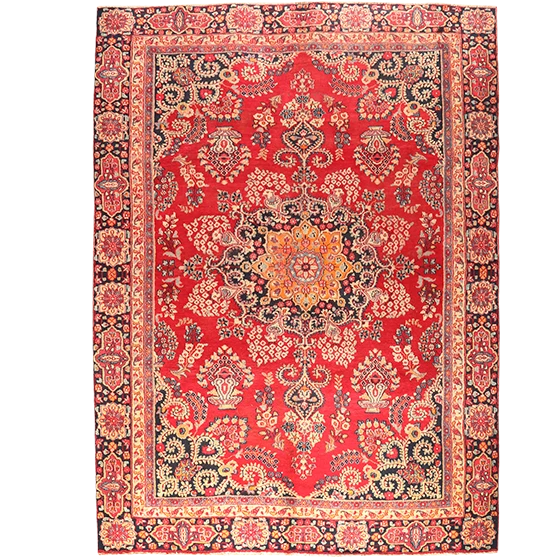
A Moud rug of about 9 by 6.25 feet with a Shah Abbasi medallion design in red, navy blue, and cream - Moud Persian Rug 9x6 ft - Medallion Semi Antique Wool Silk Hand Knotted
4
How to Recognize a Moud Rug
•
Fine Herati (Mahi) pattern - Small, regular units across the field.
•
Elegant medallions - Shah Abbasi or lobed medallions with fine outlines.
•
Harmonious palette - Red, navy, cream, and closely related shades.
•
Soft wool - The soft, lustrous wool of Khorasan.
•
Asymmetric knot - The Persian knot typical of Khorasan.
•
Clear borders - Classic floral borders with fine guard stripes.
5
How Moud Rugs Are Built
•
Knot - The asymmetric (Persian) knot.
•
Foundation - Cotton warps and wefts.
•
Pile - Soft wool, clipped to a medium or short height to show the fine drawing.
•
Density - Medium to fine.
•
Sides and ends - Overcast sides and fringes.
Older writers on Khorasan rugs mention the jufti knot, tied over four warps instead of two, which saves time but makes a thinner pile. When judging any Khorasan rug, including a Moud, check the density and the fullness of the pile. Our Birjand rug guide explains the jufti knot in more detail.
6
Colors of Moud
Moud rugs are known for calm, harmonious palettes. Our rugs use red fields, navy blue for borders and outlines, and cream for highlights and details, with touches of gold, green, and light blue. Some Moud rugs have cream or navy fields instead, which give a lighter or deeper mood. In semi-antique rugs, the colors have mellowed into a soft, unified whole. Read more in our articles on natural dyes and traditional dyeing.
7
Sizes in Our Collection
•
About 9 by 6.25 feet - A study, a bedroom, a small living room, or a dining room for four.
•
About 11 by 3.5 feet - A runner for a hallway, a kitchen, or the side of a bed.
8
Choosing a Moud
A Moud rewards a close look, so it suits rooms where people sit and spend time: a study, a bedroom, a reading corner, or a dining room. Measure the space and leave about 12 to 18 inches of floor between the rug and the walls. In a study, center the rug under a desk and chair; in a bedroom, place it at the foot of the bed or under the lower two-thirds of a queen bed. For the runner, a hallway about 4.5 feet wide is ideal. Mark the outline on the floor with painter's tape before you decide.
9
Placing a Fine Village Rug
Because its drawing is fine, a Moud looks best where its pattern can be seen and enjoyed, rather than hidden under heavy furniture. In a modern interior, its small, even Herati reads almost like a textile and pairs well with clean lines and natural materials. In a traditional home, it fits naturally with wood, books, and framed pictures. Its harmonious palette makes it easy to combine with existing furniture and colors.
10
Moud and Its Neighbors
Moud and Birjand
Birjand, the market town of the region, gives its name to many rugs of southern Khorasan. See our Birjand collection.
Moud and Mashhad
Mashhad rugs, from the provincial capital to the north, are usually larger in scale, with crimson fields. See our Mashhad collection.
Moud and Kashmar
Kashmar rugs, from central Khorasan, often have busier allover fields. See our Kashmar collection.
Moud and Ferdows
Ferdows rugs, from the west of southern Khorasan, are another village name of the region. See our Ferdows collection.
Moud and Farahan
Farahan rugs, from central Persia, are also famous for fine Herati fields. See our Farahan collection.
11
Reading a Herati Field Up Close
To appreciate a Moud, kneel down and look at a single Herati unit. At the center is a small rosette, often with a contrasting dot at its heart. Around it, a diamond is formed by thin vines, and at each point of the diamond sits a small flower. Curving around the outside are four serrated leaves, the "fish" of the Mahi name. Now look at the next unit: in a good Moud, it will be almost identical in size and shape, and the leaves of neighboring units will meet neatly. Then step back and watch the units merge into a single, shimmering texture. That double experience, precise detail up close and soft texture from afar, is the essence of a fine Herati rug.
12
The Pile Height of Fine Rugs
Fine rugs like Moud are often clipped a little shorter than village rugs, so that the small details stay crisp. A shorter pile shows the drawing clearly and gives the surface a smooth, velvety feel. It also means that a Moud should be protected from very heavy wear: use a good pad, rotate it regularly, and keep it out of the busiest paths if you can. With that care, a well-woven Moud will last for generations.
13
Abrash and Color Changes
Some Moud rugs show abrash, gentle bands where one color shifts slightly in shade, caused by wool dyed in different batches. In a fine Herati field, abrash can give a subtle depth and movement. It is a natural sign of hand-dyed wool, not a defect.
14
Matching a Moud to Your Room
The calm palette of a Moud makes it easy to live with. A red-field Moud brings warmth to a study or bedroom with pale walls; a navy or cream field suits a lighter, quieter room. Pick up one of the rug's colors for a cushion or a lamp, and let the fine pattern provide texture without dominating. Because its pattern is small, a Moud works well in smaller rooms, where a large-scale design might feel crowded.
15
The Wool of Khorasan
Khorasan has long been known for soft wool from the sheep of its high pastures. Soft wool gives a smooth, lustrous pile that suits fine drawing, because it can be clipped short without feeling harsh. In semi-antique Moud rugs, the wool has developed a gentle sheen that makes the reds and navies glow in daylight. Rub the pile between your fingers: good wool feels soft and springy, not dry or brittle. Read more in our article on Persian rug wool.
16
Why Small Patterns Wear Well
A small allover pattern like the Herati is one of the most practical designs for everyday life. Because there is no large open field, small marks and uneven wear disappear into the pattern. Furniture can sit on any part of the rug without hiding a focal point. And because the pattern repeats evenly, a Herati rug looks balanced from every direction. These qualities make a Herati Moud runner a good choice for a hallway, and a Herati field a forgiving choice for a dining room.
17
Large Rugs and Furniture
Heavy furniture can leave dents in the pile of any rug, and a fine rug shows them a little more. Move pieces slightly every few months, and brush the pile back up with your fingers. Felt pads under furniture legs spread the weight.
18
Reading the Back
Turn a Moud over. With the asymmetric knot, each knot shows as one larger loop and one smaller loop. In a good Moud, the Herati pattern shows almost as clearly on the back as on the front, a sign of fine, even knotting. Check whether each knot covers two warps or four, and look at the sides and fringes.
19
Grades and How to Judge Them
•
Drawing - Small, even, well-proportioned Herati units.
•
Density - A fine, even knot count.
•
Wool - Soft, lustrous wool with a full pile.
•
Color - Clear, harmonious colors without bleeding.
•
Condition - Even pile, intact sides and ends.
20
Questions to Ask Before You Buy
•
What is the knot density? - A sign of quality.
•
Is the pile full? - A thin pile may suggest jufti knotting or wear.
•
Has it been repaired? - Especially along the sides and at the ends.
•
What are the measurements at both ends? - Checks that the rug is square.
•
Has it been washed recently? - A fresh wash shows the true colors.
21
Semi-Antique Moud Rugs
Our Moud rugs are semi-antique, woven roughly forty to sixty years ago. They have settled colors, good wool, and many years of life ahead. See our semi-antique rugs.
22
What Affects the Price
•
Density - Finer rugs are worth more.
•
Drawing - Small, even Herati units add value.
•
Size - Larger rugs cost more.
•
Wool - Soft, lustrous wool adds value.
•
Condition - Even pile, intact sides and ends.
23
Saffron, Barberries, and Wool
The Moud region is famous in Persia not only for rugs but also for its crops. Southern Khorasan is one of the world's main sources of saffron and of barberries, the small tart berries used in Persian cooking. Families who grow these crops have long combined farming with weaving, working the loom in the quiet months between harvests. The sheep of the region's pastures supply soft wool, and the dry, sunny climate is good for drying dyed yarn. In this way, a Moud rug grows out of the same landscape as the region's famous saffron.
24
Village Weaving with City Refinement
Moud weavers worked at home on upright looms, but many followed designs and color schemes from Birjand merchants and workshops, and some used paper cartoons for more complex medallion rugs. This combination of village craft and city design explains the refinement of Moud rugs. Read more about the people behind rugs in our article on the craft from shepherd to dealer.
25
The Borders
The borders of a Moud frame the fine field with matching refinement. A typical Moud has a main border of linked palmettes and rosettes, often a version of the classic turtle border, flanked by fine guard stripes with small flowers or reciprocal patterns. Because the field is small in scale, the border is usually drawn at a similar scale, giving the whole rug a unified look. Look at how the border turns the corners: in a well-planned rug, the pattern resolves cleanly at all four corners.
26
Combining a Moud with Other Rugs
A Moud pairs naturally with other Khorasan rugs, such as Birjand, Mashhad, and Kashmar, and with fine Herati rugs from Farahan or the Hamadan region. Its harmonious palette also makes it a good companion for a bolder rug in a neighboring room. Keep one or two colors in common and vary the scale of the patterns.
27
Keeping a Runner Flat and Safe
A runner in a busy hallway needs a good pad. A felt-and-rubber pad keeps it from slipping and helps it lie flat. Turn the runner end to end every few months so that wear is spread evenly. Vacuum across the fringes gently, or not at all, and have worn ends secured by a professional. See our guide to maintaining rug fringes.
28
Caring for a Moud Rug
Vacuum regularly without a beater bar. Rotate or turn the rug every few months. Use a non-slip pad. Blot spills at once with a clean, white cloth and cold water. Have it professionally washed every few years by a specialist. Keep it out of strong direct sunlight. See our care instructions and our article on professional washing.
29
Photographs and Real Color
Fine patterns and harmonious colors can be hard to capture on screen. Daylight from a north window shows the truest colors, and a close-up shows the fineness of the drawing. If color or detail matters to you, ask us for extra photographs in daylight or close-ups of the pile.
30
Living with a Moud
A good Moud becomes a quiet companion in a home. Its fine Herati invites a closer look again and again, its colors settle further over the years, and its soft wool develops a gentle sheen. Many families keep such a rug for decades, passing it on as a piece of craftsmanship rather than simply a floor covering.
31
Common Buying Mistakes
•
Hiding the pattern - A fine rug deserves a place where it can be seen.
•
Ignoring the pile - A thin pile wears faster.
•
Skipping the pad - Rugs slip without one.
•
Ignoring the ends - Fringes need regular checks.
32
Frequently Asked Questions
Where is Moud?
In southern Khorasan, about thirty miles south of Birjand, in eastern Persia.
Is Moud the same as Mood or Mud?
Yes. They are different spellings of the same village name.
What is a Mahi design?
The local name in Khorasan for the Herati pattern, after the fish-like curved leaves around each rosette.
What designs are typical?
Fine Herati fields and elegant Shah Abbasi or lobed medallions.
What colors are typical?
Red, navy, and cream, with closely related shades.
What knot is used?
The asymmetric (Persian) knot.
Do Moud rugs have silk?
Some Moud rugs have small details highlighted in silk. Our rugs are described by their wool pile; ask us about a particular piece.
What sizes do you have?
A rug of about 9 by 6.25 feet and a runner of about 11 by 3.5 feet.
Are Moud rugs durable?
Yes, when well woven with good wool and a full pile.
How should I care for a Moud rug?
Vacuum regularly, rotate it, use a pad, and have it professionally washed every few years.
Is a Moud a good choice for a small room?
Yes. Its small-scale pattern suits smaller rooms, where a large design might feel crowded.
Is abrash a defect?
No. It is a natural sign of hand-dyed wool.
Will the colors fade further?
In a semi-antique rug the colors have largely settled. Keep it out of strong direct sunlight to protect them.
Can a Moud go in a dining room?
Yes. A Herati field hides small marks well, and the rug of about 9 by 6.25 feet suits a table for four.
Is a Moud suitable for a home with children or pets?
Yes, with a good pad and regular care. Its allover pattern hides everyday marks well.
How is a Moud different from a Birjand?
Birjand is the market name for many rugs of the region; Moud is one of its finest village names, known for small, precise Herati drawing.
33
Choose Your Moud Rug
Each Moud rug in our collection is hand-knotted, one of a kind, and inspected before it is listed. Browse our Moud collection, compare with our Birjand, Mashhad, and Kashmar rugs, or ask our experts for help.