


An hour or two north-west of Tehran, on the old road to Tabriz and the Caspian, lies the city of Qazvin. In the sixteenth century, Shah Tahmasp made it the capital of Safavid Persia, and for a few decades it was a center of royal patronage for painters, calligraphers, and weavers, before Shah Abbas moved the capital on to Isfahan. Today Qazvin is a busy provincial city, and its market gathers rugs from the villages of its broad plain and the mountain valleys to the north.
In the rug trade, the name is often spelled Kazvin. This guide explains what a Qazvin rug usually is today, how to recognize one, how it compares with its neighbors, and how to choose, place, and care for a long Qazvin like those in our collection. For the history of Safavid weaving, see our article on Persian weaving from 1499 to 1722.
1
The City and Its Plain
Qazvin sits on a wide, fertile plain between the Alborz Mountains to the north and the hills of the central plateau to the south. The plain has long been farmed for wheat, grapes, and pistachios, and its villages have combined farming with sheep raising and weaving. To the north, the valleys of Alamut and the slopes of the Alborz hold villages with their own weaving traditions. Rugs from all these places reached the Qazvin bazaar, and many were sold under the city's name.
That is why Qazvin rugs vary more than rugs from a single village. Most of those sold today are sturdy village rugs, often close in construction to the rugs of the neighboring Hamadan region, with bold medallions or allover designs and warm, saturated colors.
Qazvin, also spelled Kazvin, was briefly the Safavid capital. Its market gathers sturdy village rugs from the plain and the valleys of the Alborz.
2
How to Recognize a Qazvin Rug
•
Village construction - Sturdy, often similar to Hamadan village rugs.
•
Warm palette - Madder red, dark red, burgundy, navy, rust, and brown.
•
Medallion, prayer, or lattice designs - Classic layouts, often in long formats.
•
Symmetric knot - Common in village rugs of the region.
•
Cotton foundation - Cotton warps and wefts in most pieces.
•
Long formats - Long rugs and runners are common.
3
The Prayer Design
One of our Qazvin rugs uses a prayer or mihrab design. A pointed arch at one end of the field recalls the niche in a mosque wall that faces Mecca. Below the arch, the field may be filled with flowers, a tree, a lamp, or small geometric motifs. In village rugs, the arch is often drawn as a stepped or angular form. Prayer rugs are directional: they look best when the arch points away from the main viewing position, so place one where it can be seen from the plain end. See our Mihrab design page.
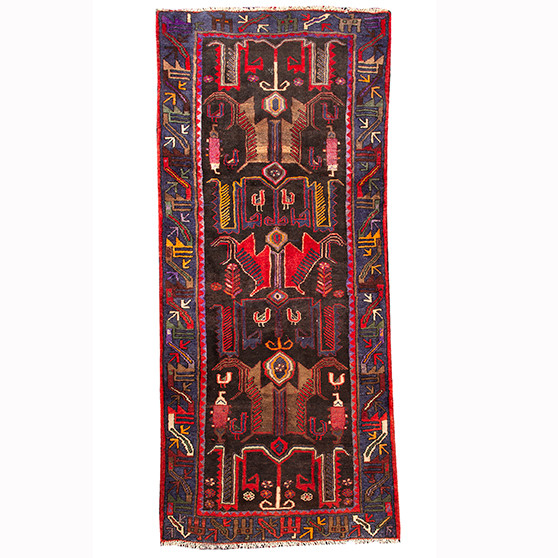
A Qazvin rug of about 9 by 4 feet with a prayer (mihrab) design in dark red, navy blue, and burgundy - Qazvin Persian Rug 8x3 ft - Mihrab Semi Antique Wool Hand Knotted
4
The Medallion Design
Our second Qazvin uses a medallion layout: a central diamond or lobed medallion on a field of small flowers and geometric motifs, with corner pieces that echo its shape. In a long rug, the medallion may be stretched along the length, giving a strong central focus that reads well from the end of a hallway. See our medallion design page.
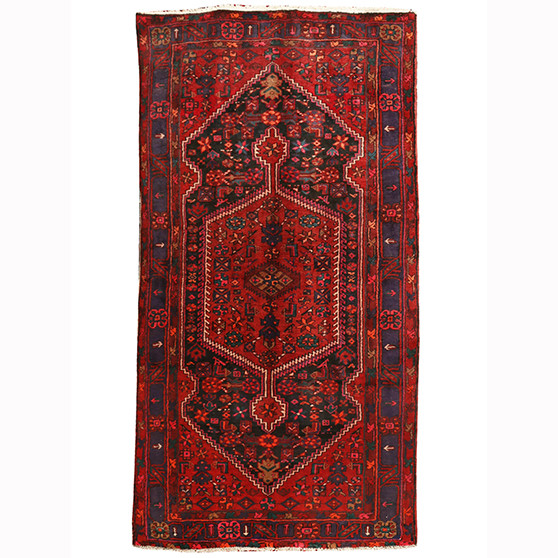
A Qazvin rug of about 9.25 by 4.75 feet with a medallion design in madder red and navy blue - Qazvin Persian Rug 9x4 ft - Medallion Semi Antique Wool Hand Knotted
5
The Diamond Lattice
Our third Qazvin uses a diamond lattice, a field divided by diagonal lines into a grid of diamonds, each filled with a small motif. It is younger than our other pieces, woven roughly twenty-five to forty years ago, and its palette of rust red, brown, and terracotta gives it an earthy, warm look. A lattice has no single focal point, so it looks good from any direction. See our lattice design page.
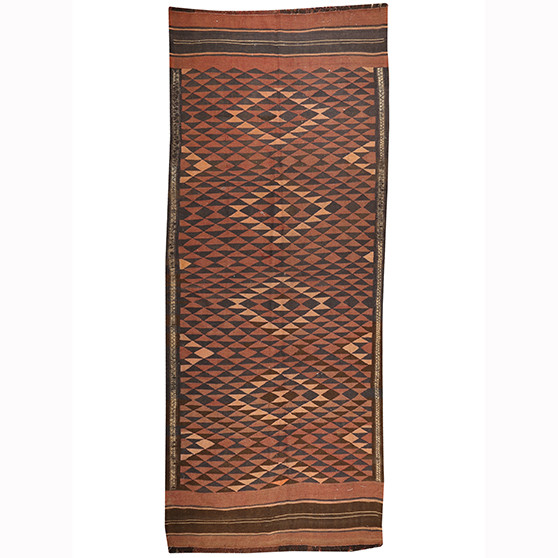
A Qazvin rug of about 11 by 4.5 feet with a diamond lattice design in rust red, brown, and terracotta - Qazvin Persian Rug 10x4 ft - Diamond Lattice Wool Hand Knotted
6
How Qazvin Rugs Are Built
•
Knot - Usually the symmetric (Turkish) knot in village rugs.
•
Foundation - Cotton warps and wefts.
•
Pile - Thick wool, clipped to a medium height.
•
Density - Coarse to medium.
•
Sides and ends - Overcast sides and fringes.
This construction makes a rug that is sturdy and comfortable underfoot, well suited to hallways and other busy spaces.
7
Colors of Qazvin
Our Qazvin rugs use warm, earthy palettes: madder red, dark red, and burgundy for fields and motifs, navy blue for depth and borders, and rust, brown, and terracotta in the lattice piece. In semi-antique rugs, the colors have mellowed into a rich, harmonious whole. Read more in our articles on natural dyes and traditional dyeing.
8
Sizes in Our Collection
Our Qazvin rugs are long rugs:
•
About 9 by 4 feet - A hallway about 5 feet wide, or the side of a bed.
•
About 9.25 by 4.75 feet - A wider hallway, a gallery, or the foot of a king bed.
•
About 11 by 4.5 feet - A long hallway or a passage between rooms.
See our runners.
9
Choosing a Long Rug
Measure your space carefully. For a hallway, leave about 6 to 12 inches of floor at each end and on each side. Check that doors can open over the rug. For a space beside a bed, the rug can extend beyond the bed at the foot. For a kitchen, a long rug can run along a counter or island. Mark the outline on the floor with painter's tape and live with it for a day before you decide.
10
Placing a Qazvin
A long Qazvin turns a plain hallway into a welcoming path. On a pale wood or stone floor, its reds and navies glow. In a modern interior, its bold design adds pattern and history to clean lines. In a traditional home, it pairs naturally with dark wood and warm textiles. The prayer rug, with its arch, also makes a striking accent at the foot of a bed or in front of a window.
11
Qazvin and Its Neighbors
Qazvin and Hamadan
Hamadan village rugs, to the south-west, share the sturdy village construction. See our Hamadan collection.
Qazvin and Zanjan
Zanjan, to the north-west, weaves village rugs with bold medallions. See our Zanjan collection.
Qazvin and Taleghan
Taleghan, in the Alborz valleys to the north-east, weaves village rugs of its own. See our Taleghan collection.
Qazvin and Saveh
Saveh, to the south, is another market town for village rugs. See our Saveh collection.
Qazvin and Tabriz
Tabriz, at the end of the old road to the north-west, is a great center of fine city rugs. See our Tabriz collection.
12
Reading the Back
Turn a Qazvin over. With the symmetric knot, each knot shows as two equal bumps. Look at the foundation: cotton warps are typical of village rugs of the region. Check whether there is one weft or two between each row of knots, a clue to the weaving tradition. Check the sides and fringes, which take the most wear on long rugs.
13
Prayer Rugs in Daily Life
In a traditional Persian home, a small prayer rug was a personal object, rolled out for daily prayers and put away afterward, or laid in a quiet corner of a room. Larger prayer-design rugs like ours, about nine feet long, were often used as ordinary floor rugs, with the arch giving the design a sense of direction. Today, many buyers choose prayer-design rugs simply for their beauty: the arch creates a graceful frame, almost like a window or a doorway woven in wool. Whatever its use, a prayer rug deserves a place where its arch can be seen and appreciated.
14
The Alborz Valleys
North of Qazvin, the Alborz Mountains rise toward the Caspian Sea. Their valleys, including Alamut, famous for the medieval fortress whose ruins still stand on a rock above the valley floor, and Taleghan to the east, are home to villages where weaving has long been part of household life. Rugs from these valleys are often sturdy and boldly drawn, made in the cold months when farm work slows. Some reach the market under the Qazvin name, others under their own village names. Our Taleghan collection shows one of these neighbors.
15
Matching a Qazvin to Your Space
The warm reds of a Qazvin suit hallways and rooms with pale or neutral walls, where the rug becomes the main source of color. Our rust and terracotta lattice suits rooms with natural wood, leather, and earthy tones. In a darker passage, choose a rug with more ivory or a lighter field, so the space does not feel heavy. Pick up the navy for a bench cushion or a framed print nearby.
16
The Ends and Fringes
The fringes of a Qazvin are the ends of its cotton warp threads. On a long rug in a busy passage, they take a lot of wear from vacuums and feet. Vacuum across them gently, or not at all, and have worn ends secured by a professional before the knots begin to come loose. Never pull a loose fringe thread; trim it instead.
17
A Practical Rug for Busy Spaces
Village rugs were made for daily use, and that practical spirit makes a Qazvin a good choice for the busiest parts of a home. Its thick wool cushions footsteps, its warm colors hide small marks, and its sturdy build lies flat without fuss.
18
Grades and How to Judge Them
•
Straightness - Straight, parallel sides along the whole length.
•
Drawing - Clear, balanced design.
•
Wool - Thick, springy, lustrous wool.
•
Color - Clear colors without bleeding.
•
Condition - Even pile, intact sides and ends.
19
Questions to Ask Before You Buy
•
How old is it? - Semi-antique or younger.
•
What are the measurements at both ends? - Checks that the rug is straight.
•
Is the pile even? - Check for worn areas.
•
Has it been repaired? - Especially along the sides and at the ends.
•
Has it been washed recently? - A fresh wash shows the true colors.
20
Semi-Antique and Vintage Qazvin Rugs
Two of our Qazvin rugs are semi-antique, woven roughly forty to sixty years ago; the lattice piece is younger, about twenty-five to forty years old. All have good wool and many years of life ahead. See our semi-antique rugs.
21
What Affects the Price
•
Length - Longer rugs cost more.
•
Age - Older pieces in good condition are often worth more.
•
Straightness - Straight rugs are worth more.
•
Wool - Lustrous wool adds value.
•
Condition - Intact sides and ends.
22
A Safavid Capital
When Shah Tahmasp moved his capital to Qazvin in the mid-sixteenth century, the city became home to royal workshops of painters, calligraphers, bookbinders, and textile makers. The court style that developed there, with its graceful arabesques, cloud bands, and flowering vines, later flowered fully in Isfahan under Shah Abbas and shaped Persian carpet design for centuries. Few rugs can be firmly assigned to Qazvin's royal workshops, but the city's role in the history of Persian design is real. Today's Qazvin village rugs are a humbler but living part of the same story.
23
Village Life and the Loom
In the villages of the Qazvin plain and the Alborz valleys, weaving was traditionally the work of women, done at home on upright looms alongside farming and raising sheep. Girls learned at their mothers' side. Many designs were kept in memory rather than drawn on paper, which is why each rug has small personal variations. Read more about the people behind rugs in our article on the craft from shepherd to dealer.
24
Borders and Guard Stripes
The borders of a Qazvin frame the field like a picture frame. A typical rug has a main border of repeating geometric flowers or rosettes, flanked by narrow guard stripes. On a long rug, the borders run unbroken for many feet, so their evenness tells you a lot about the weaver's care. Small irregularities are common in village rugs and are part of their charm.
25
Motifs in the Field
Around the main design of a Qazvin, you may find many small motifs: rosettes, stars, leaves, small palmettes, and stylized flowers, sometimes with a tiny animal or bird added by the weaver. Look closely at them when you compare rugs: they show how the weaver handled detail, and they give the field much of its texture. Read more in our article on design motifs.
26
Abrash and Color Changes
Many Qazvin rugs show abrash, horizontal bands where one color shifts slightly in shade. This happens when the weaver runs out of one batch of dyed wool and starts another. In a long rug, abrash can create a gentle rhythm from one end to the other. It is a natural sign of hand-dyed wool, not a defect.
27
Combining a Qazvin with Other Rugs
A Qazvin pairs naturally with other village rugs, such as Hamadan, Zanjan, and Saveh, which share its sturdy build and warm colors. In a home with several long spaces, our three Qazvins could even work together, sharing reds and navies while offering three different designs. Keep one or two colors in common and vary the scale of the patterns.
28
The Wool of Central Persia
The wool of Qazvin village rugs comes from sheep raised on the plains and hills of central Persia. It is strong and springy, with a good natural luster, and it takes dye well. In semi-antique rugs, the wool has developed a gentle sheen. Read more in our article on Persian rug wool.
29
Keeping a Long Rug Flat and Safe
A long rug in a busy passage needs a good pad. A felt-and-rubber pad keeps it from slipping and helps it lie flat. If a corner curls, roll it gently in the opposite direction for a few hours. Turn the rug end to end every few months so that wear and sunlight are spread evenly. Vacuum across the fringes gently, or not at all, and have worn ends secured by a professional. See our guide to maintaining rug fringes.
30
Caring for a Qazvin Rug
Vacuum regularly without a beater bar. Turn the rug end to end every few months. Use a non-slip pad. Blot spills at once with a clean, white cloth and cold water. Have it professionally washed every year or two in busy areas. Keep the sides and ends in good repair. See our care instructions and our article on professional washing.
31
Photographs and Real Color
Reds, rusts, and navies can look different on screen depending on the light. Daylight from a north window shows the truest colors, while warm lamps make reds look deeper. If color matters for your space, ask us for extra photographs in daylight or close-ups of the pile.
32
Living with a Qazvin
A good Qazvin becomes part of the house. Its colors settle further, its pile develops a soft sheen, and its design becomes a familiar sight on the way through the hallway. Many owners find that a long rug they bought for one space later moves to another and fits each in a different way.
33
Common Buying Mistakes
•
Choosing the wrong width - Measure the hallway carefully.
•
Placing a prayer rug upside down - Let the arch point away from the main view.
•
Skipping the pad - Long rugs slip easily.
•
Ignoring the sides - The long edges need regular checks.
34
Frequently Asked Questions
Where is Qazvin?
North-west of Tehran in central Persia.
Is Qazvin the same as Kazvin?
Yes. They are two spellings of the same name.
Was Qazvin a royal capital?
Yes. It was the Safavid capital in the sixteenth century, before Isfahan.
What kind of rugs are Qazvin rugs today?
Mostly sturdy village rugs from the Qazvin plain and the Alborz valleys.
What designs are typical?
Medallions, prayer designs, and diamond lattices.
What colors are typical?
Madder red, dark red, burgundy, navy, rust, and brown.
What knot is used?
Usually the symmetric (Turkish) knot in village rugs.
What sizes do you have?
Long rugs of about 9 by 4 to 11 by 4.5 feet.
How should a prayer rug be placed?
With the arch pointing away from the main viewing position.
Are Qazvin rugs durable?
Yes. Their thick wool and sturdy construction make them very durable.
Is abrash a defect?
No. It is a natural sign of hand-dyed wool.
How should I care for a Qazvin rug?
Vacuum regularly, turn it end to end, use a pad, and have it professionally washed regularly.
Can a Qazvin go in a kitchen?
Yes. Its thick wool and warm colors hide everyday marks well. Use a non-slip pad and blot spills at once.
Is a Qazvin suitable for a home with children or pets?
Yes. Its sturdy construction and warm colors stand up well to daily life.
Will the colors fade further?
In a semi-antique rug the colors have largely settled. Keep it out of strong direct sunlight to protect them.
35
Choose Your Qazvin Rug
Each Qazvin rug in our collection is hand-knotted, one of a kind, and inspected before it is listed. Browse our Qazvin collection, compare with our Hamadan, Zanjan, and Saveh rugs, or ask our experts for help.