


Between the high plateau of central Persia and the humid, green shores of the Caspian Sea, the Alborz Mountains form a great wall. One of the few natural gateways through it is the valley of the Sefid Rud, the "White River," which cuts north from the plateau toward Gilan. Halfway down this valley lies the town of Rudbar, famous in Persia for its olive groves, its olive oil, and its mild climate. The villages of the valley and the surrounding hills have long woven rugs, and those that reach the market under the Rudbar name are sturdy village pieces, often long and narrow.
The name Rudbar, which simply means "river valley," is used for more than one place in Persia. This guide is about the Rudbar of the Sefid Rud valley and its rugs. It explains how to recognize a Rudbar, how it compares with its neighbors, and how to choose, place, and care for a narrow runner like the one in our collection. For the wider story of the region's crafts, see our articles on the chadorshab of Gilan and the folk music of Mazandaran.
1
The Valley of the White River
The Sefid Rud valley is a world apart from the dry plateau. As the road descends from Qazvin, the air grows softer, and the brown hills give way to silver-green olive groves, orchards, and terraced fields. Rudbar sits at the heart of this landscape, a market town for the villages of the valley and the slopes above it. Sheep graze the higher pastures, and their wool supplies local looms. Weaving here has long been part of household life, alongside farming, olive growing, and herding.
Because the valley links the plateau and the Caspian, its weavers absorbed influences from both directions: the sturdy village traditions of the Qazvin and Zanjan regions to the south and west, and the textile crafts of Gilan to the north.
Rudbar is a town in the Sefid Rud valley, on the old road from Qazvin to Gilan. Its villages weave sturdy village rugs and runners in warm reds and navies.
2
How to Recognize a Rudbar Rug
•
Medallions along the length - A row of geometric or semi-geometric medallions.
•
Warm palette - Madder red, navy, and ivory.
•
Village construction - Sturdy, with a thick wool pile.
•
Cotton foundation - Cotton warps and wefts.
•
Symmetric knot - Common in village rugs of the region.
•
Narrow formats - Runners are typical.
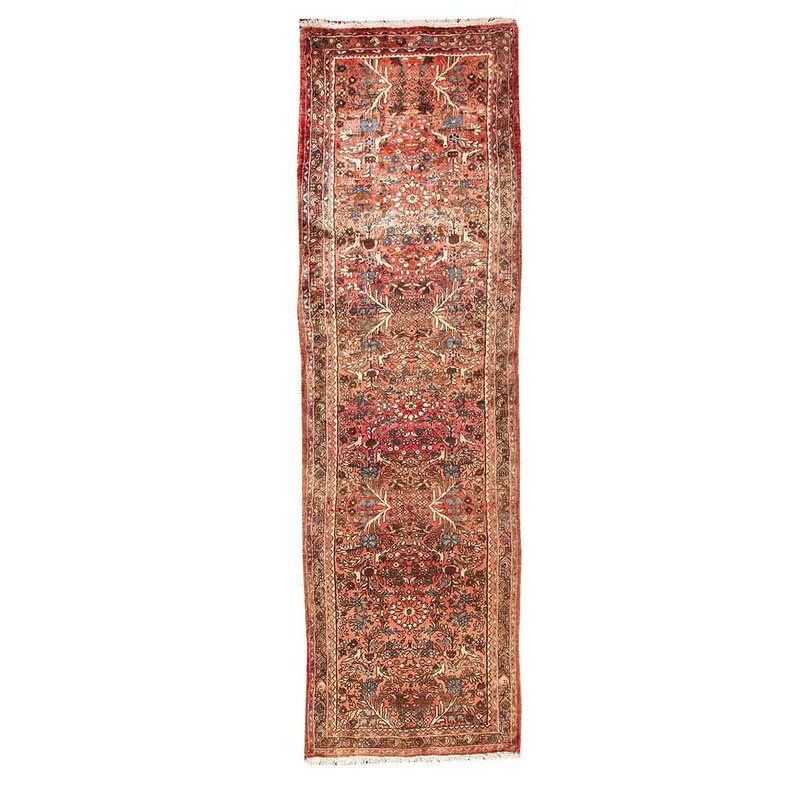
A Rudbar runner of about 9.75 by 2.75 feet with medallions in madder red, navy blue, and ivory - Rudbar Persian Rug 9x2 ft - Medallion Semi Antique Wool Hand Knotted
3
Reading a Runner's Medallions
In a narrow runner like ours, the field is too narrow for a single large medallion, so the weaver places a series of smaller medallions along the length. They may be diamonds, hexagons, or lobed forms, sometimes alternating in color, red on navy and then navy on red. Between them, small flowers, stars, and geometric motifs fill the field. The result is a strong rhythm that leads the eye down the hallway, like steps on a path.
Look at the spacing of the medallions: in a well-planned runner, they are evenly spaced, and the first and last sit at a similar distance from the ends. Small differences are normal in village weaving and part of its charm.
4
How Rudbar Rugs Are Built
•
Knot - Usually the symmetric (Turkish) knot.
•
Foundation - Cotton warps and wefts.
•
Pile - Thick wool, clipped to a medium height.
•
Density - Coarse to medium.
•
Sides and ends - Overcast sides and fringes.
This construction makes a runner that is sturdy and comfortable underfoot, well suited to the heavy foot traffic of hallways.
5
Colors of Rudbar
Our Rudbar runner uses a warm, classic palette: madder red for the field, navy blue for medallions and borders, and ivory for highlights, with smaller touches of other colors. In a semi-antique piece, the colors have mellowed into a soft, harmonious whole. Read more in our articles on natural dyes and traditional dyeing.
6
The Narrow Runner
Our Rudbar runner measures about 9.75 by 2.75 feet. A runner this narrow suits:
•
Narrow hallways - A hallway about 3.5 to 4 feet wide.
•
Stair landings - A long, narrow landing.
•
Beside a bed - Along one side of a queen or king bed.
•
Kitchens - In a galley kitchen or along a counter.
•
Entrances - Leading from the front door into the house.
See our runners for other long rugs.
7
Choosing a Narrow Runner
Measure the hallway carefully. For length, subtract about 12 to 24 inches from the length of the hall, so that 6 to 12 inches of floor show at each end. For width, a runner should leave about 4 to 6 inches of floor on each side; a 2.75 foot runner suits a hallway about 3.5 to 4 feet wide. Check that doors along the hallway can open over the rug. Mark the outline on the floor with painter's tape and walk along it before you decide.
8
Placing a Narrow Runner
A narrow runner can transform a plain passage. In a narrow hallway, it adds warmth, softens footsteps, and leads the eye. In a galley kitchen, it gives a comfortable place to stand. Beside a bed, it gives a warm place to step in the morning. On a pale wood or stone floor, the reds and navies of a Rudbar glow; in a modern interior, its bold medallions add pattern and history.
9
Rudbar and Its Neighbors
Rudbar and Qazvin
Qazvin, at the top of the valley road, gathers village rugs from its plain and the Alborz valleys. See our Qazvin collection.
Rudbar and Zanjan
Zanjan, to the west, weaves village rugs with bold medallions. See our Zanjan collection.
Rudbar and Taleghan
Taleghan, in another Alborz valley to the east, weaves its own village rugs. See our Taleghan collection.
Rudbar and Kelardasht
Kelardasht, farther east in the Alborz, is known for Kurdish village rugs. See our Kelardasht collection.
Rudbar and Hamadan
Hamadan village rugs, to the south, share the sturdy village build. See our Hamadan collection.
10
Reading the Back
Turn a Rudbar over. With the symmetric knot, each knot shows as two equal bumps. The design shows clearly on the back. Look at the cotton foundation and check whether there is one weft or two between each row of knots. Check the sides and fringes, which take the most wear on runners.
11
Gilan and the Caspian Crafts
Below Rudbar, the Sefid Rud opens onto the wide, green plain of Gilan, a land of rice paddies, tea gardens, and forested hills along the Caspian shore. Gilan has its own rich textile traditions, quite different from those of the dry plateau: colorful checked cloth called chadorshab, embroidered pieces, and fine matting woven from reeds. Rudbar's weavers lived between these two worlds, and while their pile rugs follow the village traditions of the plateau, the valley's position as a gateway to the Caspian made it a place where many crafts and goods met. Our article on the chadorshab of Gilan tells part of this story.
12
The Old Road Through the Alborz
For centuries, the Sefid Rud valley carried one of the main roads between the Persian plateau and the Caspian. Caravans brought silk, rice, and fish up from Gilan and carried grain, wool, and manufactured goods down from Qazvin. Today a highway and a railway follow the same route. Towns along the road, Rudbar among them, became markets where villagers sold their produce and their rugs to travelers and merchants.
13
Motifs in the Field
Around the medallions of a Rudbar runner, you may find many small motifs: rosettes, stars, small diamonds, leaves, and stylized flowers, sometimes with a tiny animal or bird added by the weaver. Look closely at them: they show how the weaver handled detail, and they give the field much of its texture. Read more in our article on design motifs.
14
The Wool of the Valley
The wool of Rudbar village rugs comes from sheep that graze the higher pastures above the valley. It is strong and springy, with a good natural luster, and it takes dye well. In a semi-antique runner, the wool has developed a gentle sheen. Rub the pile between your fingers: good wool feels soft and springy, not dry or brittle. Read more in our article on Persian rug wool.
15
Matching a Runner to Your Space
The warm reds of a Rudbar suit hallways with pale or neutral walls, where the runner becomes the main source of color. In a darker passage, good overhead light will make its reds and ivories glow. Pick up the navy for a bench cushion or a framed print nearby, and let the ivory tie in with white trim or doors.
16
The Ends and Fringes
The fringes of a runner are the ends of its cotton warp threads. In a hallway, they take a lot of wear from vacuums and feet. Vacuum across them gently, or not at all, and have worn ends secured by a professional before the knots begin to come loose. Never pull a loose fringe thread; trim it instead.
17
A Practical Rug for Busy Spaces
Village runners were made for daily use, and that practical spirit makes a Rudbar a good choice for the busiest parts of a home. Its thick wool cushions footsteps, its warm colors hide small marks, and its narrow shape fits the tight spaces where a larger rug cannot go.
18
Pairs of Runners
In traditional Persian rooms, runners were often laid in pairs along the sides of a main carpet. In a modern home, two runners of related colors can sit on each side of a bed, at each end of a long hallway, or in two connected passages. If you like our Rudbar, ask us for a runner of similar size and palette from a neighboring region to make a pair.
19
Stair Landings and Narrow Spaces
A narrow runner is one of the few rugs that fits a stair landing, a narrow passage behind a kitchen island, or the space between a bed and a wall. In these tight spots, a larger rug would curl against furniture or block doors, but a runner lies flat and leads the eye. On a landing, place the runner so that it is centered and leaves floor on each side; at the top of stairs, keep a clear gap between the runner and the first step for safety, and always use a good non-slip pad.
20
Grades and How to Judge Them
•
Straightness - Straight, parallel sides along the whole length.
•
Medallion spacing - Even, well-proportioned medallions.
•
Wool - Thick, springy, lustrous wool.
•
Color - Clear colors without bleeding.
•
Condition - Even pile, intact sides and ends.
21
Questions to Ask Before You Buy
•
What are the measurements at both ends? - Checks that the runner is straight.
•
Is the pile even? - Check for worn areas, especially in the center.
•
Has it been repaired? - Especially along the sides and at the ends.
•
Has it been washed recently? - A fresh wash shows the true colors.
•
How does it lie? - A runner should lie flat without ripples.
22
Semi-Antique Rudbar Rugs
Our Rudbar runner is semi-antique, woven roughly forty to sixty years ago. It has settled colors, good wool, and many years of life ahead. See our semi-antique rugs.
23
What Affects the Price
•
Length - Longer runners cost more.
•
Straightness - Straight runners are worth more.
•
Wool - Lustrous wool adds value.
•
Drawing - Well-spaced medallions add value.
•
Condition - Intact sides and ends.
24
Olives, Wool, and Weaving
Rudbar is best known in Persia for its olives. The mild, humid air of the Sefid Rud valley lets olive trees thrive here as almost nowhere else in the country, and the town's olive oil and pickled olives are sold across Persia. Farming families in the valley have long combined olive growing and herding with weaving, working the loom in the quieter months. A Rudbar runner is a product of this mixed rural economy: practical, sturdy, and made with local wool.
25
Why Runners?
Village weavers have always made many runners, for practical reasons. A narrow loom is easier to build and fits inside a small house. A narrow runner can be woven by one person, while a wide carpet needs several weavers side by side. In the traditional Persian house, runners were laid along the sides of the main room, where family and guests sat on cushions against the wall. The runner that suits a modern hallway grew out of these old domestic needs.
26
Village Life and the Loom
In the villages of the Rudbar region, weaving was traditionally the work of women, done at home on upright looms. Girls learned at their mothers' side. Many designs were kept in memory rather than drawn on paper, which is why each runner has small personal variations. Read more about the people behind rugs in our article on the craft from shepherd to dealer.
27
Borders and Guard Stripes
The borders of a Rudbar runner frame the field like a picture frame. A typical runner has a main border of repeating geometric flowers or rosettes, flanked by narrow guard stripes. On a runner, the borders run unbroken for many feet, so their evenness tells you a lot about the weaver's care.
28
Abrash and Color Changes
Many village runners show abrash, horizontal bands where one color shifts slightly in shade. This happens when the weaver runs out of one batch of dyed wool and starts another. In a runner, abrash can create a gentle rhythm from one end to the other. It is a natural sign of hand-dyed wool, not a defect.
29
Combining a Runner with Other Rugs
A Rudbar runner pairs naturally with larger village rugs in nearby rooms, such as Hamadan, Zanjan, or Qazvin rugs, which share its warm reds and navies. A runner in the hallway can carry the color of a living room rug through the house. Keep one or two colors in common and vary the scale of the patterns.
30
Keeping a Runner Flat and Safe
A runner in a busy hallway needs a good pad. A felt-and-rubber pad keeps it from slipping and helps it lie flat. If a corner curls, roll it gently in the opposite direction for a few hours. Turn the runner end to end every few months so that wear is spread evenly. Vacuum across the fringes gently, or not at all, and have worn ends secured by a professional. See our guide to maintaining rug fringes.
31
Caring for a Rudbar Runner
Vacuum regularly without a beater bar. Turn the runner end to end every few months. Use a non-slip pad. Blot spills at once with a clean, white cloth and cold water. Have it professionally washed every year or two in busy areas. Keep the sides and ends in good repair. See our care instructions and our article on professional washing.
32
Photographs and Real Color
Reds and navies can look different on screen depending on the light. Daylight from a north window shows the truest colors. If color matters for your space, ask us for extra photographs in daylight or close-ups of the pile.
33
Living with a Rudbar
A good Rudbar runner becomes part of the house. Its colors settle further, its pile develops a soft sheen, and its medallions become a familiar sight on the way through the hallway. Many owners find that a runner bought for one space later moves to another, beside a bed or in a kitchen, and fits each in a different way.
34
Common Buying Mistakes
•
Choosing too wide a runner - Leave floor on each side.
•
Choosing the wrong length - Leave floor at each end.
•
Skipping the pad - Runners slip easily.
•
Neglecting the sides - The long edges need regular checks.
35
Frequently Asked Questions
Where is Rudbar?
In the Sefid Rud valley, on the road from Qazvin through the Alborz to Gilan.
What does Rudbar mean?
"River valley." The name is used for more than one place in Persia.
What is Rudbar famous for?
Its olive groves and olive oil, as well as village weaving.
What designs are typical?
Medallions along the length of the runner.
What colors are typical?
Madder red, navy, and ivory.
What knot is used?
Usually the symmetric (Turkish) knot.
What size is your Rudbar?
About 9.75 by 2.75 feet.
How wide a hallway suits a 2.75 foot runner?
About 3.5 to 4 feet.
Are Rudbar rugs durable?
Yes. Their thick wool and sturdy construction make them very durable.
Is abrash a defect?
No. It is a natural sign of hand-dyed wool.
How should I care for a runner?
Vacuum regularly, turn it end to end, use a pad, and have it professionally washed regularly.
Can a narrow runner go in a kitchen?
Yes. It suits a galley kitchen or the space along a counter. Use a non-slip pad and blot spills at once.
Will the colors fade further?
In a semi-antique rug the colors have largely settled. Keep it out of strong direct sunlight to protect them.
Is a Rudbar runner suitable for a home with children or pets?
Yes. Its thick wool and warm colors stand up well to daily life.
36
Choose Your Rudbar Rug
Each Rudbar rug in our collection is hand-knotted, one of a kind, and inspected before it is listed. Browse our Rudbar collection, see all our runners, compare with our Qazvin and Zanjan rugs, or ask our experts for help.