


For centuries, the great plain of Moghan, near the Caspian Sea in the far north-west of Persia, filled each winter with the black tents and flocks of the Shahsavan. In spring, they moved south and up into the cool pastures on the slopes of Mount Sabalan, and in autumn they returned. Along the way, Shahsavan women wove an extraordinary variety of textiles: bags and saddlebags, bedding bags, animal trappings, kilims, and pile rugs, all decorated with bold geometric designs in strong colors.
This guide explains who the Shahsavan are, how their weaving tradition works, how to recognize a Shahsavan pile rug, and how to choose, place, and care for one like those in our collection. For more on tribal life in Persia, see our article on Persian nomads, and for the region, our article on weaving in Ardabil.
1
Who Are the Shahsavan?
The name Shahsavan is usually translated as "those who love the Shah." Historians link the confederation's formation to the Safavid period, when tribal groups of north-western Persia were organized as loyal supporters of the crown. Over time, the Shahsavan became one of the great nomadic confederations of Persia, made up of many tribes and clans, speaking a Turkic language and following a yearly migration between the Moghan plain and the Sabalan mountains. In the twentieth century, many Shahsavan families settled in villages and towns, including around Meshkin and Ardabil, though some continue to migrate with their flocks.
The Shahsavan are a Turkic-speaking tribal confederation of north-western Persia, famous for their flat-woven bags and kilims and their bold pile rugs.
2
A Tradition of Many Textiles
Shahsavan weaving is best known to collectors for its flat weaves, especially sumak, a technique in which colored wefts are wrapped around the warps to create crisp, raised patterns. Sumak bags, saddlebags, and large bedding bags called mafrash are among the most admired tribal textiles of Persia. The Shahsavan also wove kilims and pile rugs. Their pile rugs share the same design language as their flat weaves: hooked medallions, stars, stepped diamonds, and small animals and figures, in strong, clear colors. Read more in our article on kilims.
3
How to Recognize a Shahsavan Rug
•
Hooked medallions - Large geometric medallions with latch hooks along their outlines.
•
Bold geometry - Diamonds, stars, and stepped lines throughout.
•
Strong colors - Dark red, crimson, navy, ivory, and touches of orange and green.
•
Long formats - Long rugs and runners are common.
•
Symmetric knot - The Turkish knot typical of north-western Persia.
•
Tribal spirit - Lively, freely drawn small motifs.
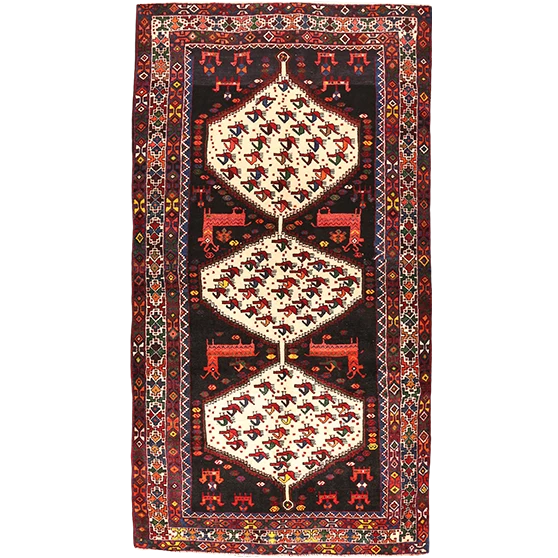
A Shahsavan rug of about 9.75 by 5 feet with geometric medallions in dark red, ivory, and crimson - Shahsavan Persian Rug 9x5 ft - Geometric Semi Antique Wool Hand Knotted
4
Reading a Shahsavan Medallion
Most Shahsavan pile rugs use a row of geometric medallions along the length of the field. The medallions are usually large hexagons or diamonds with many small hooks along their outlines, and with a star or cross at the center. They may alternate in color, red on navy and then navy on red, giving a strong rhythm. Around them, the field is scattered with small motifs: stars, small animals, combs, and stylized human figures. These designs are closely related to the weaving of the Caucasus across the nearby border, reflecting centuries of contact between peoples on both sides.
5
How Shahsavan Rugs Are Built
•
Knot - The symmetric (Turkish) knot.
•
Foundation - Wool in older tribal pieces; cotton in many later village rugs.
•
Pile - Lustrous wool, clipped to a medium height.
•
Density - Coarse to medium.
•
Sides and ends - Overcast or wrapped sides and fringes.
The result is a sturdy, springy rug that wears well. Tribal pieces may have slightly uneven sides, a sign of looms that were set up and taken down with each move.
6
Colors of Shahsavan
Our Shahsavan rugs use strong, warm palettes: dark red and crimson fields, navy blue for medallions and borders, and ivory for highlights, with smaller touches of orange, green, and gold. These colors come traditionally from madder, indigo, and other plant dyes. In semi-antique rugs, they have mellowed into a rich, harmonious whole. Read more in our articles on natural dyes and traditional dyeing.
7
Long Rugs in Our Collection
Our Shahsavan rugs are long rugs:
•
About 9.75 by 5 feet - A wide hallway, a gallery, or the foot of a king bed.
•
About 9.5 by 4 feet - A hallway about 5 feet wide, or the side of a bed.
•
About 9.75 by 3.25 feet - A narrower hallway about 4 to 4.5 feet wide.
See our runners.
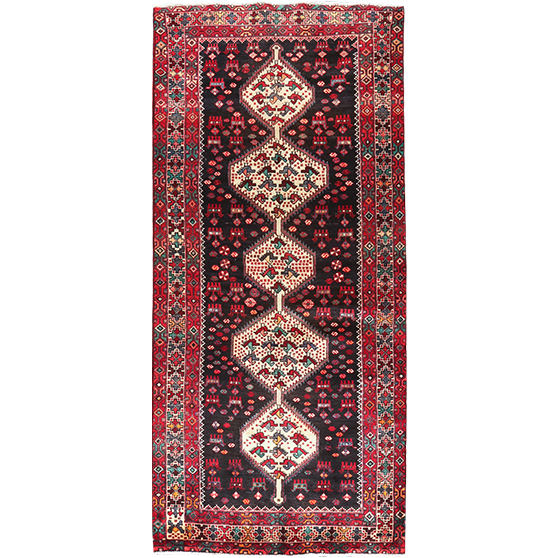
A Shahsavan rug of about 9.5 by 4 feet with geometric medallions in dark red, crimson, and ivory - Shahsavan Persian Rug 9x4 ft - Geometric Semi Antique Wool Hand Knotted
8
Choosing a Long Rug
Measure your space carefully. For a hallway, leave about 6 to 12 inches of floor at each end and on each side. Check that doors can open over the rug. For a space beside a bed, the rug can extend beyond the bed at the foot. For a kitchen, a long rug can run along a counter or island. Mark the outline on the floor with painter's tape and live with it for a day before you decide.
9
Placing a Shahsavan
A Shahsavan brings energy to a long space. On a pale wood or stone floor, its reds and navies stand out. In a modern interior, its bold hooked medallions read almost like modern art. In a rustic or traditional home, it pairs naturally with wood, leather, and woven baskets. Keep other patterns small or plain so the rug can speak.
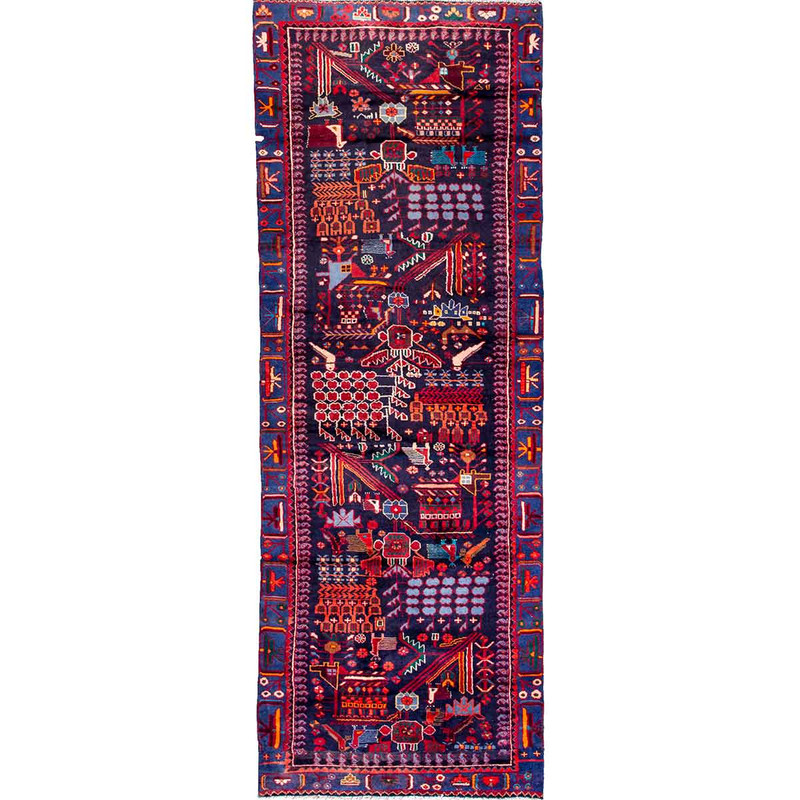
A Shahsavan runner of about 9.75 by 3.25 feet with a geometric design in dark red, navy blue, and crimson - Shahsavan Persian Rug 9x3 ft - Geometric Semi Antique Wool Hand Knotted
10
Shahsavan and Its Neighbors
Shahsavan and Meshkin
Meshkin, a market town in Shahsavan country, weaves long rugs with Caucasian-style designs. See our Meshkin collection.
Shahsavan and Ardabil
Ardabil, the provincial capital, weaves finer rugs in similar designs. See our Ardabil collection.
Shahsavan and Sarab
Sarab, south of Sabalan, is known for camel-ground runners. See our Sarab collection.
Shahsavan and Karaja
Karaja, north of Tabriz, weaves medallion-chain runners. See our Karaja collection.
Shahsavan and Qashqai
Qashqai, the great tribal confederation of the south, shares the nomadic spirit. See our Qashqai collection.
11
Reading the Back
Turn a Shahsavan over. With the symmetric knot, each knot shows as two equal bumps. Look at the foundation: wool warps suggest an older or more tribal piece, cotton a later village rug. Check the side finishes and the condition of the fringes.
12
Sumak and Mafrash
To understand Shahsavan weaving, it helps to know its most famous flat weaves. Sumak is a technique in which colored weft threads are wrapped around pairs of warps, creating a dense, slightly raised surface with crisp patterns, and long loose threads on the back. The Shahsavan used it for saddlebags, salt bags, and above all for the panels of the mafrash, a large box-shaped bag that held bedding and clothes during migration and was loaded onto camels or horses. The designs of these bags, hooked diamonds, stars, and stepped medallions, are the same ones that appear on Shahsavan pile rugs. Collectors prize old Shahsavan sumak panels as some of the finest tribal textiles of Persia.
13
Settled Shahsavan Weaving
In the twentieth century, many Shahsavan families settled in villages and towns around Meshkin, Ardabil, and the Moghan plain. Settled weavers moved from horizontal ground looms to upright looms, from wool foundations to cotton, and from bags to larger floor rugs made for sale. Their rugs kept the bold designs and strong colors of tribal weaving, but gained straighter sides and more regular shapes. Many semi-antique Shahsavan rugs on the market today, including ours, come from this settled tradition.
14
Village Life and the Loom
Whether in a tent or a village house, Shahsavan weaving has always been the work of women. Girls learned by sitting beside their mothers, first passing yarn and then tying knots. Designs were kept in memory and passed from mother to daughter, which is why each Shahsavan has small personal variations. Read more about the people behind rugs in our article on the craft from shepherd to dealer.
15
The Wool of the Sabalan Pastures
Shahsavan flocks graze the high summer pastures of Mount Sabalan, where the cold climate encourages dense, lustrous fleeces. That wool takes dye deeply and gives Shahsavan rugs their springy, glowing pile. In semi-antique rugs, the wool has developed a gentle sheen. Read more in our article on Persian rug wool.
16
Matching a Shahsavan to Your Space
The dark reds and navies of a Shahsavan suit spaces with pale or neutral walls, where the rug becomes the main source of color. In a darker hallway, choose a piece with more ivory, so the space does not feel heavy. Pick up the navy or crimson for a bench cushion or a framed print nearby.
17
Shahsavan and the Caucasus
The Shahsavan lands lie close to the Caucasus, and for centuries people, goods, and ideas crossed the Aras River in both directions. Many Shahsavan designs, the hooked medallions, the eight-pointed stars, the running borders, are close cousins of the designs on Caucasian rugs from Kazak, Shirvan, and Moghan. This shared vocabulary is part of what makes Shahsavan rugs so appealing to collectors of tribal weaving: they belong to a wider world of bold, geometric art that spans the borderlands between Persia and the Caucasus.
18
A Rug for Modern Homes
Bold geometric rugs like the Shahsavan have found new admirers among modern designers. Their strong shapes and clear colors sit well with contemporary furniture, white walls, and open plans, where a floral city rug might feel too formal. A long Shahsavan can bring color and rhythm to a minimal hallway or kitchen without looking out of place, while still carrying the history of a tribal tradition.
19
The Ends and Fringes
The fringes of a Shahsavan are the ends of its warp threads. On a long rug in a busy passage, they take a lot of wear. Vacuum across them gently, or not at all, and have worn ends secured by a professional before the knots begin to come loose. Never pull a loose fringe thread; trim it instead.
20
A Practical Rug for Busy Spaces
Tribal and village rugs were made for daily use, and that practical spirit makes a Shahsavan a good choice for the busiest parts of a home. Its lustrous wool cushions footsteps, its strong colors hide small marks, and its sturdy build lies flat without fuss.
21
Why Long Rugs?
Long, narrow rugs were practical for both nomadic and settled weavers. A narrow loom is easier to build, carry, and set up, and a long rug can be woven by one person. In a tent or a village house, long rugs lined the sides of the living space. The long rug that suits a modern hallway grew out of these old domestic needs, and Shahsavan weavers made many of them.
22
Grades and How to Judge Them
•
Wool - Lustrous, springy wool.
•
Color - Deep, clear colors without bleeding.
•
Drawing - Bold, confident, well-proportioned medallions.
•
Shape - Small irregularities are normal in tribal pieces.
•
Condition - Even pile, intact sides and ends.
23
Questions to Ask Before You Buy
•
What is the foundation? - Wool or cotton.
•
What are the measurements at both ends? - Checks the shape.
•
Has it been repaired? - Especially along the sides and at the ends.
•
Is the pile even? - Check for worn areas.
•
Has it been washed recently? - A fresh wash shows the true colors.
24
Semi-Antique Shahsavan Rugs
Our Shahsavan rugs are semi-antique, woven roughly forty to sixty years ago. They have settled colors, good wool, and many years of life ahead. See our semi-antique rugs.
25
What Affects the Price
•
Length - Longer rugs cost more.
•
Wool - Lustrous wool adds value.
•
Color - Rich, harmonious colors add value.
•
Drawing - Bold, balanced medallions add value.
•
Condition - Intact sides and ends.
26
Life Between Moghan and Sabalan
The Moghan plain, in the far north of Persia near the Aras River, is low and warm in winter, with grassy pastures that once fed huge flocks. In spring, as the plain grew hot and dry, the Shahsavan packed their tents and moved south, climbing toward the slopes of Mount Sabalan, where snowmelt fed rich summer pastures. The journey took weeks, and the textiles they wove were part of it: bags to carry belongings, trappings to decorate camels and horses, and rugs to cover the floors of their tents.
27
Motifs in the Field
Shahsavan rugs are full of small motifs:
•
Stars - Eight-pointed stars scattered in the field.
•
Small animals - Stylized horses, camels, dogs, and birds.
•
Human figures - Simple, stick-like figures.
•
Combs - Small comb shapes.
•
Latch hooks - Hooks along medallions and borders.
Writers often attach meanings to these motifs. These readings vary from family to family, and it is best to enjoy them as part of a living tradition. Read more in our article on design motifs.
28
Borders and Guard Stripes
Shahsavan borders often echo Caucasian weaving: a main border of hooked diamonds, stars, or a running vine, flanked by narrow guard stripes with zigzags or barber-pole stripes. Tribal weavers often adjust the border at a corner by eye, giving it a charming irregularity.
29
Abrash and Color Changes
Many Shahsavan rugs show abrash, horizontal bands where one color shifts slightly in shade, caused by wool dyed in small batches. In tribal rugs, abrash is admired for the movement it gives the field. It is a natural sign of hand-dyed wool, not a defect.
30
Combining a Shahsavan with Other Rugs
A Shahsavan pairs naturally with other north-western rugs, such as Meshkin, Ardabil, Sarab, and Heriz, which share its bold geometry. It also works with Kurdish and Qashqai rugs. Keep one or two colors in common and vary the scale of the patterns.
31
Keeping a Long Rug Flat and Safe
A long rug in a busy passage needs a good pad. A felt-and-rubber pad keeps it from slipping and helps it lie flat. Turn the rug end to end every few months so that wear is spread evenly. Vacuum across the fringes gently, or not at all. See our guide to maintaining rug fringes.
32
Caring for a Shahsavan Rug
Vacuum regularly without a beater bar. Turn the rug end to end every few months. Use a non-slip pad. Blot spills at once with a clean, white cloth and cold water. Have it professionally washed every year or two in busy areas. Keep the sides and ends in good repair. See our care instructions and our article on professional washing.
33
Photographs and Real Color
Dark reds, crimsons, and navies can look different on screen depending on the light. Daylight from a north window shows the truest colors. If color matters for your space, ask us for extra photographs in daylight or close-ups of the pile.
34
Living with a Shahsavan
A good Shahsavan becomes more beautiful with use. Its lustrous wool develops a deeper sheen, its colors settle further, and its bold medallions become a familiar sight. Many owners find that a long rug bought for one space later moves to another and fits each in a different way.
35
Common Buying Mistakes
•
Expecting perfect symmetry - Small variations are part of tribal weaving.
•
Choosing the wrong width - Measure carefully.
•
Skipping the pad - Long rugs slip easily.
•
Neglecting the sides - The long edges need regular checks.
36
Frequently Asked Questions
Who are the Shahsavan?
A Turkic-speaking tribal confederation of north-western Persia.
What does Shahsavan mean?
It is usually translated as "those who love the Shah."
Where did the Shahsavan migrate?
Between the Moghan plain in winter and the slopes of Mount Sabalan in summer.
What are the Shahsavan famous for?
Flat-woven bags, sumak textiles, and kilims, as well as pile rugs.
What designs are typical?
Hooked geometric medallions, stars, and small animals.
What colors are typical?
Dark red, crimson, navy, and ivory.
What knot is used?
The symmetric (Turkish) knot.
What sizes do you have?
Long rugs of about 9.5 to 10 feet long and 3.25 to 5 feet wide.
Are Shahsavan rugs durable?
Yes. Their lustrous wool and sturdy construction make them very durable.
How should I care for a Shahsavan rug?
Vacuum regularly, turn it end to end, use a pad, and have it professionally washed regularly.
What is sumak?
A flat-weave technique in which colored wefts are wrapped around the warps, used for Shahsavan bags.
Is abrash a defect?
No. It is a natural sign of hand-dyed wool.
Will the colors fade further?
In a semi-antique rug the colors have largely settled. Keep it out of strong direct sunlight to protect them.
Can a Shahsavan go in a kitchen?
Yes. Its sturdy wool and strong colors hide everyday marks well. Use a non-slip pad and blot spills at once.
Is a Shahsavan suitable for a home with children or pets?
Yes. Its lustrous wool, strong colors, and sturdy construction stand up well to daily life.
37
Choose Your Shahsavan Rug
Each Shahsavan rug in our collection is hand-knotted, one of a kind, and inspected before it is listed. Browse our Shahsavan collection, compare with our Meshkin, Ardabil, and Sarab rugs, or ask our experts for help.