


In the hills of Markazi province, roughly between Arak, Saveh, and Qom, lies the old town of Tafresh. Set at a higher altitude than the plains around it, Tafresh has a cool climate, orchards and gardens fed by mountain streams, and a long reputation as a town of scholars, poets, and civil servants. Its surrounding villages have long combined farming with sheep raising and weaving, and the rugs they make are sturdy village pieces with clear medallions and warm colors.
This guide introduces Tafresh and its weaving, explains how to recognize a Tafresh rug, how it compares with its neighbors in the Arak and Hamadan regions, and how to choose, place, and care for one like those in our collection. For the wider region, see our articles on weaving in Arak and weaving in Saveh.
1
A Town in the Hills
Tafresh lies in a region of hills and valleys between the great weaving districts of central Persia. To the west and south-west lie the Arak villages, home of Sarouk, Mahal, and Farahan rugs; to the north and north-west, the villages of Saveh and the Hamadan region. Tafresh's weavers stand between these traditions, and their rugs share features of both: the medallion layouts and warm palettes of the Arak region, and the sturdy village construction found across the Hamadan and Saveh districts.
Tafresh is a hill town between Arak, Saveh, and Qom. Its rugs are sturdy village pieces with clear medallions in warm colors.
2
How to Recognize a Tafresh Rug
•
Clear medallions - A central diamond or lobed medallion with corner pieces.
•
Warm palette - Madder red, crimson, navy, cream, and ivory.
•
Soft accents - Sometimes sky blue or light blue details.
•
Village construction - Sturdy, with a medium-thick pile.
•
Cotton foundation - Cotton warps and wefts.
•
Long formats - Long rugs and runners are common.
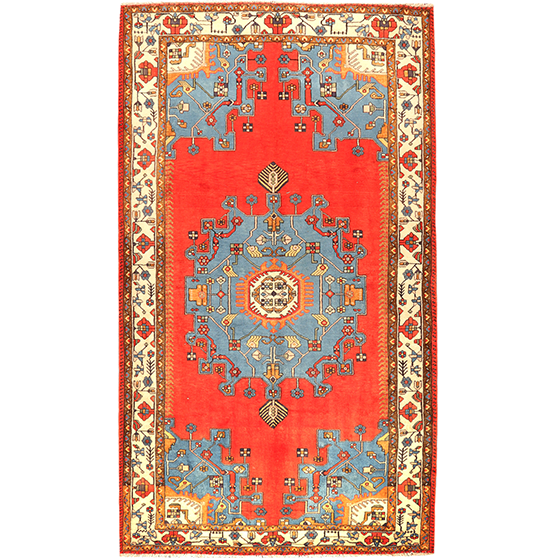
A Tafresh rug of about 10 by 5.5 feet with a medallion design in madder red, sky blue, and ivory - Tafresh Persian Rug 10x5 ft - Medallion Semi Antique Wool Hand Knotted
3
Reading a Tafresh Medallion
Most Tafresh rugs use a central medallion layout. The medallion is usually a diamond or a lobed form, sometimes with stepped or hooked outlines and pendants pointing toward the ends of the rug, with a smaller medallion inside. Corner pieces echo its shape. The field around it is filled with small flowers, leaves, and geometric motifs. In long rugs, the medallion may be stretched along the length, giving a strong central focus that reads well from the end of a hallway.
4
How Tafresh Rugs Are Built
•
Knot - Village rugs of the region may use either the symmetric or the asymmetric knot.
•
Foundation - Cotton warps and wefts.
•
Pile - Wool, clipped to a medium height.
•
Density - Coarse to medium.
•
Sides and ends - Overcast sides and fringes.
This construction makes a rug that is sturdy and comfortable underfoot, well suited to hallways and everyday rooms. If the knot type matters to you, ask us and we will check the back of a particular piece.
5
Colors of Tafresh
Our Tafresh rugs use warm, classic palettes: madder red and crimson fields, navy blue medallions and borders, and cream and ivory highlights. One of our pieces adds soft sky blue, a lighter, fresher accent than the deep navies of many village rugs. In semi-antique rugs, the colors have mellowed into a soft, harmonious whole. Read more in our articles on natural dyes and traditional dyeing.
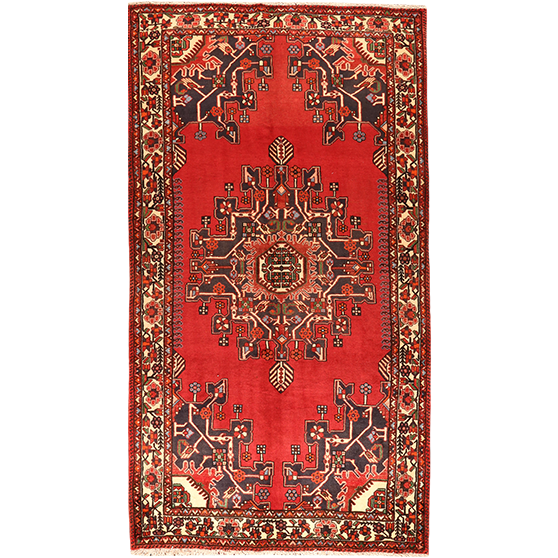
A Tafresh rug of about 9.75 by 5.25 feet with a medallion design in madder red, cream, and navy blue - Tafresh Persian Rug 9x5 ft - Medallion Semi Antique Wool Hand Knotted
6
Sizes in Our Collection
•
About 10 by 5.25 to 5.5 feet - A wide hallway, a gallery, or the foot of a king bed.
•
About 6.25 by 4.5 feet - An entrance, a study, a bedside, or a reading corner.
7
Choosing a Long Rug
Measure your space carefully. For a hallway, leave about 6 to 12 inches of floor at each end and on each side; a rug about 5.25 feet wide suits a hallway about 6 to 7 feet wide. For a space beside a bed, the rug can extend beyond the bed at the foot. Check that doors can open over the rug. Mark the outline on the floor with painter's tape before you decide.
8
The Smaller Tafresh
Our smaller Tafresh, about 6.25 by 4.5 feet, is a classic scatter size. It suits an entrance, a study, a bedside, or a reading corner, and it can echo the colors of a larger rug in a nearby room. Small rugs are easy to move from room to room as your needs change.
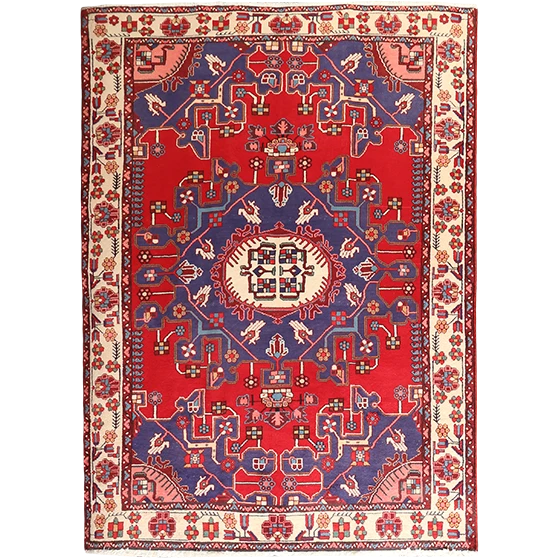
A Tafresh rug of about 6.25 by 4.5 feet with a medallion design in madder red, navy blue, and cream - Tafresh Persian Rug 6x4 ft - Medallion Semi Antique Wool Hand Knotted
9
Placing a Tafresh
A Tafresh brings warmth to any room. On a pale wood or stone floor, its reds and navies glow. In a modern interior, its clear medallion adds pattern and history to clean lines. In a traditional home, it pairs naturally with dark wood and warm textiles. A long Tafresh can turn a plain hallway into a welcoming path through the house.
10
Tafresh and Its Neighbors
Tafresh and Saveh
Saveh, to the north, is a market town for village rugs of the region. See our Saveh collection.
Tafresh and Arak
Arak, to the south-west, is the center of a great weaving region. See our Arak collection.
Tafresh and Sarouk
Sarouk, in the Arak region, weaves dense, double-wefted floral rugs. See our Sarouk collection.
Tafresh and Mahal
Mahal rugs, from the Arak region, are room-size rugs with large floral designs. See our Mahal collection.
Tafresh and Hamadan
Hamadan village rugs, to the west, share the sturdy village build. See our Hamadan collection.
11
Reading the Back
Turn a Tafresh over. Look at the knots: symmetric knots show as two equal bumps, asymmetric knots as one larger loop and one smaller. Check whether there is one weft or two between each row of knots. Look at the cotton foundation and the condition of the sides and fringes.
12
The Landscape Behind the Rugs
The country around Tafresh is a landscape of rounded hills, narrow valleys, and small streams that run down from the higher ground in spring. Villages sit where water can be gathered, surrounded by orchards of walnut, almond, and fruit trees, small fields of wheat and barley, and pastures for sheep and goats on the slopes above. The climate is cooler than on the plains toward Qom and Saveh, with cold winters and mild summers. That pattern of life, with flocks on the hills and long winter months indoors, has shaped weaving across central Persia for generations, and it is easy to see in Tafresh rugs: wool from local flocks, practical sizes for village homes, and designs that a weaver could carry in memory from one rug to the next.
Because the town sits among several larger weaving districts, its rugs have often travelled to market through neighboring towns. In the trade, village pieces from this area have sometimes been sold under the names of better known centers nearby, and the label on an older rug depends partly on the dealer who handled it. We describe our pieces as Tafresh based on their design, structure, and source, and we are happy to explain the reasons behind any attribution.
13
Wool from the Hills
Good wool is the foundation of a good village rug. Sheep raised on hill pastures with cold winters tend to grow a fleece with plenty of natural lanolin, which gives the pile a soft sheen and helps it shed dust and resist stains. In the villages, wool was traditionally washed, carded, and spun by hand before dyeing. Hand-spun wool varies slightly in thickness, and that small irregularity catches the light and gives the surface of an older rug its lively, slightly uneven texture. When you run your hand over a good Tafresh, the pile should feel springy and full rather than dry or brittle.
14
Design Traditions Shared with the Region
The medallion layouts of Tafresh belong to a family of designs found across central Persia. A central diamond with pendants, a field of small flowers and leaves, and corner pieces that repeat parts of the medallion appear in village rugs from the Arak region, from Saveh, and from the villages around Hamadan. Within that family, each village developed its own habits: the exact outline of the medallion, the type of flower used in the field, the balance between red and blue, and the style of the main border. Tafresh rugs tend toward clear, well spaced drawing and a warm red ground, which gives them a calm, orderly look even when the field is busy with small motifs.
Weavers also borrowed and adapted. A design seen on a rug in the market, or brought into the village by a new bride, could be woven in a local way and become part of the village repertoire. That is why it is often more useful to look at a rug as a whole, its structure, wool, colors, and drawing together, than to rely on a single motif when deciding where it was made.
15
Dyes and How Colors Age
The reds of village rugs in this region come traditionally from madder root, which can produce shades from soft brick and rose to deep crimson depending on the dye bath and mordant. Blues come from indigo, from pale sky blue to near black navy depending on the number of dips. Creams and ivories are often undyed wool. Over decades, light and use soften these colors. Reds may mellow toward a warmer rose, blues may lighten slightly, and the whole rug settles into a gentler harmony. This aging is part of the appeal of a semi-antique rug, and it is very different from the flat, uniform fading of poor quality dyes.
16
Where a Tafresh Works Best
•
Hallways - The long format and sturdy pile suit everyday traffic.
•
Bedrooms - A long rug along the side or foot of a bed adds warmth underfoot.
•
Entrances - The smaller size makes a welcoming first impression.
•
Studies and offices - Warm reds and navies suit wood furniture and bookshelves.
•
Kitchens and breakfast areas - Away from direct splashes, a wool rug is forgiving.
Wherever you place it, give the rug a little space around it so the borders can be seen. A rug that runs under furniture on every side loses its frame, while a rug with a margin of floor around it reads as a finished piece.
17
Matching Colors in Your Home
The madder reds and navies of a Tafresh work with a wide range of interiors. Warm whites, cream, and soft gray walls let the rug's colors stand out. Wood tones from honey oak to dark walnut pair naturally with its reds. Navy, deep green, and ochre textiles echo the palette. If your room already has strong colors, pick one color from the rug, such as the navy of the medallion or the sky blue accents, and repeat it in a cushion, a throw, or a print on the wall. That simple step ties the rug into the room without making the space feel busy.
18
Light and Placement
Strong, direct sunlight can fade any natural fiber over many years. If your Tafresh lies in a sunny spot, consider sheer curtains or UV filtering film on the window, and rotate the rug so that light falls evenly across it. In rooms with underfloor heating, keep the temperature moderate and use a pad that allows air to circulate. Avoid placing a rug where water may collect, such as directly in front of a sink or a door that lets rain in.
19
Grades and How to Judge Them
•
Drawing - A clear, balanced medallion.
•
Wool - Soft, lustrous wool with a full pile.
•
Color - Clear colors without bleeding.
•
Straightness - Straight sides and square corners.
•
Condition - Even pile, intact sides and ends.
20
Questions to Ask Before You Buy
•
Which knot is used? - A clue to the weaving tradition.
•
What are the measurements at both ends? - Checks that the rug is straight.
•
Is the pile even? - Check for worn areas.
•
Has it been repaired? - Especially along the sides and at the ends.
•
Has it been washed recently? - A fresh wash shows the true colors.
21
Semi-Antique Tafresh Rugs
Our Tafresh rugs are semi-antique, woven roughly forty to sixty years ago. They have settled colors, good wool, and many years of life ahead. See our semi-antique rugs.
22
What Affects the Price
•
Size - Longer and larger rugs cost more.
•
Drawing - A clear, balanced medallion adds value.
•
Wool - Lustrous wool adds value.
•
Color - Harmonious colors add value.
•
Condition - Intact sides and ends.
23
A Town of Scholars
Tafresh has long been known in Persia for the many scholars, writers, and officials who came from the town. Its cool climate and quiet hills were good for study, and its families valued education. That reputation for care and learning is part of the town's character, and it is pleasant to think of it in the careful work of its weavers as well.
24
Village Life and the Loom
In the villages around Tafresh, weaving was traditionally the work of women, done at home on upright looms alongside farming and raising sheep. Girls learned at their mothers' side. Many designs were kept in memory, which is why each rug has small personal variations. Read more about the people behind rugs in our article on the craft from shepherd to dealer.
25
Borders and Guard Stripes
The borders of a Tafresh frame the field like a picture frame. A typical rug has a main border of repeating rosettes or geometric flowers, flanked by narrow guard stripes. On a long rug, the borders run unbroken for many feet, and their evenness tells you a lot about the weaver's care.
26
Abrash and Color Changes
Many Tafresh rugs show abrash, horizontal bands where one color shifts slightly in shade, caused by wool dyed in different batches. It is a natural sign of hand-dyed wool, not a defect.
27
Combining a Tafresh with Other Rugs
A Tafresh pairs naturally with other village rugs of central Persia, such as Saveh, Hamadan, and Malayer, and with Arak-region rugs such as Mahal and Sarouk. Our two long Tafresh rugs share a palette and could work together on each side of a bed or in two connected hallways. Keep one or two colors in common and vary the scale of the patterns.
28
Keeping a Long Rug Flat and Safe
A long rug in a busy passage needs a good pad. A felt-and-rubber pad keeps it from slipping and helps it lie flat. Turn the rug end to end every few months so that wear is spread evenly. Vacuum across the fringes gently, or not at all. See our guide to maintaining rug fringes.
29
Caring for a Tafresh Rug
Vacuum regularly without a beater bar. Turn or rotate the rug every few months. Use a non-slip pad. Blot spills at once with a clean, white cloth and cold water. Have it professionally washed every year or two in busy areas. Keep the sides and ends in good repair. See our care instructions and our article on professional washing.
30
Photographs and Real Color
Reds, sky blues, and navies can look different on screen depending on the light. Daylight from a north window shows the truest colors. If color matters for your space, ask us for extra photographs in daylight or close-ups of the pile.
31
Living with a Tafresh
A good Tafresh becomes part of the house. Its colors settle further, its pile develops a soft sheen, and its medallion becomes a familiar sight. Many owners find that a rug bought for one space later moves to another and fits each in a different way.
32
Common Buying Mistakes
•
Choosing the wrong width - Measure the hallway carefully.
•
Skipping the pad - Long rugs slip easily.
•
Expecting perfect symmetry - Small variations are part of village weaving.
•
Ignoring the ends - Fringes need regular checks.
33
Frequently Asked Questions
Where is Tafresh?
In the hills of Markazi province, between Arak, Saveh, and Qom.
What kind of rugs are Tafresh rugs?
Sturdy village rugs with clear medallions.
What colors are typical?
Madder red, crimson, navy, cream, ivory, and sometimes sky blue.
What sizes do you have?
Two long rugs of about 10 by 5.25 feet and a rug of about 6.25 by 4.5 feet.
Are Tafresh rugs durable?
Yes. Their sturdy construction makes them durable.
Can the two long rugs be used together?
Yes. They share a palette and work well as a pair.
Is abrash a defect?
No. It is a natural sign of hand-dyed wool.
How should I care for a Tafresh rug?
Vacuum regularly, turn it, use a pad, and have it professionally washed regularly.
How old are your Tafresh rugs?
They are semi-antique, roughly forty to sixty years old.
Are Tafresh rugs hand-knotted?
Yes. Every Tafresh in our collection is hand-knotted with a wool pile on a cotton foundation.
How do Tafresh rugs compare with Sarouk rugs?
Sarouk rugs are usually denser and more formal, with curving floral designs. A Tafresh is a sturdier village rug with a simpler, more geometric medallion.
Can a Tafresh be used in a room with pets?
Yes, with care. Wool is resilient, but trim claws, clean accidents quickly, and watch the fringes.
Can I see more photographs?
Yes. Ask us for daylight photographs, close-ups of the pile, or pictures of the back.
34
Choose Your Tafresh Rug
Each Tafresh rug in our collection is hand-knotted, one of a kind, and inspected before it is listed. Browse our Tafresh collection, compare with our Saveh, Hamadan, and Mahal rugs, or ask our experts for help.