


Among the many village names of western Persia, Vist (also written Viss, Vis, or Wiss) stands for a particular kind of rug: sturdy, room-size or long village pieces with bold, large-scale geometric drawing. Dealers place these rugs in the Hamadan region, among the hundreds of weaving villages that make up one of the largest rug families of Persia. What sets a Vist apart is the scale and confidence of its design: big angular medallions, strong corner pieces, and wide borders that read clearly from across a room.
This guide explains how to recognize a Vist, how it fits among the village rugs of western Persia, how it compares with Heriz and other bold rugs, and how to choose, place, and care for one like those in our collection. For the wider region, see our article on weaving in Hamadan.
1
A Village Name in the Hamadan Family
Hamadan province and the lands around it have hundreds of weaving villages, and rugs from the region are often sold under the name of a village, a group of villages, or simply as Hamadan. Some village names became trade names for a type of rug, used by dealers for pieces that share a look and a structure. Vist is one of these names. Exact village attributions in the Hamadan region are often uncertain, and different dealers draw the borders between village types in different places. We describe our pieces as Vist based on their design, structure, and source, and we are happy to explain our reasons.
Vist (Viss) rugs are village rugs of the Hamadan region, known for bold, large-scale geometric drawing and room-size and long formats.
2
How to Recognize a Vist Rug
•
Large-scale drawing - Big angular medallions and corner pieces.
•
Geometric style - Straight lines and stepped outlines rather than curves.
•
Warm palette - Red, madder red, navy blue, beige, gold, and black.
•
Sturdy build - A thick wool pile on a cotton foundation.
•
Larger formats - Room-size and long rugs as well as smaller sizes.
•
Rustic character - Small irregularities in drawing and color.
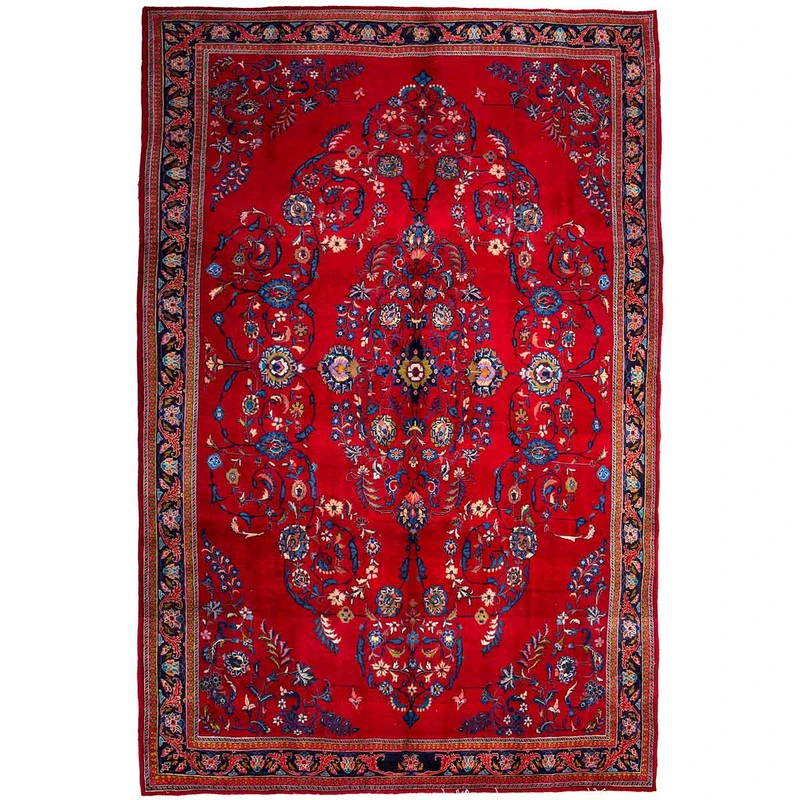
A Vist rug of about 13 by 8.25 feet with a medallion design in red, navy blue, and gold - Vist Persian Rug 12x8 ft - Medallion Semi Antique Wool Hand Knotted
3
The Bold Medallion
The medallion of a Vist is drawn on a large scale. It may be a stepped diamond, a hexagon, or a cross-shaped form with hooked outlines and pendants, filling much of the field. Corner pieces are often large too, cutting the field into strong geometric shapes. Inside the medallion and around it, small flowers, stars, and geometric figures fill the space. The effect is graphic and powerful, more like a bold painting than a delicate miniature. This large-scale drawing is one reason Vist rugs suit modern interiors so well: the design reads clearly even when furniture covers part of the rug.
4
The Herati in a Village Hand
Not every Vist uses a medallion. One of our pieces uses the Herati design, sometimes called Mahi (fish): a lattice of small diamonds with rosettes at the center and curving leaves around them, repeated across the field. In the hands of a village weaver, the Herati becomes bolder and more angular than in a city rug, with larger units and stronger colors. See our Herati designs.
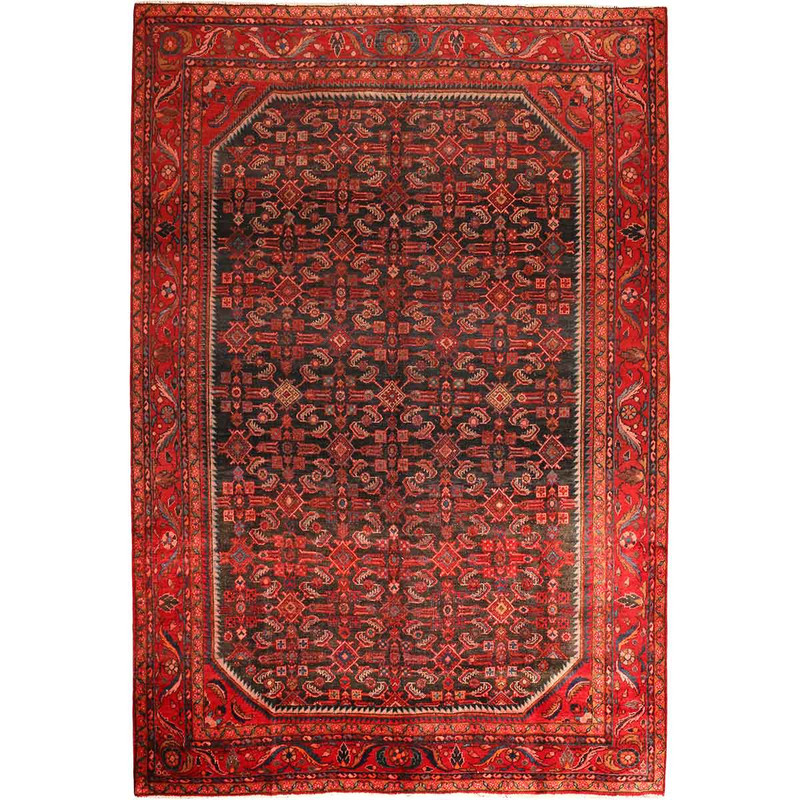
A Vist rug of about 10.75 by 7.25 feet with a Herati design in madder red, burgundy, and black - Vist Persian Rug 10x7 ft - Geometric Semi Antique Wool Hand Knotted
5
How Vist Rugs Are Built
•
Knot - Hamadan-region village rugs usually use the symmetric (Turkish) knot.
•
Foundation - Cotton warps and wefts.
•
Wefts - Often single, in the Hamadan manner; some pieces may be double wefted.
•
Pile - Thick wool, clipped to a medium height.
•
Density - Coarse to medium.
•
Sides and ends - Overcast sides and fringes.
This construction makes a rug that is heavy, sturdy, and comfortable underfoot, well suited to busy family rooms. If structure matters to you, ask us and we will check the back of a particular piece.
6
Colors of Vist
Our Vist rugs use warm, strong palettes: red and madder red fields, navy blue medallions and borders, beige and ivory highlights, and accents of gold, burgundy, and black. In semi-antique rugs, these colors have softened and settled into a warm, harmonious whole. Read more in our articles on natural dyes and traditional dyeing.
7
Sizes in Our Collection
•
About 7 by 5 to 8 by 5 feet - A medium rug for a bedroom, a study, or a smaller living room.
•
About 10.75 by 5.5 feet - A long rug for a gallery, a wide hallway, or the foot of a large bed.
•
About 10.75 by 7.25 feet - A rug for a living or dining room.
•
About 13 by 8.25 feet - A room-size rug for a large living or dining room.
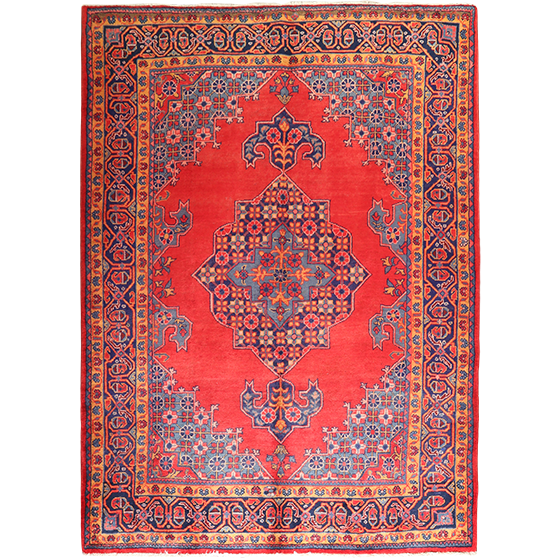
A Vist rug of about 10.75 by 5.5 feet with a medallion design in red, navy blue, and beige - Vist Persian Rug 10x5 ft - Geometric Semi Antique Wool Hand Knotted
8
Choosing a Room-Size Vist
A room-size Vist brings bold pattern and warmth to a room. For a living room, choose a size that lets the front legs of the sofa and chairs rest on the rug. For a dining room, the rug should extend at least 24 inches beyond the table on each side so chairs stay on the rug when pulled out. Because a Vist medallion is large, consider where it will sit: centered under a coffee table or a dining table, it frames the furniture; offset, it can lose its balance. Mark the outline on the floor with painter's tape before you decide.
9
The Long Vist
Our long Vist, about 10.75 by 5.5 feet, is a wide long rug. It suits a gallery or a wide hallway, a long space in front of a sofa, or the foot of a large bed. Its medallion is stretched along the length, giving a strong central focus.
10
Placing a Vist
A Vist's bold drawing works in many settings. In a modern interior with plain walls and simple furniture, it becomes the main source of pattern and color. In a farmhouse or rustic setting, its village character suits wood, stone, and natural textiles. In a traditional home, it pairs well with dark wood and brass. Because the design is large-scale, keep other patterns in the room smaller and quieter.
11
Matching Colors in Your Home
The reds and navies of a Vist pair well with warm whites, cream, soft gray, and pale ochre walls. Oak, walnut, and leather complement the reds. Navy, deep green, and charcoal textiles echo the darker tones, and gold accents pick up the highlights.
12
Vist and Its Neighbors
Vist and Heriz
Heriz rugs, from the villages of Azerbaijan in north-west Persia, are the most famous bold, geometric village rugs. A Vist shares their large-scale drawing but belongs to the Hamadan family. See our Heriz collection.
Vist and Hamadan
Hamadan is the name of the whole family of village rugs to which Vist belongs. See our Hamadan collection.
Vist and Bibikabad
Bibikabad, also in the Hamadan region, is another village name known for larger rugs with bold designs. See our Bibikabad collection.
Vist and Malayer
Malayer rugs, from the south of the Hamadan region, include both village pieces and finer double-wefted rugs. See our Malayer collection.
Vist and Mahal
Mahal rugs, from the Arak region to the east, are room-size rugs with large floral designs. See our Mahal collection.
13
Reading the Back
Turn a Vist over. Look at the knots: symmetric knots show as two equal bumps. Count the wefts between each row of knots. Look at the cotton foundation and the condition of the sides and fringes.
14
The Landscape of the Hamadan Region
The Hamadan region is a high plateau ringed by mountains, with the great peak of Alvand rising south-west of the city of Hamadan. Villages spread across valleys and plains watered by mountain streams, with fields of wheat and barley, orchards, and pastures for sheep. Winters are long and cold; summers are mild. That rhythm of life, with flocks on the hills and long months indoors, has shaped weaving across the region for generations. It explains the sturdy build of the rugs, the use of local wool, and the habit of weaving designs from memory.
15
Why Bold Drawing?
Village weavers usually worked without paper drawings, carrying the design in memory and adjusting it as the rug grew. Large, simple shapes are easier to keep in memory and to place on a big loom than small, curving details. A bold medallion also reads well in a village room, where a rug is seen from across the floor. Over generations, these practical reasons produced a style of drawing that today looks strikingly modern: strong geometry, clear contrasts, and confident scale. Vist rugs are a good example of this tradition.
16
Wool and Texture
Good wool is the foundation of a good village rug. Sheep that graze on mountain pastures with cold winters grow a fleece rich in natural lanolin, which gives the pile a soft sheen and helps it resist dirt. In the villages, wool was traditionally washed, carded, and spun by hand before dyeing. Hand-spun wool varies slightly in thickness, and that small irregularity gives the surface of an older rug a lively texture. Read more in our article on wool.
17
Borders and Guard Stripes
The borders of a Vist are usually wide and strong, in proportion to the large-scale field. A main border of repeating geometric flowers, rosettes, or a reciprocal pattern is flanked by narrow guard stripes. At the corners, village weavers often solved the turn of the border in their own way, and a corner that changes the pattern slightly is part of the rug's character.
18
Village Life and the Loom
In the villages of the Hamadan region, weaving was traditionally the work of women, done at home on upright looms. A room-size rug could take many months, sometimes with two or more weavers working side by side. Girls learned at their mothers' side, first helping with wool and simple rows, later weaving their own rugs. Read more about the people behind rugs in our article on the craft from shepherd to dealer.
19
Motifs in the Field
The small motifs scattered across the field are part of a shared vocabulary of western Persia: eight-pointed stars, small rosettes, stylized leaves and flowers, and occasional small animals or birds. Read more about such motifs in our article on design motifs, and on reading a rug's design as a whole in how to read a Persian rug.
20
Where a Vist Works Best
•
Living rooms - A room-size Vist holds a seating group with bold pattern.
•
Dining rooms - A strong medallion centered under the table.
•
Bedrooms - A medium rug under or beside the bed.
•
Galleries and wide hallways - The long Vist suits long spaces.
•
Family rooms - A thick pile suits everyday use.
21
Combining a Vist with Other Rugs
A Vist pairs naturally with other bold village rugs, such as Heriz, Bibikabad, and Hamadan rugs. In a large home, a room-size Vist in the living room can lead into a hallway with a long Vist or a Hamadan runner in a similar red and navy palette. Keep one or two colors in common and vary the scale of the patterns.
22
Keeping a Large Rug Healthy
A large, heavy rug needs a good pad to stay flat and to protect the floor. Rotate the rug every year or so, so that wear and light are spread evenly. Under chair and table legs, small felt cups help spread the weight. Vacuum across the fringes gently, or not at all. See our guide to maintaining rug fringes.
23
Light and Placement
Strong, direct sunlight can fade any natural fiber over many years. If your rug lies in a sunny spot, consider sheer curtains or UV filtering film, and rotate the rug so that light falls evenly. Avoid placing a rug where water may collect.
24
A Rug for Modern Rooms
Designers often choose bold village rugs like Vist for modern interiors. The reasons are simple. A large-scale geometric design holds its own next to clean-lined furniture, plain walls, and large windows. Warm reds bring life to cool palettes of white, gray, and black. And the slightly worn, rustic character of a semi-antique village rug adds a sense of history to a new space. If you are furnishing a modern room, consider letting a Vist be the main source of color and pattern, and keep cushions, curtains, and art simple around it.
25
Living with a Vist
A good village rug becomes part of the house. Its colors settle further, its pile develops a soft sheen, and its bold medallion becomes a familiar sight. Many owners find that a Vist bought for one room later moves to another and fits each in a different way. Because it is sturdy, it can live in the busiest rooms of a home, where it is seen and enjoyed every day.
26
Grades and How to Judge Them
•
Drawing - A bold, balanced medallion and well resolved corners.
•
Wool - Soft, lustrous wool with a full pile.
•
Color - Clear colors without bleeding.
•
Straightness - Straight sides and square corners.
•
Condition - Even pile, intact sides and ends.
27
Questions to Ask Before You Buy
•
Is it single or double wefted? - A clue to the village type.
•
What are the measurements at both ends? - Checks that the rug is straight.
•
Is the pile even? - Check for worn areas.
•
Has it been repaired? - Especially along the sides and at the ends.
•
Has it been washed recently? - A fresh wash shows the true colors.
Read our notes on what to know before you buy.
28
Semi-Antique Vist Rugs
Our Vist rugs are semi-antique, woven roughly forty to sixty years ago. They have settled colors, good wool, and many years of life ahead. See our semi-antique rugs.
29
What Affects the Price
•
Size - Larger rugs cost more.
•
Drawing - A bold, balanced design adds value.
•
Wool - Lustrous wool adds value.
•
Color - Harmonious colors add value.
•
Condition - Intact sides and ends.
30
Abrash and Color Changes
Many Vist rugs show abrash, horizontal bands where one color shifts slightly in shade, caused by wool dyed in different batches. On a large red field, abrash gives movement and depth. It is a natural sign of hand-dyed wool, not a defect.
31
Caring for a Vist Rug
Vacuum regularly without a beater bar. Rotate the rug every few months. Use a non-slip pad. Blot spills at once with a clean, white cloth and cold water. Have it professionally washed every year or two in busy areas. Keep the sides and ends in good repair. See our care instructions and our article on professional washing.
32
Photographs and Real Color
Reds and navies can look different on screen depending on the light. Daylight from a north window shows the truest colors. If color matters for your space, ask us for extra photographs in daylight or close-ups of the pile.
33
Common Buying Mistakes
•
Choosing too small - A room-size rug should hold the furniture.
•
Offsetting the medallion - Center it under the main furniture.
•
Expecting perfect symmetry - Small variations are part of village weaving.
•
Skipping the pad - Every rug needs one.
34
Frequently Asked Questions
Where do Vist rugs come from?
The Hamadan region of western Persia.
Is Vist the same as Viss or Wiss?
Yes. These are different spellings of the same name.
What kind of rugs are Vist rugs?
Sturdy village rugs with bold, large-scale geometric drawing.
What colors are typical?
Red, navy blue, beige, gold, burgundy, and black.
What sizes do you have?
From about 7 by 5 feet to about 13 by 8.25 feet.
Are Vist rugs durable?
Yes. Their thick pile and sturdy build make them durable.
How should I care for a Vist rug?
Vacuum regularly, rotate it, use a pad, and have it professionally washed regularly.
How does a Vist compare with a Heriz?
Both have bold, geometric drawing. Heriz rugs come from Azerbaijan in north-west Persia; Vist rugs belong to the Hamadan family.
How old are your Vist rugs?
They are semi-antique, roughly forty to sixty years old.
Is abrash a defect?
No. It is a natural sign of hand-dyed wool.
Can I see more photographs?
Yes. Ask us for daylight photographs, close-ups of the pile, or pictures of the back.
Will a Vist suit a modern room?
Yes. Its large-scale geometric design and warm reds work well with clean lines and plain walls.
Where should the medallion sit?
Centered under the main piece of furniture, such as a coffee table or dining table, so the design stays balanced.
Is a Vist single or double wefted?
Many are single wefted in the Hamadan manner, but some pieces may be double wefted. Ask us and we will check a particular rug.
Can a Vist be used in a busy family room?
Yes. Its thick pile and sturdy build make it a good choice for everyday use.
35
Choose Your Vist Rug
Each rug in our collection is hand-knotted, one of a kind, and inspected before it is listed. Browse our Vist collection, compare with our Heriz, Hamadan, and Bibikabad rugs, or ask our experts for help.