


In the high valleys south of Isfahan, where the Zagros mountains rise toward the lands of the Bakhtiari and the Qashqai, live the Yalameh: a tribal people who, like many groups of the region, once moved with their flocks between winter and summer pastures and have since largely settled in villages. Their rugs have a strong, instantly recognizable style. A field of stepped diamond medallions, edged with small hooks and arranged in a vertical row, sits on a ground of crimson or navy, with bright accents of ivory, green, and gold.
Yalameh rugs are not common on the market, and they are often admired by collectors for their bold geometry and lively color. This guide explains who the Yalameh are, how to recognize their rugs, how they compare with the rugs of their neighbors, and how to choose, place, and care for the small pieces in our collection. For the wider region, see our article on weaving in Chaharmahal.
1
Who Are the Yalameh?
The Yalameh are generally described as a tribal group of the highlands around the borders of Isfahan, Chaharmahal and Bakhtiari, and Fars provinces, with links to the wider Turkic and tribal world of the southern Zagros. Their exact history and affiliations are described differently by different writers, and like many tribes of the region they have mixed and intermarried with neighboring groups over the centuries. What is clear is that they developed a distinctive weaving style, recognizable across their rugs, that sets them apart from both the Bakhtiari to the west and the Qashqai to the south.
The Yalameh are a tribal people of the highlands south of Isfahan. Their rugs are known for stepped, hooked diamond medallions in a vertical row, in crimson, navy blue, and ivory.
2
How to Recognize a Yalameh Rug
•
Stepped diamond medallions - Often two, three, or more in a vertical row.
•
Hooked outlines - Small hooks or latches along the edges of the diamonds.
•
Bright palette - Crimson, navy blue, ivory, with green, gold, and orange accents.
•
Small geometric fill - Stars, small animals, and geometric figures around the medallions.
•
Sturdy pile - Lustrous highland wool.
•
Small to medium sizes - Scatter rugs, long rugs, and medium rugs.
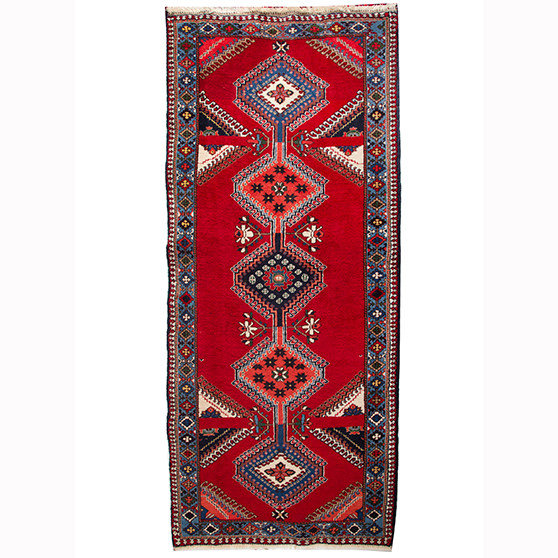
A Yalameh rug of about 6.5 by 2.75 feet with a medallion design in crimson, navy blue, and ivory - Yalameh Persian Rug 6x2 ft - Medallion Semi Antique Wool Hand Knotted
3
Reading the Medallions
The heart of a Yalameh design is the stepped diamond. Each diamond is built from straight, stair-stepped lines, and its outline is often fringed with small hooks, giving it a lively, almost serrated edge. Inside, a smaller diamond or star sits at the center, sometimes within another frame. The diamonds are usually stacked in a vertical row along the length of the rug, sometimes joined by a central pole, and their colors may alternate: a navy diamond, then an ivory one, then a red one. Around them, the field is scattered with small stars, rosettes, birds, animals, and geometric figures.
On a small rug, a single diamond may fill the field; on a long rug, a chain of diamonds runs from end to end. Because the weavers worked from memory, the diamonds are rarely identical: one may be wider, another may have a different inner figure, and the colors may change from one to the next. These variations give a Yalameh its lively, hand-made character.
4
How Yalameh Rugs Are Built
•
Knot - Tribal and village rugs of this region may use the symmetric or asymmetric knot; ask us if you want a particular piece checked.
•
Foundation - Cotton or wool warps and wefts.
•
Pile - Lustrous wool, clipped to a medium height.
•
Density - Medium, finer than many village rugs of similar style.
•
Sides and ends - Overcast sides, sometimes in two colors, and fringes.
This construction makes a rug that is sturdy, supple, and comfortable underfoot. Good Yalameh rugs use soft, lustrous wool from highland flocks, which gives the colors a rich glow.
5
Colors of the Highlands
Yalameh weavers are known for bright, lively color. Our pieces use crimson and navy blue with ivory. Other Yalameh rugs add green, gold, orange, and light blue in small amounts, so that the small motifs sparkle against the ground. In semi-antique rugs, these colors have softened and settled into a warm, harmonious whole. Read more in our articles on natural dyes and traditional dyeing.
6
Sizes in Our Collection
•
About 6.5 by 2.75 feet - A narrow long rug for a short hallway, an entrance, a bedside, or in front of a kitchen counter.
•
About 5.25 by 3.25 feet - A small rug for an entrance, a study, a bedside, or a reading corner.

A Yalameh rug of about 5.25 by 3.25 feet with a medallion design in crimson, navy blue, and ivory - Yalameh Persian Rug 5x3 ft - Medallion Semi Antique Wool Hand Knotted
7
Choosing a Small Tribal Rug
Small tribal rugs are some of the most versatile pieces in a home. They can sit at an entrance, beside a bed, in front of a fireplace, in a study, or under a small table. They can move from room to room as your needs change, and they bring color and character to spaces where a large rug would not fit. Measure the space first and allow a little floor around the rug so its borders can be seen.
8
The Narrow Long Rug
Our narrow Yalameh, about 6.5 by 2.75 feet, is a long, slender rug. It suits a short hallway, the space beside a bed, the front of a kitchen counter, or an entrance. Its row of diamonds gives a sense of movement along the length, guiding the eye through a narrow space.
9
Placing a Yalameh
A Yalameh's bright colors and bold geometry work in many settings. In a modern interior with plain walls and simple furniture, it becomes a point of color and pattern. In a traditional home, it pairs naturally with dark wood and warm textiles. In a bohemian or eclectic interior, it sits happily with other tribal pieces and handmade objects. Small pieces can also hang on a wall as textile art.
10
Matching Colors in Your Home
The crimson and navy of a Yalameh pair well with warm whites, cream, and soft gray walls. Wood, leather, and brass complement the reds. Navy, deep green, and gold textiles echo the palette. If your room already has strong colors, pick one color from the rug, such as the ivory of a diamond, and repeat it in a cushion or a throw.
11
Yalameh and Its Neighbors
Yalameh and Bakhtiari
Bakhtiari rugs, from the valleys to the west, are known for garden (kheshti) panel designs and sturdy village construction. See our Bakhtiari collection.
Yalameh and Qashqai
Qashqai rugs, from the tribes of Fars to the south, share the bold geometry and bright colors of southern tribal weaving. See our Qashqai collection.
Yalameh and Shahreza
Shahreza, the town once called Qomsheh, lies on the road between Isfahan and Fars, near Yalameh lands. See our Shahreza collection.
Yalameh and Abadeh
Abadeh, further south in Fars, weaves rugs with Qashqai-style designs in a village build. See our Abadeh collection.
Yalameh and Lori
The Lors of the Zagros also weave bold tribal rugs. See our Lori collection.
12
Reading the Back
Turn a Yalameh over. Look at the knots: symmetric knots show as two equal bumps, asymmetric knots as one larger and one smaller loop. Check the material of the warps and wefts. Look at the sides: Yalameh rugs often have overcast sides in two alternating colors. Check the fringes.
13
The Landscape Behind the Rugs
The lands of the Yalameh lie on the high plateau where the Zagros mountains meet the plains south of Isfahan. It is a country of wide valleys, dry hills, and high pastures, with cold winters and warm, bright summers. Traditionally, families moved their flocks of sheep and goats between lower winter grounds and cooler summer pastures in the mountains, following routes that passed through the lands of other tribes. Over the twentieth century, most families settled in villages, but sheep remained central to life, and wool from highland flocks remained the material of weaving.
The highlands produce lustrous, strong wool, and that wool is one of the secrets of a good Yalameh. When it is spun by hand and dyed in clear colors, it gives the pile a glow that makes the small motifs sparkle.
14
Tribal Weaving in the Southern Zagros
The highlands of the southern Zagros are home to several great weaving traditions. To the west are the Bakhtiari, whose rugs often show garden panels; to the south and south-west, the Qashqai confederation of Fars, with its lively tribal medallions; and around and between them, smaller groups such as the Yalameh, the Lors, and others. Designs and techniques passed between these groups through trade, marriage, and shared pastures. A Yalameh may therefore remind you of a Qashqai in its colors or of a Bakhtiari village rug in its build, while its stepped, hooked diamonds remain its own. Read more about the tribes of the region in our article on Qashqai and Bakhtiari tribes.
15
Women at the Loom
In Yalameh families, as among their neighbors, weaving was women's work. Girls learned from their mothers and grandmothers, first spinning and helping with simple rows, then weaving small pieces of their own. Designs were kept in memory and passed down within the family, with each weaver adding her own touches: a favorite small animal, a change in color, a different inner figure in a diamond. Read more about the people behind rugs in our article on the craft from shepherd to dealer.
16
Motifs in the Field
The small motifs scattered around the diamonds are part of a tribal vocabulary shared across the southern Zagros: eight-pointed stars, small rosettes, combs, birds, goats, dogs, and human figures. Some may have had protective or symbolic meanings; others may simply fill a space with something the weaver liked. Read more about such motifs in our article on design motifs, and on reading a rug's design as a whole in how to read a Persian rug.
17
Borders and Guard Stripes
The borders of a Yalameh are usually narrower than the field, framing the diamonds without competing with them. A main border of small repeating geometric flowers or a reciprocal pattern is flanked by narrow guard stripes, sometimes in a barber-pole or dotted design. At the corners, tribal weavers often solved the turn of the border in their own way, and a corner that changes the pattern slightly is part of the rug's character.
18
Hanging a Small Rug on a Wall
Small tribal rugs are often hung as textile art. To hang a rug safely, sew a strip of cotton webbing or a fabric sleeve to the back along the top edge, and hang it from a rod or a strip of Velcro fixed to the wall. Never nail or staple through the rug. Keep it away from direct sun and from heat sources such as radiators.
19
Combining a Yalameh with Other Rugs
A Yalameh pairs naturally with other tribal rugs of the southern Zagros, such as Qashqai, Bakhtiari, Lori, and Abadeh rugs. Our two Yalameh pieces share a palette and could work together, one in an entrance and one beside a bed. Keep one or two colors in common and vary the scale of the patterns.
20
Where a Yalameh Works Best
•
Entrances - A bright first impression.
•
Bedsides - Warmth underfoot in the morning.
•
Studies - Color and character in a small room.
•
Kitchens - The narrow rug in front of a counter, away from direct splashes.
•
Walls - As textile art.
21
Light and Placement
Bright colors can fade in strong, direct sunlight over many years. If your rug lies in a sunny spot, consider sheer curtains or UV filtering film, and rotate the rug so that light falls evenly. Avoid placing a rug where water may collect.
22
Why the Hooks?
The small hooks that fringe a Yalameh diamond are one of the oldest devices in tribal weaving. Found across the rugs of Persia, the Caucasus, Anatolia, and Central Asia, hooked outlines soften the hard steps of a geometric figure and give it movement, so that a diamond seems to shimmer rather than sit still. Some writers link such hooks to stylized animal horns or plants; others see them simply as a practical way to draw a lively outline with knots. Whatever their origin, they give a Yalameh its signature look, and the crispness of the hooks is one of the best measures of a weaver's skill.
23
Living with a Yalameh
A good tribal rug becomes part of the house. Its colors settle further, its pile develops a soft sheen, and its diamonds become a familiar sight. Small rugs like ours move easily from room to room, and many owners find that a piece bought for an entrance later finds a home beside a bed or on a wall. Because Yalameh rugs are made of strong highland wool, they can live in the busy parts of a home, where they are seen and enjoyed every day.
24
Keeping a Small Rug Safe
Small rugs move and curl more easily than large ones. A thin felt-and-rubber pad cut slightly smaller than the rug keeps it flat and stops it from slipping on wood, stone, or tile. If a corner curls, lay the rug flat with a light weight on the corner for a few days. Vacuum across the fringes gently, or not at all. See our guide to maintaining rug fringes.
25
Grades and How to Judge Them
•
Drawing - Clear, lively diamonds with crisp hooks.
•
Wool - Soft, lustrous wool with a full pile.
•
Color - Bright, clear colors without bleeding.
•
Straightness - Straight sides and square corners.
•
Condition - Even pile, intact sides and ends.
26
Questions to Ask Before You Buy
•
Which knot is used? - A clue to the weaving tradition.
•
What are the measurements at both ends? - Checks that the rug is straight.
•
Is the pile even? - Check for worn areas.
•
Has it been repaired? - Especially along the sides and at the ends.
•
Has it been washed recently? - A fresh wash shows the true colors.
Read our notes on what to know before you buy.
27
Semi-Antique Yalameh Rugs
Our Yalameh rugs are semi-antique, woven roughly forty to sixty years ago. They have settled colors, good wool, and many years of life ahead. See our semi-antique rugs.
28
What Affects the Price
•
Size - Larger rugs cost more.
•
Drawing - Clear, lively diamonds add value.
•
Wool - Lustrous wool adds value.
•
Color - Bright, harmonious colors add value.
•
Condition - Intact sides and ends.
29
Abrash and Color Changes
Many Yalameh rugs show abrash, horizontal bands where one color shifts slightly in shade, caused by wool dyed in different batches. It is a natural sign of hand-dyed wool, not a defect.
30
Caring for a Yalameh Rug
Vacuum regularly without a beater bar. Turn or rotate the rug every few months. Use a non-slip pad, especially under a small rug. Blot spills at once with a clean, white cloth and cold water. Have it professionally washed every year or two in busy areas. Keep the sides and ends in good repair. See our care instructions and our article on professional washing.
31
Photographs and Real Color
Crimson and navy can look different on screen depending on the light. Daylight from a north window shows the truest colors. If color matters for your space, ask us for extra photographs in daylight or close-ups of the pile.
32
Common Buying Mistakes
•
Skipping the pad - Small rugs slip easily.
•
Expecting perfect symmetry - Small variations are part of tribal weaving.
•
Ignoring the sides - Overcasting needs regular checks.
•
Placing it in direct sun - Bright colors can fade over time.
33
Frequently Asked Questions
Who are the Yalameh?
A tribal people of the highlands south of Isfahan, near Chaharmahal and Fars.
What does a Yalameh rug look like?
Stepped, hooked diamond medallions in a vertical row, in bright colors.
What colors are typical?
Crimson, navy blue, ivory, with green, gold, and orange accents.
What sizes do you have?
About 6.5 by 2.75 feet and about 5.25 by 3.25 feet.
Are Yalameh rugs durable?
Yes. Lustrous wool and a sturdy build make them durable.
Is abrash a defect?
No. It is a natural sign of hand-dyed wool.
How should I care for a Yalameh rug?
Vacuum regularly, turn it, use a pad, and have it professionally washed regularly.
How does a Yalameh compare with a Qashqai?
Both are tribal rugs with bold geometry and bright colors. A Yalameh is usually recognized by its stepped, hooked diamonds in a vertical row.
Can a small Yalameh hang on a wall?
Yes, mounted on a fabric sleeve or a strip of Velcro, never nailed.
How old are your Yalameh rugs?
They are semi-antique, roughly forty to sixty years old.
Can I see more photographs?
Yes. Ask us for daylight photographs, close-ups of the pile, or pictures of the back.
34
Choose Your Yalameh Rug
Each rug in our collection is hand-knotted, one of a kind, and inspected before it is listed. Browse our Yalameh collection, compare with our Bakhtiari, Qashqai, and Abadeh rugs, or ask our experts for help.