


Charcoal is the color of smoke, slate, and wet stone. It is darker than gray and softer than black, and in a Persian rug it brings depth without the full weight of a black field. Few rugs are charcoal from edge to edge. More often, charcoal appears as a smoky ground behind a red medallion, a wide border around an ivory field, or the dark outlines that draw a design. In each case it gives the rug a cool, composed character that sits easily in a modern home.
This guide explains what we mean by charcoal, where the color comes from in a hand-knotted rug, how to tell it apart from black, navy, and gray, which rugs in our collection carry it, and how to place and care for a charcoal rug. For the full palette, see our guide to Persian rug colors, and for the darkest tones, our guide to black Persian rugs.
1
What We Mean by Charcoal
In our catalog, a rug is listed as charcoal when a deep, smoky gray is one of its main colors: a dark field, a wide dark border, or strong dark-gray medallions and outlines. Charcoal sits between several neighbors. It is softer and grayer than black, darker than gray, and less blue than navy blue or midnight blue. In practice, many charcoal areas in Persian rugs are very dark blues or browns that read as gray, and the same rug can look charcoal in daylight and nearly black at night.
Charcoal in a Persian rug is a deep, smoky gray between black and gray. It usually comes from natural dark or gray wool, iron-based dyes, or deep blues and browns that read as slate.
2
Where Charcoal Comes From
Persian dyers had no single charcoal dye. The color comes from several sources, often combined:
•
Natural gray wool - Some flocks give gray fleece, and dark and light wool spun together gives a soft heathered gray.
•
Natural dark brown wool - Very dark brown fleece looks charcoal when it sits next to cool blues and ivory.
•
Iron and tannin dyes - Oak galls, pomegranate rind, and other tannin plants with iron give grays, slate tones, and blacks.
•
Deep indigo - Navy that has softened slightly over time can take on a smoky, slate-like cast.
•
Synthetic dyes - In the twentieth century, stable synthetic grays and blacks made even charcoal tones easier to dye.
Our articles on mordants and natural dyes explain how iron and tannins change color, and our article on Persian rug wool covers the natural colors of fleece.
3
Charcoal, Black, Navy, and Gray
Because these colors are so close, it helps to look for small clues:
•
Black - The deepest dark, often with a warm brown or purple undertone in older rugs.
•
Charcoal - A smoky, neutral dark that looks gray rather than brown or blue in daylight.
•
Navy blue - A deep blue that glows blue beside ivory and red.
•
Gray - A lighter, cooler neutral, rare in traditional rugs.
When you look at photographs, compare the dark areas with the ivory parts of the rug. Next to ivory, navy looks clearly blue, brown-black looks warm, and charcoal looks gray. If the exact tone matters, ask us for a description in daylight.
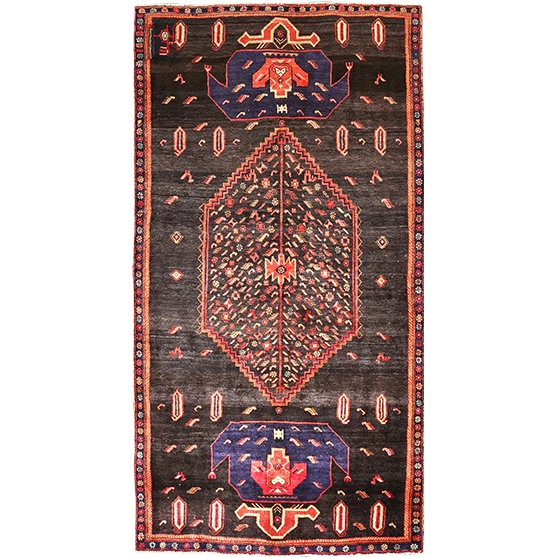
A Bijar rug of about 8.25 by 4.25 feet with a red hexagonal medallion and red and blue pendants on a smoky charcoal field - Bijar Persian Rug 8x4 ft - Medallion Semi Antique Wool Silk Hand Knotted
4
Charcoal Fields in Kurdish and Village Rugs
Some of the most striking charcoal rugs come from the villages of western Persia. In Bijar and other Kurdish rugs, a dark smoky field can carry a bold red medallion with pendants at each end, so the medallion seems to glow like a coal in the dark. Bijar rugs are woven very densely, and their dark wool has a deep, velvety look. Our Kurdish rug guide explains how Bijar rugs are built and why they are so durable.
5
Charcoal in Southern Tribal Rugs
In southern Persia, weavers in the Kerman region and the tribes of Fars used dark grounds as a backdrop for chains of bright medallions. A dark slate or navy field with pink, red, and ivory diamonds has a crisp, graphic look. Sirjan rugs, made in Kerman province near the lands of the Afshar tribes, often use deep grounds of this kind. Our Sirjan rug guide describes their designs and neighbors.
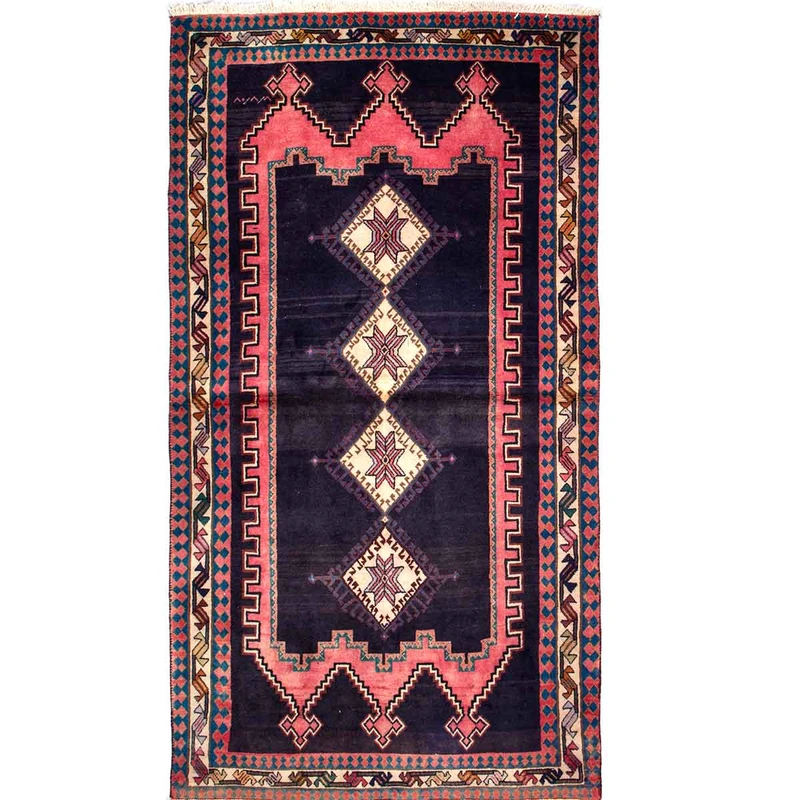
A Sirjan rug of about 7 by 3.75 feet with a chain of four pink and ivory diamond medallions on a deep charcoal-navy field - Sirjan Persian Rug 7x3 ft - Medallion Semi Antique Wool Hand Knotted
6
Charcoal Borders in City Rugs
City rugs rarely have charcoal fields, but they often use charcoal and dark slate in their borders and outlines. A wide charcoal border around an ivory or cream field frames the design sharply and gives the rug a tailored, architectural look. This is common in some rugs from Khorasan, such as Sabzevar and Mashhad, and in some Tabriz rugs. If you want a light rug with a strong dark frame, look for this combination. Our Sabzevar rug guide explains this Khorasan tradition.
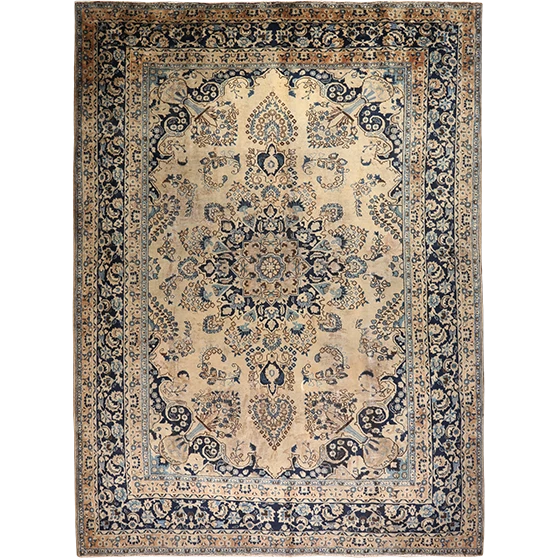
A Sabzevar rug of about 11.25 by 8.25 feet with a charcoal-blue medallion and a wide charcoal border around an ivory field - Sabzevar Persian Rug 11x8 ft - Medallion Semi Antique Wool Hand Knotted
7
Charcoal as a Drawing Color
Charcoal and black are the main drawing colors of Persian rugs. Every flower, leaf, and medallion needs an outline to read clearly, and dark gray outlines give a design a softer, more painterly look than pure black. In fine city rugs, charcoal outlines are often used together with ivory and pale blue, so the design looks as if it were drawn in ink on paper. In tribal rugs, thicker dark outlines give motifs their bold, graphic edges.
8
Why Charcoal Rugs Are Rare
Gray was not a favorite color of traditional Persian weavers, who preferred the warmth of madder red, the depth of indigo, and the light of ivory. Natural gray fleece was less common than white and brown, and gray dyes were made mainly with iron, which slowly weakens wool. As a result, charcoal appears in older rugs mostly as outlines, borders, and the occasional dark field. This makes a rug with a true charcoal ground a find, and it explains why our charcoal group is small.
9
Corrosion in Charcoal and Dark Areas
When charcoal and dark gray tones were made with iron, they age in a special way. Over many decades, the iron weakens the wool, so dark knots wear down faster than the colors around them. In older rugs, this gives dark outlines and fields a slightly lower pile, and the design stands out in relief. Light, even corrosion is a normal sign of age; deep corrosion in large dark areas affects durability. We describe the condition of dark areas in every older rug, and our Before You Buy page explains what to look for.
10
Charcoal Rugs in Modern Rooms
Charcoal is a natural partner for modern interiors. It echoes gray sofas, black metal, concrete floors, and dark window frames, while the red, pink, or ivory in the rug adds warmth and pattern. A charcoal Persian rug can be the one strong, handmade element that makes a minimal room feel personal. Keep the rest of the palette simple, and let the rug's medallion or border provide the color.
11
Charcoal Rugs in Living Rooms
In a living room, a charcoal rug grounds the seating group and gives the room a calm, enclosed feeling. It works especially well with light walls and pale wood floors, where the dark rug provides contrast. If your room is small or dim, choose a rug with charcoal borders and a lighter field rather than a fully dark rug. Our size guide explains how to size a rug for a seating group.
12
Charcoal Rugs in Bedrooms and Studies
Charcoal suits rooms meant for rest and focus. In a bedroom, a charcoal rug under the bed pairs beautifully with white and gray bedding. In a study, it echoes dark bookshelves and leather chairs. Small charcoal rugs of about 3 by 5 or 4 by 6 feet are also lovely beside a bed or under a desk. Our 4x6 rug guide describes where that size fits.
13
Charcoal Rugs in Entries and Hallways
Dark rugs are practical in entries and hallways because they hide the dust of shoes. A long charcoal rug or runner with bright medallions welcomes guests with color while staying easy to care for. Place a runner so that it leaves a few inches of floor on each side and stops 12 to 18 inches short of each end of the hallway. Our runner guide has the details.
14
Pairing Colors with a Charcoal Rug
•
White and warm gray walls - Clean and calm, with the rug adding depth.
•
Pale oak and ash floors - Light wood balances a dark rug.
•
Rose and blush - Pink accents echo the pink medallions in many dark rugs.
•
Madder red - Red pillows or art pick up the warmth of the medallion.
•
Brass and brushed gold - Warm metals keep charcoal from feeling cold.
•
Black accents - Black frames and lamps sharpen a charcoal room.
15
Charcoal and Light
Charcoal changes with light more than many people expect. In cool north light, it looks gray and stony; in warm evening light, it can look nearly black, and any blue or brown undertone becomes stronger. In a bright, sunny room, a charcoal rug gives the floor weight and balance. In a dim room, it can make the space feel smaller, so choose a rug where charcoal is balanced by ivory, red, or pink.
16
Charcoal and Everyday Life
Charcoal hides spills, dust, and dark dirt well, which makes it a good choice for busy rooms. It does show lint and light pet hair, so regular vacuuming is important. For homes with light-haired pets, a charcoal rug with an ivory or red design hides hair better than a plain dark field.
17
Designs Often Seen with Charcoal
•
Medallion - Bright medallions on dark grounds in village and tribal rugs.
•
Geometric - Chains of diamonds and hooked motifs on dark fields.
•
Herati - Small repeating units drawn with dark outlines.
•
Tribal and nomadic - Dark-ground rugs from the tribes of Fars and Kerman.
•
Shah Abbasi - Palmettes framed by dark borders in city rugs.
18
Older Charcoal Rugs
All of our charcoal rugs are semi-antique or older. Age softens charcoal into a gentle, smoky tone and gives dark wool a soft, lived-in feel. When you look at an older charcoal rug, check whether dark areas are lower than the rest of the pile and whether any dark knots have worn to the foundation. Our notes on semi-antique and antique rugs explain more.
19
Charcoal Rugs as Wall Hangings
A small charcoal rug with a bright medallion also makes a striking wall hanging. The dark ground reads like the background of a painting, and the medallion becomes the subject. Hang the rug with a sleeve or a Velcro strip sewn along the top edge, never with nails through the rug, and keep it out of direct sun.
20
Heathered Gray Wool
One of the most beautiful sources of charcoal is wool that was never dyed at all. When a spinner combines dark brown or black fleece with lighter gray or white fleece, the yarn takes on a heathered look, with tiny flecks of light and dark. Knotted into a rug, this yarn reads as a soft, living charcoal that changes slightly from one area to the next. Heathered wool is more common in village and tribal weaving, where spinners worked with the mixed fleeces of their own flocks. If you look closely at the dark areas of a village rug, you may see these flecks, a quiet sign that the wool was spun by hand.
21
Charcoal Next to Red
The pairing of charcoal and red is one of the most dramatic in Persian weaving. A madder red medallion on a smoky gray ground looks warm and bright, while the charcoal keeps the red from feeling loud. This pairing is especially effective in long rugs and runners, where a chain of red medallions runs down a dark field. In a room, it works with both warm and cool palettes, because the red brings warmth and the charcoal fits with gray and black furnishings.
22
Charcoal Next to Pink and Rose
Some dark-ground rugs carry pink and rose medallions instead of deep red. Pink on charcoal has a softer, more modern look, and it pairs beautifully with blush textiles, brass, and pale wood. Rose tones in older rugs often come from madder that has softened with age, so the contrast between the dark ground and the pale medallion has grown gentler over the years. If you love this look, see our pink rugs as well.
23
Charcoal with Ivory: A Graphic Pairing
When charcoal frames an ivory or cream field, the rug looks crisp and tailored, almost like a drawing in charcoal on paper. This combination suits rooms with white walls and black accents, and it is a good choice for anyone who loves contrast but does not want a dark field. A light field with a charcoal border also shows the design clearly from across a room, which makes it a strong choice for a large living room or dining room.
24
Small Charcoal Rugs
Charcoal works beautifully in small rugs. A dark mat of about 2 by 3 feet beside a bed or at a front door is practical and striking, and a small dark rug can anchor a reading chair or a desk without taking over a room. Small rugs are also a good way to try a dark color before committing to a large rug. Our 2x3 rug guide and 3x5 rug guide describe where these sizes fit.
25
Charcoal and Abrash
Dark fields often show abrash, the gentle bands of lighter and darker tone that come from different batches of wool. In a charcoal field, abrash can appear as soft shifts between gray, slate, and brown-black. These shifts give a dark field depth and movement, and they are a clear sign of handwork. When you look at a charcoal rug, view the full photographs to see how much abrash it has.
26
Charcoal Through the Seasons
A charcoal rug adapts to the seasons with small changes around it. In winter, with wool throws, warm lamps, and red accents, it feels cozy and enclosed. In summer, with white linen, green plants, and open windows, it feels cool and calm, like shade on a hot day. Few colors make that change so easily, which is why a charcoal rug can stay in the same room for many years.
27
Seeing Charcoal on a Screen
Dark colors are hard to photograph and harder to show on screens. A charcoal field can look nearly black on one phone and gray-blue on another. Our photographs are taken in consistent light, but if the exact tone of a dark rug matters for your room, look at every photograph in the listing and ask us for a description in daylight before you decide.
28
A Color for Quiet Rooms
Above all, charcoal is a color for rooms where you want calm. It absorbs light, softens sound visually, and lets the colors around it stand out. A charcoal Persian rug gives that calm a handmade warmth that a plain gray carpet cannot.
29
Questions to Ask Before You Buy
•
Is it charcoal, black, navy, or brown? - Compare the dark areas with the ivory in daylight photographs.
•
How much charcoal is there? - Field, border, or outlines change the mood of the rug.
•
Is there corrosion? - Check dark areas in older rugs.
•
How bright is the room? - Dark rugs suit bright rooms best.
•
What colors balance the dark? - Look for red, pink, or ivory that ties into your room.
30
Caring for a Charcoal Rug
Vacuum regularly with suction only, or with the beater bar raised, since dark rugs show lint. Rotate the rug every six to twelve months. Blot spills with a clean white cloth and cold water, and never rub. Avoid bleach and strong cleaners, which can leave pale marks on dark wool. For older rugs with corroded dark areas, avoid heavy furniture on the low parts. Have the rug washed by a professional who cleans hand-knotted rugs every few years. Our care instructions explain each step.
31
Frequently Asked Questions
Is charcoal a traditional color in Persian rugs?
Mostly as outlines, borders, and occasional dark fields. True charcoal grounds are uncommon, which is why our charcoal group is small.
How is charcoal made in Persian rugs?
With natural dark or gray wool, with iron and tannin dyes, and with deep blues and browns that read as slate.
What is the difference between charcoal and black?
Charcoal is a smoky dark gray; black is deeper and in older rugs often warm brown-black.
Does a charcoal rug suit a modern room?
Very well. Charcoal pairs naturally with gray, white, black metal, and pale wood.
Does a charcoal rug show dirt?
It hides dark dirt and spills well but shows lint and pale pet hair. Regular vacuuming keeps it fresh.
32
Choose Your Charcoal Rug
A charcoal Persian rug brings depth and calm to a room, with the warmth of a hand-knotted design. Browse our charcoal rugs, compare them with our black, gray, and navy blue groups, and ask our experts if you would like help choosing.