


Some Persian rugs are built around a single dominant shape, a medallion at the center or a niche at one end. Others spread their beauty evenly across the whole field. The Afshan design belongs to the second family. The word comes from the Persian verb afshandan, to scatter or sprinkle, and an Afshan field looks exactly like that: flowers, buds, leaves, and palmettes scattered across the ground and linked by delicate, curling vines, with no single focal point.
This guide explains what an Afshan design is, how to recognize one, how it changes from city workshops to village and tribal looms, how it compares with related all-over designs, and how to choose, place, and live with an Afshan rug from our collection. For the wider language of Persian patterns, see our articles on Persian rug design and design motifs.
1
What "Afshan" Means
In Persian, afshan describes something strewn or sprinkled: gold leaf scattered over a page of calligraphy is called zar-afshan, "gold-scattered," and the same idea runs through the rug design. In weaving, the term describes a field covered evenly with floral motifs and vines, without a central medallion. In the trade, Afshan is often used broadly for many medallion-less floral fields, and you will sometimes see the same rug described as Afshan, all-over, or bi-toranj (without medallion). What matters is the effect: a continuous, even surface of flowers.
Afshan means "scattered." An Afshan rug covers the whole field with flowers, leaves, palmettes, and vines, without a single central medallion.
2
How to Recognize an Afshan Rug
•
No dominant medallion - The field reads as one continuous surface.
•
Scattered flowers - Rosettes, palmettes, buds, and leaves spread across the ground.
•
Linking vines - Thin curling stems, often in spirals, connect the motifs.
•
Even density - Motifs are spaced to fill the field without large empty areas.
•
Repeat or free drawing - Some fields repeat a unit, others are drawn freely across the whole rug.
•
Framing borders - A strong border holds the busy field together.
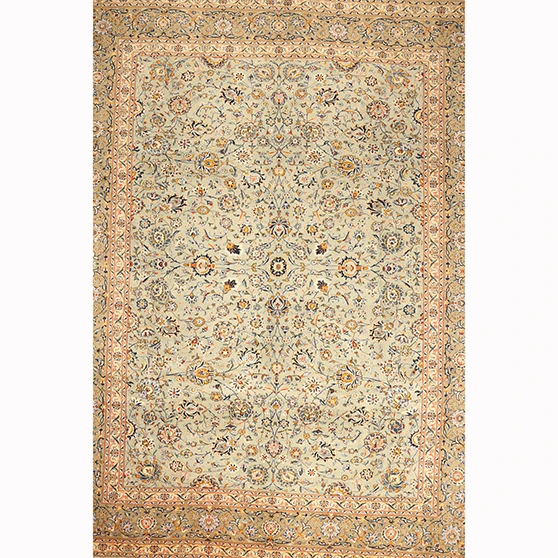
A Kashan rug of about 12.75 by 9.75 feet with an Afshan design in cream, camel, and rust red - Kashan Persian Rug 12x9 ft - Afshan Semi Antique Wool Silk Hand Knotted
3
The Structure Beneath the Flowers
An Afshan field often looks free and spontaneous, but in city rugs it usually rests on a hidden framework. Beneath the flowers lies a system of spiraling vines, sometimes in two or more layers, that curl across the field in regular arcs. Palmettes and rosettes sit at the points where the vines turn or meet. In the best rugs, you can follow a single vine with your eye from one side of the rug to the other, passing flower after flower. This underlying spiral framework is closely related to the Islimi (arabesque) tradition of Persian ornament, and many Afshan fields combine the two.
In village and tribal rugs, the framework is simpler. The weaver may scatter flowers in loose rows or in an offset grid, linking them with short, angular stems. The result is less flowing but often livelier, with a charm that comes from small changes and personal touches.
4
City Afshan Rugs
In city workshops such as Kashan, Tabriz, Isfahan, and Najafabad, Afshan designs are drawn on a full-size cartoon by a designer and woven with fine knots, so that curves stay smooth and flowers are drawn in detail. City Afshan rugs often use a refined palette, such as cream, camel, and rust, or ivory with soft blues and reds, and they may include delicate shading within each flower. See our Kashan, Tabriz, and Najafabad collections.
5
Village Afshan Rugs
In the villages of the Hamadan region and the Arak region, Afshan designs are woven from memory or from a small sample, with a coarser knot and a sturdier build. Flowers become more angular, vines become shorter, and the colors are often bolder: madder red grounds with navy and ivory flowers. Our collection includes many long Hamadan runners with Afshan fields, where the scattered flowers run the whole length of the rug. See our Hamadan and Sarouk collections.
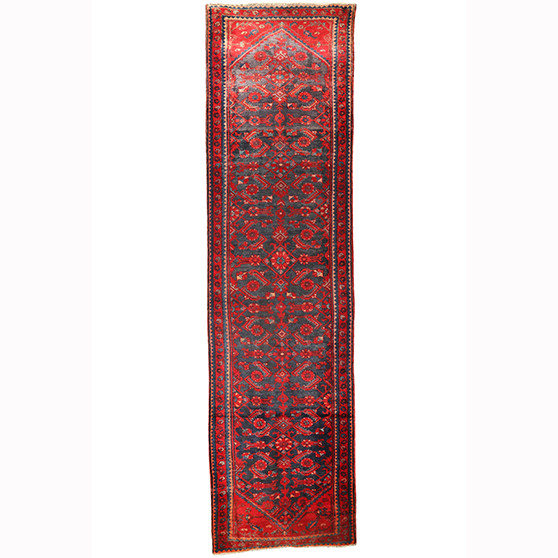
A Hamadan runner of about 13.75 by 3.75 feet with an Afshan field in madder red and navy blue - Hamadan Persian Rug 13x3 ft - Afshan Semi Antique Wool Hand Knotted
6
Bakhtiari and Tribal Afshan Rugs
Bakhtiari weavers, in the valleys west of Isfahan, also weave Afshan fields, often in a sturdy village build with strong reds, navies, and creams. Their flowers are larger and more geometric than in city rugs, and the overall look is warm and robust. See our Bakhtiari collection.
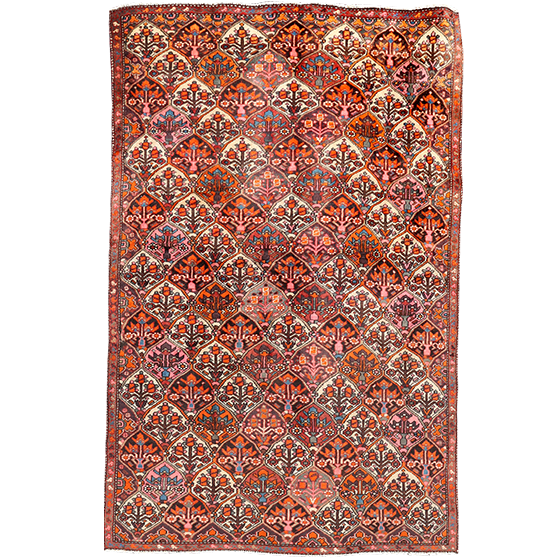
A Bakhtiari rug of about 8.75 by 5.25 feet with an Afshan all-over design in madder red, rust, cream, and navy blue - Bakhtiari Persian Rug 8x5 ft - Afshan Semi Antique Wool Hand Knotted
7
Afshan and Related Designs
Afshan and Herati
The Herati design is also all-over, but it is built from a small, strict repeat: a diamond with a rosette at its center and curving leaves around it. An Afshan field is freer and more varied. See our Herati designs.
Afshan and Islimi
Islimi (arabesque) designs are built from spiraling, split-leaf vines. Many Afshan fields use Islimi vines as their framework, and the two terms sometimes overlap. See our Islimi designs.
Afshan and Mina Khani
The Mina Khani design arranges large and small flowers in a regular lattice linked by curving stems. It is more ordered than a typical Afshan. See our Mina Khani designs.
Afshan and Shah Abbasi
Shah Abbasi designs use large palmettes named after the Safavid shah, often scattered over the field in an Afshan manner or around a medallion. See our Shah Abbasi designs.
Afshan and Medallion designs
Some rugs place a medallion over an Afshan field. In the trade these are usually described as medallion rugs, with an Afshan ground. See our medallion designs.
8
Directional and Non-Directional Fields
Look at an Afshan rug from both ends. In many fields, the flowers point in different directions, so the rug looks the same from any side. This non-directional quality is one reason Afshan rugs are so easy to place: there is no top or bottom to worry about. Some Afshan rugs, however, have a clear direction, with flowers growing upward from one end. If the rug will be seen mainly from one side, such as from a doorway, check which way it reads best.
9
Colors of Afshan Rugs
Afshan designs appear in almost every palette. Classic city rugs often use cream or ivory grounds with flowers in rust, camel, soft red, and blue. Village rugs favor madder red grounds with navy, ivory, and green flowers. Some rugs use navy grounds, where the flowers glow like stars on a night sky. Because the field is busy, color balance matters: in a good Afshan, no single color jumps out, and the eye moves evenly across the whole rug. Read more in our articles on natural dyes and the nine ranges of Persian colors.
10
Why All-Over Rugs Are Easy to Live With
An Afshan rug has practical advantages. Because there is no central medallion, furniture can sit anywhere on the rug without hiding the main feature. A sofa, a coffee table, or a bed can cover part of the field and the design still reads as complete. Busy all-over patterns are also forgiving: small marks and signs of wear are less visible than on a plain ground or a large open medallion. That makes an Afshan a good choice for living rooms, dining rooms, and family spaces.
11
Choosing an Afshan Rug by Room
•
Living rooms - A room-size Afshan holds a seating group without a focal point to center.
•
Dining rooms - The even field looks good from every chair.
•
Bedrooms - The bed can cover much of the rug without hiding a medallion.
•
Hallways - A long Afshan runner adds pattern along the whole length.
•
Studies - A small Afshan brings detail and warmth to a quiet room.
12
Sizes in Our Collection
Our Afshan rugs cover a wide range of sizes, from small Hamadan rugs of about 3 by 2 feet and long Hamadan runners of 9 to 16 feet, to medium Bakhtiari and Sarouk rugs and room-size Kashan, Tabriz, and Najafabad rugs. Browse by size: runners, 5x8, 8x11, 9x12, and 10x13.
13
Matching an Afshan to Your Room
A busy Afshan field pairs best with calm surroundings. Plain walls, solid upholstery, and simple curtains let the rug's pattern lead. Pick one or two colors from the rug, such as the rust of a flower or the blue of a vine, and repeat them in cushions, throws, or art. A cream-ground Afshan lightens a room and suits modern and coastal interiors; a red-ground Afshan warms a room and suits traditional interiors with wood and leather.
14
A Short History of the Scattered Field
All-over floral fields have a long history in Persian art. Under the Safavid dynasty, in the sixteenth and seventeenth centuries, court designers in cities such as Isfahan, Kashan, and Tabriz developed sophisticated systems of spiraling vines, palmettes, and blossoms that appear in carpets, book illumination, and tilework alike. The great vase carpets and garden carpets of the period show how far these all-over designs could be taken. Over the following centuries, the scattered floral field spread from court workshops to city workshops and then to villages, where weavers simplified and reinterpreted it in their own way. Read more about these periods in our articles on weaving from 1499 to 1722 and from 1722 to 1925.
15
How an Afshan Is Drawn and Woven
Persian designers distinguish rugs by how much of the design the weaver needs in front of her. In a medallion rug, a quarter of the design is often enough, because the weaver mirrors it. An Afshan field can be drawn in several ways. Some city Afshans are mirrored like a medallion rug, so a quarter cartoon is enough. Others repeat a small unit across the field, the method called vagireh, so the weaver works from a small sample. The most ambitious city rugs are drawn across the whole field without repetition, and the weaver needs the full cartoon. Village weavers usually work from memory or from a small sample, which is why their Afshan fields vary so much. See our Vaghireh designs and read about cartoons in Tabriz rug painters.
16
Afshan on a Runner
The long, narrow shape of a runner suits an all-over design. A medallion can look cramped on a runner, but an Afshan field simply continues along the length, so the eye travels from one end to the other without stopping. That is one reason why so many Hamadan runners use Afshan fields. When you choose an Afshan runner, look at how the weaver handled the ends: a good runner begins and ends cleanly against the border, without flowers cut awkwardly in half.
17
Borders Around a Busy Field
Because an Afshan field is busy, the border has an important job: it frames the field and gives the eye a place to rest. City Afshan rugs often have a wide main border of palmettes and rosettes on a contrasting ground, flanked by narrow guard stripes. Village rugs may use a simpler border of repeating flowers or a reciprocal pattern. A border that contrasts with the field, such as a navy border around a red field, makes the whole design clearer.
18
Living with an Afshan
A scattered floral field rewards long looking. In the first weeks, you see the overall color and texture. Over months and years, you begin to notice small things: a flower drawn a little differently, a vine that changes direction, a color that shifts with the light. Many owners say that an Afshan rug never quite looks the same twice, which is part of its lasting appeal.
19
Reading the Motifs
•
Palmettes - Large fan-shaped flowers seen from the side, often the largest motifs in the field.
•
Rosettes - Round flowers seen from above, scattered between the palmettes.
•
Buds and leaves - Small motifs that fill the spaces and keep the density even.
•
Split leaves - Curving, forked leaves from the Islimi tradition, often at the turns of the vines.
•
Cloud bands - Thin ribbon-like forms that appear in some city fields.
•
Small animals or birds - Occasional additions in village and tribal Afshans.
Each of these motifs has its own history in Persian art. Read more in our article on design motifs, and on reading a rug as a whole in how to read a Persian rug.
20
Afshan in Different Weaving Traditions
The same scattered idea looks very different from one weaving center to the next. In Kashan, an Afshan may be dense and formal, with deep reds and blues. In Tabriz, it may be finely drawn on an ivory ground with many shades. In Isfahan and Najafabad, it often echoes the tilework of Safavid architecture. In Hamadan villages, it becomes bolder and more angular on a madder red ground. In Bakhtiari rugs, it takes on large, robust flowers and strong color contrasts. Comparing Afshans from different places is one of the best ways to learn how a single design idea travels through Persian weaving. Read more in our article on Isfahan rugs and Safavid architecture.
21
Combining Afshan Rugs with Other Designs
An Afshan rug pairs well with simpler designs in neighboring rooms. A room-size Afshan in a living room can lead into a hallway with a plain-bordered runner, or into a dining room with a medallion rug in a similar palette. Two busy all-over rugs side by side can compete; keep one or two colors in common and vary the scale of the patterns.
22
How to Judge an Afshan Rug
•
Balance - Motifs spread evenly, with no crowded or empty areas.
•
Flow - Vines that connect smoothly, especially in city rugs.
•
Drawing - Clear flowers with crisp outlines.
•
Color harmony - No single color dominating the field.
•
Borders - Corners that turn cleanly, framing the busy field.
•
Condition - Even pile, intact sides and ends.
23
Questions to Ask Before You Buy
•
Is the field directional? - Check how it reads from your main viewpoint.
•
What are the measurements at both ends? - Checks that the rug is straight.
•
Is the pile even? - Check for worn areas.
•
Has it been repaired? - Especially along the sides and at the ends.
•
Has it been washed recently? - A fresh wash shows the true colors.
Read our notes on what to know before you buy and our guide on how to buy a Persian rug.
24
The Garden Behind the Design
Persian art has long imagined the garden as a picture of paradise, and many Persian rug designs echo the garden. A medallion rug can suggest a pool at the center of a garden; a Kheshti rug divides the field into flower beds. An Afshan rug suggests a meadow or a garden in full bloom, where flowers grow freely across the ground. Read more in our article on garden design.
25
Photographs and Real Color
A busy floral field can look different on screen than in a room, and creams, rusts, and blues shift with the light. Daylight from a north window shows the truest colors. If color matters for your space, ask us for extra photographs in daylight, close-ups of the flowers, or pictures of the back, which show the knotting and the true depth of the dyes.
26
Caring for an Afshan Rug
Vacuum regularly without a beater bar. Rotate the rug every few months so that wear and light are spread evenly. Use a non-slip pad. Blot spills at once with a clean, white cloth and cold water. Have it professionally washed every year or two in busy areas; cream grounds may need it more often. See our care instructions and our article on professional washing.
27
Frequently Asked Questions
What does Afshan mean?
Scattered or strewn, from the Persian verb afshandan.
Does an Afshan rug have a medallion?
Usually not. The field is covered evenly with flowers and vines.
Where are Afshan rugs woven?
In city workshops such as Kashan and Tabriz, in Hamadan villages, and by Bakhtiari weavers, among others.
How is Afshan different from Herati?
Herati is a small, strict repeat; Afshan is freer and more varied.
Are Afshan rugs good for busy rooms?
Yes. The busy field hides small marks and works with furniture anywhere on the rug.
What sizes do you have?
From small rugs and long runners to room-size rugs.
Is an Afshan rug directional?
Many are not, so they look the same from every side. Some have flowers growing in one direction; check from your main viewpoint.
Can an Afshan rug have a medallion?
Some rugs place a medallion over an Afshan field. They are usually described as medallion rugs with an Afshan ground.
What colors work best?
Cream grounds lighten a room; red and navy grounds warm it and hide wear better in busy spaces.
How should I care for an Afshan rug?
Vacuum regularly without a beater bar, rotate it, use a pad, and have it professionally washed regularly.
Can I see more photographs?
Yes. Ask us for daylight photographs, close-ups of the flowers, or pictures of the back of any rug.
28
Choose Your Afshan Rug
Each rug in our collection is hand-knotted, one of a kind, and inspected before it is listed. Browse our Afshan rugs, compare with our Herati and Islimi designs, or ask our experts for help.