


Most Persian rug designs can be described in a word: medallion, Herati, Afshan, boteh, lattice. But many rugs do not fit a single label. A weaver might divide the field into panels and fill each one with a different motif. She might set a prayer niche above a flowering tree, place a medallion on a lattice, or frame a field of botehs with a wide band of garden squares. In our catalog, these rugs are grouped as Composite designs: rugs whose field is built from two or more design ideas working together.
This guide explains what a composite design is, the most common ways Persian weavers combine designs, how to read a composite rug, where such rugs are woven, and how to choose, place, and care for one like those in our collection. For the wider language of Persian patterns, see our articles on Persian rug design and design motifs.
1
What Makes a Design Composite?
Persian designers and dealers classify rugs by their main layout: a central medallion, an all-over repeat, a niche, panels, stripes, or a pictorial scene. A composite rug is one where two or more of these layouts are combined in a way that neither dominates. The term is descriptive rather than technical, and different dealers draw the line in different places. A rug with a medallion on an Afshan field, for example, is usually simply called a medallion rug. We use Composite for rugs where the combination itself is the most striking feature.
A composite rug combines two or more design ideas in one field, such as garden panels with different motifs, or a prayer niche over a tree or lattice.
2
Common Kinds of Composite Design
•
Panels with many motifs - A garden (Kheshti) field where each panel holds a different flower, tree, or boteh.
•
Niche and field - A mihrab (prayer niche) above a lattice, a tree, or a scattered floral field.
•
Medallion and panels - A central medallion set over a field divided into compartments.
•
Bands and fields - Horizontal bands of different patterns stacked along the length.
•
Mixed small motifs - Small pieces that combine several motifs in a compact design.
3
How to Recognize a Composite Rug
•
More than one layout - Two design systems visible at once.
•
Varied compartments - Panels or zones that each tell a different story.
•
Strong framework - Lines, borders, or bands that hold the parts together.
•
Inventive drawing - Unexpected combinations that show the weaver's choices.
•
Balanced composition - Parts arranged so the whole still feels unified.
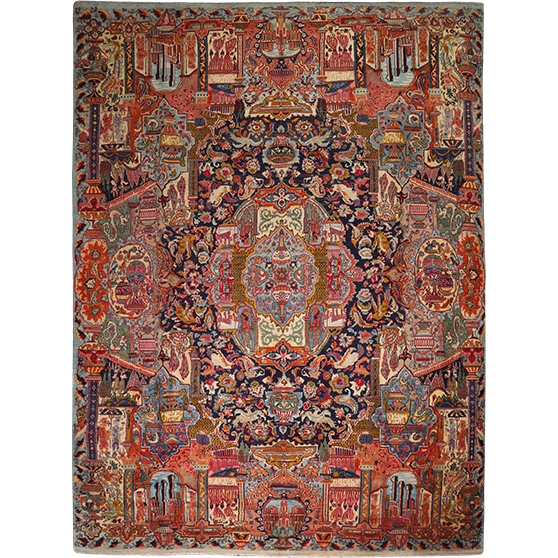
A Kashmar rug of about 13 by 9.75 feet with a garden panel design in madder red and navy blue - Kashmar Persian Rug 13x9 ft - Kheshti Semi Antique Wool Hand Knotted
4
The Garden Panel as a Composite Design
The most common composite design in our collection is the garden panel, known in Persian as Kheshti (from khesht, a brick or tile). The field is divided into squares, rectangles, or diamonds, like the beds of a formal Persian garden, and each panel is filled with a motif: a cypress, a willow, a flowering shrub, a vase of flowers, a boteh, a small animal. Because every panel can hold a different design, a single garden rug may contain a dozen motifs, arranged in a regular grid. The Bakhtiari weavers of the Chaharmahal valleys are the best known for this design, but it is also woven in Khorasan towns such as Kashmar and in the north-west. See our Kheshti designs, our Bakhtiari and Kashmar collections, and our article on Bakhtiari design.
5
Reading a Garden Panel Rug
Start with the grid. Count the panels across and along the rug, and notice whether they are all the same size. Then look at the pattern of motifs: are they repeated in a regular sequence, mirrored around the center, or placed freely? In many rugs, the same few motifs repeat diagonally across the field, so that cypresses line up on one diagonal and flowering trees on another. Finally, look at the colors of the panel grounds. A weaver may alternate red, navy, ivory, and green grounds in a checkerboard rhythm, which gives the field its lively, tiled look.
6
The Prayer Niche as a Composite Design
A mihrab (prayer niche) rug has a pointed arch at one end of the field. In a composite design, the space under the arch is filled with another design: a lattice, a tree, a vase of flowers, or a scattered floral field. Some prayer rugs place two or three small niches side by side, or stack a niche above a panel of garden squares. Our Bijar rug with a prayer design shows how a niche can frame and organize the field beneath it. See our Mihrab designs and our Bijar collection.
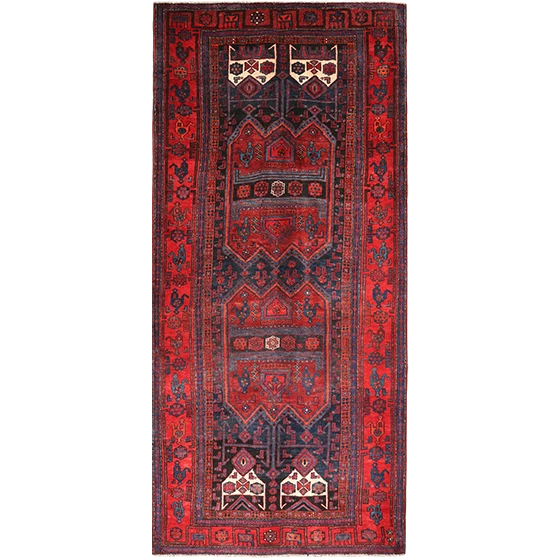
A Bijar rug of about 11 by 4.5 feet with a prayer niche design in crimson, navy blue, and dark red - Bijar Persian Rug 11x4 ft - Mihrab Semi Antique Wool Silk Hand Knotted
7
Panels on a Long Rug
On a long rug or runner, garden panels and mixed motifs work especially well. The field becomes a sequence of compartments that the eye follows from one end to the other, like walking along a garden path. Our Meshkin long rug, from the north-west, uses a garden panel design in madder red, navy, and cream, with bold, geometric motifs in each compartment. See our Meshkin collection.
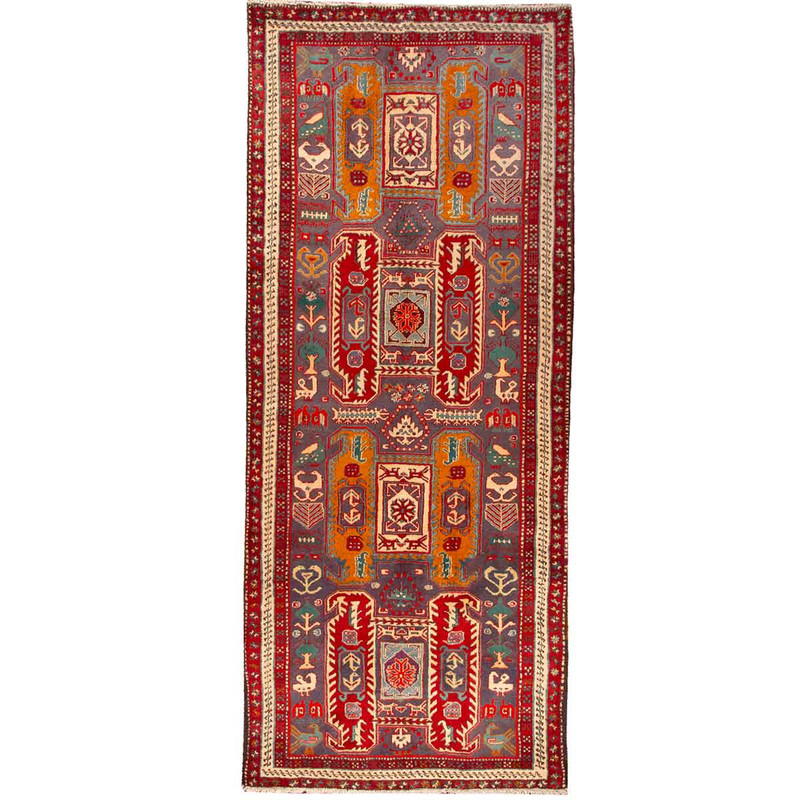
A Meshkin rug of about 10.75 by 4.5 feet with a garden panel design in madder red, navy blue, and cream - Meshkin Persian Rug 10x4 ft - Geometric Semi Antique Wool Hand Knotted
8
Small Composite Pieces
Our collection also includes small square pieces, about 1 by 1 to 2 by 1 feet, that combine several motifs in a compact space: a small medallion with botehs at the corners, a niche with a tiny tree, or a grid of four or six small panels. These pieces are charming on a table, a chest, a shelf, or a wall, and they show in miniature how Persian weavers combine designs.
9
Where Composite Designs Are Woven
Composite designs are found in many weaving traditions, but some are especially known for them:
•
Bakhtiari - Garden panel rugs with many motifs.
•
Khorasan - Panel and garden designs in towns such as Kashmar.
•
North-west - Meshkin, Ardabil, and Tabriz rugs with panels and mixed motifs.
•
Kurdish - Bijar and other rugs with niches and mixed fields.
•
Tribal - Qashqai and Baluch rugs that mix medallions, small figures, and panels freely.
Read more about the regions in our articles on weaving in Bakhtiar and weaving in Khorasan.
10
Composite Designs and Their Relatives
Composite and Kheshti
Every Kheshti rug is a composite of many motifs, but in a regular grid. See our Kheshti designs.
Composite and Mihrab
A prayer rug becomes composite when the field under the niche holds a second design. See our Mihrab designs.
Composite and Tree of Life
A tree of life often appears beneath a niche or inside panels. See our Tree of Life designs.
Composite and Medallion
A medallion over a panel field or lattice is another common combination. See our Medallion designs.
11
Colors of Composite Rugs
Because composite rugs contain many parts, color does much of the work of holding them together. Weavers often use a limited palette, such as madder red, navy, ivory, and green, repeated across all the panels or zones, so that the variety of motifs is balanced by a consistent set of colors. In garden rugs, alternating panel grounds create a checkerboard rhythm; in niche rugs, a contrasting color inside the arch makes the niche stand out. Read more in our articles on natural dyes and the nine ranges of Persian colors.
12
Sizes in Our Collection
Our Composite rugs range from small square pieces of about 1 by 1 foot to long rugs of about 10 to 11 feet and room-size garden rugs of about 12 by 10 to 13 by 9.75 feet. Browse by size: runners, 6x9, 9x12, and 10x13.
13
Choosing a Composite Rug by Room
•
Living rooms - A room-size garden rug gives every part of the room something to look at.
•
Dining rooms - A grid of panels looks balanced from every chair.
•
Hallways - A long panel rug becomes a path through a garden.
•
Studies and libraries - A rug full of stories suits a room for reading and thinking.
•
Walls and tables - Small composite pieces work as textile art.
14
Matching a Composite Rug to Your Room
A composite rug is busy and full of incident, so it pairs best with calm surroundings. Plain walls, solid upholstery, and simple furniture let the rug's many parts be seen. Choose one or two colors from the rug, such as the navy of the panel frames or the green of a cypress, and repeat them in textiles. Avoid other strong patterns nearby; let the rug be the story in the room.
15
Why Weavers Combine Designs
There are several reasons a weaver might combine designs. In village and tribal weaving, designs were kept in memory, and a weaver with a rich repertoire might want to show many of the motifs she knew in a single rug, especially in a dowry piece. In garden rugs, the combination follows the idea of the Persian garden itself, where many plants grow side by side within an ordered plan. In prayer rugs, the niche gives the rug a direction and a purpose, while the field beneath it adds beauty and meaning. And in some workshops, combining designs was a way to create something new for the market while staying within a familiar vocabulary.
16
The Persian Garden Behind the Grid
The garden has long been one of the central images of Persian art. A formal Persian garden, or chahar bagh, is divided by water channels and paths into regular beds, each planted with trees and flowers. Garden carpets of the Safavid period showed this plan directly, with channels, fish, and flower beds seen from above. Later garden panel rugs simplified the plan into a grid of compartments, but the idea remains: a rug that brings an ordered garden into the home. Read more in our article on garden design.
17
Motifs You May Find in the Panels
•
Cypress - A tall, slender tree, a symbol of life and endurance. See our Cypress Tree designs.
•
Willow - A drooping tree, sometimes linked with remembrance.
•
Flowering tree - A tree in blossom, often with birds.
•
Vase of flowers - Flowers rising from a small vase. See our Vase designs.
•
Boteh - The Persian paisley. See our Boteh designs.
•
Rosette or star - A round flower or a geometric star. See our Rosette designs.
•
Small animals and birds - Deer, birds, or lions in some tribal and village rugs.
The meanings people attach to these motifs are traditions and interpretations rather than fixed rules. Read more in our articles on design motifs and the tree of life.
18
Village and City Composites
In city workshops, composite designs are drawn on a cartoon, and the parts fit together precisely: panels are equal, curves are smooth, and motifs are mirrored exactly. In village and tribal weaving, the composition is freer. A panel may be a little wider than its neighbor, a motif may change halfway along the rug, or the weaver may run out of space and adjust the last row of panels. These differences are part of the character of a village composite and often make it more lively than a perfectly regular city rug.
19
Living with a Composite Rug
A composite rug is one you keep discovering. In the first days, you see the overall grid or the shape of the niche. Over months, you begin to notice individual panels, small animals, a change in a tree's branches, a color that appears only once. Many owners enjoy pointing out details to guests, and children often love finding animals and trees in garden rugs. Few designs offer as much to look at over the years.
20
Borders That Hold It Together
With so much happening in the field, the borders of a composite rug carry a special responsibility. A strong main border, often with a repeating rosette or a reciprocal pattern, frames the field like a garden wall. In garden panel rugs, the lines between the panels act as inner borders, and they are often drawn in a contrasting color with small repeating motifs of their own. Look at how the inner lines meet the main border: in a well woven rug, the grid ends cleanly against the frame.
21
Combining a Composite Rug with Other Rugs
A composite rug is a strong statement, so pair it with quieter rugs in neighboring rooms. A garden panel rug in a living room can lead into a hallway with a simple lattice or Afshan runner in a similar palette. Two composite rugs side by side can compete for attention; keep one or two colors in common and vary the scale of the patterns.
22
Photographs and Real Color
Panel rugs with many colors can look different on screen depending on the light. Daylight from a north window shows the truest colors. If color matters for your space, ask us for extra photographs in daylight or close-ups of individual panels.
23
Composite Designs as Storytelling
Many people describe Persian rugs as stories woven in wool, and composite rugs make the idea easy to see. A garden rug reads like a walk through a garden, panel by panel. A prayer rug with a tree beneath its niche reads like a picture of paradise seen through a doorway. A tribal rug with a medallion, small animals, and a band of stars can read like a record of the weaver's world. Read more about this way of looking in how to read a Persian rug and how to see beauty in a Persian rug.
24
How to Judge a Composite Rug
•
Unity - The parts should feel like one design, not a collection of fragments.
•
Framework - Panel lines and borders drawn evenly and straight.
•
Drawing - Clear motifs in each compartment.
•
Color balance - A consistent palette across all zones.
•
Condition - Even pile, intact sides and ends.
25
Questions to Ask Before You Buy
•
Which designs are combined? - Helps you describe and compare rugs.
•
Where was it woven? - Bakhtiari, Khorasan, north-western, and tribal composites differ.
•
What are the measurements at both ends? - Checks that the rug is straight.
•
Is the pile even? - Check for worn areas.
•
Has it been repaired? - Especially along the sides and at the ends.
Read our notes on what to know before you buy and our guide on how to buy a Persian rug.
26
Hanging a Small Composite Piece
Small composite pieces make lovely wall hangings, where their many motifs can be seen at eye level. Sew a strip of cotton webbing or a fabric sleeve to the back along the top edge, and hang it from a rod or a strip of Velcro fixed to the wall. Never nail or staple through the rug. Keep it away from direct sun and from heat sources such as radiators, and take it down once a year to vacuum it gently on both sides.
27
Caring for a Composite Rug
Vacuum regularly without a beater bar. Rotate the rug every few months so that wear and light are spread evenly. Use a non-slip pad. Blot spills at once with a clean, white cloth and cold water. Have it professionally washed every year or two in busy areas. See our care instructions and our article on professional washing.
28
Frequently Asked Questions
What is a composite rug design?
A design that combines two or more layouts, such as panels with different motifs or a niche over a lattice.
Is a Kheshti rug a composite design?
Yes, in the sense that it combines many motifs in a grid of panels.
Which weavers are known for composite designs?
Bakhtiari weavers above all, as well as weavers in Khorasan, the north-west, Kurdish regions, and tribal groups.
Are composite rugs hard to place?
Not if the surroundings are calm. Plain walls and simple furniture let the rug's details show.
What sizes do you have?
From small square pieces to long rugs and room-size garden rugs.
Do the motifs in the panels have meanings?
Many motifs carry traditional associations, such as the cypress with life and endurance, but these are interpretations rather than fixed rules.
How should I care for a composite rug?
Vacuum regularly without a beater bar, rotate it, use a pad, and have it professionally washed regularly.
Can I see more photographs?
Yes. Ask us for daylight photographs, close-ups of individual panels, or pictures of the back of any rug.
Can a small composite piece hang on a wall?
Yes, mounted on a fabric sleeve or a strip of Velcro, never nailed.
Are composite rugs hand-knotted?
Yes. Every rug in our collection is hand-knotted.
Is a composite rug a good first Persian rug?
Yes, if you enjoy detail. It offers more to look at than almost any other design, and its busy field is forgiving in everyday use.
Which rooms suit a composite rug best?
Living rooms, dining rooms, studies, and hallways, wherever calm surroundings let its details show.
29
Choose Your Composite Rug
Each rug in our collection is hand-knotted, one of a kind, and inspected before it is listed. Browse our Composite rugs, compare with our Kheshti and Mihrab designs, or ask our experts for help.