


Look closely at the field of a fine Persian city rug and you will often see thin, curling lines running beneath the flowers: vines that spiral, branch, split into forked leaves, and curl back on themselves in an endless rhythm. This is the Eslimi, the Persian arabesque. It is one of the oldest and most important systems of ornament in Persian art, used for centuries in tile panels, carved stucco, illuminated manuscripts, metalwork, and textiles. In rugs, it gives the field a sense of continuous, flowing movement.
This guide explains what an Eslimi is, how it differs from the related Khatai floral system, how to recognize and read it in a rug, how it appears in city, village, and tribal weaving, and how to choose, place, and care for an Eslimi rug like those in our collection. For the wider language of Persian patterns, see our articles on Persian rug design and design motifs.
1
What Is an Eslimi?
An Eslimi is a stylized vine made of spiraling stems and split leaves: leaves that fork into two curling tips, like a stylized wing or a pair of horns. The stems spiral outward, branch, and meet other spirals, so that the whole field is covered by an interlocking network of curves. Unlike a naturalistic plant, an Eslimi does not grow from a root toward the light; it spreads in every direction, endlessly, without beginning or end. That sense of infinite continuity is the heart of the design.
The word is generally linked in Persian to the Islamic arts (eslimi, from Islam), but the spiraling vine has older roots in the art of the region, and Persian artists developed it into one of their most distinctive forms of ornament.
Eslimi (Islimi) is the Persian arabesque: spiraling vines with forked, split leaves that interlock across the field in a continuous, endless pattern.
2
Eslimi and Khatai
Persian designers traditionally distinguish two systems of ornament that often work together:
•
Eslimi - Spiraling vines and split leaves, abstract and rhythmic.
•
Khatai - Flowers, buds, palmettes, and leafy stems, more floral and naturalistic.
In many Persian rugs, the two are layered: an Eslimi network of spirals forms the skeleton of the field, and Khatai flowers and palmettes sit along it, at the turns and meeting points of the spirals. When dealers call a rug "Eslimi," they usually mean that the arabesque spirals are prominent enough to define the design, rather than hidden beneath flowers.
3
How to Recognize an Eslimi Rug
•
Spiraling stems - Curling vines that turn in regular arcs.
•
Split leaves - Forked leaf tips at the ends and turns of the vines.
•
Interlocking network - Spirals that meet and overlap to cover the field.
•
Symmetry - Mirrored spirals, especially around a medallion.
•
Continuous movement - No dead ends; the eye can follow a vine across the rug.
•
Layered drawing - Often two networks of vines in different colors, one over the other.
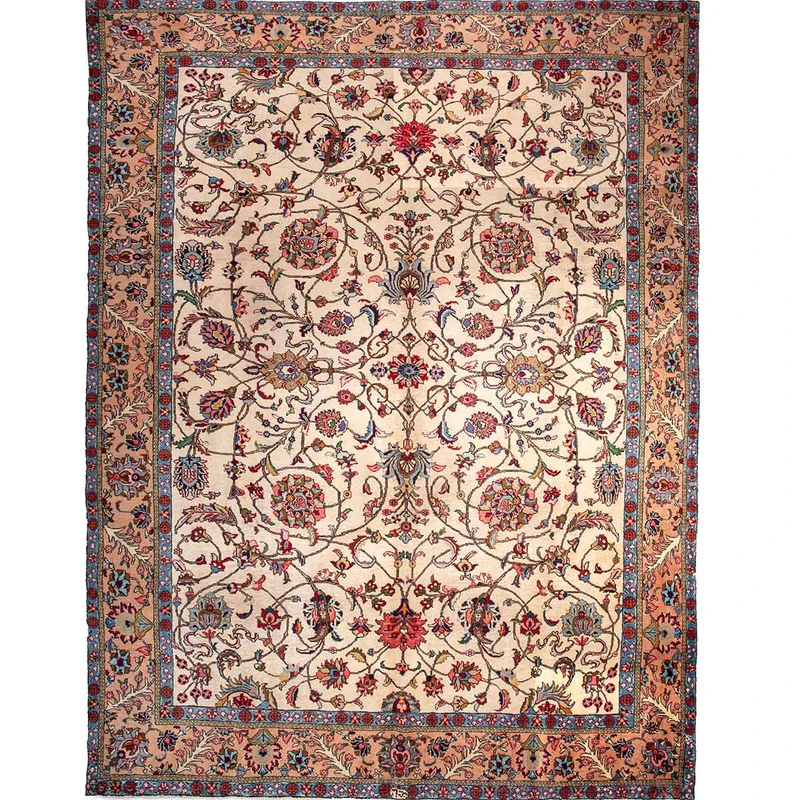
A Tabriz rug of about 13.5 by 6.75 feet with an Eslimi arabesque design in cream, madder red, and terracotta - Tabriz Persian Rug 13x6 ft - Eslimi Semi Antique Wool Silk Hand Knotted
4
Reading an Eslimi Field
Start by finding a single vine and following it. Notice how it curls into a spiral, splits into a forked leaf, and sends out a branch that becomes the next spiral. Then look for the second layer: in many city rugs, there are two Eslimi networks drawn in different colors, one thicker and one finer, overlapping like two transparent sheets of lace. Finally, look at where the flowers sit. In a good Eslimi design, every flower is placed at a meaningful point in the network, so the whole field feels organized and alive at the same time.
5
Eslimi Around a Medallion
Many of the finest Eslimi rugs combine the arabesque with a central medallion. The medallion itself may be built from Eslimi spirals, and the field around it is filled with mirrored scrolls that radiate from the center toward the corners. This layout is classic in Tabriz, Kashan, Isfahan, and Arak-region rugs. The Eslimi gives the field movement, and the medallion gives it a focus. Our Kashan rug with a medallion shows how the two work together. See our Medallion designs and our Kashan collection.
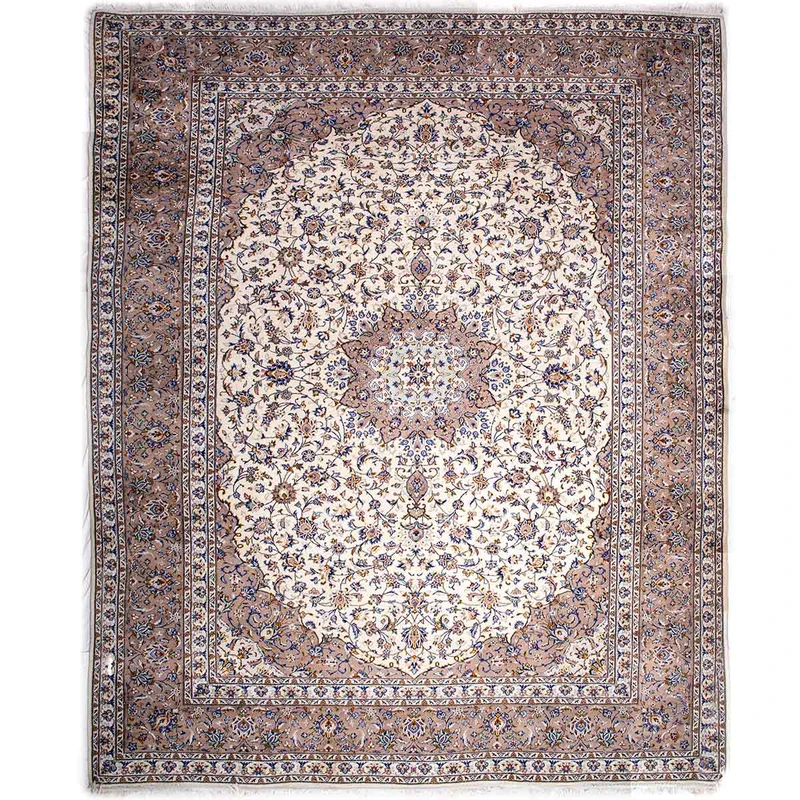
A Kashan rug of about 13 by 9.75 feet with a medallion and Eslimi scrolls in cream, brown, and navy blue - Kashan Persian Rug 12x9 ft - Medallion Semi Antique Wool Silk Hand Knotted
6
Eslimi on Runners
On a runner, the Eslimi becomes a flowing chain of spirals that travels the length of the rug. Arak, Mahal, Ferdows, and Meshkabad runners in our collection use Eslimi scrolls in this way, often on cream or red grounds, with the spirals mirrored along the center line. Our antique Meshkabad runner shows how graceful the arabesque can be in a long, narrow format. See our Meshkabad, Arak, and Ferdows collections.
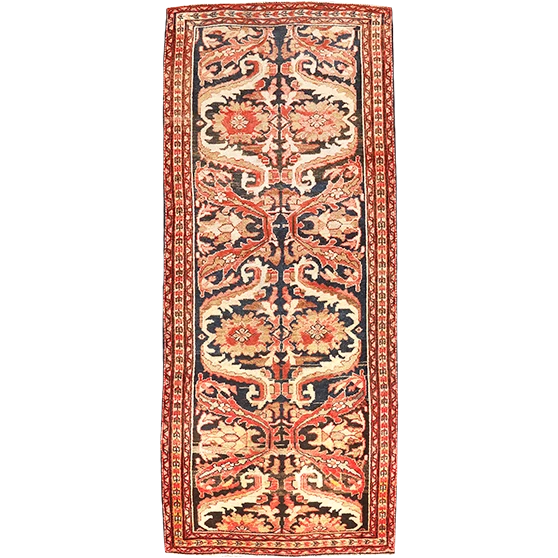
An antique Meshkabad runner of about 9.5 by 3.75 feet with Eslimi patterns in cream, madder red, and navy blue - Meshkabad Persian Rug 9x3 ft - Eslimi Antique Wool Hand Knotted
7
City Eslimi Rugs
The Eslimi reaches its greatest refinement in city rugs woven from a full cartoon. In Tabriz, designers draw complex, multi-layered arabesques in many shades; in Isfahan, Eslimi scrolls echo the tilework of Safavid mosques; in Kashan and the Arak region, they frame bold medallions in classic reds and navies. Fine knotting is needed to draw smooth spirals, so Eslimi rugs are typically city or workshop pieces. Read more in our articles on Tabriz rug painters and Isfahan rugs and Safavid architecture.
8
Village and Tribal Eslimi
When village weavers adopt the Eslimi, the curves become angular. Spirals turn into stepped hooks, split leaves become geometric forks, and the network becomes simpler and bolder. In Heriz and Sharabian rugs, for example, the angular Eslimi gives medallions and corners their characteristic crisp, architectural look. These angular arabesques are a fascinating example of how a city design is translated into the language of village weaving. See our Heriz and Sharabian collections.
9
Forms of the Eslimi
Persian ornament traditions name several forms of the arabesque, and designers use these names to describe the shape of the leaves and spirals. Among them are the simple Eslimi with plain split leaves, and the dahan-ezhdari or "dragon-mouth" Eslimi, whose leaf tips open like a mouth. Other forms are named after the way the spirals are arranged or filled. These terms come from the craft tradition of designers and illuminators, and different sources use them in slightly different ways.
10
Eslimi and Related Designs
Eslimi and Afshan
An Afshan field scatters flowers over the field, often linked by Eslimi vines. See our Afshan designs.
Eslimi and Shah Abbasi
Shah Abbasi palmettes are large Khatai flowers often set along Eslimi spirals. See our Shah Abbasi designs.
Eslimi and Herati
The Herati is a small, regular repeat; the Eslimi is a large, flowing network. See our Herati designs.
Eslimi and Medallion
Medallions and Eslimi fields are among the most common combinations in city rugs. See our Medallion designs.
11
Colors of Eslimi Rugs
Eslimi rugs often use contrast to make the spirals visible: cream vines on a red ground, red vines on a navy ground, or two networks in different colors on a cream field. Our Tabriz rug uses cream, madder red, and terracotta; our Kashan uses cream, brown, and navy; our Meshkabad runner combines cream, madder red, and navy. Read more in our articles on natural dyes and the nine ranges of Persian colors.
12
Sizes in Our Collection
Our Eslimi rugs include small rugs of about 4 by 2 to 4 by 3 feet, long runners of about 9 to 13 feet from Arak, Mahal, Ferdows, and Meshkabad, a long Tabriz rug of about 13.5 by 6.75 feet, and many room-size medallion rugs with Eslimi fields from Kashan, Mahal, Bakhtiari, and other centers. Browse by size: runners, 4x6, 9x12, and 10x13.
13
Choosing an Eslimi Rug by Room
•
Living rooms - A room-size Eslimi medallion rug brings movement and elegance.
•
Dining rooms - Mirrored spirals look balanced from every side.
•
Hallways - An Eslimi runner flows along the passage.
•
Formal rooms - City Eslimi rugs suit classic, refined interiors.
•
Modern rooms - The abstract spirals also suit contemporary spaces.
14
Matching an Eslimi Rug to Your Room
An Eslimi rug is full of curves, so it pairs well with straight lines: simple furniture, plain walls, and clean architecture let the arabesque stand out. Pick one or two colors from the rug, such as the cream of the vines or the red of the ground, and repeat them in textiles. Avoid busy curving patterns in curtains or upholstery nearby; let the rug provide the movement.
15
The Eslimi Beyond Rugs
To understand the Eslimi in rugs, it helps to see it in the other Persian arts. On the tiled domes and portals of Safavid mosques in Isfahan, Eslimi spirals in white and gold cover vast surfaces of blue tile. In illuminated manuscripts, the opening pages are framed by Eslimi scrolls in gold and lapis. In carved stucco and wood, the same spirals cast soft shadows. Carpet designers drew on this shared vocabulary, often working in the same workshops as illuminators and tile designers, and the Eslimi in a rug is part of this larger family of Persian ornament. Read more about the link between rugs and architecture in our article on Isfahan rugs and Safavid architecture.
16
A Short History of the Arabesque in Rugs
Spiraling vine scrolls appear in the art of the region long before the great Persian carpets, but it was in the court workshops of the Timurid and Safavid periods, from the fifteenth to the seventeenth centuries, that the Eslimi reached its most elaborate form in carpets. Court designers created rugs with several overlapping layers of spirals, each in a different color, covering vast fields with breathtaking complexity. From these court pieces, the Eslimi passed to city workshops in Tabriz, Kashan, Isfahan, and Kerman, and from there to village weavers, who simplified and reinterpreted it. Read more in our articles on weaving from 1499 to 1722 and from 1722 to 1925.
17
How an Eslimi Is Designed
An Eslimi rug begins with the designer, not the weaver. The designer draws the spirals on squared paper, usually one quarter of the field, so that the weaver can mirror it to complete the rug. The design must work at two scales: as a whole, the spirals should create a balanced, flowing composition; up close, every leaf and curve should be crisp when translated into knots. This is skilled work, and the best Eslimi designers were highly respected artists. Read about the designers of Tabriz in our article on Tabriz rug painters.
18
Why Fine Knotting Matters
Curves are hard to weave. A rug is built from rows of knots, like pixels in a digital image, so a smooth spiral can only be drawn if the knots are small enough. In a coarse rug, a spiral becomes a series of steps; in a fine rug, it looks like a smooth line. That is why the most fluid Eslimi designs come from finely knotted city rugs, while village versions are angular. When you look at an Eslimi rug up close, notice how smoothly the curves are drawn: it is a good sign of the rug's fineness.
19
Living with an Eslimi Rug
An Eslimi rug rewards long looking. At first you see the overall rhythm of the spirals; over time, you begin to follow individual vines, notice where they split and rejoin, and discover how each flower is placed. Many owners describe a sense of calm in following the endless curves, a quality that has made the arabesque one of the most enduring designs in Persian art.
20
Borders with Eslimi Scrolls
The Eslimi is not only a field design. Many Persian rugs use an Eslimi scroll in the main border: a continuous vine that undulates around the rug, with split leaves and palmettes at each turn. A good Eslimi border turns the corners smoothly, without a break in the vine, which is a sign of careful drawing. Even when the field uses another design, such as a Herati or a medallion, an Eslimi border can give the whole rug a sense of graceful movement.
21
Eslimi in Medallions and Corners
Look closely at the medallion of a classic city rug and you will often find the Eslimi inside it. The outline of the medallion may be formed by Eslimi scrolls, and its center may hold a smaller rosette surrounded by mirrored spirals. The corner pieces, or spandrels, often repeat a quarter of the medallion, with Eslimi vines curling toward the center. Recognizing the Eslimi in these places helps you understand how the whole rug is built from a few shared elements.
22
Combining an Eslimi Rug with Other Rugs
An Eslimi rug pairs well with calmer designs nearby. A room-size Eslimi medallion rug in a living room can lead into a hallway with a lattice or Herati runner in a similar palette, where the straight lines of the grid balance the curves of the arabesque. Keep one or two colors in common and vary the scale of the patterns.
23
Photographs and Real Color
Creams, reds, and terracottas can look different on screen depending on the light. Daylight from a north window shows the truest colors. If color matters for your space, ask us for extra photographs in daylight or close-ups of the spirals.
24
Where Eslimi Rugs Are Woven
•
Tabriz - Complex, multi-layered arabesques in many shades.
•
Kashan - Classic Eslimi fields around bold medallions.
•
Isfahan and Najafabad - Arabesques that echo Safavid tilework.
•
Arak region - Mahal, Meshkabad, and Arak rugs and runners with Eslimi scrolls.
•
Khorasan - Ferdows and Kashmar rugs with flowing vines.
•
Heriz and Sharabian - Angular, geometric versions of the Eslimi.
Read more in our articles on weaving in Kashan and weaving in Arak.
25
The Meaning of Endless Spirals
Many writers see in the endless Eslimi a reflection of ideas found throughout Persian art: growth without end, the unity of many parts in one whole, and a garden that never stops blooming. Others see it simply as a brilliant solution to a design problem, a way to cover a large surface with ornament that never feels repetitive. Both readings help explain why the Eslimi has remained central to Persian art for so many centuries. Read more in how to read a Persian rug.
26
How to Judge an Eslimi Rug
•
Flow - Smooth, continuous spirals without awkward breaks.
•
Symmetry - Mirrored scrolls that match across the field.
•
Drawing - Crisp split leaves and clear outlines.
•
Contrast - Vines clearly visible against the ground.
•
Knotting - Fine enough to draw curves smoothly.
•
Condition - Even pile, intact sides and ends.
27
Questions to Ask Before You Buy
•
Where was it woven? - City and village Eslimis differ greatly.
•
What are the measurements at both ends? - Checks that the rug is straight.
•
Is the pile even? - Check for worn areas.
•
Has it been repaired? - Especially along the sides and at the ends.
•
Has it been washed recently? - A fresh wash shows the true colors.
Read our notes on what to know before you buy and our guide on how to buy a Persian rug.
28
Caring for an Eslimi Rug
Vacuum regularly without a beater bar. Rotate the rug every few months so that wear and light are spread evenly. Use a non-slip pad. Blot spills at once with a clean, white cloth and cold water. Have it professionally washed every year or two in busy areas; cream grounds may need it more often. See our care instructions and our article on professional washing.
29
Frequently Asked Questions
What is an Eslimi design?
The Persian arabesque: spiraling vines with forked, split leaves that interlock across the field.
Is Eslimi the same as Islimi?
Yes. They are two spellings of the same Persian word.
What is the difference between Eslimi and Khatai?
Eslimi is the spiral and split-leaf system; Khatai is the floral system of flowers and palmettes. Many rugs combine both.
Which rugs use Eslimi designs?
City rugs from Tabriz, Kashan, Isfahan, and the Arak region above all, and in angular form, Heriz and Sharabian rugs.
Does an Eslimi rug have a medallion?
Often, but not always. The arabesque can frame a medallion or fill the whole field.
What sizes do you have?
From small rugs and long runners to room-size rugs.
Why are city Eslimi rugs smoother than village ones?
Fine knotting lets the weaver draw smooth curves; in coarser village rugs, the spirals become stepped and angular.
How should I care for an Eslimi rug?
Vacuum regularly without a beater bar, rotate it, use a pad, and have it professionally washed regularly.
Can I see more photographs?
Yes. Ask us for daylight photographs, close-ups of the spirals, or pictures of the back of any rug.
Does an Eslimi suit a modern interior?
Yes. The abstract spirals pair well with straight lines, plain walls, and simple furniture.
Are Eslimi rugs hand-knotted?
Yes. Every rug in our collection is hand-knotted.
What is a dragon-mouth Eslimi?
A form whose split leaf tips open like a mouth, called dahan-ezhdari in Persian.
30
Choose Your Eslimi Rug
Each rug in our collection is hand-knotted, one of a kind, and inspected before it is listed. Browse our Eslimi rugs, compare with our Afshan and Shah Abbasi designs, or ask our experts for help.