


Imagine looking down on a Persian garden from above: paths and water channels divide the ground into regular beds, and each bed holds its own planting, a cypress here, a flowering tree there, a rose bush, a willow beside the water. A Kheshti rug captures that view. Its field is divided into a grid of panels, and each panel holds a motif, so the whole rug becomes a garden of many plants arranged in perfect order.
This guide explains what Kheshti means, how the grid is built, how to read the motifs in the panels, how the design varies from Bakhtiari to Khorasan and other regions, and how to choose, place, and care for a Kheshti rug like those in our collection. For the wider language of Persian patterns, see our articles on Persian rug design and garden design.
1
What Kheshti Means
Khesht is the Persian word for a brick, especially the sun-dried mud bricks used for centuries in Persian building, and by extension a tile. A Kheshti design is therefore a "brick" or "tile" design: a field made of panels laid side by side like tiles on a floor. In English, the design is often called the garden or panel design, and in the trade it is sometimes called Khesti or Kheshti garden. All these names describe the same idea: a field divided into compartments, each with its own motif.
Kheshti means brick or tile. A Kheshti rug divides the field into panels like the beds of a Persian garden, each filled with a tree, flower, vase, or boteh.
2
How to Recognize a Kheshti Rug
•
A grid of panels - Squares, rectangles, or diamonds across the field.
•
A motif in each panel - Trees, flowers, vases, botehs, or small medallions.
•
Framing lines - Narrow borders around each panel, often with small repeating motifs.
•
Alternating grounds - Panels in different background colors.
•
Diagonal rhythm - The same motif often repeats along a diagonal.
•
No dominant medallion - The grid itself is the design.
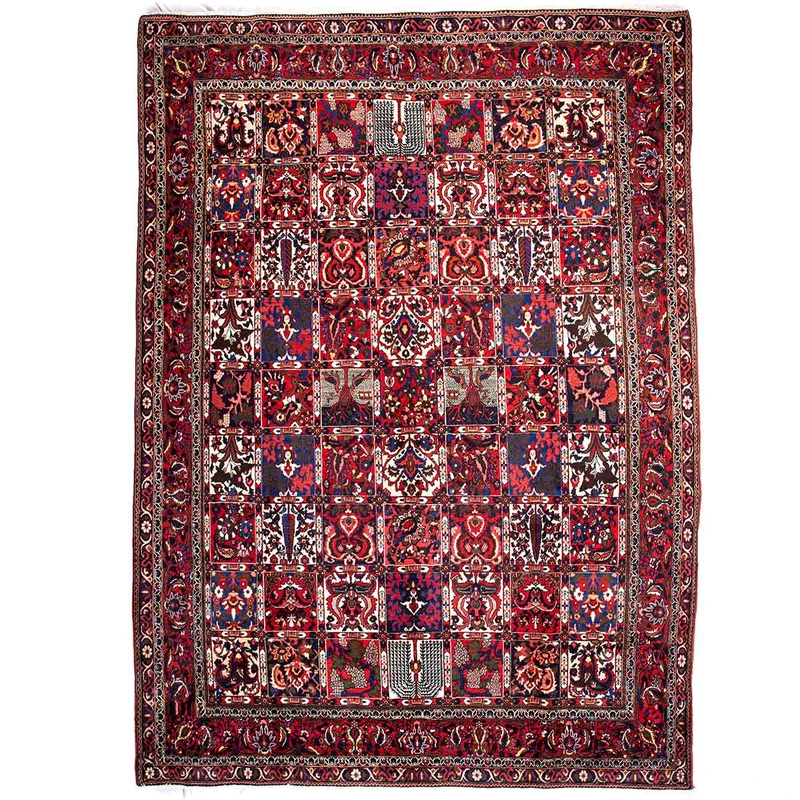
A Bakhtiari rug of about 12 by 8.75 feet with a Kheshti garden panel design in dark red, crimson, and navy blue - Bakhtiari Persian Rug 12x8 ft - Kheshti Semi Antique Wool Hand Knotted
3
Reading the Grid
Start by counting the panels: how many across, how many along the rug. Notice whether they are squares, rectangles, or diamonds, and whether they are all the same size. Then look at the lines between them: in many Bakhtiari rugs, each panel is framed by a narrow border with its own small pattern, so the grid becomes a lattice of decorated bands. Finally, look at the panel grounds: weavers often alternate red, navy, ivory, green, and gold grounds in a pattern that runs diagonally across the field, like a checkerboard.
4
Reading the Motifs
Each panel holds a motif, and part of the pleasure of a Kheshti rug is finding them all. Common panel motifs include:
•
Cypress - Tall and slender, a symbol of life and endurance. See our Cypress Tree designs.
•
Willow - A drooping tree, often in alternate panels with the cypress.
•
Flowering tree - A tree in blossom, sometimes with birds.
•
Vase of flowers - Flowers rising from a vase. See our Vase designs.
•
Boteh - The Persian paisley. See our Boteh designs.
•
Rosette or small medallion - A round flower or small geometric medallion.
•
Animals and birds - Occasional small figures in village rugs.
The motifs often repeat in a regular sequence, so that cypresses line up along one diagonal and flowering trees along another. In some rugs, every panel is different. The traditional meanings attached to these motifs, such as the cypress for endurance and the flowering tree for renewal, are interpretations rather than fixed rules. Read more in our article on the tree of life.
5
The Bakhtiari Garden Rug
The Kheshti is above all the design of the Bakhtiari weavers of Chaharmahal and Bakhtiari, in the Zagros valleys west of Isfahan. Their garden rugs are sturdy, thick village rugs, often in room sizes and wide formats, with bold panels in strong reds, navies, ivories, greens, and golds. Villages such as Chaleshtar, Shalamzar, and Saman are known in the trade for Bakhtiari rugs of different grades. A Bakhtiari Kheshti is one of the most recognizable rugs in Persian weaving. See our Bakhtiari collection and our articles on Bakhtiari design and weaving in Bakhtiar.
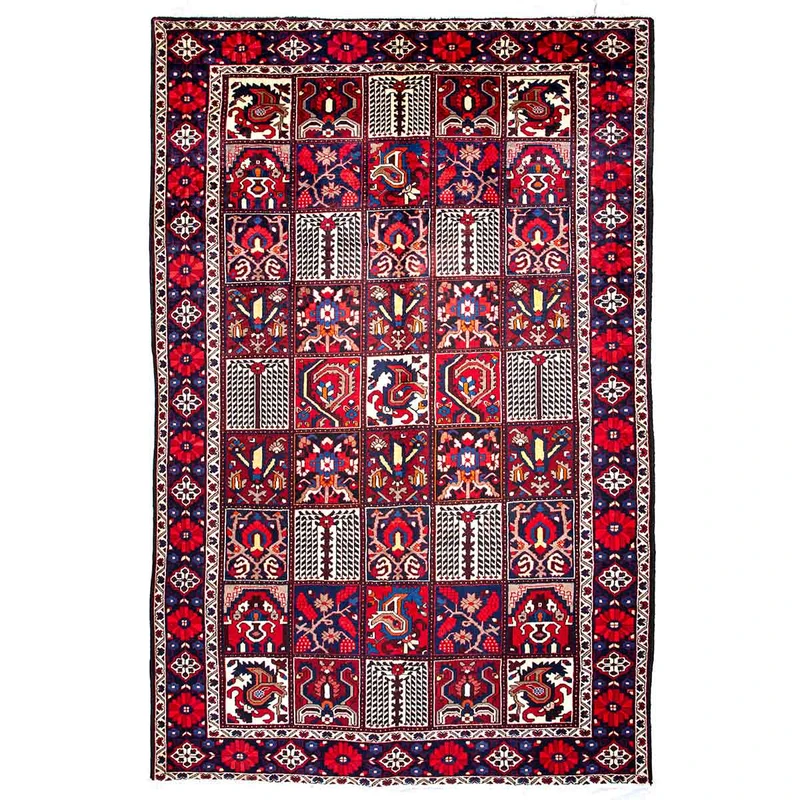
A Bakhtiari rug of about 10.25 by 6.5 feet with a Kheshti design in madder red, navy blue, and cream - Bakhtiari Persian Rug 10x6 ft - Kheshti Semi Antique Wool Hand Knotted
6
Kheshti in Khorasan
Garden panel designs are also woven in Khorasan, in north-eastern Persia, in towns such as Kashmar, where the panels may be drawn in a finer, more curvilinear style and in softer colors such as cream, brown, and madder red. These rugs show how the same idea can take on a city-like refinement. See our Khorasan and Kashmar collections and our article on weaving in Khorasan.
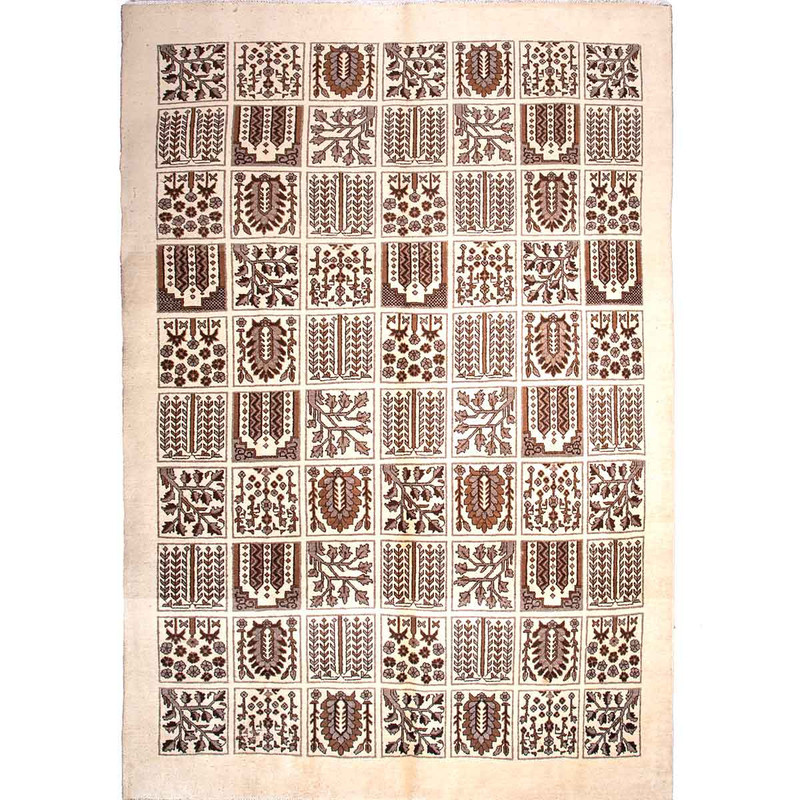
A Khorasan rug of about 11 by 7.5 feet with a Kheshti garden design in cream, brown, and madder red - Khorasan Persian Rug 10x7 ft - Kheshti Semi Antique Wool Silk Hand Knotted
7
Kheshti in Other Regions
Garden panel designs also appear in Kurdish and north-western rugs, in Tabriz workshops, and in some tribal weaving, each with its own drawing and palette. Small Tabriz pieces may hold a few delicate panels; Kurdish rugs may use bold, geometric panels. See our Kurdish and Tabriz collections.
8
The Persian Garden Behind the Grid
The garden has been central to Persian culture for thousands of years. The classic Persian garden, the chahar bagh or fourfold garden, is divided by water channels into four parts, each further divided into beds of trees and flowers. Safavid garden carpets showed this plan directly, with channels, fish, and flower beds. The Kheshti design simplifies the plan into a regular grid, but the idea remains: a rug that brings an ordered, ever-blooming garden into the home. Several Persian gardens are listed together by UNESCO as The Persian Garden.
9
Kheshti and Related Designs
Kheshti and Composite
A Kheshti rug combines many motifs in one field, which makes it a kind of composite design. See our Composite designs.
Kheshti and Diamond Lattice
A diamond lattice divides the field into diamonds rather than squares. See our Diamond Lattice designs.
Kheshti and Tree of Life
Trees are the most common panel motif. See our Tree of Life designs.
Kheshti and Mihrab
Some prayer rugs place garden panels beneath the niche. See our Mihrab designs.
10
Colors of Kheshti Rugs
Kheshti rugs use color to make the grid come alive. Bakhtiari rugs alternate panel grounds in madder red, navy, ivory, green, and gold, with motifs in contrasting colors, so that the field looks like a quilt or a tiled floor. Khorasan rugs often use softer palettes of cream, brown, and madder red. Read more in our articles on natural dyes and the nine ranges of Persian colors.
11
Sizes in Our Collection
Our Kheshti rugs include room-size Bakhtiari garden rugs of about 12 by 8.75 to 12.5 by 10.25 feet, long and medium rugs of about 9 by 6 to 10.25 by 7 feet, a Kashmar rug of about 13 by 9.75 feet, and small Tabriz and Zanjan pieces. Browse by size: 6x9, 8x11, 9x12, and 10x13.
12
Choosing a Kheshti Rug by Room
•
Living rooms - A garden rug gives every part of the room something to look at.
•
Dining rooms - The grid looks balanced from every chair.
•
Family rooms - Sturdy Bakhtiari rugs suit everyday use.
•
Studies - A rug full of trees and flowers suits a quiet room.
•
Children's rooms - Children love finding the trees and animals.
13
Matching a Kheshti Rug to Your Room
A Kheshti rug is busy and colorful, so it pairs best with calm surroundings. Plain walls, solid upholstery, and simple furniture let the panels be seen. Pick one or two colors from the rug, such as the green of the cypresses or the red of the panel grounds, and repeat them in textiles. In a modern room, the grid of a Kheshti rug echoes the geometry of windows, shelving, and tiles.
14
How a Kheshti Rug Is Woven
A garden panel rug is a clever design for a village weaver. The grid gives the rug a clear framework: once the weaver knows the size of the panels and the width of the framing lines, she can build the field step by step, one row of panels at a time. Each panel holds one motif, which she knows by heart, and she can vary the motifs and colors as she goes. Bakhtiari weavers traditionally worked on upright looms in village homes, often from memory or a small sample, and the grid let them weave large, complex rugs without a full cartoon. Read more about the people behind the rugs in our article on the craft from shepherd to dealer.
15
The Bakhtiari Build
Bakhtiari Kheshti rugs are known for their sturdy construction. They are usually woven with the symmetric knot on a cotton foundation, often double-wefted, with a thick wool pile from the flocks of the Zagros. The result is a heavy, durable rug that lies flat and stands up well to daily use. That is one reason Bakhtiari garden rugs are so popular in family homes: they combine a rich, detailed design with a practical, hard-wearing build. Read more about the region in our article on weaving in Chaharmahal.
16
Square, Rectangular, and Diamond Panels
Not all Kheshti rugs use the same grid. The most common form uses squares or near-squares in a regular checkerboard. Some rugs use tall rectangles, which suit trees like cypresses and willows. Others turn the grid on its side to make diamond panels, which blur the line between the Kheshti and the diamond lattice. A few rugs mix panel shapes, with large panels at the center and smaller ones at the edges. Each grid gives the rug a different rhythm, from calm and orderly to lively and dynamic.
17
Panels and Medallions
Some Kheshti rugs add a central medallion over the grid, or replace the central panels with a larger compartment holding a medallion or a vase of flowers. These rugs combine the focus of a medallion with the richness of a garden field. Others place a small medallion inside every panel, so that the grid becomes a field of small medallions. Looking for these variations is part of the pleasure of browsing garden rugs. See our Medallion designs.
18
Borders of Garden Rugs
The borders of a Kheshti rug frame the garden like a wall. A main border of repeating rosettes, palmettes, or a geometric vine is usually flanked by narrow guard stripes. Because the field is so busy, many garden rugs use a border with a calmer, more regular pattern, and often a contrasting ground color, so that the grid is clearly framed. Look at how the panel lines meet the border: in a well woven rug, the grid ends cleanly against the frame.
19
Living with a Kheshti Rug
A garden rug is one you keep discovering. In the first days, you see the grid and the overall color. Over time, you begin to notice individual panels: a cypress drawn a little differently, a bird in a flowering tree, a panel whose color appears nowhere else. Children often love finding the trees and animals, and guests enjoy pointing out details. Few designs offer as much to look at over the years, and few feel as welcoming as a garden that blooms on the floor in every season.
20
Combining a Kheshti Rug with Other Rugs
A Kheshti rug is a strong statement, so pair it with quieter designs nearby. A garden rug in the living room can lead into a hallway with a simple Herati or lattice runner in a similar palette. Two garden rugs in neighboring rooms can work if they share colors and differ in scale. Keep one or two colors in common and let the garden rug be the star.
21
Photographs and Real Color
Garden rugs with many colors can look different on screen depending on the light. Daylight from a north window shows the truest colors. If color matters for your space, ask us for extra photographs in daylight or close-ups of individual panels.
22
The Garden Carpets of the Past
The Kheshti design has distinguished ancestors. In the Safavid period, Persian workshops wove great garden carpets that showed a formal garden seen from above: water channels with fish and ducks, paths, pavilions, and beds of trees and flowers arranged in a grid. Several famous examples survive in museum collections. Later, especially in north-western Persia and among Kurdish weavers in the eighteenth and nineteenth centuries, the garden plan was simplified into rows of compartments, and from there it was adopted and transformed by Bakhtiari weavers into the panel design we know today. Read more in our article on weaving from 1722 to 1925.
23
Kheshti Rugs in Modern Interiors
The grid of a Kheshti rug fits naturally into modern architecture. Its squares echo windows, tiles, shelves, and the clean lines of contemporary furniture, while the trees and flowers inside each panel add warmth and life. Designers often use a garden rug as the main source of color in an otherwise neutral room, or pair it with mid-century furniture, where its geometry and color feel surprisingly at home. A Kheshti rug can bridge traditional and modern styles better than almost any other Persian design.
24
Kheshti and Children
Garden rugs have long been favorites in family homes, and not only because they are sturdy. The panels give children a world to explore: they count the trees, look for birds, and invent games on the squares. Many adults remember the garden rug of their childhood home, and the design carries a sense of warmth and family that few others share.
25
Wool and Texture
Bakhtiari garden rugs are woven with wool from the flocks of the Zagros, a strong, lustrous wool that gives the pile a soft sheen and helps it resist wear. Hand-spun wool varies slightly in thickness, which gives the surface of an older rug a lively texture and makes the colors of the panels glow. Read more in our article on wool.
26
How to Judge a Kheshti Rug
•
Grid - Panels of even size and straight framing lines.
•
Motifs - Clear, well drawn trees and flowers.
•
Color rhythm - A pleasing pattern of panel grounds across the field.
•
Wool - Lustrous wool with a full pile.
•
Straightness - Straight sides and square corners.
•
Condition - Even pile, intact sides and ends.
27
Questions to Ask Before You Buy
•
Is it Bakhtiari or Khorasan? - Build and drawing differ.
•
Are the panels even? - Check the grid across the whole rug.
•
What are the measurements at both ends? - Checks that the rug is straight.
•
Is the pile even? - Check for worn areas.
•
Has it been repaired? - Especially along the sides and at the ends.
Read our notes on what to know before you buy and our guide on how to buy a Persian rug.
28
Caring for a Kheshti Rug
Vacuum regularly without a beater bar. Rotate the rug every few months so that wear and light are spread evenly. Use a non-slip pad. Blot spills at once with a clean, white cloth and cold water. Have it professionally washed every year or two in busy areas. See our care instructions and our article on professional washing.
29
Frequently Asked Questions
What does Kheshti mean?
Brick or tile in Persian; the field is divided into panels like tiles.
Is Kheshti the same as a garden design?
Yes. In English it is often called the garden or panel design.
Who weaves Kheshti rugs?
Above all the Bakhtiari weavers of Chaharmahal and Bakhtiari, as well as weavers in Khorasan and other regions.
What motifs appear in the panels?
Cypresses, willows, flowering trees, vases, botehs, rosettes, and sometimes animals.
Are Kheshti rugs durable?
Bakhtiari Kheshti rugs are sturdy village rugs, well suited to busy rooms.
What sizes do you have?
From small pieces to room-size rugs of about 13 by 10 feet.
Can a Kheshti rug have a medallion?
Yes. Some add a central medallion over the grid or place a small medallion in every panel.
How should I care for a Kheshti rug?
Vacuum regularly without a beater bar, rotate it, use a pad, and have it professionally washed regularly.
Can I see more photographs?
Yes. Ask us for daylight photographs, close-ups of the panels, or pictures of the back of any rug.
Are Kheshti rugs good for modern rooms?
Yes. The grid echoes modern architecture, while the trees and flowers add warmth.
Are Kheshti rugs hand-knotted?
Yes. Every rug in our collection is hand-knotted.
Where does the garden panel design come from?
From the Persian garden plan, shown in Safavid garden carpets and later simplified into rows of panels by Kurdish and Bakhtiari weavers.
Which rooms suit a Kheshti rug best?
Living rooms, dining rooms, family rooms, and studies, wherever calm surroundings let the panels show.
Do garden rugs hide wear?
Yes. The busy, colorful panels hide small marks well.
30
Choose Your Kheshti Rug
Each rug in our collection is hand-knotted, one of a kind, and inspected before it is listed. Browse our Kheshti rugs, see our Bakhtiari collection, or ask our experts for help.