


In most Persian rugs, a medallion appears once, at the center of the field. In Turkmen rugs, the medallion becomes a repeat: dozens of identical guls set in rows and columns across a deep red ground, like a crowd of jewels. The word gul (also written gol or göl) is often linked with the Persian word for flower, though some scholars connect it with a Turkic word for lake or with tribal emblems. Whatever its origin, the gul is the heart of Turkmen design.
Our Turkmen collection guide introduces the Turkmen people and their weaving in general. This guide focuses on the gul itself: its anatomy, its main types, how it is arranged in the field, how it has been used beyond Turkmen weaving, and how to choose and care for a gul rug like those in our collection. For the history of Turkmen weaving, see our articles on Turkmen weaving and the Ashgabat Carpet Museum.
1
The Anatomy of a Gul
•
Outline - An octagon, a lobed polygon, or a rounded shape.
•
Quarters - The interior divided into four parts by a cross or diagonal lines.
•
Alternating colors - Opposite quarters often share a color, creating a diagonal rhythm.
•
Inner motifs - Small stylized figures, often described as birds, animals, or plants, in each quarter.
•
Central element - A small square, star, or rosette at the heart.
•
Linking lines - In some rugs, thin lines join the guls into a grid.
A gul is the repeating medallion of Turkmen rugs: an octagon divided into colored quarters, set in rows across a red field, often with smaller secondary guls between.
2
Major and Minor Guls
Most gul rugs use two kinds of gul. The major gul (or primary gul) is the large medallion repeated in rows. The minor gul (or secondary gul) is a smaller figure placed between the major guls, often in a different shape, such as a cross, a diamond, or a small star. Names used in the trade for common minor guls include the chemche and the gurbaghe, among others. The interplay of major and minor guls gives the field its rhythm: large and small, round and angular, repeating across the whole rug.
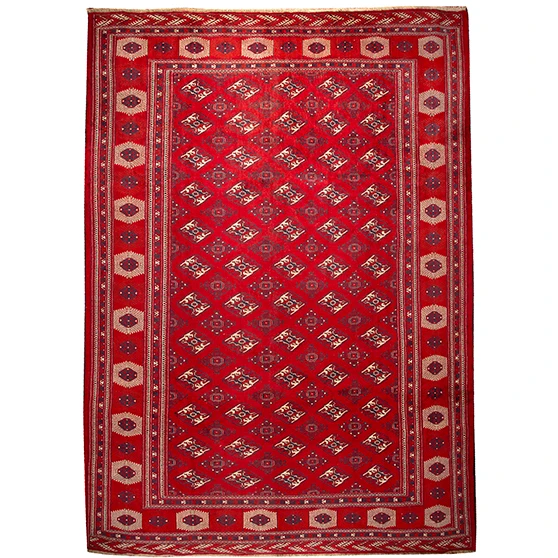
A Turkmen rug of about 13 by 9.75 feet with rows of guls in madder red, crimson, and ivory - Turkmen Persian Rug 13x9 ft - Geometric Semi Antique Wool Silk Hand Knotted
3
The Main Tribal Guls
The Tekke gul
The Tekke gul is the most familiar: a rounded octagon divided into quarters, with small stylized figures, set in rows linked by thin lines that run through the field. It is the model for the rugs sold under the trade name Bokhara.
The Yomud guls
Yomud weavers used several guls, including a lozenge-shaped or hooked gul often called the kepse, and a stepped, diamond-like gul sometimes called dyrnak, with lively secondary motifs.
The Salor gul
The Salor gul is a large, lobed gul regarded by many scholars as one of the oldest forms. Salor rugs are highly prized by collectors.
The Saryk and Chodor guls
Saryk and Chodor weavers had their own guls; the Chodor are known for a stepped gul called the ertmen.
The Ersari gul
The Ersari, many of whom lived in what is now northern Afghanistan, used large, bold guls, often in looser drawing and larger formats.
Gul names and attributions vary between writers, and tribes borrowed and adapted guls over time. A rug's tribe is best judged by its gul, structure, knot, and colors together. See our Afghan collection for rugs in the Ersari tradition.
4
Reading a Gul Rug
Start by finding the major gul and counting how many there are across and along the rug. Then find the minor guls between them. Next, look at the colors inside the guls: in many rugs, the quarters alternate red and blue or red and ivory, and the order may change from row to row, creating diagonal lines of color across the field. Look at the inner motifs, which may be small birds, animal heads, or plants in stylized form. Finally, look at the ends: many Turkmen rugs have a wide elem, an end panel with its own pattern, outside the main border.
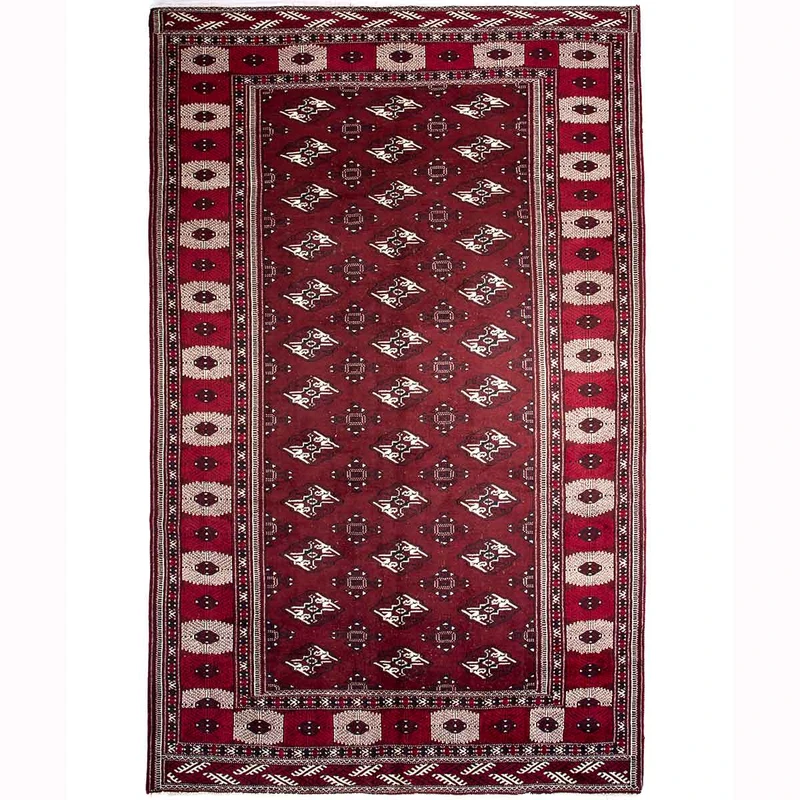
A Turkmen rug of about 12 by 7 feet with a gul design in dark red, cream, and burgundy - Turkmen Persian Rug 11x6 ft - Geometric Semi Antique Wool Silk Hand Knotted
5
Guls as Tribal Emblems
It has often been said that each Turkmen tribe had its own gul, used almost like a coat of arms, and that when one tribe defeated another, the losing tribe's gul could be taken over or abandoned. There is some truth in this: certain guls are strongly associated with certain tribes. But scholars also show that guls were borrowed, adapted, and shared, especially in later rugs made for the market. The idea of the gul as a tribal emblem is best seen as a helpful starting point rather than a strict rule.
6
The Bokhara Name
In the rug trade, rugs with Tekke-style guls in rows are often called Bokhara rugs, after the great market city of Bukhara in Central Asia, where many Turkmen rugs were traded. The name describes a design, not where the rug was woven: Bokhara-style rugs have been woven by Turkmen weavers in Persia and Central Asia, and in many other places. When you see the word Bokhara, think of the gul design rather than a particular origin.
7
Gul Rugs in Persia
In Persia, Turkmen weavers live mainly in Golestan province, on the plain known as the Turkmen Sahra, around towns such as Gonbad-e Kavus. Their rugs continue the gul tradition, often in deep reds, with Tekke or Yomud guls. Many of the gul rugs in our collection are semi-antique pieces from this tradition. See our Turkmen collection and our article on weaving in Golestan.
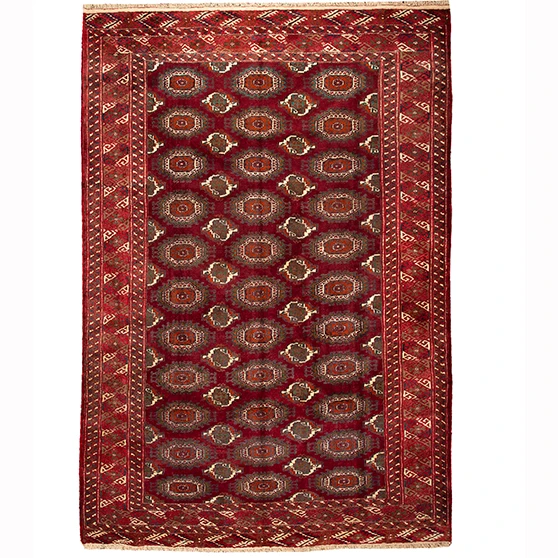
A Turkmen rug of about 11.5 by 7.5 feet with guls in dark red, burgundy, and navy blue - Turkmen Persian Rug 11x7 ft - Geometric Semi Antique Wool Silk Hand Knotted
8
Guls Beyond Turkmen Rugs
The gul has travelled beyond Turkmen weaving. Some Bakhtiari, Baluch, and other Persian rugs use gul-like octagons in rows, and many rugs woven for the market around the world copy the Bokhara gul layout. When a non-Turkmen rug uses guls, the drawing and colors usually reveal its origin: a Bakhtiari gul rug, for example, will have the sturdy build and palette of Bakhtiari weaving. Our Turkmen Gul group includes a few such rugs alongside Turkmen pieces.
9
Turkmen Gul and Related Designs
Turkmen Gul and Medallion
A gul is a medallion repeated many times. See our Medallion designs.
Turkmen Gul and Geometric
Gul rugs belong to the geometric family. See our Geometric designs.
Turkmen Gul and Tribal
Turkmen weaving is one of the great tribal traditions. See our Tribal and Nomadic designs.
Turkmen Gul and Vaghireh
A field of repeating guls is a classic repeat design. See our Vaghireh designs.
10
Colors of Gul Rugs
Red is the heart of Turkmen color. Gul rugs use madder red, crimson, dark red, and burgundy grounds, with guls in red, navy, ivory, and touches of orange, brown, and black. Some rugs use lighter palettes of cream and camel. The rich reds come from madder, often dyed in many shades. Read more in our articles on natural dyes and the nine ranges of Persian colors.
11
Sizes in Our Collection
Our Turkmen Gul rugs range from small mats to room-size rugs of about 11 by 7 to 13 by 9.75 feet. Browse by size: 4x6, 6x9, 8x11, 9x12, and 10x13.
12
Choosing a Gul Rug by Room
•
Living rooms - Rows of guls give a calm, even pattern under furniture.
•
Dining rooms - The repeating field looks good from every chair.
•
Studies and libraries - Deep reds suit wood, leather, and books.
•
Modern rooms - The strict geometry suits clean lines.
•
Walls - Small gul pieces work as textile art.
13
Matching a Gul Rug to Your Room
Red gul rugs pair well with warm whites, cream, soft gray, and pale ochre walls. Cognac leather, walnut, and brass complement the reds. Navy, deep green, and charcoal textiles echo the darker tones. Because the gul field is even and calm, it can sit comfortably with patterned fabrics, as long as the colors agree.
14
Guls on Bags and Small Pieces
Guls appear not only on floor rugs but on the many bags and small weavings of Turkmen life. Large storage bags called chuval often show rows of guls, sometimes a special chuval gul different from the main carpet gul. Smaller bags called torba and mafrash use smaller guls or bands of motifs. Many small Turkmen pieces on today's market began as the faces of such bags, and they are often more finely knotted than floor rugs. Our Turkmen collection includes many small gul pieces. Read more on our Turkmen collection page.
15
The Elem
Many Turkmen gul rugs have a wide elem at each end, a panel outside the main border filled with its own pattern, such as rows of small trees, diamonds, or stars. On bags and door hangings, the elem may be very prominent. When you look at a gul rug, notice whether it has elems and how they are drawn: they are part of the design, not just extra length, and they sometimes help identify the tribe.
16
Linked and Free Guls
In some rugs, the major guls are linked by thin lines that run vertically and horizontally through the field, creating a grid. This is typical of the Tekke style. In others, the guls are free, floating on the red ground without connecting lines, with minor guls placed between them. Linked guls give a more architectural, ordered look; free guls give a lighter, more open field.
17
Colors Inside the Gul
The color scheme inside the guls is often a key to the design. In a classic Tekke gul, the quarters alternate between two colors, such as red and blue, and the colors are arranged so that diagonal lines of the same color run across the whole field. Some weavers varied the colors from gul to gul in subtle ways, so that no two guls are exactly the same. Looking closely at these color schemes reveals the weaver's care and creativity.
18
How a Gul Rug Is Woven
A gul field is a natural repeat design. Once the weaver knows the gul and its spacing, she can repeat it across the rug, row by row, often from memory or from a small sample. Turkmen weavers traditionally worked on horizontal ground looms in the tent or the house, sometimes with two or more women working side by side. Keeping the guls even and the rows straight across a large rug takes great skill. See our Vaghireh designs for more on repeat designs.
19
Living with a Gul Rug
A gul rug brings a calm, rhythmic order to a room. Its repeating medallions create a sense of stability, and its deep reds give warmth. Over time, owners notice the small differences between guls, the color changes, the details of the inner motifs, and the rug becomes a familiar, quietly fascinating presence.
20
Combining Gul Rugs
Gul rugs combine well with each other and with other tribal rugs. A room-size gul rug in a living room can be paired with small Turkmen mats on a wall or at an entrance; because the palette is so consistent, the pieces feel like a collection. Gul rugs also pair well with Baluch and Afghan rugs, and with plain or striped flat textiles.
21
Photographs and Real Color
Deep reds can look different on screen depending on the light. Daylight from a north window shows the truest colors. If color matters for your space, ask us for extra photographs in daylight or close-ups of the guls.
22
The Tribes Behind the Guls
The Turkmen were traditionally organized into tribes such as the Tekke, Yomud, Salor, Saryk, Ersari, and Chodor, each with its own territory around the oases and steppes east of the Caspian Sea. Their histories of alliance and rivalry are reflected, at least in part, in the movement of guls from one group to another. Today, Turkmen people live in Turkmenistan, in Golestan province in north-eastern Persia, in northern Afghanistan, and elsewhere, and their weaving continues in all these places. Read more in our article on weaving in Golestan.
23
The Shine of Turkmen Wool
Turkmen gul rugs are famous for their sheen. It comes from fine, lustrous wool from steppe sheep, carefully spun and clipped short so that the guls are crisp and the surface feels almost velvety. When you look along the pile, the reds seem to glow. A short pile shows the design sharply, but it also shows wear more quickly than a thick village pile, so a good pad and regular rotation are important. Read more in our article on wool.
24
The Asymmetric Knot
Many Turkmen groups used the asymmetric (Persian) knot, though some used the symmetric knot, and the knot type is one of the clues to a rug's tribal origin. Turn a gul rug over: on the back, asymmetric knots show as one larger and one smaller loop, symmetric knots as two equal bumps. If structure matters to you, ask us and we will check a particular piece.
25
Gul Rugs at Room Size
Many of our gul rugs are room-size, about 11 by 7 to 13 by 9.75 feet. At this scale, the repeating guls create a calm, even surface that works well under furniture, since there is no central medallion to keep visible. For a living room, choose a size that lets the front legs of the sofa and chairs rest on the rug; for a dining room, allow at least 24 inches of rug beyond the table on each side. Read more in our article on choosing a rug for your home.
26
Inner Motifs and Their Readings
The small figures inside the quarters of a gul have prompted many interpretations. Some writers see stylized birds or animals, perhaps once totems of the tribe; others see plants, flowers, or simply abstract shapes passed down through generations of weavers. Because the motifs were woven from memory and copied over centuries, their original meanings may be lost. What remains is their beauty and their role in identifying a tribal tradition. Read more in how to read a Persian rug.
27
How to Judge a Gul Rug
•
Gul drawing - Crisp, even guls with clear inner details.
•
Regularity - Guls evenly spaced in straight rows.
•
Knotting - Fine, even knots give sharper guls.
•
Color - Rich, clear reds without bleeding.
•
Condition - Even pile, intact sides and ends.
28
Questions to Ask Before You Buy
•
Which gul is it? - A clue to the tribal tradition.
•
What is the knot and foundation? - Further clues to origin.
•
What are the measurements at both ends? - Checks that the rug is straight.
•
Is the pile even? - Short pile shows wear quickly.
•
Has it been repaired? - Especially along the sides and at the ends.
Read our notes on what to know before you buy and our guide on how to buy a Persian rug.
29
Caring for a Gul Rug
Vacuum regularly without a beater bar. Rotate the rug every few months so that wear and light are spread evenly. Use a good felt-and-rubber pad, especially for short-piled Turkmen rugs. Blot spills at once with a clean, white cloth and cold water. Have it professionally washed every year or two in busy areas. See our care instructions and our article on professional washing.
30
Frequently Asked Questions
What is a gul?
The repeating medallion of Turkmen rugs, usually an octagon divided into colored quarters.
What is the difference between major and minor guls?
Major guls are the large repeated medallions; minor guls are smaller figures placed between them.
Did each tribe have its own gul?
Certain guls are strongly linked with certain tribes, but guls were also borrowed and shared.
What is a Bokhara rug?
A trade name for rugs with Tekke-style guls in rows; it describes the design, not where the rug was woven.
What sizes do you have?
From small mats to room-size rugs of about 13 by 9.75 feet.
What is an elem?
A wide end panel outside the main border, filled with its own pattern.
How should I care for a gul rug?
Vacuum regularly without a beater bar, rotate it, use a good pad, and have it professionally washed regularly.
Can I see more photographs?
Yes. Ask us for daylight photographs, close-ups of the guls, or pictures of the back of any rug.
Where do Turkmen weavers live?
In Turkmenistan, in Golestan province in north-eastern Persia, in northern Afghanistan, and elsewhere.
Are gul rugs hand-knotted?
Yes. Every rug in our collection is hand-knotted.
Is a gul a flower?
The word is often linked with the Persian word for flower, but its origin is debated.
Do gul rugs suit modern rooms?
Yes. Their strict, repeating geometry suits clean lines and simple furniture.
Are gul rugs good for busy rooms?
Yes, with a good pad and regular rotation to protect the short pile.
31
Choose Your Gul Rug
Each rug in our collection is hand-knotted, one of a kind, and inspected before it is listed. Browse our Turkmen Gul rugs, see our Turkmen collection, or ask our experts for help.