


Turkmen Rugs: Guls, Tribes, and Weaving of the Turkmen Sahra
Los Angeles Home of Rugs on Nov 17th 2026
Few rugs are as instantly recognizable as Turkmen rugs. Rows of octagonal medallions called guls march across deep red fields; small geometric motifs fill every space; and the whole surface glows with the warm, saturated colors of madder. To many people, these are the archetypal "Bokhara" rugs, a name borrowed from the old market city where many were sold. To collectors, Turkmen weavings are among the most fascinating of all tribal textiles, each tribe with its own emblems, techniques, and traditions.
Turkmen tribes have lived for centuries across the steppes and oases of Central Asia, and some of them have long been settled in northeastern Persia, in the region known as the Turkmen Sahra (Turkmen plain), today part of Golestan Province near the Caspian Sea. This article introduces the Turkmen people and their weaving, the major tribes, the meaning of guls and other motifs, the many kinds of Turkmen weavings, their colors and structure, and how to recognize and care for Turkmen rugs.
1
The Turkmen People
The Turkmen are a Turkic-speaking people whose ancestors moved westward from the steppes of Central Asia in the medieval period. For centuries they lived as nomadic and semi-nomadic herders and horsemen across a vast region stretching from the Caspian Sea to the Amu Darya river, in what are today Turkmenistan, northern Afghanistan, Uzbekistan, and northeastern Persia. They were organized into tribes, each with its own territory, customs, and identity.
In Persia, Turkmen communities live mainly in the Turkmen Sahra, around towns such as Gonbad-e Kavus, Bandar Torkaman, and Aq Qala. The largest groups are the Yomut (Yamut), who have lived in the region for centuries, and the Tekke, some of whom settled in Persia in the twentieth century. Our article on weaving in Golestan explores the region in more detail.
2
A Short History of Turkmen Weaving
Turkmen weaving is very old, and some of its motifs may preserve forms used by Central Asian weavers for many centuries. The Turkmen tribes carried their weaving traditions with them as they moved across Central Asia, and their pile rugs, bags, and tent bands were part of daily life long before they were known outside the region.
In the nineteenth century, the world of the Turkmen changed dramatically. The Russian Empire expanded into Central Asia, and after the fall of the Tekke fortress at Geok Tepe in 1881, much of the Turkmen territory came under Russian control. New railways and markets brought Turkmen rugs to Russia and then to Europe and America, where collectors and dealers began to appreciate them. In the twentieth century, Soviet collectivization transformed weaving in Soviet Turkmenistan, while Turkmen communities in Persia continued their own traditions in the Turkmen Sahra, where weaving remains part of family life today.
3
Weaving in Turkmen Life
For Turkmen nomads, weaving was woven into every part of life. Their round felt tents (yurts) were furnished almost entirely with textiles made by the women of the family: pile rugs for the floor, a special rug to cover the tent door, storage bags of all sizes hung around the walls, decorative bands wrapped around the tent frame, and trappings to decorate camels and horses for weddings and migrations. These weavings provided warmth, storage, and decoration, and they displayed the skill and status of the family.
Weaving was the work of women and girls, learned from mothers and grandmothers. A young woman's weavings were an important part of her dowry, and the quality of her work was a source of pride for the whole family. Designs and techniques were passed down within the tribe, so that each tribe's weavings developed a recognizable character.
Most Turkmen weavings were made for the weavers' own use rather than for sale. Only in the nineteenth and twentieth centuries, as demand grew in Russia and the West, did Turkmen weavers begin to produce rugs in larger numbers for the market.
4
The Gul - Emblem of the Tribe
The central motif of Turkmen weaving is the gul, an octagonal or lozenge-shaped medallion repeated in rows across the field. Scholars believe that the main gul of a rug often served as an emblem of the tribe that wove it, rather like a heraldic device. Each major tribe had its own characteristic primary gul, and when one tribe was defeated by another, the victors sometimes adopted the gul of the defeated tribe as a secondary motif.
A typical Turkmen rug has two kinds of guls:
•
Primary guls (major guls) - large octagons arranged in rows, usually divided into quarters by color, with small motifs inside.
•
Secondary guls (minor guls) - smaller motifs placed between the primary guls, often star-shaped or cruciform.
The arrangement of guls, their proportions, and the details within them are among the most important clues for identifying which tribe wove a rug. Browse our Turkmen gul designs.
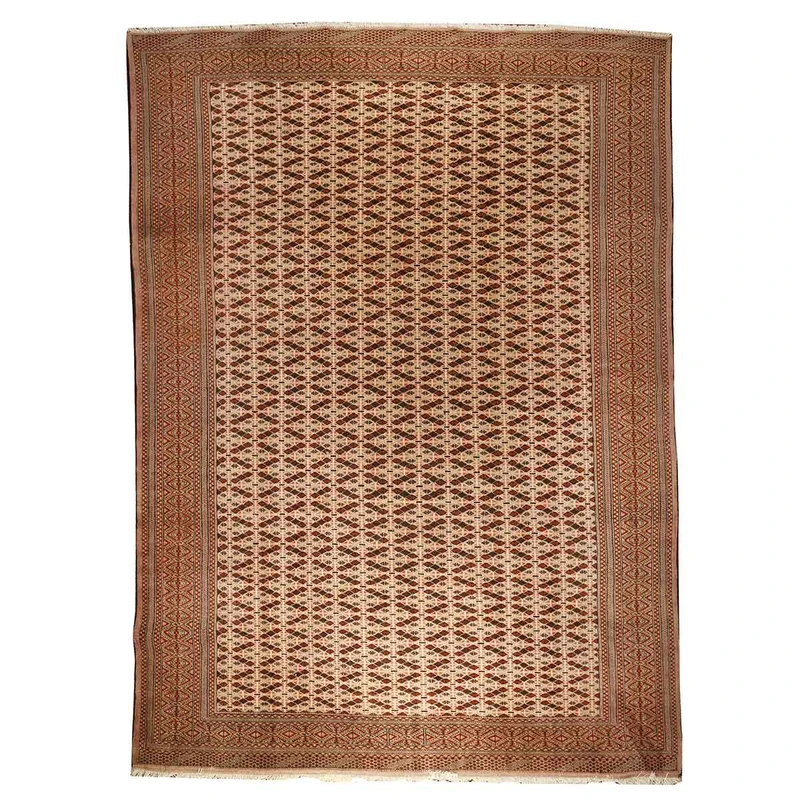
A Turkmen rug with rows of gul medallions on a red ground - Turkmen Persian Rug 12x9 ft - Geometric Semi Antique Wool Silk Hand Knotted
5
Symbols Beyond the Gul
Although the gul dominates the field, Turkmen weavings are filled with other motifs, many of them with protective or symbolic associations:
•
Ram's horn motifs (kochak) - curling hooks that recall the horns of a ram, a symbol of strength and fertility, common in borders, ensis, and bags.
•
Trees and shrubs - small stylized trees, especially in elem panels and ensis, sometimes interpreted as trees of life.
•
Amulet shapes - triangular and diamond-shaped motifs believed to offer protection against the evil eye.
•
Running borders - repeated geometric motifs, rosettes, and stars that frame the field.
•
Animal and bird figures - simple, stylized creatures in some trappings and elems.
Many of these motifs also appear in Turkmen jewelry, embroidery, and felt, reflecting a shared visual language across Turkmen crafts. Our article on Persian rug motifs explains many related symbols.
6
The Major Turkmen Tribes
Tekke
The Tekke were the largest and most powerful Turkmen tribe in the nineteenth century, centered around the oases of Merv and Akhal. Tekke rugs are known for their fine, precise weaving, deep red grounds, and the characteristic Tekke gul: a rounded octagon quartered in red and white or ivory, with small motifs inside. Tekke rugs are the source of the classic "Bokhara" look familiar to many Western buyers.
Yomut
The Yomut (Yamut), many of whom live in the Turkmen Sahra of Persia, are known for a wide variety of designs and a slightly different palette, often with a more purple-brown red and more use of white and other accent colors. Yomut weavers used several different guls, including the diamond-shaped kepse gul and the dyrnak gul with its hooked "comb" motifs, and they were famous for their asmalyk camel trappings.
Salor, Saryk, Ersari, and Others
Other important tribes include the Salor, considered one of the oldest and most prestigious Turkmen tribes, whose rugs are among the most sought-after by collectors; the Saryk, known for their rich colors and distinctive guls; the Ersari, living along the Amu Darya, whose rugs are often larger, bolder, and more varied; and the Chodor and Arabatchi. Each has its own guls, techniques, and palettes, and specialists can often identify a rug's tribe with great precision.
7
The Many Kinds of Turkmen Weavings
Turkmen weavers produced a remarkable range of textiles, each with its own name, size, and purpose:
•
Main carpet (khali) - the largest pile rug, used on the floor of the tent, with rows of guls on a red field.
•
Ensi - a rug that hung over the door of the tent, with a distinctive design divided into four panels by a cross-shaped band, often interpreted as a garden or a door. In the trade it is sometimes called a "hatchli" rug. Its four-part layout has led some to call it the "four seasons" design.
•
Chuval - a large storage bag hung inside the tent, with a pile face decorated with guls.
•
Torba - a long, narrow bag, also used for storage.
•
Mafrash - a small bag for personal items.
•
Asmalyk - a pentagonal trapping hung on the flanks of the bridal camel during wedding processions, especially associated with the Yomut.
•
Tent bands - long, narrow bands woven to wrap around the tent frame, sometimes many meters long.
•
Elem - decorative panels at the ends of rugs, woven in a different design from the field, like a skirt.
Many of these weavings, especially bags and trappings, are now highly prized by collectors for their fine weaving, rich colors, and rarity.
8
Colors - The World of Madder
Turkmen rugs are dominated by red. Turkmen dyers were masters of madder, producing an extraordinary range of reds from bright scarlet to deep brick, rust, mahogany, and purple-brown, often combined with insect reds for brilliant accents. Other colors - dark blue from indigo, ivory, yellow, green, and orange - are used sparingly, as small accents that make the reds glow.
Each tribe had its own characteristic shades: Tekke rugs often have a warm, slightly brownish red; Yomut rugs a more purplish or chestnut red; Saryk and Salor rugs rich, deep reds with brilliant insect-dyed accents. Old Turkmen rugs with natural dyes develop a beautiful, mellow glow over time. Our article on the principal natural dyes explains how madder produces these reds.
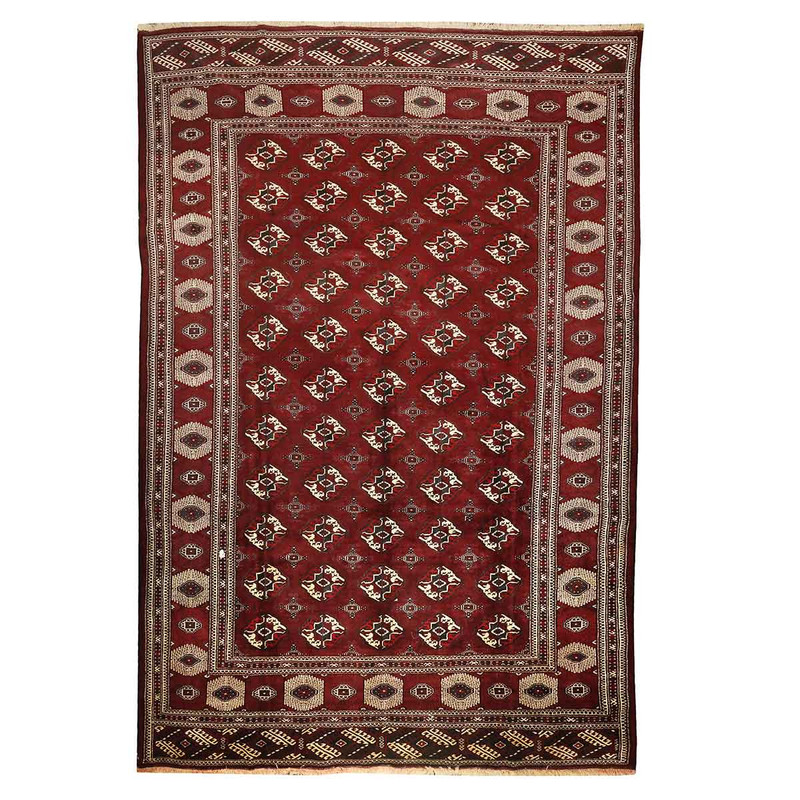
A Turkmen rug with gul medallions in warm madder red tones - Turkmen Persian Rug 13x9 ft - Geometric Semi Antique Wool Silk Hand Knotted
9
The Weaver's Year
In traditional Turkmen life, weaving followed the rhythm of the seasons. Sheep were sheared in spring and sometimes again in autumn; the wool was washed, sorted, and spun by hand during quieter periods; and dyeing was done in batches when plant materials and water were available. Weaving itself often took place in the warmer months, when the horizontal loom could be set up outside or inside the tent, though work on a large piece might continue for many months.
A large main carpet could occupy a weaver and her helpers for the better part of a year, while bags and smaller pieces took weeks. Because the work was so demanding and the pieces so important for the household and the dowry, Turkmen women put great care into every detail, from the choice of wool to the precise drawing of each gul. This care is visible in the finest old Turkmen weavings, which can look almost like fine velvet.
10
Wool, Silk, and Special Materials
While wool is the foundation of Turkmen weaving, some tribes used small amounts of silk for highlights, adding brilliance to particular motifs, and insect reds were sometimes reserved for silk or special accents. Undyed white cotton was occasionally used for highlights in later pieces because it stays bright. Goat hair, strong and dark, was used for side finishes and some bags. These materials, together with the exceptional softness of Central Asian wool, give Turkmen weavings their characteristic depth and luster.
11
Structure and Technique
Turkmen weavers worked on horizontal ground looms that could be dismantled and carried during migrations. Their rugs are typically woven entirely of wool, including the warps and wefts, with a short, dense, silky pile. Knot types vary by tribe: Tekke and Salor weavers often used the asymmetrical knot, while Yomut weavers frequently used the symmetrical knot. Many Turkmen weavings are very finely knotted, and their wool, from Central Asian sheep, is known for its softness and luster.
The sides of Turkmen rugs are usually finished with a simple overcast in dark wool or goat hair, and the ends often have a band of flatweave and a decorative elem panel. These details, along with knot type and color, help specialists identify the tribe and age of a piece. Our article on how a Persian rug is made explains these structural terms.
12
Turkmen Influence in Persian Weaving
Turkmen designs have influenced weaving across Persia, especially in neighboring regions. Many Baluch rugs from Khorasan use gul-like motifs and deep red palettes reminiscent of Turkmen work, and some village rugs of northeastern Persia show Turkmen influence in their borders and motifs. In the twentieth century, the "Bokhara" design - rows of Tekke-style guls - was also widely woven in other countries, especially Pakistan, which is why many rugs sold as "Bokhara" today are not Turkmen at all. See our article on Khorasan rugs and weaving in Baluchestan.
13
Life in the Turkmen Sahra Today
The Turkmen Sahra of Golestan Province is a broad, fertile plain between the Caspian Sea and the mountains, where many Turkmen families now live in towns and villages rather than tents. Agriculture and animal husbandry remain important, and the region is famous for its horses: the Turkmen have bred fine, fast horses for centuries, and horse racing is a beloved tradition in the area.
The town of Gonbad-e Kavus is home to a remarkable brick tomb tower built over a thousand years ago and inscribed on UNESCO's World Heritage List. In towns and villages across the plain, women still weave rugs and bags at home, and local markets sell Turkmen rugs, textiles, and crafts. These weavings continue the traditions described in this article, often with designs and colors passed down through many generations.
14
How to Recognize a Turkmen Rug
•
Rows of guls - octagonal or lozenge medallions repeated across the field.
•
Dominant red palette - madder reds, from scarlet to mahogany and purple-brown, with small accents of other colors.
•
All-wool construction - wool warps, wefts, and pile, often with dark side finishes.
•
Fine, short, silky pile - especially in older pieces.
•
Elem panels - decorative bands at the ends, different from the field.
To tell an authentic Turkmen rug from a modern imitation, look at the wool, the dyes, the drawing of the guls, and the structure on the back. Imitations are often made with cotton foundations and machine-spun wool, and their guls tend to be mechanically uniform.
15
Turkmen Rugs in Your Home
Turkmen rugs bring warmth and depth to almost any room. Their rich reds and repeating patterns work beautifully with wood, leather, and natural materials, and their geometric order suits both traditional and modern interiors. Large Turkmen carpets anchor living rooms and studies, while smaller bags, chuvals, and asmalyks make striking wall hangings or cushion covers. Because their patterns repeat evenly, Turkmen rugs also look good when furniture covers part of them. Explore our Turkmen collection and red rugs.
16
Caring for Turkmen Rugs
Turkmen rugs, with their fine wool and short pile, are durable but deserve gentle care. Vacuum regularly without a beater bar, rotate rugs to even out wear, and keep them out of strong direct sunlight, which can fade even well-dyed reds over time. Antique Turkmen rugs and bags should be cleaned only by specialists experienced with tribal textiles, as their wool foundations can shrink if dried carelessly. Our guides to cleaning a Persian rug at home and professional rug cleaning explain more.
17
Collecting Turkmen Weavings
Turkmen weavings have a passionate international following among collectors. Antique pieces from the nineteenth century and earlier, especially Salor, Saryk, and Tekke rugs and bags with fine natural dyes, are highly prized, and rare asmalyks and ensis command special attention. Collectors value fine weaving, excellent wool, saturated natural colors including insect reds, good condition, and original ends and sides. Semi-antique Turkmen rugs from the twentieth century offer the classic look at more accessible prices. See our article on investing in hand-knotted rugs.
18
Turkmen Weavings as Art
In recent decades, Turkmen weavings have increasingly been recognized as works of art in their own right. Museums in Europe, North America, and Central Asia hold important collections of Turkmen rugs and bags, and exhibitions have shown how these textiles combine strict geometric order with subtle variation, rich color, and extraordinary technical skill. The Ashgabat carpet museum in Turkmenistan is one of the best-known collections, described in our article on the Ashgabat Carpet Museum.
For collectors and homeowners alike, part of the appeal of a Turkmen rug is this combination of discipline and freedom: a strict repeating structure, within which each weaver made countless small choices of color and detail that give every piece its own life.
19
Frequently Asked Questions
Why are Turkmen rugs called Bokhara?
Many Turkmen rugs were traded through the market city of Bukhara, so Western dealers called them "Bokhara." The name is now used loosely for any rug with rows of Turkmen-style guls.
What is a gul?
An octagonal or lozenge-shaped medallion repeated across the field of a Turkmen rug. Each tribe had its own characteristic guls.
Are Turkmen rugs Persian?
Turkmen tribes live in several countries, including northeastern Persia. Rugs woven by Turkmen communities in the Turkmen Sahra of Golestan are Persian Turkmen rugs.
Are modern "Bokhara" rugs real Turkmen rugs?
Not always. Many rugs sold as "Bokhara" are woven in other countries using Turkmen-style designs. Authentic Turkmen rugs are woven by Turkmen weavers, usually with all-wool construction.
Why are Turkmen rugs mostly red?
Turkmen dyers were masters of madder, and red held deep cultural importance. Other colors were used as accents to make the reds glow.
What is an ensi?
A Turkmen rug made to hang over the door of the tent, usually divided into four panels by a cross-shaped band.
20
A Living Heritage
Turkmen weaving is one of the great tribal art traditions of the world, a record of nomadic life, tribal identity, and extraordinary skill with wool and madder. In the Turkmen Sahra of Persia and across Central Asia, Turkmen women continue to weave, keeping alive designs and techniques that have been passed down for generations.
At Los Angeles Home of Rugs, you can explore our Turkmen collection and other nomadic rugs, each with a Certificate of Authenticity documenting its origin, materials, and age. If you have questions, please ask our experts.
Explore the Collection
Turkmen Rugs
Turkmen Gul Designs
Baluch Rugs
Nomadic Rugs
Red Rugs
Geometric Designs
Persian Rug FAQ