


How to Buy a Persian Rug: The Complete Buyer's Guide
Los Angeles Home of Rugs on Nov 17th 2026
Buying a Persian rug is one of the most rewarding purchases you can make for your home. A good hand-knotted rug brings color, warmth, and character to a room, and with proper care it can last for generations, becoming a family heirloom. It is also a purchase that rewards a little knowledge. Persian rugs come in an enormous variety of sizes, designs, qualities, ages, and prices, and knowing what to look for makes the difference between a rug you will love for decades and one you regret.
This guide walks you through the whole process, step by step: deciding what you need, choosing size, color, and design, understanding the different types of Persian rugs, judging quality, recognizing authenticity, understanding age and price, buying online with confidence, and caring for your rug once it is home. Along the way we link to our more detailed articles on each topic.
1
Step 1 - Start With the Room
The best rug purchases begin not in a showroom or online store but in the room where the rug will live. Before you look at a single rug, consider:
•
How the room is used - a busy family room, entryway, or dining room needs a more durable rug than a bedroom or formal living room.
•
Traffic and lifestyle - children, pets, and shoes in the house all point toward sturdy village and tribal rugs with dense wool and busy patterns.
•
Light - strong direct sunlight will gradually soften colors. A rug in a sunny room should be rotated regularly, and very delicate silk rugs are better placed elsewhere.
•
Existing colors and furniture - note the colors of your walls, floors, sofa, curtains, and artwork. A rug can either pick up these colors or introduce a new accent.
•
The feeling you want - formal and elegant, warm and relaxed, bold and colorful, or calm and neutral.
Taking a few photos of the room and noting its key colors will make every later decision easier.
2
Step 2 - Choose the Right Size
Size is the most common mistake in buying a rug. A rug that is too small makes a room look disjointed; one that is too large can overwhelm it. Measure your space carefully and consider these guidelines:
•
Living rooms - choose a rug large enough that at least the front legs of all the main seating pieces rest on it. In many rooms this means an 8x10, 9x12, or larger. Leave roughly 12 to 18 inches of bare floor around the edges of the room.
•
Dining rooms - the rug should extend at least 24 inches beyond the table on all sides, so that chairs stay on the rug when pulled out.
•
Bedrooms - a large rug under the lower two-thirds of the bed, extending on both sides, or a pair of smaller rugs or runners on either side.
•
Hallways and stairs - runners should leave a few inches of floor visible on each side and allow a little floor at each end.
•
Entryways - a small rug or runner that suits the door width and traffic flow.
Remember that hand-knotted rugs are made by hand, so their dimensions can vary by a few inches from the nominal size. Always check the actual measurements. Our rug size guide explains standard sizes and how to measure, and you can browse by size, from runners to 9x12 and oversize carpets.
A practical trick: before buying, mark the rug's outline on your floor with painter's tape or lay out newspapers. Live with it for a day or two to see how the size feels as you walk around the room.
3
Step 3 - Choose Color and Design
Color
Color is usually the first thing people notice in a rug and the most important factor in how it will look in a room. Classic Persian palettes of madder red and navy blue suit traditional interiors and warm wood furniture. Ivory, beige, and soft blue rugs feel lighter and suit transitional and modern spaces. Rust, camel, and gold tones bring warmth, while deep tribal reds and browns add richness. Browse our collection by color to explore the options.
Design
Design determines a rug's personality. A central medallion creates a focal point and suits rooms where the rug will be largely visible. All-over and lattice designs work well when furniture covers part of the rug. Geometric tribal and village designs feel relaxed and characterful, while curvilinear floral city designs feel refined and formal. Our articles on Persian rug design and Persian rug motifs explain the possibilities, and you can browse by design.
Look at the Rug From Both Ends
The pile of a hand-knotted rug leans in one direction. Looking at the rug from one end, with the pile, colors appear lighter and shinier; from the other end, against the pile, they appear darker and richer. This is normal, and you can use it to your advantage: place the rug so that it looks best from the main viewpoint in the room, such as the entrance or the sofa.
4
Step 4 - Understand the Types of Persian Rugs
Persian rugs fall into three broad categories, each with its own character and price range:
•
City rugs - woven in workshops in cities such as Kashan, Isfahan, Tabriz, Nain, and Qom, from detailed cartoons, usually with fine knotting, curvilinear designs, and cotton or silk foundations. They are refined and often formal.
•
Village rugs - woven in villages such as those around Heriz, Hamadan, and Arak, often from memory, with bolder designs and very durable construction. Excellent value and character.
•
Tribal and nomadic rugs - woven by peoples such as the Qashqai, Bakhtiari, Baluch, and Kurds, with geometric designs, wool foundations, and strong colors. Personal, spontaneous, and full of life.
There is no single "best" type; the right choice depends on your room, your taste, and your budget. Browse our city, village, and nomadic rugs.
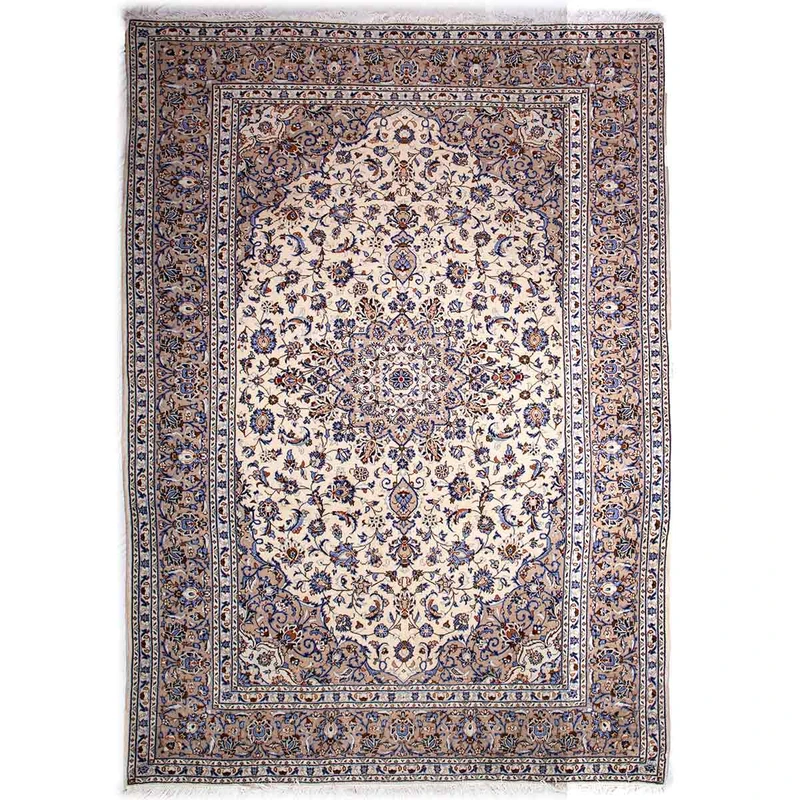
A city rug from Kashan with a medallion in cream, navy blue, and burgundy - Kashan Persian Rug 11x8 ft - Medallion Semi Antique Wool Silk Hand Knotted
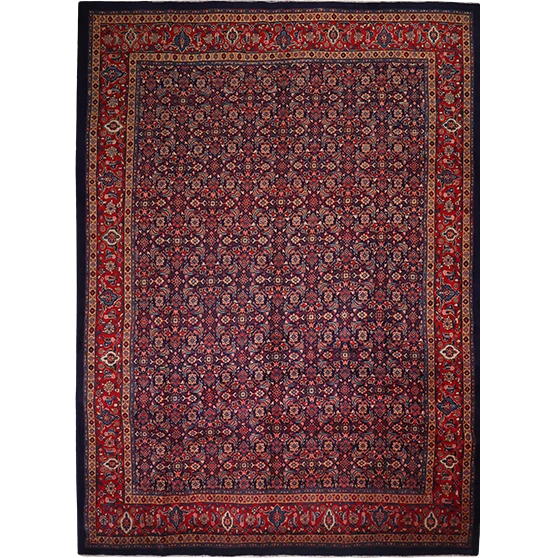
A village-made Mahal with an all-over Herati design - Mahal Persian Rug 13x9 ft - Herati Semi Antique Wool Silk Hand Knotted
5
Step 5 - Judge the Quality
Once you have narrowed your choices, look closely at quality. You do not need to be an expert to make a good judgment. Check the following:
Wool and Materials
Good wool is the foundation of a good rug. It should feel soft yet springy, with a natural luster. Dry, harsh, or brittle wool suggests poor quality, and excessive loose fibers can indicate short-staple or skin wool. Our article on Persian rug wool explains what to look for. If a rug is described as silk, check whether the pile is truly silk or only silk highlights, and be cautious of very low-priced "silk" rugs, which may be made from mercerized cotton or artificial silk.
Dyes and Colors
Look for clear, rich colors without bleeding. Check where red or dark areas meet white or ivory: crisp edges indicate stable dyes, while pink or gray halos suggest bleeding. Gentle abrash - soft bands of color variation - is a sign of hand-dyed wool, not a defect. Our guide to natural dyes explains how to recognize them.
Knot Density
Turn the rug over and count the knots along one inch horizontally and one inch vertically, then multiply. Higher density allows finer detail, but it is not the only measure of quality. A village rug with 80 knots per square inch and excellent wool may be more durable and more beautiful than a finer rug with poor materials. Our article on how a Persian rug is made explains knot density and structure.
Construction and Shape
Lay the rug flat. It should lie reasonably flat without strong ripples or curling edges. Check that the sides are fairly straight and the corners roughly square; small variations are normal in handmade rugs. Fold the rug in half lengthwise and then widthwise to check that the design is reasonably symmetrical. Check that the sides (overcasting) and fringes are intact and secure.
The Back of the Rug
The back tells you a great deal. In a hand-knotted rug, the design is clearly visible on the back, and each knot is slightly irregular. Look for any repairs, patches, or reweaving, and check for signs of moth damage or dry rot (stiff, brittle areas that crack when bent).
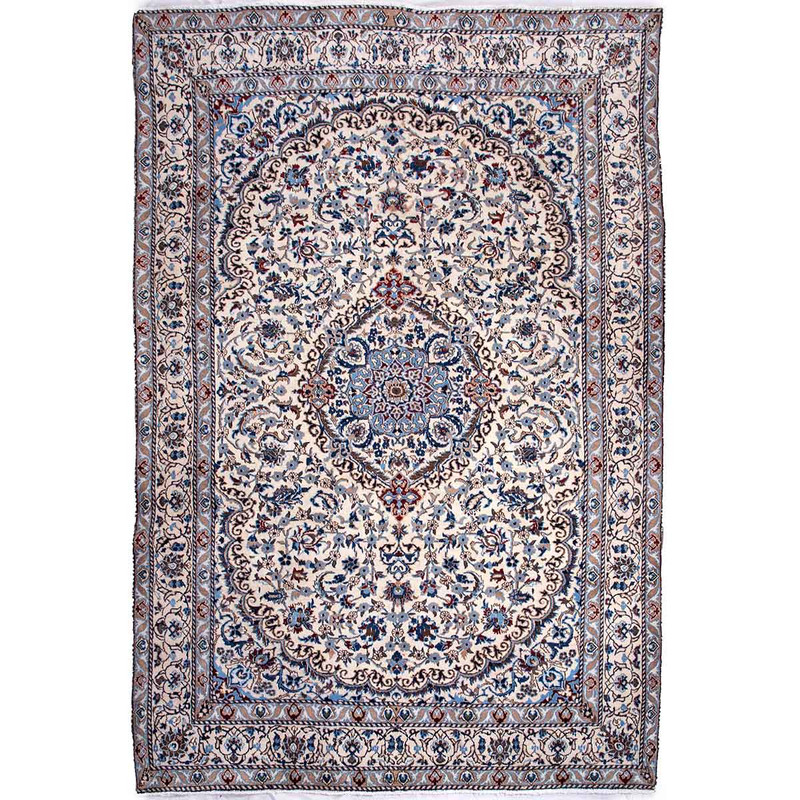
A finely knotted Nain in wool and silk, where knot density allows delicate detail - Nain Persian Rug 9x6 ft - Medallion Semi Antique Wool Silk Hand Knotted
6
Step 6 - Make Sure It Is Authentic
The term "Persian rug" is sometimes used loosely for rugs that are not hand-knotted or were not made in Persia. To be sure you are getting an authentic hand-knotted Persian rug:
•
Check the fringe - in a hand-knotted rug, the fringe is the end of the warp threads that run through the whole rug. A sewn-on or glued fringe indicates a machine-made or hand-tufted rug.
•
Check the back - a hand-tufted rug has a fabric or latex backing that hides the structure. A machine-made rug has a perfectly regular back with no knot irregularities.
•
Fold the pile - folding a hand-knotted rug reveals rows of individual knots at the base of the pile.
•
Ask for documentation - a reputable seller provides clear information on origin, materials, age, and construction, ideally with a certificate of authenticity.
At Los Angeles Home of Rugs, every rug comes with a Certificate of Authenticity documenting its origin, materials, and age.
7
Step 7 - Understand Age
Persian rugs are often described by age:
•
New - recently woven, often with bright, fresh colors.
•
Semi-antique or vintage - generally twenty to about seventy or eighty years old, with softened colors and a gentle patina. Browse our semi-antique and vintage rugs.
•
Antique - generally rugs around eighty to one hundred years old or more, valued for their age, dyes, and historical character. Browse our antique rugs.
Older rugs often have more mellow colors and natural dyes, and they show their history through gentle wear. Be cautious of rugs that look artificially aged through harsh chemical washes or painting; ask the seller how a rug was washed and whether any colors have been retouched.
8
Step 8 - Understand Price
The price of a Persian rug reflects many factors:
•
Size - larger rugs require more materials and far more weaving time.
•
Knot density and fineness - finer rugs take much longer to weave.
•
Materials - silk and high-quality wool cost more than ordinary wool.
•
Dyes - natural dyes and hand-spun wool add value.
•
Origin and type - fine city rugs from famous centers often command higher prices.
•
Age and condition - antique rugs in good condition can be worth more than new ones.
•
Artistic quality - a beautifully drawn, harmonious rug is worth more than a mechanically correct one.
Set a budget, but stay flexible enough to choose quality. A well-made rug at a fair price will give you decades of use and often retains value, while a cheap rug may wear out quickly. Our article on investing in hand-knotted rugs explores long-term value.
9
Buying a Persian Rug Online
Buying online can give you access to a far wider selection and better prices than local stores. To buy with confidence:
•
Study the photos - look at the overall rug, close-ups of the pile, and photos of the back. Ask for more photos if needed.
•
Check the dimensions - compare exact measurements with your space.
•
Read the description carefully - origin, materials, age, knot type, condition, and any repairs.
•
Understand the return policy - make sure you can return the rug if it does not suit your room. See our shipping and returns page.
•
Use the room visualizer - many rug pages on our site offer a "View in Your Room" tool so you can preview the rug in a setting.
•
Ask questions - a good online seller will answer quickly and honestly. You can always ask our experts.
Remember that colors can look slightly different on screens than in real life, and that rugs look different in natural daylight and lamplight.
10
Red Flags to Watch For
•
"Going out of business" sales that never end - permanent sales with inflated "original" prices are a long-standing tactic in the rug trade.
•
Prices that seem too good to be true - very cheap "hand-knotted silk" or "antique" rugs are often machine-made, artificial silk, or misrepresented.
•
Vague descriptions - a seller who cannot tell you a rug's origin, materials, or age is a warning sign.
•
Pressure to buy immediately - a reputable dealer will give you time to decide and, where possible, to see the rug in your home.
•
Heavily painted or chemically treated rugs sold as natural - look at the base of the pile and the back for color differences.
11
Questions to Ask the Seller
•
Where was the rug made, and roughly when?
•
Is it hand-knotted? What is the knot density?
•
What are the pile and foundation made of?
•
Are the dyes natural, synthetic, or a mix?
•
Has the rug been repaired, retouched, or chemically washed?
•
What is the return policy, and is there a certificate of authenticity?
Our Before You Buy page summarizes other useful points.
12
Matching a Rug to Each Room
•
Living room - the rug sets the tone of the whole room. Choose your rug early, or at the same time as major furniture, because it is far easier to match paint and cushions to a rug than the other way around.
•
Dining room - choose a durable rug with a low-to-medium pile so chairs slide easily, and a pattern that forgives the occasional spill. Rectangular or square rugs work best under rectangular tables; round tables look lovely on round rugs or square rugs.
•
Bedroom - softness matters most here. Plush wool and gentle colors create a restful atmosphere, and finer city rugs are well suited because traffic is light.
•
Hallway and stairs - sturdy runners with dense wool, such as Bijar, Heriz, Hamadan, or Kurdish runners, handle constant foot traffic.
•
Kitchen - a small, durable rug or runner with a busy pattern adds warmth; place it away from the stove and sink splash zone where possible.
•
Office or study - classic rugs in rich colors give a sense of calm and tradition; make sure desk chairs have a protective mat or soft casters.
13
Pairing Rugs Within One Home
Many homes have several Persian rugs, and they do not need to match. In fact, a mix of rugs from different regions often looks more natural and interesting than a perfectly coordinated set. A good rule of thumb is to keep a common thread - a shared color, a similar level of formality, or a similar scale of pattern - while letting each rug have its own character. A bold tribal rug in the family room can sit happily alongside a refined city rug in the living room if their colors relate. When rugs are visible together, such as in an open-plan space, vary the scale of their patterns so they do not compete.
14
A Rug as an Heirloom and a Gift
A Persian rug is one of the few household objects that can be passed down through generations. Many families remember the rug they grew up with, and a well-chosen rug can become part of a family's story. Persian rugs also make meaningful gifts for weddings, new homes, and milestones. Small rugs, runners, and silk pieces are especially popular as gifts, and a certificate of authenticity adds to their value as a keepsake.
15
Professionals and the Trade
If you are an interior designer, architect, or home stager, ask about trade programs. Many rug dealers offer special pricing, larger selections, and the ability to try rugs in a client's space. Learn about our Trade Program.
16
After You Buy
Once your rug is home, a few simple habits will keep it beautiful for decades: use a good rug pad, vacuum regularly without a beater bar, rotate it once or twice a year, blot spills immediately, and have it professionally washed every few years. Our guides to cleaning a Persian rug at home and professional rug cleaning explain everything, and our care instructions summarize the essentials.
17
Frequently Asked Questions
How can I tell if a rug is really Persian?
Look at the design, materials, and structure, and ask for documentation. A reputable seller will provide clear information on origin and a certificate of authenticity.
Is a higher knot count always better?
No. Higher knot counts allow finer designs, but wool quality, dyes, design, and craftsmanship matter just as much.
Should I buy new or antique?
It depends on your taste and budget. New rugs offer fresh colors; antique and semi-antique rugs offer mellow colors, patina, and history.
Can I use a Persian rug in a home with pets?
Yes. Choose a sturdy village or tribal rug with a busy pattern, and deal with accidents promptly.
How long will a Persian rug last?
With reasonable care, a well-made hand-knotted Persian rug can last for generations.
18
Enjoy the Search
Choosing a Persian rug is a journey, and part of the pleasure lies in discovering the variety of designs, colors, and traditions along the way. Take your time, trust your eye, ask questions, and choose the rug you love. A rug that speaks to you will bring joy to your home for many years.
At Los Angeles Home of Rugs, our collection of authentic hand-knotted Persian rugs includes city, village, and tribal pieces in every size, each with a Certificate of Authenticity. If you would like personal help choosing a rug, please ask our experts.