


The Safavid Golden Age of Persian Carpets: 1499 to 1722
Los Angeles Home of Rugs on Nov 17th 2026
Of all the periods in the long history of Persian rugs, none is more celebrated than the age of the Safavid dynasty. Between the early sixteenth century and the fall of Isfahan in 1722, carpet weaving in Persia was transformed from a widespread craft into a royal art. Court painters designed carpets, royal workshops wove them with silk, gold, and silver thread, and the finest examples were sent as gifts to the rulers of Europe and Asia. The carpets of this age are now treasured in the world's great museums, and their designs are still woven in Persian workshops today.
This article is the second in our series on the history of Persian weaving. It follows the story from the beginnings to 1499 and is followed by 1722 to 1925. Here we explore how the Safavids created the golden age of Persian carpets, the masterpieces it produced, and the legacy it left.
1
The Rise of the Safavids
In 1501, the young Shah Ismail I captured Tabriz and declared himself shah, founding the Safavid dynasty. For the first time in centuries, Persia was united under a native dynasty, and Shia Islam became the official religion. The Safavids would rule for more than two centuries, creating a strong state with a distinct Persian identity, and their courts became some of the most brilliant centers of art in the world.
The Safavids inherited the rich artistic traditions of the Timurid court at Herat and the Turkmen courts at Tabriz. Artists from both traditions came together in the new royal workshops, and the result was a remarkable flowering in painting, book arts, architecture, tilework, textiles, and, above all, carpets.
2
Carpets Become a Royal Art
The Court Workshops
The key innovation of the Safavid period was the organization of carpet weaving in royal workshops (karkhaneh). These were not simply weaving rooms but complete artistic enterprises, bringing together designers, dyers, spinners, and weavers under royal patronage. Court painters and illuminators - the same artists who created exquisite manuscripts - drew carpet designs on paper. Their drawings were translated into detailed cartoons, squared paper on which each square represented one knot, which the weavers followed precisely.
The Curvilinear Revolution
This method made possible the great change in Persian carpet design: the shift from geometric patterns to flowing curvilinear designs. Medallions, arabesques, palmettes, scrolling vines, cloud bands, animals, and figures could now be drawn with the same freedom as in a painting. Weavers achieved this detail with very fine knotting, often several hundred knots per square inch, using the finest wool and silk. Our article on Persian rug design explains how these compositions work.
The Great Patrons
Under Shah Tahmasp I (ruled 1524 to 1576), a great patron of the arts, court workshops produced some of the most magnificent carpets ever made. Tahmasp moved the capital from Tabriz to Qazvin, and workshops flourished in Tabriz, Kashan, and other cities. Under Shah Abbas the Great (ruled 1588 to 1629), the empire reached its height. Shah Abbas moved the capital to Isfahan in 1598, transforming it into one of the most beautiful cities in the world, and he actively promoted carpet weaving as both an art and a source of national wealth through trade.
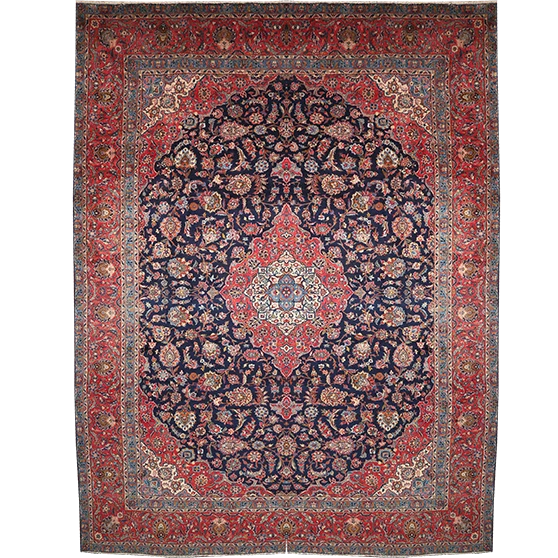
A Kashan medallion rug in crimson, navy blue, and cream, in the classical tradition - Kashan Persian Rug 13x10 ft - Medallion Semi Antique Wool Silk Hand Knotted
3
Inside a Royal Workshop
A Safavid royal workshop was a complex operation. At its head was a master responsible for quality and production, working closely with the court designer who created the drawings. Specialist dyers prepared the colors, often from the finest and most expensive materials available, including insect reds and indigo, while spinners prepared wool and silk yarns of exceptional fineness. Teams of weavers worked side by side at large vertical looms, following the cartoons row by row.
A great carpet could take years to complete. The finest pieces had extremely high knot densities and were woven on silk foundations, which allowed the weavers to render the curving lines of the design with great precision. Every stage - design, dyeing, spinning, weaving, and finishing - was carried out by specialists, a level of organization that explains the extraordinary quality of the surviving carpets.
Materials of Luxury
The Safavid state controlled much of Persia's silk production, centered in the Caspian provinces of Gilan and Mazandaran, and silk was one of the empire's most valuable exports. This gave court workshops access to abundant, high-quality silk for pile and foundations. For the most luxurious carpets, weavers added threads of silk wrapped with thin strips of gold or silver, woven as flat brocade areas that shimmered in the light. Combined with natural dyes of the highest quality, these materials produced carpets of unmatched splendor.
4
The Great Weaving Centers
Under the Safavids, several cities became famous for their carpets:
•
Tabriz - the first Safavid capital and a center of court weaving in the early sixteenth century, associated with many of the earliest masterpieces. See our article on the art of Tabriz rugs.
•
Kashan - famous for silk carpets and for the fine weaving traditions that produced many court pieces. See our article on Kashan rugs.
•
Isfahan - the capital of Shah Abbas, home to royal workshops producing luxurious carpets for the court and for export. See our article on the legacy of Isfahan rugs.
•
Kerman - known for the so-called vase carpets and garden carpets woven in a distinctive technique.
•
Herat - in the east, a continuing center of fine carpet weaving, associated with large carpets with floral fields.
•
Joshaqan - a town near Kashan whose distinctive lattice designs, first recorded in this period, are still woven today. See our article on weaving in Joshaqan.
5
Masterpieces of the Safavid Age
The Ardabil Carpets
The most famous Persian carpets in the world are the twin Ardabil Carpets, woven for the shrine of Sheikh Safi al-Din at Ardabil, the spiritual home of the Safavid dynasty. They carry a woven inscription with a verse of poetry and the date 946 in the Islamic calendar (1539 to 1540), along with the name of Maqsud Kashani, generally understood to be the designer or master in charge. Each carpet shows a great golden medallion surrounded by a ring of pendants, with hanging lamps at each end, set on a deep blue field filled with flowering vines.
One of the pair, the larger and more complete, is in the Victoria and Albert Museum in London; the other, smaller carpet is in the Los Angeles County Museum of Art - right here in our home city. The two carpets were partly used to repair each other in the nineteenth century, which explains their different sizes. Our article on the conservation of the Ardabil carpet tells their remarkable story.
The Milan Hunting Carpet
Another celebrated masterpiece is the hunting carpet in the Museo Poldi Pezzoli in Milan. It carries an inscription naming its designer, Ghiyath al-Din Jami, and a date in the 1540s. Its field shows horsemen hunting lions, deer, and other animals among flowering trees - a scene drawn from the world of Persian miniature painting and royal pastimes. Hunting carpets like this show how completely carpet design had absorbed the art of the painter.
The Chelsea Carpet and Other Treasures
The Chelsea Carpet, also in the Victoria and Albert Museum, is one of the finest Safavid carpets in existence, with a dense design of medallions, animals, and floral scrolls. Other great Safavid carpets, including silk animal carpets and medallion carpets with gold and silver thread, are preserved in museums in Vienna, Paris, New York, Washington, Stockholm, Lisbon, and elsewhere. Scholars estimate that around 1,500 carpets from the classical Safavid period survive, many of them fragments.
6
Silk, Gold, and the Polonaise Carpets
At the height of the Safavid period, the most luxurious carpets were woven with silk pile and brocaded with gold and silver thread. A famous group of these, often attributed to the workshops of Isfahan and Kashan in the early seventeenth century, became known in the West as Polonaise carpets. The name comes from the fact that several were found in the collections of Polish noble families and were first exhibited in Europe as "Polish" carpets in the nineteenth century, before scholars recognized them as Persian.
Polonaise carpets have soft, pastel colors - pinks, greens, yellows, and light blues - against glittering metal-thread grounds. Many were made as diplomatic gifts or for export to European courts, and they show how carpets had become instruments of royal prestige and diplomacy. Our article on Persian silk rugs explores the long tradition of silk weaving that made them possible.
7
The Vase Carpets of Kerman
In Kerman, weavers of the Safavid period developed a distinctive group of carpets that scholars call vase carpets, named after the small vases from which flowering plants grow in many of their designs. Their fields are covered with complex lattices of flowers, palmettes, and leaves, often on several overlapping levels. They are woven in a characteristic structure, sometimes called the "vase technique," with multiple wefts, some of them in different materials. Kerman also produced fine garden carpets in this period, including the famous Wagner Garden Carpet, described in our article on Persian garden rugs.
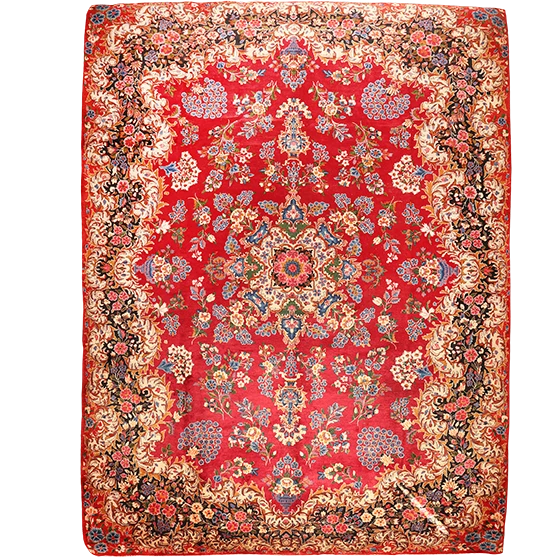
A Kerman medallion rug in crimson, cream, and navy blue, from a city famous for its Safavid carpets - Kerman Persian Rug 13x9 ft - Medallion Semi Antique Wool Silk Hand Knotted
8
Village and Tribal Weaving in the Safavid Age
The splendor of the court carpets can make it easy to forget that most rugs in Safavid Persia were not made in royal workshops at all. In villages and nomadic camps across the country, weavers continued to make rugs for their own homes and tents, for local markets, and for trade. These rugs were woven from memory, in geometric and stylized designs, with wool foundations and natural dyes, much as tribal and village rugs are woven today.
Very few of these everyday rugs survive from the Safavid period, because they were used until they wore out. But the continuity of tribal and village weaving explains how the craft survived the collapse of the court workshops in 1722. When royal patronage disappeared, the knowledge of weaving lived on in thousands of homes, ready to support the great revival of the nineteenth century. Our articles on Qashqai weaving and Kurdish rugs explore some of these enduring traditions.
9
Carpets, Trade, and Diplomacy
Under Shah Abbas, carpets became an important part of Persia's trade with the outside world. The shah encouraged commerce with Europe, India, and the Ottoman Empire, and Persian carpets traveled along trade routes by land and sea. European trading companies, including the English and Dutch East India Companies, dealt in Persian goods, and Persian carpets appeared in European palaces and noble homes.
Carpets were also sent as diplomatic gifts. Safavid shahs presented fine carpets to European rulers, Ottoman sultans, and Mughal emperors, and foreign ambassadors returned from Persia with carpets as signs of royal favor. Some carpets were even ordered with European coats of arms woven into them, a sign of how international the trade had become.
10
What European Travelers Saw
Many European travelers visited Safavid Persia and recorded their impressions. The French jeweler Jean Chardin and the merchant Jean-Baptiste Tavernier, who traveled in Persia in the seventeenth century, described the royal workshops, the bazaars, and the luxury of Persian homes, where carpets covered the floors of every room. Their accounts are valuable sources for understanding how carpets were made, traded, and used in this period, and they helped spread the fame of Persian carpets in Europe.
11
The Influence of Safavid Design
The designs created by Safavid court artists became the foundation of Persian carpet design for the following centuries. The medallion and corner composition, the Shah Abbasi palmette, the islimi arabesque, the vase, the hunting scene, and the garden all reached their classic forms in this period. Many of these designs are still woven today in Isfahan, Kashan, Tabriz, Nain, Qom, and Kerman, often closely following Safavid models.
Safavid designs also influenced carpet weaving far beyond Persia. Mughal emperors in India brought Persian weavers to their workshops, and Mughal carpets show clear Persian influence. Ottoman, Caucasian, and later European carpet designs also borrowed from the Safavid vocabulary. Our article on Persian rug motifs explains many of these classic elements.
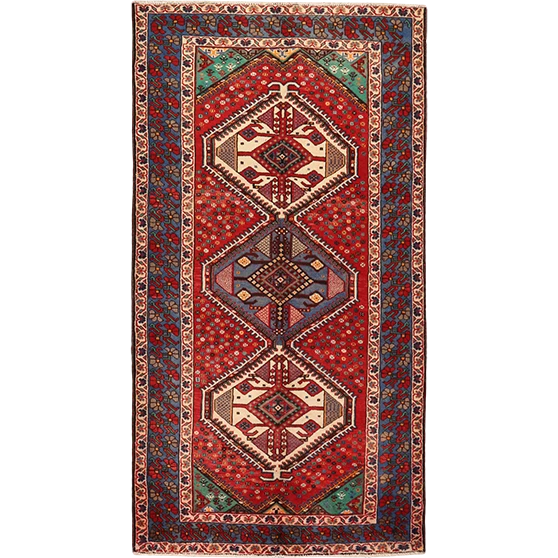
An Isfahan rug in madder red, cream, and navy blue, carrying forward the city's Safavid design heritage - Isfahan Persian Rug 10x5 ft - Medallion Semi Antique Wool Silk Hand Knotted
12
Carpets and the Architecture of Isfahan
Safavid carpets did not exist in isolation; they were part of a unified artistic vision that included architecture, tilework, painting, and textiles. In Isfahan, Shah Abbas created the great Naqsh-e Jahan Square, surrounded by the Shah Mosque, the Sheikh Lotfollah Mosque, the Ali Qapu Palace, and the entrance to the royal bazaar. The domes of these mosques, covered in tilework of medallions, arabesques, and floral scrolls, share the same design language as the carpets woven in the city's workshops.
Looking up into the dome of the Sheikh Lotfollah Mosque, with its central sunburst medallion and radiating patterns, it is easy to see the connection with a classic medallion carpet. The same designers and the same aesthetic ideals shaped both. This is why Isfahan rugs today, with their symmetrical medallions and graceful arabesques, still feel so connected to the architecture of their city.
13
A Timeline of the Safavid Era
•
1501 - Shah Ismail I founds the Safavid dynasty in Tabriz.
•
1524 to 1576 - reign of Shah Tahmasp I, a great patron of the arts; the capital moves to Qazvin.
•
1539 to 1540 - the Ardabil Carpets are completed for the shrine at Ardabil.
•
1540s - the Milan hunting carpet is woven, signed by Ghiyath al-Din Jami.
•
1588 to 1629 - reign of Shah Abbas the Great; the empire reaches its height.
•
1598 - the capital moves to Isfahan; royal workshops flourish there.
•
Early 17th century - Polonaise silk and metal-thread carpets are woven for the court and as diplomatic gifts.
•
1722 - an Afghan army captures Isfahan, ending the Safavid golden age.
14
The End of the Golden Age
After the death of Shah Abbas in 1629, the Safavid state gradually weakened. Carpet weaving continued at a high level for some decades, but royal patronage declined. In 1722, an Afghan army besieged and captured Isfahan, bringing the Safavid golden age to a dramatic end. The court workshops were scattered, and the great tradition of royal carpet weaving was interrupted.
Yet the knowledge did not disappear. Weavers in cities, villages, and tribes continued their craft, preserving designs and techniques that would be revived in the nineteenth century, when Persian carpet weaving entered a new period of growth. That story is told in our next article, 1722 to 1925.
The interruption lasted for much of the eighteenth century, a period of wars and changing dynasties, but the memory of the Safavid masterpieces remained, and later generations of weavers would look back to them as the highest standard of their art.
15
Seeing Safavid Carpets Today
If you want to see Safavid carpets in person, several museums hold outstanding collections:
•
Los Angeles County Museum of Art - the smaller of the two Ardabil carpets and other important Islamic carpets.
•
Victoria and Albert Museum, London - the larger Ardabil Carpet and the Chelsea Carpet.
•
Metropolitan Museum of Art, New York - an important collection of Safavid carpets, including silk and animal carpets.
•
Museo Poldi Pezzoli, Milan - the famous signed hunting carpet.
•
Museum of Applied Arts, Vienna - a celebrated silk hunting carpet and other masterpieces.
•
The Carpet Museum in Tehran - the national carpet museum, with a major collection of Persian carpets from many periods.
Many of these museums also show their carpets online, so you can explore them in detail from home.
16
Frequently Asked Questions
Why is the Safavid period called the golden age of Persian carpets?
Because carpet weaving became a royal art, with court designers, organized workshops, and luxurious materials, producing many of the greatest carpets ever made.
What is the most famous Safavid carpet?
The Ardabil Carpet, dated 1539 to 1540, is the most famous. One of the pair is in London, and the other is in Los Angeles.
What are Polonaise carpets?
Luxurious silk carpets with gold and silver thread, woven in Isfahan and Kashan in the seventeenth century. They were named "Polonaise" because many were found in Polish noble collections.
Did Safavid carpets use natural dyes?
Yes. All Safavid carpets were dyed with natural materials such as madder, indigo, insect reds, and plant yellows, which is why many still show rich, harmonious colors after more than four centuries.
Where were Safavid carpets woven?
Mainly in court and city workshops in Tabriz, Kashan, Isfahan, Kerman, and Herat, with village and tribal weaving continuing throughout the country.
Can I buy a Safavid carpet?
Genuine Safavid carpets are extremely rare and are mostly in museums. However, many later Persian rugs faithfully continue Safavid designs.
17
A Living Legacy
The Safavid golden age gave the world some of its greatest works of textile art, and its influence can be felt in almost every classical Persian rug made since. When you look at a medallion rug from Kashan, a Shah Abbasi design from Isfahan, or a floral carpet from Kerman, you are seeing the legacy of the designers and weavers who worked for the Safavid shahs more than four hundred years ago.
At Los Angeles Home of Rugs, you can explore rugs that carry this heritage forward, including our Kashan, Isfahan, Tabriz, and Kerman collections and our Shah Abbasi and medallion designs. Every rug comes with a Certificate of Authenticity. If you have questions, please ask our experts.
Explore the Classical Tradition
Kashan Rugs
Isfahan Rugs
Tabriz Rugs
Kerman Rugs
Shah Abbasi Designs
Hunting Designs
Vase Designs
Antique Rugs