


Persian Rug History 1722 to 1925: Decline, Revival, and Export
Los Angeles Home of Rugs on Nov 17th 2026
When an Afghan army captured Isfahan in 1722, the golden age of Safavid carpet weaving came to an abrupt end. The royal workshops that had produced the Ardabil and hunting carpets were scattered, and for much of the eighteenth century Persia was torn by war and changing dynasties. Yet within little more than a century, Persian weaving would rise again, this time not for the shahs but for homes across Europe and America. By the early twentieth century, Persian rugs had become one of the country's most important exports and a symbol of luxury around the world.
This article, the third in our series on the history of Persian weaving, follows the story from the fall of the Safavids to the end of the Qajar dynasty in 1925. It covers the long decline of the eighteenth century, the Qajar revival, the merchants of Tabriz, the arrival of foreign companies such as Ziegler, the challenge of synthetic dyes, and the rise of the great weaving centers whose names are still famous today. It follows the Safavid golden age, 1499 to 1722 and is followed by 1925 to the present.
1
The Eighteenth Century - A Century of Upheaval
The decades after 1722 were among the most turbulent in Persian history. Afghan rule was followed by the rise of Nader Shah (ruled 1736 to 1747), a brilliant military leader who drove out the Afghans and led campaigns as far as India, but whose wars drained the country's resources. After his assassination, Persia was divided again until Karim Khan Zand (ruled 1750 to 1779) brought a period of relative peace from his capital in Shiraz.
In these unsettled times, the great court workshops did not revive. Fine carpet weaving on the Safavid scale required stable patronage, wealthy clients, and secure trade routes, all of which were in short supply. Some carpets were still woven for mosques, shrines, and wealthy households, and many of these were used until they wore out. But the real continuity of Persian weaving lay elsewhere: in the villages and nomadic camps, where women continued to weave rugs for their own homes and tents just as they had for centuries.
The survival of village and tribal weaving through the eighteenth century is the reason Persian weaving could revive so quickly in the nineteenth. The skills, designs, and dye knowledge never disappeared; they simply waited for new demand.
2
The Qajar Dynasty and a Slow Recovery
In 1789, Agha Mohammad Khan founded the Qajar dynasty, which would rule Persia until 1925, with Tehran as its capital. The early Qajar period brought more stability, and with it a gradual recovery of trade and crafts. Carpets were again woven for the court, for wealthy families, and for religious institutions, and the art of fine city weaving began to return in centers such as Kashan, Kerman, Isfahan, and Tabriz.
The Qajar era also brought new artistic influences. Contact with Europe increased through diplomacy, trade, and travel, and Persian artists began to adopt European elements - naturalistic roses and bouquets known as gol farang ("foreign flowers"), perspective in painting, and new decorative motifs. Nasser al-Din Shah (ruled 1848 to 1896), who traveled to Europe several times, was fascinated by European culture, and the Qajar court style blended Persian traditions with these new ideas. Pictorial rugs showing kings, poets, and scenes from Persian literature became popular in this period. See our article on pictorial rugs.
3
Qajar Court Carpets and Silk
Alongside the export trade, fine carpets continued to be made for Persian patrons. Qajar princes, governors, and wealthy merchants commissioned carpets for their palaces and homes, and religious shrines received carpets as gifts. Kashan in particular revived the weaving of silk carpets, producing small, extremely fine silk rugs with jewel-like colors that were treasured both in Persia and abroad. Some of these silk rugs reproduced classical Safavid designs, while others introduced new Qajar motifs and pictorial scenes.
Inscriptions and signatures became more common in this period. Workshops in Kashan, Tabriz, and Kerman often wove their names, the names of patrons, verses of poetry, or dates into the borders of fine carpets. These inscriptions help scholars date and attribute rugs, and they add to the interest of a piece for collectors. See our article on Persian silk rugs.
4
Kerman - From Shawls to Carpets
Kerman offers a striking example of how economic change shaped Persian weaving. In the early nineteenth century, Kerman was famous for its fine wool shawls, woven with intricate boteh patterns and exported widely. When European machine-made imitations and changing fashions undermined the shawl trade in the mid-nineteenth century, Kerman's skilled weavers turned increasingly to carpets.
Their background in fine textile work showed. Kerman carpets of the late nineteenth and early twentieth centuries are celebrated for their soft wool, wide palettes of delicate colors, and naturalistic floral designs, and the finest pieces from the nearby town of Ravar - known in the trade as "Laver Kerman" - are among the most admired Persian carpets of the period. See our articles on weaving in Kerman and weaving in Ravar.
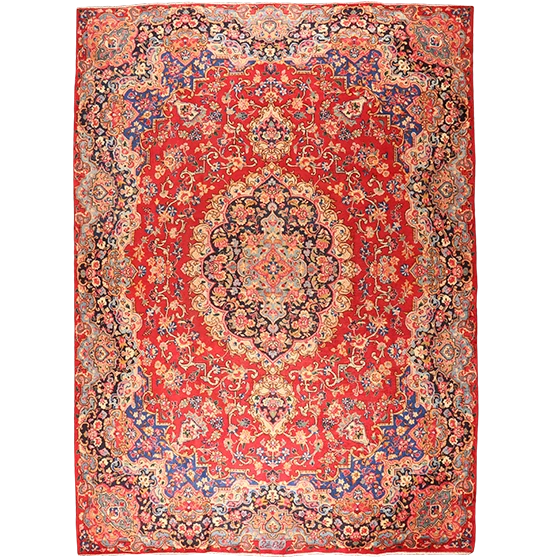
A Kerman medallion rug in crimson, navy blue, and beige - Kerman Persian Rug 10x7 ft - Medallion Semi Antique Wool Silk Hand Knotted
5
Western Demand Transforms the Trade
In the second half of the nineteenth century, a new force transformed Persian weaving: Western demand. Oriental rugs had become fashionable in Europe and the United States, prized by wealthy collectors, decorators, and the growing middle class. International exhibitions displayed Persian carpets to large audiences, and books and articles praised their beauty.
At first, dealers simply bought up old carpets wherever they could find them in Persia and the Ottoman Empire. But by the 1870s and 1880s, the supply of good old rugs was running low, while demand kept rising. The solution was to organize the production of new rugs on a large scale, made specifically for Western buyers.
6
Persian Rugs Conquer the West
In the late nineteenth century, Persian rugs became part of fashionable life in Europe and America. International exhibitions, such as the Vienna World's Fair of 1873, displayed Persian carpets to huge audiences, and in 1891 a major exhibition of Oriental carpets in Vienna helped establish the serious study of carpets as an art form. European scholars and museum curators began to collect and publish classical carpets, raising their prestige further.
Decorating fashions reinforced the trend. In Victorian Britain and Gilded Age America, richly furnished interiors filled with Oriental rugs were a sign of wealth, taste, and worldliness. Department stores in London, Paris, and New York opened rug departments, and importers in New York and Boston built large businesses supplying Persian rugs to American homes. By the early twentieth century, the United States had become one of the most important markets for Persian rugs, a position it would hold for much of the century.
7
The Routes of the Rug Trade
Getting rugs from Persian villages to Western homes was a long journey. From Tabriz, the traditional route ran by caravan to Trabzon on the Black Sea coast and then by ship to Istanbul, the great clearing house of the Oriental rug trade, where merchants from Europe and America came to buy. Rugs from southern regions, such as Kerman and Fars, often traveled to the Persian Gulf ports and onward by sea. Over time, steamships, new roads, and railways in neighboring countries made the journey faster and cheaper, helping the trade to grow.
Each stage added cost and risk, and rugs passed through many hands - weavers, local agents, washers, merchants, exporters, and importers - before reaching a customer. This long chain helps explain why the trade was dominated by large merchant houses and companies with the capital and connections to manage it.
8
The Merchants of Tabriz
The leaders of this new industry were the merchants of Tabriz, the great commercial city of northwestern Persia. Tabriz merchants had long been involved in trade with the Ottoman Empire and Europe, sending goods by caravan to Trabzon on the Black Sea and on to Istanbul, which was then the main market for Oriental rugs. As demand grew, they began to commission new rugs, setting up looms in Tabriz and in the villages around it, and later in other regions.
Tabriz merchants invested in weaving in the Heriz district, in Sultanabad (today's Arak), in Kerman, Mashhad, and elsewhere. They supplied wool, dyes, and designs, paid weavers, and collected the finished rugs for export. This network of merchants, workshops, and village weavers became the backbone of the modern Persian rug industry. See our article on the art of Tabriz rugs.
9
Foreign Companies Arrive
Foreign firms followed. The best known was Ziegler and Company, a Manchester-based firm with Swiss origins, which opened offices in Tabriz in the 1870s and in Sultanabad in 1883. Ziegler set up looms, ran its own dye house, and commissioned large decorative carpets with simplified, open designs and softer colors suited to European and American homes. These "Ziegler" carpets are now among the most sought-after decorative carpets on the market. Our articles on Arak (Sultanabad) rugs and Sultanabad rugs tell this story in detail.
Other companies joined in the early twentieth century, including the London-based Oriental Carpet Manufacturers, which organized production in several Persian cities, as well as German and other European firms in Tabriz and elsewhere. American importers also commissioned rugs directly, especially from the Sarouk and Hamadan regions. These companies brought capital, organization, and access to Western markets, and they shaped the designs, sizes, and colors of many Persian rugs made in this period.
10
The Great Weaving Centers of the Era
The export boom gave rise to, or revived, many of the weaving centers whose names are still famous today:
•
Heriz - village weavers near Tabriz produced bold, geometric room-size carpets with great medallions, durable wool, and brick-red, blue, and ivory palettes. The finest early examples are often called Serapi. See our article on weaving in Heriz.
•
Sarouk and Farahan - the Arak region produced fine, dense rugs with curvilinear and Herati designs; later, the "American Sarouk" was made for the United States. See our article on Farahan rugs.
•
Kashan - revived fine weaving in wool and silk, including the famous Mohtasham and "Kurk" Kashans, celebrated for their exceptional wool and craftsmanship. See our article on weaving in Kashan.
•
Kerman - soft, naturalistic floral carpets in wide palettes, including fine Ravar (Laver Kerman) pieces.
•
Tabriz - the commercial capital, producing fine workshop carpets in many designs, including medallions, hunting scenes, and pictorial rugs.
•
Mashad - large city carpets, including those of the famous Amoghli workshop. See our article on Khorasan rugs.
•
Bijar and Senneh - Kurdish weaving of exceptional density and fineness. See our article on Kurdish rugs of Persia.
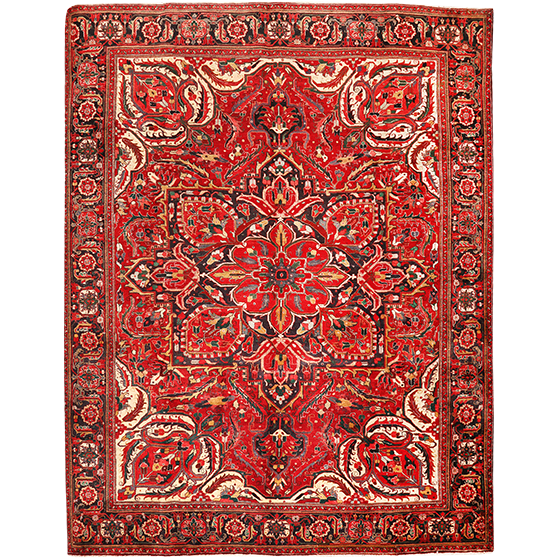
A Heriz medallion rug in madder red, crimson, and navy blue - Heriz Persian Rug 12x9 ft - Medallion Semi Antique Wool Hand Knotted
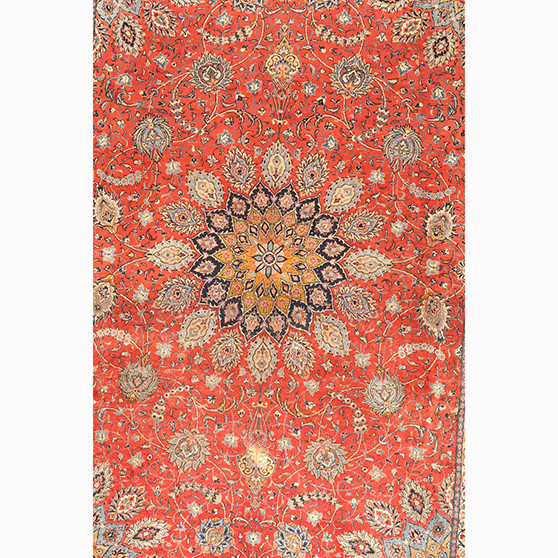
A Sarouk with a medallion design in madder red, beige, cream, and navy blue - Sarouk Persian Rug 13x9 ft - Medallion Semi Antique Wool Hand Knotted
11
The Aniline Crisis
The export boom also brought a serious challenge: synthetic dyes. Invented in Europe in the 1850s, aniline dyes reached Persian dye houses by the 1870s. They were cheap and easy to use, but many faded badly in sunlight or bled when washed. Western buyers began to complain about harsh, unstable colors, and the reputation of Persian rugs suffered.
The Persian government responded with some of the earliest quality-control measures in the history of the rug trade. Around 1904, the import of aniline dyes was banned, graduated taxes were used to discourage their use, and there were attempts to confiscate rugs woven with synthetically dyed yarn. Enforcement was uneven, but many weaving areas continued to use natural dyes, and many rugs from this period show beautiful, stable colors. Our article on Persian rug dyeing explains this story in more detail.
12
Life for the Weavers
For the weavers themselves, the export boom brought both opportunity and hardship. Weaving became an important source of income for many rural families, especially for women, whose work at the loom could support a household. At the same time, the commission system meant that weavers often worked for low pay, under deadlines set by merchants and companies, with designs chosen for distant buyers rather than for themselves. Children also worked at the looms in many places, a practice that later reforms sought to end.
Persian historical research has documented how the carpet trade transformed the economy and social life of weaving regions such as Arak, Kerman, and the villages around Tabriz. The industry created wealth for merchants and brought Persian rugs to the world, but its benefits were unevenly shared.
13
Designs for New Markets
Western demand also shaped design. Buyers wanted large room sizes to fit European and American homes, so the proportion of room-size carpets increased greatly. Colors were sometimes softened, designs simplified or enlarged, and new compositions created to suit Western interiors. The open, large-scale designs of Ziegler carpets, the detached floral sprays of American Sarouks, and the room-size medallions of Heriz are all products of this period.
At the same time, classical designs remained popular. Many workshops copied or adapted Safavid designs, such as medallion carpets, vase carpets, and hunting scenes, and some fine Kashan and Tabriz rugs of this period are remarkably faithful to their Safavid models. This blend of tradition and adaptation gives the rugs of the late nineteenth and early twentieth centuries their special place in the history of Persian weaving.
14
Collecting Rugs from This Era
Rugs made between about 1870 and 1925 form the core of the antique Persian rug market today. Fine Heriz and Serapi carpets, Ziegler Sultanabads, Farahans, Mohtasham and Kurk Kashans, Laver Kermans, and Amoghli Mashhads are among the most sought-after decorative carpets in the world. Their combination of natural dyes, fine wool, mature patina, and designs created for Western homes makes them especially appealing to collectors and designers.
When evaluating an antique rug from this period, pay attention to the dyes, the wool, the condition of the pile and foundation, any repairs, and the quality of the drawing. Our articles on investing in hand-knotted rugs and how to buy a Persian rug offer practical guidance, and you can browse our antique and semi-antique collections.
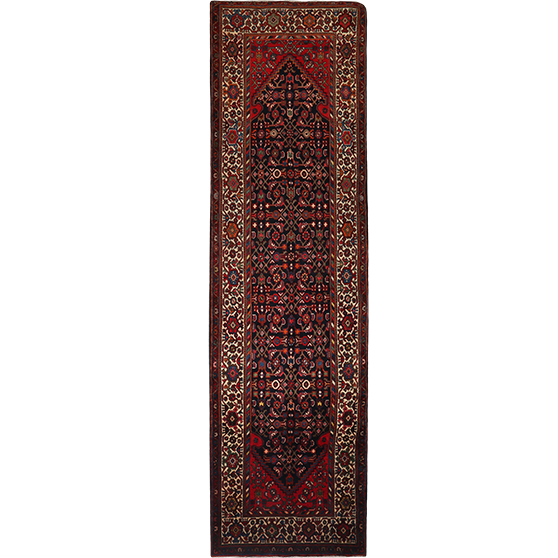
An antique Farahan runner in burgundy and navy blue with a Herati medallion design - Farahan Persian Rug 13x3 ft - Medallion Antique Wool Hand Knotted
15
The End of the Qajar Era
The early twentieth century brought great change to Persia. The Constitutional Revolution of 1905 to 1911 introduced a parliament and new political ideas, and the First World War brought foreign occupation, disruption of trade, and economic hardship. After the war, national feeling and economic pressures led many foreign firms to scale back or close their weaving operations in Persia, although trade with Persian merchants continued.
In 1925, the Qajar dynasty came to an end, and Reza Khan was proclaimed shah, founding the Pahlavi dynasty. A new chapter in Persian weaving was about to begin, marked by state involvement, modernization, and new markets. That story continues in our next article, 1925 to the present.
16
A Timeline from 1722 to 1925
•
1722 - an Afghan army captures Isfahan; the Safavid golden age ends.
•
1736 to 1747 - reign of Nader Shah.
•
1750 to 1779 - Karim Khan Zand rules from Shiraz.
•
1789 - the Qajar dynasty is founded; Tehran becomes the capital.
•
Mid-19th century - Kerman's shawl industry declines and its weavers turn to carpets.
•
1870s to 1880s - Western demand soars; Tabriz merchants organize production for export; aniline dyes arrive.
•
1883 - Ziegler and Company opens its office in Sultanabad.
•
Around 1904 - the Persian government bans the import of aniline dyes.
•
1905 to 1911 - the Constitutional Revolution.
•
1914 to 1918 - the First World War disrupts trade.
•
1925 - the Qajar dynasty ends and the Pahlavi dynasty begins.
17
Frequently Asked Questions
Why did Persian weaving decline after 1722?
The fall of the Safavids ended royal patronage, and decades of war and instability disrupted trade and the wealthy markets that fine weaving needed. Village and tribal weaving continued.
Who revived the Persian rug industry?
Tabriz merchants led the revival in the late nineteenth century, followed by foreign firms such as Ziegler, all responding to strong Western demand.
What is a Ziegler carpet?
A carpet woven in the Sultanabad region for the Ziegler company, usually large, with open, large-scale designs and softer colors made for Western homes.
Did all rugs of this period use synthetic dyes?
No. Synthetic dyes appear in some rugs from the 1870s onward, but many weaving areas continued to use natural dyes, and many rugs of this period have entirely natural colors.
Are rugs from this period antiques today?
Yes. Rugs made between about 1870 and 1925 are generally considered antique and are among the most collected Persian rugs.
18
A Revival That Shaped the Modern Rug
The period from 1722 to 1925 began with destruction and ended with a thriving international industry. The Persian rugs that fill homes and auction catalogs around the world today owe much to this era: to the village and tribal weavers who kept their skills alive, to the merchants of Tabriz who organized the revival, and to the countless weavers whose work turned Persian rugs into a global treasure.
At Los Angeles Home of Rugs, you can explore rugs from the great weaving centers of this era, including our Heriz, Sarouk, Farahan, Kashan, and Kerman collections. Every rug comes with a Certificate of Authenticity documenting its origin, materials, and age. If you have questions, please ask our experts.
Explore the Collection
Antique Rugs
Semi-Antique Rugs
Heriz Rugs
Sarouk Rugs
Farahan Rugs
Kashan Rugs
Kerman Rugs
Persian Rug FAQ