


Some Persian rug names point to a single town or village. Khamseh is different. The word simply means "five," and it has been used for two quite different places and peoples: a region of five districts around Zanjan in north-western Persia, and a confederation of five tribes in Fars in the south. Rugs from both are sold under the same name, and both share a love of bold geometry and strong color.
This guide explains the two meanings of Khamseh, how to recognize the features of each, how to read the rug in front of you, and how to choose, place, and care for a Khamseh runner like those in our collection. For the tribal weaving of Fars, see our articles on weaving in Fars and Qashqai weaving.
1
The Khamseh of Zanjan
In north-western Persia, the region around the city of Zanjan was historically called Khamseh, after the five districts that made it up. It lies on the main road between Tehran and Tabriz, in a landscape of high plains and hills. Its villages, many of them Turkic-speaking, have long combined farming with herding and weaving.
Persian accounts of Zanjan weaving describe several village traditions in the region: thick, heavily wefted rugs from some districts, fine village rugs from places such as Gholtogh, and later the Afshar style introduced from West Azerbaijan. Rugs from this region sold under the Khamseh name are usually village rugs with cotton foundations, geometric or semi-geometric medallions, and strong reds and navies. See our Zanjan and Gholtogh collections.
2
The Khamseh Tribes of Fars
In the south, in the province of Fars, the Khamseh confederation was formed in the nineteenth century from five tribal groups: Arab, Basseri, and several Turkic-speaking tribes. Their migrations followed routes east of Shiraz, between summer and winter pastures. Their weaving belongs to the great tribal tradition of Fars, alongside that of the Qashqai.
Tribal Khamseh rugs from Fars are often woven on wool foundations, with geometric medallions, small animals and birds, and a free, lively drawing. Arab Khamseh rugs are especially known for stylized birds, sometimes called hen or chicken motifs, scattered across the field. See our Qashqai and Shiraz collections.
Khamseh means "five." It names a region of five districts around Zanjan in the north-west, and a confederation of five tribes in Fars in the south.
3
How to Tell Them Apart
Because both traditions are sold as Khamseh, it helps to know the clues that point to one or the other:
•
Foundation - Village rugs of the Zanjan region usually have cotton foundations; older tribal rugs of Fars often have wool foundations, though cotton appears in later pieces.
•
Wefts - Fars tribal rugs often have dyed or dark wool wefts; north-western village rugs usually have white cotton wefts.
•
Edges - Fars tribal rugs often have colorful, striped side finishes; north-western rugs usually have simpler overcasting.
•
Drawing - Fars tribal rugs often have small animals, birds, and free drawing; north-western rugs tend toward more orderly medallions.
•
Format - Both weave runners and small rugs; Fars tribal rugs are often squarer or smaller.
Our Khamseh runners, with cotton foundations and orderly medallions in crimson, burgundy, and navy, show the features of village weaving. As always, the rug itself, its wool, drawing, and condition, matters more than the name.
4
How to Recognize a Khamseh Runner
•
Medallions along the length - A series of stepped or hooked medallions down the center line.
•
Deep red ground - Crimson, dark red, or burgundy fields.
•
Navy and cream details - Navy outlines and borders, cream highlights.
•
Geometric drawing - Straight lines, steps, and diagonals.
•
Bold borders - Geometric borders framed by guard stripes.
•
Thick wool - A full, resilient pile.
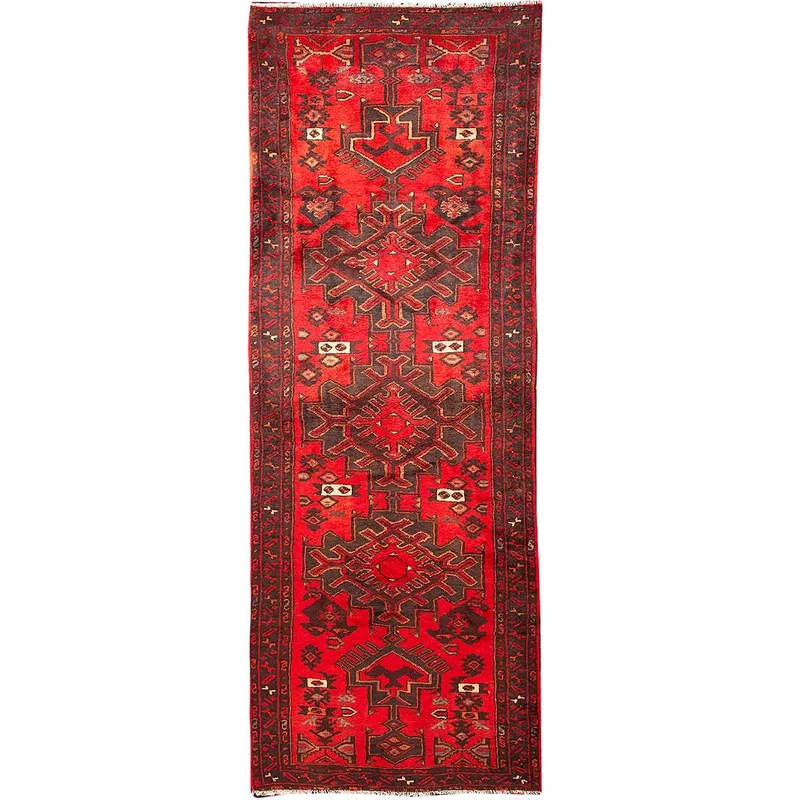
A Khamseh runner of about 9.5 by 3.5 feet with medallions on a crimson and dark red field, in burgundy, cream, and navy - Khamseh Persian Rug 9x3 ft - Medallion Semi Antique Wool Hand Knotted
5
Reading the Medallions
In a Khamseh runner, the medallions are the main event. They are usually diamonds or hexagons with stepped outlines, sometimes with hooks along the edges, and they may alternate in color or shape along the length. Inside each medallion, a smaller motif, such as a star, a cross, or a rosette, gives a focal point. Around them, small geometric filler motifs keep the field lively.
Look at how the weaver handles the spacing: in a well-planned runner, the medallions are evenly spaced, and the first and last sit at a similar distance from the ends.
6
How Khamseh Rugs Are Built
•
Knot - The symmetric (Turkish) knot is common in north-western village rugs; Fars tribal rugs may use either knot.
•
Foundation - Cotton in our semi-antique runners.
•
Pile - Thick, resilient wool, clipped to a medium height.
•
Density - Coarse to medium.
•
Sides and ends - Overcast sides and fringes.
The result is a sturdy, comfortable runner that lies flat and wears well.
7
Colors of Khamseh
Our Khamseh runners use a deep, warm palette: crimson and dark red fields, burgundy for depth, navy for outlines and borders, cream for highlights, and touches of ochre and black. Deep reds dominate, which makes these runners rich and warming in a hallway.
In semi-antique rugs, these colors have mellowed. The crimsons have softened toward rose and rust, and the creams have warmed.
8
The Runner Format
Our Khamseh runners measure about 9.5 by 3.5 feet. This classic runner size suits:
•
Hallways - A 3.5 foot runner suits a hallway about 4 to 4.5 feet wide.
•
Kitchens - Along a counter or island.
•
Bedsides - Along the side of a queen or king bed.
•
Entrances - Leading from the front door into the house.
•
Landings - On a landing at the top of the stairs.
See our runners for other long rugs.
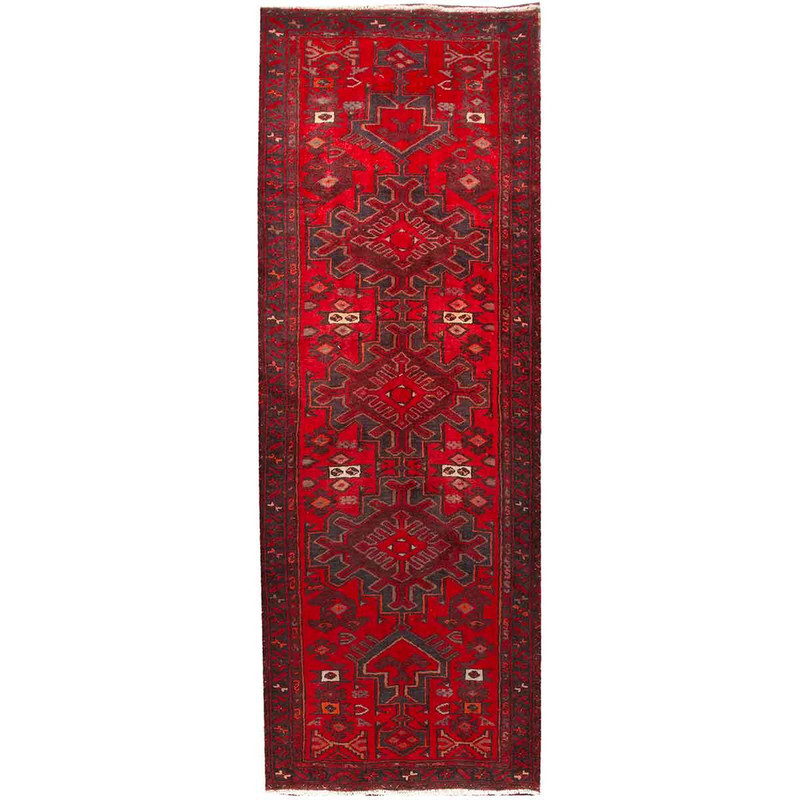
A Khamseh runner of about 9.5 by 3.5 feet in crimson, dark red, burgundy, and navy, with ochre accents - Khamseh Persian Rug 9x3 ft - Medallion Semi Antique Wool Hand Knotted
9
A Pair of Runners
Our two Khamseh runners are close in size and palette, which makes them a natural pair. They can sit on each side of a bed, at each end of a long hallway, or along both sides of a long dining table. In a traditional Persian room, long rugs were laid in pairs along the sides of the main carpet, so a pair of runners continues an old tradition.
10
Choosing the Right Runner
Measure the hallway carefully. For length, subtract about 12 to 24 inches from the length of the hall, so that 6 to 12 inches of floor show at each end. For width, subtract about 8 to 12 inches, so that 4 to 6 inches of floor show on each side. Check that doors along the hallway can open over the rug. Mark the outline on the floor with painter's tape and walk along it before you buy.
11
Placing a Deep Red Runner
A deep red runner brings warmth to a hallway, which is often the darkest and plainest space in a home. On a pale wood or stone floor, the reds glow. In a modern interior, a Khamseh runner can be the one strong note of color in a neutral passage. In a traditional home, it pairs naturally with wood paneling and framed pictures.
12
Khamseh and Its Neighbors
Khamseh and Zanjan
Zanjan rugs come from the same north-western region. The Khamseh name is often used for the region's village and tribal weavings. See our Zanjan collection.
Khamseh and Gholtogh
Gholtogh is one of the finest village names of the Zanjan region. See our Gholtogh collection.
Khamseh and Qashqai
Qashqai rugs, from the other great tribal confederation of Fars, share the tribal spirit of the southern Khamseh. See our Qashqai collection.
Khamseh and Shiraz
Shiraz is the market name for many tribal and village rugs of Fars. See our Shiraz collection.
Khamseh and Hamadan
Hamadan village rugs, to the south of Zanjan, share the sturdy village construction. See our Hamadan collection.
13
Grades and How to Judge Them
•
Straightness - Straight, parallel sides along the whole length.
•
Medallion spacing - Even, well-proportioned medallions.
•
Wool - Thick, springy, lustrous wool.
•
Color - Clear colors without bleeding.
•
Condition - Even pile, intact sides and ends.
14
Reading the Back
On the back of a Khamseh runner, the medallions show clearly in relatively large knots. Look at the wefts: white cotton wefts suggest a north-western village rug, while dark or dyed wool wefts suggest a tribal rug. Check the overcasting on the long sides and the fringes at the ends, which take the most wear.
15
Keeping a Hallway Runner Fresh
A hallway runner works harder than almost any other rug. A doormat outside the front door catches grit that would otherwise wear the wool. Vacuum weekly, and once in a while lift the runner, clean the floor beneath, and turn it end to end. Every year or two, have it professionally washed. Check the long sides and have worn overcasting renewed before the knots begin to loosen.
16
The Colors and Their Dyes
The deep reds of Khamseh runners come from madder root, the navies from indigo, browns and blacks from walnut husks and iron, and ochres from yellow dyes such as weld. In mid-twentieth-century rugs, synthetic dyes were also used alongside natural ones. In semi-antique pieces, you may see abrash, slight changes of shade within one color, which give the field movement. Read more in our articles on natural dyes and traditional dyeing.
17
Village and Tribal Weaving
Whether woven in a village near Zanjan or in a tribal tent in Fars, a Khamseh rug is the work of women who learned their craft from their mothers. Designs are usually woven from memory rather than from paper cartoons, which is why each rug has small, personal variations: a medallion slightly larger than its neighbor, a color changed mid-row, a border that shifts rhythm. Read more about the people behind rugs in our article on the craft from shepherd to dealer.
18
Combining a Khamseh with Other Rugs
A Khamseh runner pairs naturally with larger village and tribal rugs. Next to a Heriz, Hamadan, or Qashqai, it shares the bold geometry and warm reds. With a finer city rug, it adds a rustic contrast. Keep one color in common and vary the scale of the patterns.
19
Questions to Ask Before You Buy
•
What is the foundation? - Cotton or wool.
•
What color are the wefts? - A clue to origin.
•
What are the measurements at both ends? - Checks that the runner is straight.
•
Has it been repaired? - Especially along the sides and at the ends.
•
Has it been washed recently? - A fresh wash shows the true colors.
20
Semi-Antique Khamseh Runners
Our Khamseh runners are semi-antique, woven roughly forty to sixty years ago. They have settled colors, good wool, and sturdy construction, with many years of life ahead. See our semi-antique rugs.
21
What Affects the Price
•
Length - Longer runners cost more.
•
Straightness - Straight runners are worth more.
•
Wool - Lustrous wool adds value.
•
Pairs - A matching pair is more valuable than two single runners.
•
Condition - Intact sides and ends.
22
Caring for a Khamseh Runner
Vacuum regularly without a beater bar. Turn the runner end to end every few months. Use a non-slip pad. Blot spills at once. Have it professionally washed every year or two in busy areas. Keep the sides and ends in good repair. See our care instructions and our guide to maintaining rug fringes.
23
Common Buying Mistakes
•
Assuming one origin - Khamseh can mean the Zanjan region or the Fars tribes.
•
Choosing the wrong length - Measure carefully.
•
Skipping the pad - Runners slip easily.
•
Neglecting the sides - The long edges need regular checks.
24
The Road Between Tehran and Tabriz
The Zanjan region sits on one of the oldest roads in Persia, the route that links the capital with Tabriz and the north-west. For centuries, caravans, traders, and travelers passed through its towns, and the region's villages absorbed ideas from both directions. That position helps explain why rugs sold under the Khamseh name can show a mix of influences: the bold geometry of the north-western villages, the medallion layouts of the Hamadan plains, and, in some districts, the designs that later Afshar settlers brought with them. A Khamseh runner is, in this sense, a rug of the road, made by villagers who saw many styles pass by and kept the ones that suited their looms.
25
Life on the Fars Migration Routes
The Khamseh tribes of Fars lived a very different life. Their year was shaped by migration: winters in the warmer lowlands, summers in the cooler highlands, with flocks moving between them. Weaving was done on horizontal ground looms that could be taken down, rolled up, and set up again at the next camp. This is why tribal rugs of Fars are often smaller, and why their sides can be slightly uneven: the loom was re-tensioned each time the camp moved. Their wool came from their own flocks, which is one reason it is often so lustrous. Read more in our article on Persian nomads.
26
Symbols in the Field
Small motifs scattered around the medallions are part of the charm of a Khamseh rug. Weavers often add stars, crosses, rosettes, combs, and small animals. In the tribal rugs of Fars, birds are especially common, sometimes so many that the field seems to flutter. Many writers attach meanings to these motifs, such as protection, fertility, or good fortune. These readings are part of a living tradition, but they vary from family to family, and a weaver may simply have added a motif because she liked it or because her mother wove it. It is best to enjoy them as personal touches rather than as a fixed code.
27
Why Runners Suit Village Looms
Long, narrow rugs have always been practical for village weavers. A narrow loom is easier to build and fits inside a small house. A runner also uses less wool at a time and can be woven by one person, while a large carpet needs several weavers working side by side. In the traditional Persian house, runners were laid along the sides of the main room, so families needed them in pairs. The runner format that suits a modern hallway grew out of these old domestic needs.
28
Living with a Khamseh Runner
Over the years, a good Khamseh runner becomes part of the house. Its deep reds will mellow a little more, its pile will settle into a soft sheen where feet pass most often, and its small irregularities will become familiar. Many owners find that a runner they bought for a hallway later moves to a kitchen, a bedroom, or a new home, and fits each space in a different way. Because it is hand-knotted with sturdy wool, it can stay in daily use for decades with ordinary care.
29
Photographs and Real Color
Deep reds are among the hardest colors to photograph. Depending on the light, a crimson field can look brighter, darker, or more orange on screen than it does on the floor. Daylight from a north window shows the truest color; warm evening lamps make reds look richer and browner. If color matters for your room, ask us for extra photographs in daylight, or for a close-up of the pile next to a familiar object. We are always happy to describe how a runner looks in person before you decide.
30
Frequently Asked Questions
What does Khamseh mean?
"Five" in Persian.
Which places are called Khamseh?
The region of five districts around Zanjan, and the confederation of five tribes in Fars.
Who are the Khamseh tribes of Fars?
A confederation formed in the nineteenth century from Arab, Basseri, and Turkic-speaking tribes.
How can I tell a Zanjan Khamseh from a Fars Khamseh?
Look at the foundation, the weft color, the side finishes, and the drawing.
What designs are typical of your runners?
Stepped or hooked medallions along the length, on deep red fields.
What colors are typical?
Crimson, dark red, burgundy, navy, and cream, with ochre and black.
What size are your Khamseh runners?
About 9.5 by 3.5 feet.
Can the two runners be used as a pair?
Yes. They are close in size and palette.
How wide a hallway suits a 3.5 foot runner?
About 4 to 4.5 feet.
Are Khamseh rugs durable?
Yes. Their thick wool and sturdy construction make them very durable.
What is abrash?
Slight changes of shade within one color, caused by wool dyed in different batches.
How should I care for a runner?
Vacuum regularly, turn it end to end, use a pad, and have it professionally washed regularly.
Are Khamseh rugs village or tribal rugs?
Both. Rugs from the Zanjan region are usually village rugs, while those of the Khamseh confederation in Fars are tribal rugs.
Why do Fars tribal rugs often have birds?
Birds are a favorite motif of Khamseh weavers in Fars, especially in Arab Khamseh rugs, and they give the field a lively feel.
Will the colors fade further?
In a semi-antique rug the colors have largely settled. Keep the rug out of strong direct sunlight to protect them.
Can a Khamseh runner go in a kitchen?
Yes. Its thick wool and deep colors hide everyday marks well. Blot spills at once and use a non-slip pad.
31
Choose Your Khamseh Rug
Each Khamseh rug in our collection is hand-knotted, one of a kind, and inspected before it is listed. Browse our Khamseh collection, see all our runners, compare with our Zanjan and Qashqai rugs, or ask our experts for help.