


South of Lake Urmia, in the province of West Azerbaijan, lies the town of Mahabad, an old market center for a region of Kurdish villages, farms, and pastures. The landscape is one of rolling hills, river valleys, and mountains that rise toward the borders of Persia. For generations, the villages around Mahabad have woven rugs that combine the bold spirit of Kurdish weaving with a careful, orderly construction.
Mahabad rugs are less famous than Bijar or Senneh, the great Kurdish names of Kurdistan province, but they are much loved by buyers who know them. This guide explains where Mahabad rugs come from, how to recognize them, how they compare with their neighbors, and how to choose, place, and care for one like those in our collection. For the wider story, see our articles on Kurdish rugs and weaving in Azerbaijan.
1
Where Mahabad Lies
Mahabad sits in the south of West Azerbaijan province, where the Turkic-speaking north of the province meets the Kurdish-speaking south. To the north is Lake Urmia and the towns of the Azerbaijan plain; to the south are the mountains of Kurdistan province, home of Senneh and Bijar. This position at a meeting point of cultures helps explain the look of Mahabad rugs: Kurdish in spirit, with some of the order and structure of the north-western weaving towns.
The town has long been a market where villagers sold wool, grain, livestock, and rugs. Rugs from the surrounding villages were brought here and sent on to Tabriz and Tehran, and from there to export markets.
Mahabad rugs are Kurdish village rugs from the south of West Azerbaijan province, between Lake Urmia and the mountains of Kurdistan.
2
How to Recognize a Mahabad Rug
•
Geometric designs - Diamond lattices, Herati-like allover patterns, and stepped medallions.
•
Clear colors - Madder red, blue, navy, ivory, and black, with touches of green and gold.
•
Sturdy build - A firm, heavy handle typical of Kurdish village rugs.
•
Symmetric knot - The Turkish knot typical of Kurdish and north-western weaving.
•
Cotton foundation - Cotton warps and wefts in most village pieces.
•
Orderly drawing - More regular and balanced than many tribal Kurdish rugs.
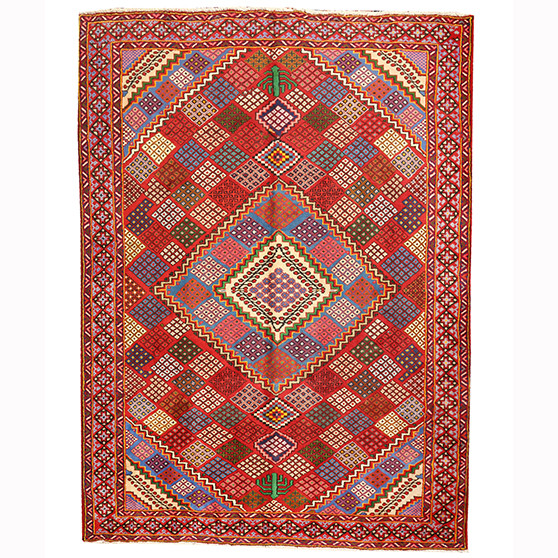
A Mahabad rug of about 10 by 7 feet in a diamond lattice design in madder red, blue, and ivory - Mahabad Persian Rug 9x6 ft - Geometric Semi Antique Wool Hand Knotted
3
The Diamond Lattice
One of our Mahabad rugs is woven in a diamond lattice design. The field is divided by diagonal lines into a grid of diamonds, each filled with a small motif such as a rosette, a star, or a stylized flower. The lattice creates an allover pattern without a single focal point, so the eye moves freely across the rug. In Mahabad rugs, the lattice is often drawn with clear, even lines and alternating colors, giving the field a calm, ordered rhythm. See our lattice design page.
Look at how the weaver handles the edges of the lattice. In a well-planned rug, the diamonds meet the border cleanly, with half-diamonds along the sides that complete the pattern. Small irregularities are common in village rugs, but a balanced edge is a sign of care.
4
The Medallion Layout
Our other Mahabad rug uses a medallion layout. In Mahabad rugs, medallions are usually geometric: diamonds, hexagons, or stepped polygons with hooked outlines, set on a field of small motifs. Corner spandrels often echo the medallion's shape. Some Mahabad rugs place a medallion on top of an allover pattern, so that the field and the medallion work together.
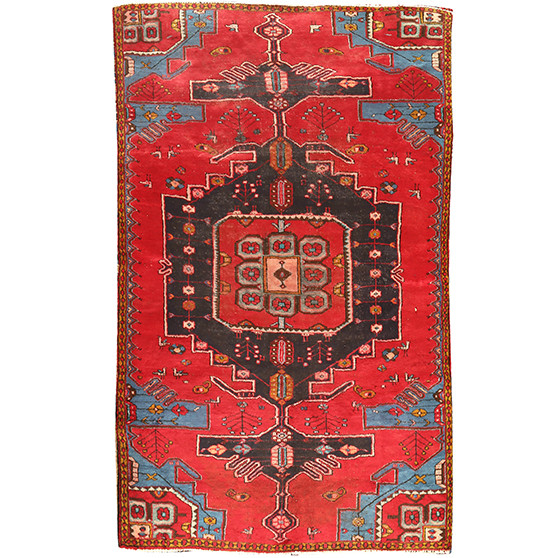
A Mahabad rug of about 8.5 by 5.25 feet with a geometric medallion design in red, blue, and black - Mahabad Persian Rug 8x5 ft - Geometric Semi Antique Wool Hand Knotted
5
Colors of Mahabad
Mahabad rugs are known for clear, confident colors. Our rugs use madder red for fields and motifs, blue and navy for depth and contrast, ivory for highlights, and black for outlines, with smaller touches of green, gold, and orange. Kurdish weavers in general favor strong, saturated colors, and in Mahabad rugs they are combined with a balanced, orderly drawing.
In semi-antique rugs, these colors have mellowed. The reds have softened, the blues have deepened, and the ivories have warmed. Black outlines, often made with iron-based dyes, may have worn slightly lower than the surrounding pile, giving the surface a gentle relief. Read more in our articles on natural dyes and traditional dyeing.
6
How Mahabad Rugs Are Built
•
Knot - The symmetric (Turkish) knot.
•
Foundation - Cotton warps and wefts.
•
Pile - Thick, resilient wool, clipped to a medium height.
•
Density - Medium.
•
Sides and ends - Overcast sides and fringes.
This construction gives Mahabad rugs their characteristic firmness. They lie flat, hold their shape, and stand up well to heavy foot traffic.
7
Mahabad and Its Neighbors
Mahabad and Bijar
Bijar rugs, from Kurdistan province to the south-east, are denser and heavier, with tightly packed wefts. See our Bijar collection.
Mahabad and Senneh
Senneh rugs, from Sanandaj, are much finer, with a very short pile. See our Senneh collection.
Mahabad and Kurdish
Mahabad rugs belong to the broad family of Kurdish rugs. See our Kurdish collection.
Mahabad and Azerbaijan
The weaving towns of Azerbaijan to the north share the symmetric knot and orderly drawing. See our Azerbaijan collection.
Mahabad and Heriz
Heriz rugs, from the east of Azerbaijan, share bold geometry and durable wool. See our Heriz collection.
8
Sizes in Our Collection
•
About 10 by 7 feet - A medium living room, a dining room for six, or a bedroom.
•
About 8.5 by 5.25 feet - A study, a small living room, a bedside, or an entrance.
9
Choosing the Right Size
Measure the space and leave about 12 to 18 inches of floor between the rug and the walls. In a living room, place at least the front legs of the main furniture on the rug. In a dining room, let the rug extend about 24 inches beyond the table on every side. In a bedroom, a rug of about 10 by 7 feet can sit under a queen bed with rug on each side. Mark the outline on the floor with painter's tape before you decide.
10
Placing a Lattice Rug
A lattice rug is very flexible. Because its pattern has no single focus, it does not need to be centered under one piece of furniture. That makes it a good choice for open spaces, for rooms with off-center furniture, and for dining rooms, where chairs and a table cover parts of the field. Its even pattern also reads well from any direction.
11
Placing a Medallion Rug
A medallion rug looks best when the medallion is visible. In a living room, center it on the seating group. In a study, center it in front of a desk or reading chair. In a bedroom, place it so that the medallion sits at the foot of the bed.
12
Matching a Mahabad to Your Room
The clear reds and blues of a Mahabad rug suit rooms with pale or neutral walls, where they become the main source of color. Pick up the blue for cushions or curtains, and the ivory for upholstery. In a modern interior, a Mahabad adds pattern and warmth. In a traditional or rustic home, it pairs naturally with wood, leather, and woven textiles.
13
Kurdish Weaving in the North-West
Kurdish communities live across a wide arc of western Persia, from Kermanshah in the south to West Azerbaijan in the north. Their rugs vary from the fine Senneh to the heavy Bijar and the sturdy village rugs of Kermanshah. Mahabad rugs are the northern branch of this family. They share the strong colors and durable wool of Kurdish weaving, but their position near the Azerbaijan weaving towns gives them a more orderly feel. Read more in our article on Kurdish rugs.
14
From Sheep to Loom
The wool of a Mahabad rug begins with sheep grazing the hill pastures of the region. After shearing, the wool is washed, sorted, and spun, then dyed and dried. Village weavers work on upright looms in their homes, usually from memory or from a sample of a familiar design. Read more in our articles on Persian rug wool and the craft from shepherd to dealer.
15
Motifs in the Field
Around the main design of a Mahabad rug, you may find many small motifs:
•
Rosettes - Small geometric flowers inside the lattice.
•
Stars - Eight-pointed stars.
•
Hooked diamonds - Diamonds with hooks along their outlines.
•
Leaves - Stylized leaves recalling the Herati pattern.
•
Running dog - A hooked, wave-like border motif.
Read more in our article on design motifs.
16
Borders and Guard Stripes
The borders of a Mahabad rug frame the field like a picture frame. A typical rug has one wide main border with a repeating geometric flower, a hooked vine, or a row of stars, flanked by narrow guard stripes with small zigzags or reciprocal triangles. In a well-woven rug, the border turns each corner cleanly.
17
Abrash and Color Changes
Many Mahabad rugs show abrash, horizontal bands where one color shifts slightly in shade. This happens when the weaver runs out of one batch of dyed wool and starts another. In village rugs, abrash is a natural sign of hand-dyed wool and is often admired for the movement it gives the field. It is not a defect.
18
Lake Urmia and the Land Around It
Lake Urmia, to the north of Mahabad, is one of the largest lakes in the Middle East, a vast salt lake ringed by plains, orchards, and mountains. The rivers that feed it water the farms and pastures of the region, including the valleys around Mahabad. This is good sheep country, with green spring pastures and cold winters, and for centuries the wool of its flocks has supplied local looms. The long winters, when farm work slows, have always been a season for weaving in the villages.
19
Village Life and the Loom
In the villages around Mahabad, weaving has traditionally been the work of women, done at home on upright looms set against a wall. Girls learned by sitting beside their mothers and grandmothers, first passing yarn, then tying simple knots, and finally weaving whole rows. Many designs were kept in memory rather than drawn on paper. A finished rug might be used at home, kept for a daughter's dowry, or sold in the Mahabad market to bring in cash for the family. This domestic tradition explains much about Mahabad rugs: their practical sizes, their sturdy construction, and the small personal touches that make each one unique.
20
Herati and Allover Patterns
Besides the diamond lattice, Mahabad weavers often use allover patterns based on the Herati, a small repeating unit of a rosette inside a diamond, surrounded by curved leaves. In Kurdish village rugs, the Herati is usually drawn in a bolder, more angular way than in city rugs, with leaves that become hooks and rosettes that become stars. The result is a field full of movement that still feels ordered. See our Herati design page.
21
The Ends and Fringes
The fringes of a Mahabad rug are the ends of its cotton warp threads, tied off after the rug is cut from the loom. Many village rugs also have a narrow band of flat weave between the last row of knots and the fringe, which helps lock the knots in place. Fringes are among the first parts of a rug to wear. Vacuum across them gently, or not at all, and have worn ends secured by a professional before the knots begin to come loose. See our guide to maintaining rug fringes.
22
Large Rugs and Furniture
Heavy furniture can leave dents in the pile of any rug. Move pieces slightly every few months, and brush the pile back up with your fingers. Felt pads under furniture legs spread the weight. When you rotate the rug, the pile will wear evenly over the years, and the colors will stay balanced across the whole field.
23
Grades and How to Judge Them
•
Drawing - Clear, well-proportioned lattice or medallion.
•
Wool - Thick, springy, lustrous wool.
•
Color - Clear colors without bleeding.
•
Straightness - Straight sides and square corners.
•
Condition - Even pile, intact sides and ends.
24
Reading the Back
On the back of a Mahabad rug, the design shows clearly in medium-sized knots. With the symmetric knot, each knot shows as two equal bumps. Look at the cotton foundation, the evenness of the rows, and the condition of the sides and fringes. Compare it with a Bijar, which feels much stiffer and heavier, and a Senneh, which is thin and flexible.
25
Questions to Ask Before You Buy
•
What is the foundation? - Cotton or wool.
•
What are the measurements at both ends? - Checks that the rug is square.
•
Has it been repaired? - Especially along the sides and at the ends.
•
Are the dark colors worn? - Corroded blacks are normal in older rugs.
•
Has it been washed recently? - A fresh wash shows the true colors.
26
Semi-Antique Mahabad Rugs
Our Mahabad rugs are semi-antique, woven roughly forty to sixty years ago. They have settled colors, good wool, and many years of life ahead. See our semi-antique rugs.
27
What Affects the Price
•
Size - Larger rugs cost more.
•
Drawing - Clear, balanced designs add value.
•
Wool - Lustrous wool adds value.
•
Color - Clear, harmonious colors add value.
•
Condition - Intact sides and ends.
28
Combining a Mahabad with Other Rugs
A Mahabad pairs naturally with other Kurdish and north-western rugs, such as Bijar, Heriz, Hamadan, and Kurdish village rugs, which share its bold geometry and warm reds. With a finer city rug, it adds a rustic contrast. Keep one or two colors in common and vary the scale of the patterns.
29
Why Kurdish Rugs Wear So Well
Kurdish rugs have a reputation as some of the most durable rugs of Persia. The wool from mountain sheep is strong and springy, so the pile recovers after it is pressed down. The symmetric knot holds the pile firmly. And village weavers made rugs for their own use, so they valued strength over speed. These qualities make a Mahabad a practical choice for living rooms, dining rooms, and family rooms.
30
Living with a Mahabad
A good Mahabad becomes part of the house. Its colors settle further, its pile develops a soft sheen, and its pattern becomes familiar. Many families keep such a rug for decades, moving it from one room or home to another as their lives change. With ordinary care, it can stay in daily use for many more years.
31
Caring for a Mahabad Rug
Vacuum regularly without a beater bar. Rotate the rug every six months so that wear and sunlight are spread evenly. Use a non-slip pad. Blot spills at once with a clean, white cloth and cold water. Have it professionally washed every few years. Keep it out of strong direct sunlight. See our care instructions and our article on professional washing.
32
Photographs and Real Color
Reds and blues can look different on screen depending on the light. Daylight from a north window shows the truest colors, while warm lamps make the reds look deeper. If color matters for your room, ask us for extra photographs in daylight or close-ups of the pile. We are glad to describe how a rug looks in person.
33
Common Buying Mistakes
•
Confusing it with a Bijar - Mahabad rugs are lighter and less dense.
•
Choosing the wrong size - Measure carefully.
•
Skipping the pad - Rugs slip without one.
•
Ignoring the ends - Fringes need regular checks.
34
Frequently Asked Questions
Where is Mahabad?
In the south of West Azerbaijan province, south of Lake Urmia, in north-western Persia.
Who weaves Mahabad rugs?
Kurdish villagers of the Mahabad region.
What designs are typical?
Diamond lattices, allover patterns, and geometric medallions.
What colors are typical?
Madder red, blue, navy, ivory, and black.
What knot is used?
The symmetric (Turkish) knot.
How is a Mahabad different from a Bijar?
A Bijar is denser and heavier, with tightly packed wefts. A Mahabad is lighter and more flexible.
What sizes do you have?
About 10 by 7 feet and about 8.5 by 5.25 feet.
Are Mahabad rugs durable?
Yes. Their thick wool and sturdy construction make them very durable.
Does a lattice rug need to be centered?
No. Its even pattern looks good in many positions.
Is abrash a defect?
No. It is a natural sign of hand-dyed wool.
How should I care for a Mahabad rug?
Vacuum regularly, rotate it, use a pad, and have it professionally washed every few years.
Is a Mahabad rug suitable for a home with children or pets?
Yes. Its thick wool, clear colors, and sturdy construction stand up well to daily life.
Can a Mahabad go in a dining room?
Yes. At about 10 by 7 feet, it suits a table for six, and a lattice pattern hides small marks well.
Are Mahabad rugs still woven?
Village weaving continues in the region, but semi-antique pieces like ours have settled colors and mature wool that new rugs do not yet have.
Can a Mahabad go in a bedroom?
Yes. The larger rug can sit under a queen bed, and the smaller one works well at the foot of a bed or beside it.
Will the colors fade further?
In a semi-antique rug the colors have largely settled. Keep it out of strong direct sunlight to protect them.
35
Choose Your Mahabad Rug
Each Mahabad rug in our collection is hand-knotted, one of a kind, and inspected before it is listed. Browse our Mahabad collection, compare with our Kurdish, Bijar, and Heriz rugs, or ask our experts for help.