


Some rug regions sit at a crossroads, and Malayer is one of them. The town lies in the south-east of Hamadan province, close to the border with the Arak region of central Persia. To the north and west stretch the villages that weave sturdy Hamadan rugs; to the east lie the villages of the old Sultanabad district, home of Sarouk, Mahal, and Farahan rugs. The weavers of the Malayer district drew on both traditions, and their rugs carry something of each.
This guide explains where Malayer rugs come from, how they are made, how to read their designs and colors, and how to choose, place, and care for a Malayer rug like those in our collection. For more history, see our articles on Malayer rugs and weaving in Hamadan.
1
The Malayer District
Malayer is a market town surrounded by fertile plains and hills, known in Persia for its vineyards and raisins and for its woodworking and furniture makers. Around it lie many villages where weaving has long been part of household life. Their rugs were brought to the Malayer market and sold on to Hamadan, Arak, and Tehran, and from there to export markets. Several village names of the district are known in the trade in their own right, among them Jozan, whose fine rugs are sometimes called Jozan Sarouk. See our Jozan collection.
Malayer lies where the Hamadan and Arak weaving regions meet. Its rugs combine Hamadan's sturdy village build with some of Arak's floral refinement.
2
Two Weaving Traditions in One District
What makes Malayer rugs interesting is that the district stands between two ways of weaving. Hamadan village rugs are usually woven with the symmetric (Turkish) knot and a single weft, a single thick cotton thread passed after each row of knots. Rugs of the Arak region, such as Sarouk, are usually woven with the asymmetric (Persian) knot and a double weft, two threads after each row, which gives a denser, stiffer rug. In the Malayer district, both habits are found. Some villages weave in the Hamadan way, others in a manner closer to the Arak region, and many Malayer rugs combine the symmetric knot with a double weft.
For a buyer, this means that Malayer rugs can vary more than rugs from a single village. The best way to judge one is by the rug itself: its wool, its drawing, its density, and its condition.
3
How to Recognize a Malayer Rug
•
Medallion or allover designs - Geometric or semi-floral medallions, Herati and boteh patterns.
•
Warm colors - Madder red, navy, burgundy, cream, and camel.
•
Firm handle - Often denser than an ordinary Hamadan village rug.
•
Cotton foundation - Cotton warps and wefts.
•
Balanced drawing - Between the bold geometry of Hamadan and the floral style of Arak.
•
Long rugs and runners - Long formats are a Malayer specialty.
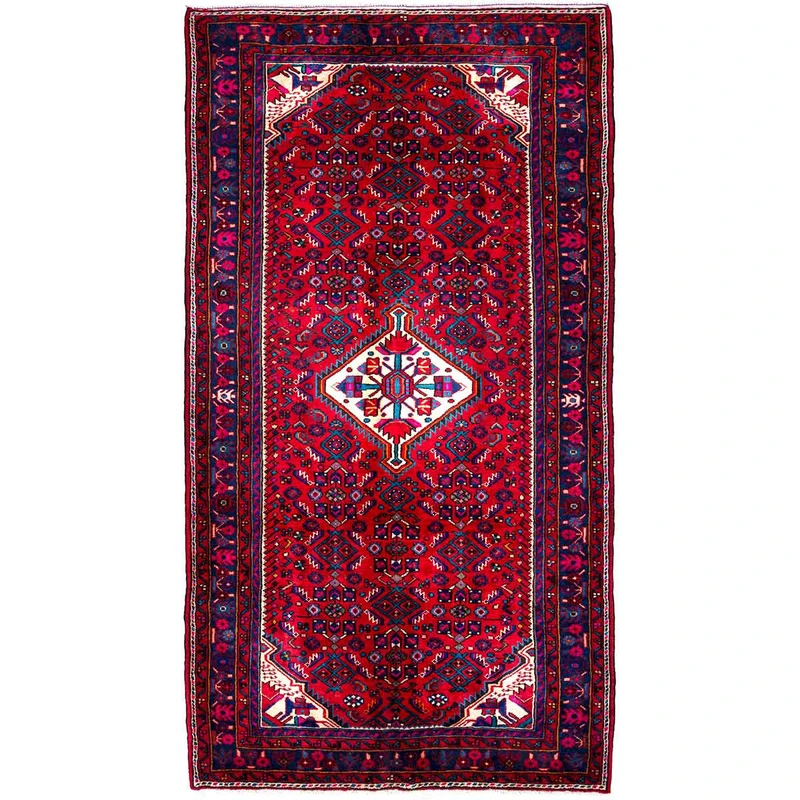
A Malayer rug of about 10 by 5.25 feet with a medallion design in madder red, navy blue, and burgundy - Malayer Persian Rug 9x5 ft - Medallion Semi Antique Wool Hand Knotted
4
Reading the Medallion
In a Malayer rug, the medallion is often a diamond or lobed form, sometimes with stepped or hooked outlines, set on a field of small flowers, leaves, and geometric motifs. Corner pieces frame the field. In some Malayers, the medallion is drawn in a more floral way, with curved outlines and palmettes, recalling the rugs of the Arak region. In others, it is boldly geometric, closer to Hamadan village weaving. Our rugs have clear medallions in madder red and navy, with a balanced, harmonious field.
5
Malayer Runners and Long Rugs
The Malayer district has long been admired for its runners and long rugs. Older Malayer runners, often with Herati or boteh patterns on red or navy fields, are prized by collectors. Today, long Malayer rugs remain a practical choice for hallways, passages, and the sides of beds. Our long Malayer, about 10 by 5.25 feet, is wide enough for a broad hallway or the foot of a king bed. See our runners.
6
How Malayer Rugs Are Built
•
Knot - Usually the symmetric (Turkish) knot; the asymmetric knot is also found.
•
Foundation - Cotton warps and wefts.
•
Wefts - Single or double, depending on the village.
•
Pile - Good wool, clipped to a medium height.
•
Density - Medium, often firmer than an ordinary Hamadan.
•
Sides and ends - Overcast sides and fringes.
7
Colors of Malayer
Our Malayer rugs use warm, classic palettes: madder red fields, navy blue medallions and borders, burgundy for depth, and cream for highlights, with touches of green, gold, and light blue. In semi-antique rugs, these colors have mellowed into a soft, harmonious whole. You may also see abrash, gentle changes of shade within one color, which give the field movement. Read more in our articles on natural dyes and traditional dyeing.
8
The Small Malayer
Our small Malayer, about 5.75 by 3.5 feet, is a classic scatter-size rug. It suits an entrance, a bedside, a study, a bathroom, or the space in front of a kitchen sink. Small rugs are also a good way to bring a piece of Persian weaving into a room that already has a larger rug, or to try a style before choosing a larger piece. See our 3x5 rugs and 4x6 rugs.
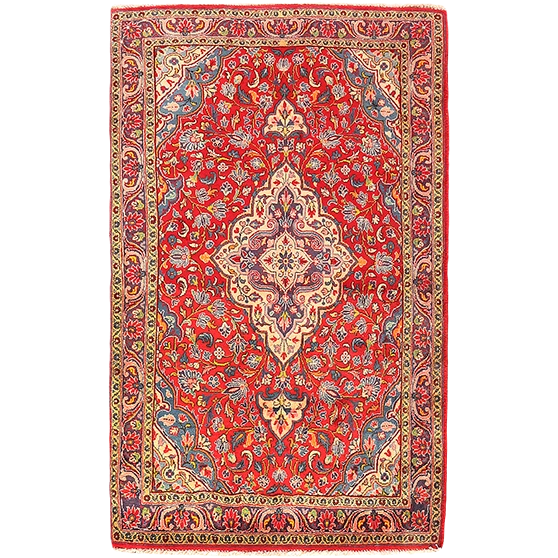
A Malayer rug of about 5.75 by 3.5 feet with a central medallion in madder red, cream, and navy blue - Malayer Persian Rug 5x3 ft - Medallion Semi Antique Wool Hand Knotted
9
Malayer and Its Neighbors
Malayer and Hamadan
Hamadan village rugs share the symmetric knot, but usually have a single weft and bolder drawing. See our Hamadan collection.
Malayer and Sarouk
Sarouk rugs, from the Arak region, use the asymmetric knot and a double weft, with finer floral drawing. See our Sarouk collection.
Malayer and Jozan
Jozan is a village of the Malayer district known for fine, double-wefted rugs. See our Jozan collection.
Malayer and Tuyserkan
Tuyserkan, to the west, weaves sturdy Hamadan-type village rugs. See our Tuyserkan collection.
Malayer and Nahavand
Nahavand, to the south-west, is another village name of the Hamadan region. See our Nahavand collection.
Malayer and Mahal
Mahal rugs, from the Arak region to the east, share warm floral palettes. See our Mahal collection.
10
Choosing a Long Rug
Measure your space carefully. For a hallway, leave about 6 to 12 inches of floor at each end and on each side. A rug about 5.25 feet wide suits a hallway about 6 to 7 feet wide. For a space beside a bed, the rug can extend beyond the bed at the foot. Check that doors can open over the rug. Mark the outline on the floor with painter's tape before you decide.
11
Placing a Malayer
A Malayer brings warmth to any room. On a pale wood or stone floor, its reds and navies glow. In a modern interior, it adds pattern and history to clean lines. In a traditional home, it pairs naturally with wood furniture and framed pictures. A long Malayer at the foot of a bed, or along a wide hallway, creates a welcoming path through the house.
12
Reading the Back
Turn a Malayer over and look at the wefts. If you see one thick weft thread between rows of knots, the rug was woven in the Hamadan manner. If you see two, it was woven with a double weft, closer to the Arak manner, and the rug will usually feel stiffer and denser. Look also at the knots: with the symmetric knot, each knot shows as two equal bumps. Check the sides and fringes.
13
Village Life Around Malayer
In the villages of the Malayer district, weaving has traditionally been the work of women, done at home on upright looms alongside farming, vine growing, and raising sheep. Girls learned at their mothers' side, first passing yarn and then tying knots. In some villages, designs were woven from memory; in others, especially those that worked for merchants from Arak or Hamadan, weavers followed a sample rug or a design drawn on squared paper. That mix of home weaving and merchant-organized weaving helps explain the variety of Malayer rugs. Read more about the people behind rugs in our article on the craft from shepherd to dealer.
14
The Herati and Boteh in Malayer Rugs
Besides medallions, two allover patterns are especially associated with Malayer rugs. The Herati is a small repeating unit of a rosette inside a diamond surrounded by curved leaves; in Malayer rugs it is often drawn at a medium scale, so that the field has a lively texture without feeling busy. The boteh, a teardrop or paisley shape, may be arranged in neat rows across the field, sometimes alternating in color. Both patterns appear on many older Malayer runners. See our Herati design and boteh design pages.
15
Borders and Guard Stripes
The borders of a Malayer rug frame the field like a picture frame. A typical rug has a main border with a chain of rosettes or palmettes, or a geometric version of the classic turtle border, flanked by narrow guard stripes with small flowers or reciprocal patterns. In a well-woven rug, the border turns each corner cleanly. Compare borders when you compare rugs: their drawing often tells you as much about the weaver's skill as the field does.
16
The Wool of the Hamadan Region
The wool of the Malayer district comes from sheep raised on the plains and hills of Hamadan province. It is strong and springy, with a good natural luster, and it takes dye well. In semi-antique rugs, the wool has developed a gentle sheen. Rub the pile between your fingers: good wool feels soft and springy, not dry or brittle. Read more in our article on Persian rug wool.
17
Matching a Malayer to Your Room
The warm reds of a Malayer suit rooms with pale or neutral walls, where they become the main source of color. Pick up the navy for cushions or curtains and the cream for upholstery. A small Malayer can echo the colors of a larger rug in the same room or a nearby room, tying spaces together. In a modern interior, a Malayer adds warmth and history; in a traditional home, it pairs naturally with dark wood and brass.
18
Combining a Malayer with Other Rugs
A Malayer pairs naturally with other rugs of the Hamadan and Arak regions, such as Hamadan, Borchelu, Jozan, Sarouk, and Mahal, which share its warm reds and navies. Keep one or two colors in common and vary the scale of the patterns, so that the rugs work together without competing. See our Borchelu collection.
19
Keeping a Long Rug Flat and Safe
A long rug in a busy passage needs a good pad. A felt-and-rubber pad keeps it from slipping and helps it lie flat. If a corner curls, roll it gently in the opposite direction for a few hours. Turn the rug end to end every few months so that wear and sunlight are spread evenly. Vacuum across the fringes gently, or not at all, and have worn ends secured by a professional. See our guide to maintaining rug fringes.
20
Photographs and Real Color
Reds, burgundies, and navies can look different on screen depending on the light. Daylight from a north window shows the truest colors, while warm lamps make the reds look deeper. If color matters for your room, ask us for extra photographs in daylight or close-ups of the pile. We are glad to describe how a rug looks in person.
21
Living with a Malayer
A good Malayer becomes part of the house. Its colors settle further, its pile develops a soft sheen, and its medallion becomes a familiar center to the space. Many families keep such a rug for decades, moving it from one room or home to another as their lives change. With ordinary care, a semi-antique Malayer can stay in daily use for many more years.
22
Abrash and Color Changes
Many Malayer rugs show abrash, horizontal bands where one color shifts slightly in shade. This happens when the weaver runs out of one batch of dyed wool and starts another. In village rugs, abrash is a natural sign of hand-spun, hand-dyed wool and is often admired for the movement it gives the field. In a long rug, it can create a gentle rhythm from one end to the other. It is not a defect, and it usually adds to the character of a rug.
23
Motifs in the Field
Around the medallion of a Malayer rug, you may find many small motifs: rosettes, small palmettes, stars, leaves, and stylized flowers, sometimes with tiny animals or birds added by the weaver. In more floral Malayers, these motifs are linked by thin vines; in more geometric pieces, they float freely across the field. Look closely at them when you compare rugs: they show how the weaver handled detail, and they give the field much of its texture when seen from a few steps away. Read more in our article on design motifs.
24
Small Rugs in Busy Places
A small rug works hard. In an entrance, it catches grit from shoes; in a kitchen, it catches spills. Shake or vacuum it often, and turn it regularly so that one end does not wear faster than the other. A good pad keeps it from sliding on smooth floors. Because a small Malayer is light, it is also easy to take outside, air in the shade, and bring back in.
25
Malayer in the Wider Hamadan Family
The Hamadan region is one of the largest weaving areas of Persia, with hundreds of villages, each with its own habits. Within that family, Malayer stands out as a district where village rugs often reach a higher density and a more refined drawing than the ordinary Hamadan. For buyers, a Malayer offers the warmth and durability of a Hamadan village rug with a little more finesse, often at a reasonable price. Our article on weaving in Hamadan gives a wider map of the region.
26
Grades and How to Judge Them
•
Density - A firm, even weave.
•
Wool - Soft, lustrous wool with a full pile.
•
Drawing - A clear, balanced medallion.
•
Color - Clear colors without bleeding.
•
Condition - Even pile, intact sides and ends.
27
Questions to Ask Before You Buy
•
Single or double weft? - A clue to the weaving tradition.
•
What are the measurements at both ends? - Checks that the rug is square.
•
Is the pile even? - Check for worn areas.
•
Has it been repaired? - Especially along the sides and at the ends.
•
Has it been washed recently? - A fresh wash shows the true colors.
28
Semi-Antique Malayer Rugs
Our Malayer rugs are semi-antique, woven roughly forty to sixty years ago. They have settled colors, good wool, and many years of life ahead. See our semi-antique rugs.
29
What Affects the Price
•
Size - Larger rugs cost more.
•
Density - Double-wefted, denser rugs are often worth more.
•
Wool - Lustrous wool adds value.
•
Drawing - Well-drawn designs add value.
•
Condition - Intact sides and ends.
30
Caring for a Malayer Rug
Vacuum regularly without a beater bar. Turn or rotate the rug every few months. Use a non-slip pad. Blot spills at once with a clean, white cloth and cold water. Have it professionally washed every year or two in busy areas and every few years elsewhere. Keep it out of strong direct sunlight. See our care instructions and our article on professional washing.
31
Common Buying Mistakes
•
Expecting one standard - Malayer rugs vary by village.
•
Choosing the wrong size - Measure carefully.
•
Skipping the pad - Rugs slip without one.
•
Ignoring the ends - Fringes need regular checks.
32
Frequently Asked Questions
Where is Malayer?
In the south-east of Hamadan province, near the Arak region of central Persia.
How are Malayer rugs different from Hamadan rugs?
Many Malayers are double-wefted and denser, with somewhat more refined drawing.
How are Malayer rugs different from Sarouks?
Sarouks use the asymmetric knot and finer floral drawing; most Malayers use the symmetric knot.
What designs are typical?
Medallions, Herati and boteh patterns.
What colors are typical?
Madder red, navy, burgundy, cream, and camel.
What sizes do you have?
A long rug of about 10 by 5.25 feet and a small rug of about 5.75 by 3.5 feet.
Are Malayer rugs durable?
Yes. Their firm structure and good wool make them durable.
What is a double weft?
Two weft threads after each row of knots, which makes a denser, stiffer rug.
Is abrash a defect?
No. It is a natural sign of hand-dyed wool.
How should I care for a Malayer rug?
Vacuum regularly, rotate it, use a pad, and have it professionally washed regularly.
Can a small Malayer go in a kitchen or bathroom?
Yes. Use a non-slip pad, blot spills at once, and let it dry fully if it gets wet.
Is Jozan part of the Malayer district?
Yes. Jozan is a village of the district known for fine, double-wefted rugs.
Is a Malayer suitable for a home with children or pets?
Yes. Its firm structure, good wool, and warm colors stand up well to daily life.
Will the colors fade further?
In a semi-antique rug the colors have largely settled. Keep it out of strong direct sunlight to protect them.
33
Choose Your Malayer Rug
Each Malayer rug in our collection is hand-knotted, one of a kind, and inspected before it is listed. Browse our Malayer collection, compare with our Hamadan, Jozan, and Sarouk rugs, or ask our experts for help.