


About ninety miles south of Tehran lies Qom, one of the holiest cities of Persia. Pilgrims come from across the country to the gilded shrine at its heart, and its religious schools draw students from many lands. For centuries, Qom was known for its shrine, its seminaries, and its sweets, not for carpets. That changed in the twentieth century, when weavers and merchants, many from nearby Kashan, set up looms in the city. Within a few decades, Qom had become one of the most respected names in fine Persian weaving.
This guide explains how Qom weaving developed, how to recognize a Qom rug, how silk and wool Qoms differ, and how to choose, place, and care for a fine rug like the one in our collection. For the history of weaving in the city, see our article on weaving in Qom, and for silk, our article on silk in Persian rugs.
1
A Young Weaving Center
Unlike Kashan, Kerman, or Tabriz, Qom has no centuries-old carpet tradition. Commercial weaving there is usually dated to the early and middle twentieth century, when workshops opened in the city and in nearby villages. Without an old local style to follow, Qom weavers were free to borrow from the best designs of Persia: the medallions and vases of Kashan and Isfahan, the garden panels of Bakhtiari rugs, the boteh of Saraband, the hunting scenes of Safavid court carpets. They combined these with fine knotting and bright, clear colors, and a distinctive Qom style emerged.
Qom became especially famous for silk rugs, woven entirely in silk on silk foundations, with extremely fine knotting. But the city and its villages also weave fine wool rugs, often with silk highlights, and these are the most common Qoms on the market among older pieces.
Qom is a holy city south of Tehran. Its weaving began in the twentieth century and quickly became famous for very fine silk and wool rugs with crisp, colorful designs.
2
How to Recognize a Qom Rug
•
Crisp, precise drawing - Fine outlines and clear details.
•
Borrowed classic designs - Medallions, vases, gardens, boteh, and hunting scenes.
•
Clear, bright colors - Often lighter and brighter than older city rugs.
•
Fine knotting - A high knot count, especially in silk pieces.
•
Asymmetric knot - The Persian knot.
•
Short pile - Clipped short to show the fine drawing.
3
Silk Qoms and Wool Qoms
The two main kinds of Qom rugs are easy to tell apart once you know what to look for:
•
Silk Qom - Silk pile on a silk foundation. Very fine, very thin, with a brilliant sheen that changes as you walk around the rug. Often small sizes.
•
Wool Qom - Wool pile on a cotton foundation, sometimes with silk highlights. Still fine, with a soft, matte surface and a little more body.
Our Qom is a wool rug, described by its pile of wool on a cotton foundation. If silk matters to you, ask us about any piece; we are happy to check and describe exactly which parts, if any, are silk.
4
The Medallion Qom
Our Qom uses a medallion design: a central medallion on a field of flowers and vines, with matching corner pieces and a classic floral border. In a Qom, the drawing is crisp and precise, with fine outlines around each flower and leaf. Our rug's palette of cream, camel, and madder red is warm and soft, a little quieter than the bright silk Qoms the city is best known for. See our medallion design page.
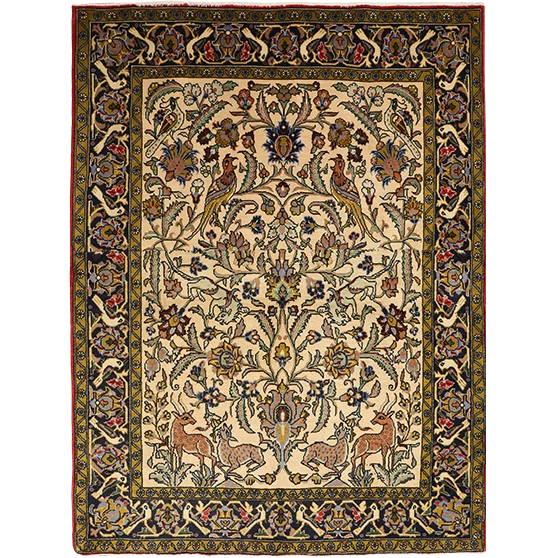
A Qom rug of about 5 by 4 feet with a medallion design in cream, camel, and madder red - Qom Persian Rug 5x3 ft - Medallion Semi Antique Silk Hand Knotted
5
Other Qom Designs
Because Qom borrowed from all over Persia, its weavers use a wide range of designs:
•
Vase designs - Flowers rising from vases, sometimes stacked in rows.
•
Garden designs - Panels filled with flowers and trees.
•
Boteh - Rows of teardrop or paisley motifs.
•
Hunting scenes - Riders, animals, and trees, after Safavid court carpets.
•
Prayer designs - Arches with lamps, columns, or trees.
•
Pictorial rugs - Scenes and portraits woven like paintings.
6
How Qom Rugs Are Built
•
Knot - The asymmetric (Persian) knot.
•
Foundation - Cotton in wool rugs; silk in silk rugs.
•
Pile - Fine wool or silk, clipped short.
•
Density - Fine to very fine.
•
Sides and ends - Overcast sides and fringes; silk rugs have silk fringes.
The result is a thin, supple rug with a smooth surface that shows every detail of the design.
7
Colors of Qom
Qom rugs are known for clear, often bright palettes: ivory and cream fields, light blues, turquoise, greens, salmon, and reds, sometimes with gold. Wool Qoms are often softer in tone, with creams, camels, and madder reds, as in our rug. In semi-antique pieces, colors have mellowed into a harmonious whole. Read more in our article on natural dyes.
8
Choosing a Fine Small Rug
A small Qom suits places where its fine drawing can be enjoyed up close: beside a bed, in a study, in an entrance, or in front of a fireplace. It also makes an elegant accent in a room that already has a larger rug. Because fine rugs have a short pile, place them where they see moderate rather than very heavy traffic. Our Qom, about 5 by 4 feet, is a classic scatter size. See our 3x5 rugs and 4x6 rugs.
9
Hanging a Fine Rug
Small, fine rugs like Qoms are sometimes hung on a wall, where they can be admired like a painting. If you hang a rug, use a fabric sleeve sewn to the back or a hook-and-loop strip, never nails through the rug, and keep it out of direct sunlight. On the floor, use a good pad and keep it away from the busiest paths.
10
Qom and Its Neighbors
Qom and Kashan
Kashan, to the south, gave Qom many of its first weavers and designs. See our Kashan collection.
Qom and Isfahan
Isfahan rugs share fine knotting and classic medallion designs. See our Isfahan collection.
Qom and Nain
Nain rugs are also very fine, with lighter cream and blue palettes. See our Nain collection.
Qom and Tabriz
Tabriz rugs, from the north-west, use the symmetric knot. See our Tabriz collection.
Qom and Saveh
Saveh, to the west, weaves village rugs of a very different, sturdier kind. See our Saveh collection.
11
Reading the Back
Turn a Qom over and you will see why it is admired: the design shows almost as clearly on the back as on the front, in tiny, even knots. With the asymmetric knot, each knot shows as one larger loop and one smaller loop. Check the foundation: cotton in wool rugs, silk in silk rugs. Look at the sides and fringes.
12
Why Silk Shines
Silk fibers are long, smooth, and slightly triangular in cross-section, so they reflect light like tiny prisms. That is why a silk rug seems to change color as you walk around it: viewed from one end, with the pile, it looks lighter and brighter; from the other end, against the pile, darker and richer. Wool has a softer, more matte luster. In wool Qoms with silk highlights, the silk outlines catch the light and seem to glow against the wool around them. Silk is also very strong for its thickness, which allows the very thin warps and tiny knots of the finest Qoms. Our article on silk in Persian rugs explains more.
13
How to Tell Silk from Wool
A few simple observations help. Silk feels cool and very smooth, almost slippery, while wool feels warmer and slightly springy. Silk has a strong sheen that changes with the viewing angle. On the back, silk knots are tiny and very even. The fringe of a silk rug is usually silk, thin and shiny, while wool rugs usually have cotton fringes. There are also convincing imitations, such as mercerized cotton or synthetic fibers, so for a valuable piece, buy from a dealer who will describe the material honestly. We describe every rug by what it is.
14
Pile Direction
Every hand-knotted rug has a pile direction, because the knots lean slightly toward one end. Run your hand along the rug: one way feels smooth, the other slightly rough. In fine rugs like Qoms, the pile direction strongly affects how colors look. Viewed against the pile, colors look deeper; viewed with the pile, lighter. When you place a Qom, look at it from the main viewing position, such as a doorway or a sofa, and turn it until the colors look their best.
15
Rooms for Fine Rugs
Fine rugs are happiest in rooms where people walk in socks or slippers more than in outdoor shoes: bedrooms, studies, formal living rooms, and dressing rooms. In these spaces, a Qom will keep its short, velvety pile for many decades. If you would like a fine rug in a busier space, use a thicker pad, rotate it more often, and place it where it is admired more than walked on.
16
Small Rugs, Big Craft
It is easy to overlook small rugs, yet in fine weaving a small rug can hold as much skill as a large one. A Qom of about 5 by 4 feet may contain hundreds of thousands of knots, each tied by hand, and its design must be planned so that the medallion, corners, and borders fit perfectly within a small space. For many collectors, a small fine rug is the first step into Persian weaving: affordable, easy to place, and endlessly rewarding to look at.
17
Abrash and Color Changes
Fine workshop rugs usually show little abrash, because their wool is dyed in large, carefully matched batches. If you see gentle bands of shade in a Qom, it is a natural sign of hand-dyed wool rather than a defect, but in a fine city rug it is usually subtle. Very strong, sharp color changes in a fine rug are worth asking about.
18
The Ends and Fringes
The fringes of a Qom are the ends of its warp threads, cotton in wool rugs and silk in silk rugs. They are delicate and take wear from vacuums and feet. Vacuum across them gently, or not at all, and have worn ends secured by a specialist. See our guide to maintaining rug fringes.
19
Grades and How to Judge Them
•
Density - A high, even knot count.
•
Drawing - Crisp, precise, well-proportioned design.
•
Material - Fine wool or silk, lustrous and even.
•
Color - Clear, harmonious colors without bleeding.
•
Condition - Even pile, intact sides and ends.
20
Questions to Ask Before You Buy
•
Wool or silk? - Ask which parts, if any, are silk.
•
What is the knot density? - A sign of quality.
•
Is the pile even? - Check for worn areas.
•
Has it been repaired? - Especially along the sides and at the ends.
•
Has it been washed recently? - A fresh wash shows the true colors.
21
Semi-Antique Qom Rugs
Our Qom is semi-antique, woven roughly forty to sixty years ago, from the period when Qom weaving was establishing its reputation. It has settled colors, fine wool, and many years of life ahead. See our semi-antique rugs.
22
What Affects the Price
•
Material - Silk rugs cost much more than wool rugs.
•
Density - Finer rugs are worth more.
•
Size - Larger fine rugs are rarer and cost more.
•
Drawing - Crisp, balanced designs add value.
•
Condition - Even pile, intact sides and ends.
23
The Holy City
Qom grew around the shrine of Fatimah Masumeh, the sister of Imam Reza, whose golden dome and blue-tiled courtyards draw pilgrims year-round. The city is also a great center of religious learning, with seminaries that attract students from many countries. Its bazaar sells everything pilgrims need, from prayer beads to sweets, and in the twentieth century carpets joined that list. The steady flow of visitors gave Qom weavers a ready market, and many fine Qom rugs were first bought as gifts or souvenirs of a pilgrimage.
24
Workshops and Signed Rugs
Many fine Qom rugs were woven in workshops whose masters designed the patterns and supervised the weaving. Some of the finest pieces carry a woven signature in the border, naming the workshop or master. A signature can add interest and value, but it is not a guarantee of quality on its own. Judge the rug itself: its density, drawing, material, and condition. Read more about how designs travel from paper to loom in our article on the craft from shepherd to dealer.
25
Reading a Fine Medallion Up Close
To appreciate a Qom, look closely at its medallion. Follow a single vine from the center outward and see how it splits, curls, and ends in a palmette or a leaf. Notice the thin outlines that separate one color from the next. Then step back and watch the whole design settle into balance. Our article on how to read a Persian rug's secret language offers more ways to look.
26
Matching a Qom to Your Room
The soft cream, camel, and red of our Qom suit rooms with warm wood, linen, and brass. Brighter silk Qoms, with their turquoise, salmon, and ivory, suit lighter, more colorful rooms. In a modern interior, a small Qom adds a jewel-like accent. In a traditional room, it fits naturally with fine furniture and framed pictures. Pick up one of its colors for a cushion or a lamp nearby.
27
Combining a Qom with Other Rugs
A small Qom pairs naturally with other fine city rugs, such as Kashan, Isfahan, and Nain, and can sit beside a larger rug in the same palette. Keep one or two colors in common and vary the scale of the patterns, so that the rugs work together without competing.
28
Caring for a Fine Rug
Vacuum gently without a beater bar, using the lowest power setting. Rotate the rug every few months. Use a good non-slip pad. Blot spills at once with a clean, white cloth and cold water; never rub. Have it professionally washed every few years by a specialist who knows fine rugs and silk. Keep it out of strong direct sunlight, which can fade light colors and silk. See our care instructions and our article on professional washing.
29
Photographs and Real Color
Fine detail, soft creams, and silk sheen are all hard to capture on screen. Daylight from a north window shows the truest colors. If color or detail matters to you, ask us for extra photographs in daylight or close-ups of the pile.
30
Living with a Qom
A good Qom becomes a small treasure in a home. Its fine drawing invites a closer look again and again, its colors settle further over the years, and its short pile develops a soft sheen. Many families keep such a rug for generations, treating it as much as a work of craftsmanship as a floor covering.
31
Common Buying Mistakes
•
Assuming every Qom is silk - Many fine Qoms are wool.
•
Putting a fine rug in a heavy-traffic area - Choose a sturdier rug for busy spaces.
•
Cleaning silk at home - Leave silk to specialists.
•
Skipping the pad - Thin rugs slip easily.
32
Frequently Asked Questions
Where is Qom?
About ninety miles south of Tehran, in central Persia.
Is Qom the same as Qum or Ghom?
Yes. They are different spellings of the same city.
How old is Qom weaving?
Commercial weaving in Qom dates mainly from the twentieth century.
Are all Qom rugs silk?
No. Qom is famous for silk rugs, but many fine Qoms are wool, sometimes with silk highlights.
Is your Qom silk?
Our Qom is described by its wool pile on a cotton foundation. Ask us about any silk details.
What designs are typical?
Medallions, vases, gardens, boteh, hunting scenes, and prayer designs.
What knot is used?
The asymmetric (Persian) knot.
What size is your Qom?
About 5 by 4 feet.
Can a Qom be hung on a wall?
Yes. Use a fabric sleeve or a hook-and-loop strip, never nails, and keep it out of direct sunlight.
Are Qom rugs durable?
Yes, with care. They are fine rugs, best in places with moderate traffic.
How should I care for a Qom rug?
Vacuum gently, rotate it, use a pad, and have it washed by a specialist every few years.
How can I tell silk from wool?
Silk feels cool and very smooth and has a strong, changing sheen. Ask us; we describe every rug by its real material.
What is pile direction?
The way the knots lean. Colors look deeper against the pile and lighter with it.
Is a small Qom a good first fine rug?
Yes. It is easy to place, rewarding to look at, and more affordable than a large fine rug.
Will the colors fade?
Light colors and silk can fade in strong sunlight. Keep a Qom out of direct sun or use curtains during the brightest hours.
Can a Qom go in a bedroom?
Yes. A bedroom is one of the best places for a fine rug, beside the bed or in front of a dresser.
33
Choose Your Qom Rug
Each Qom rug in our collection is hand-knotted, one of a kind, and inspected before it is listed. Browse our Qom collection, compare with our Kashan, Isfahan, and Nain rugs, see our silk rugs, or ask our experts for help.