


In the heart of eastern Persia, where the great salt desert of the north meets the sand desert of the south, lies the oasis of Tabas. For travelers crossing the desert, it has always been a welcome sight: date palms, orange and citrus trees, running water channels, and gardens, in a landscape otherwise made of sand, salt, and stone. Tabas has long been a meeting point between the weaving worlds of Yazd and Kerman to the south-west and Khorasan to the north-east, and its rugs share the floral grace of the city traditions of both.
This guide introduces the oasis of Tabas, explains how to recognize a Tabas rug, how it compares with its neighbors, and how to choose, place, and care for a Tabas like those in our collection. For the wider region, see our articles on weaving in Yazd and weaving in Khorasan.
1
An Oasis in the Desert
Tabas has existed for many centuries as an oasis on the routes crossing the deserts of central and eastern Persia. Its water comes from springs and underground channels called qanats, which carry water from distant hills to the gardens and palm groves. The town's historic Golshan Garden, with its pools and tall palms, is a famous example of the Persian garden in a desert setting. In 1978, a devastating earthquake destroyed much of the old town, which was later rebuilt. Through all its history, Tabas has been a place where travelers rested and goods, including rugs, changed hands.
Tabas is a desert oasis between Yazd and Khorasan. Its rugs are city-style floral weavings, often with light cream and ivory grounds.
2
How to Recognize a Tabas Rug
•
Floral designs - Graceful medallions and allover Afshan patterns.
•
Light grounds - Cream, ivory, and white fields are common.
•
Classic accents - Navy, indigo, madder red, rust, and antique gold.
•
Curvilinear drawing - Flowing vines and naturalistic flowers.
•
Asymmetric knot - The Persian knot of the city traditions.
•
Cotton foundation - Cotton warps and wefts.
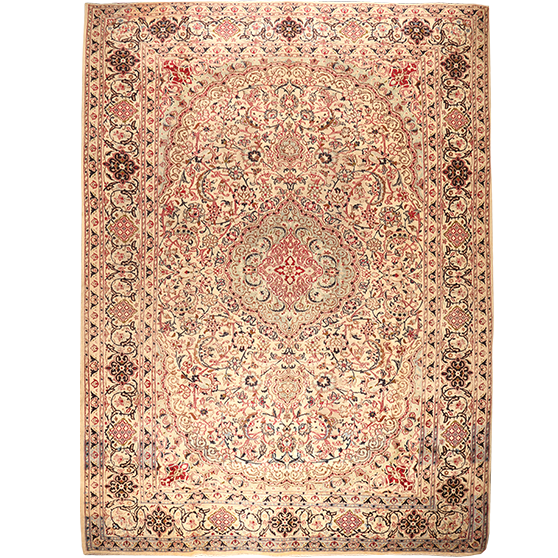
A Tabas rug of about 13 by 9.5 feet with a medallion design in cream, ivory, and madder red - Tabas Persian Rug 12x9 ft - Medallion Semi Antique Wool Silk Hand Knotted
3
The Cream-Ground Medallion
Our room-size Tabas has a medallion layout on a light cream and ivory field. A central floral medallion, with pendants and matching corner pieces, sits on a field of scrolling vines and flowers drawn in madder red and other accents. Light grounds like this are less common than red ones in Persian rugs, and they give a room a bright, airy feel. The drawing is graceful and balanced, in the city tradition. See our medallion design page.
4
The Afshan Design
Two of our Tabas rugs use an Afshan design, an allover pattern of flowers, palmettes, and vines scattered across the field without a central medallion. Afshan means "scattered" or "sprinkled." On a light ground, the flowers seem to float, giving the rug a delicate, garden-like quality. An Afshan rug has no single focal point, so it looks good from every direction and works well under furniture. See our Afshan design page.
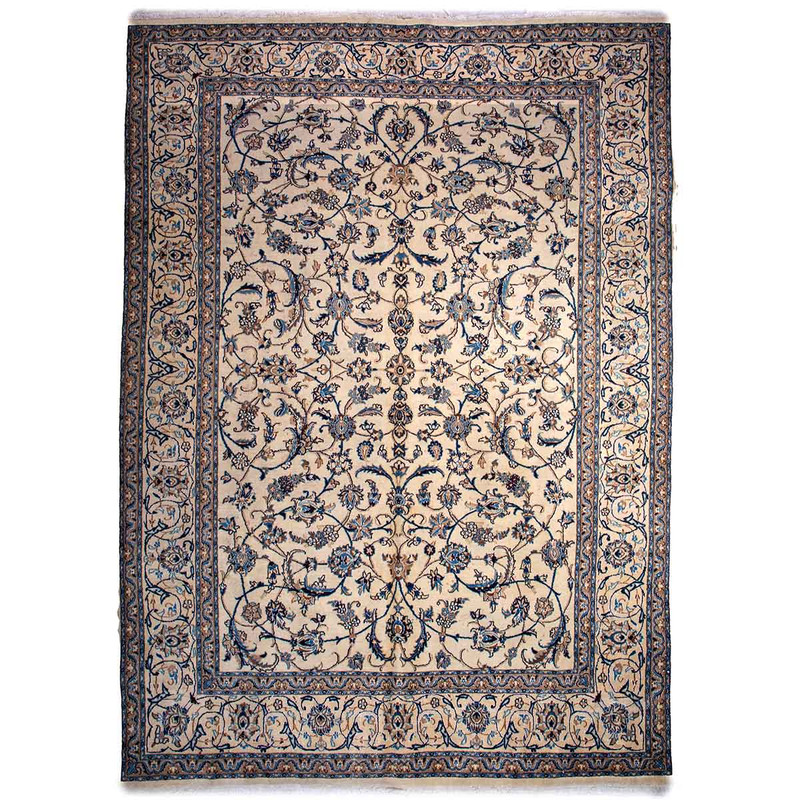
A Tabas rug of about 11.25 by 7.75 feet with an allover Afshan design in cream, navy blue, and indigo - Tabas Persian Rug 11x7 ft - Afshan Semi Antique Wool Silk Hand Knotted
5
How Tabas Rugs Are Built
•
Knot - The asymmetric (Persian) knot.
•
Foundation - Cotton warps and wefts.
•
Pile - Wool, clipped to a medium or short height.
•
Density - Medium to fine.
•
Sides and ends - Overcast sides and fringes.
This construction makes a rug that is smooth and comfortable underfoot, with drawing clear enough to enjoy up close.
6
Colors of Tabas
Our Tabas rugs use light, elegant palettes: cream, ivory, and white grounds, with navy, indigo, madder red, rust, and antique gold for the design. These palettes give Tabas rugs a lighter, softer look than many Persian rugs, which suits bright rooms and modern interiors. In semi-antique rugs, the colors have mellowed into a soft, harmonious whole. Read more in our articles on natural dyes and traditional dyeing.
7
Sizes in Our Collection
•
About 13 by 9.5 feet - A large living room or a dining room for eight.
•
About 11.25 by 7.75 feet - A living room or a dining room for six.
•
About 7.75 by 6.5 feet - A study, a bedroom, or a sitting area.
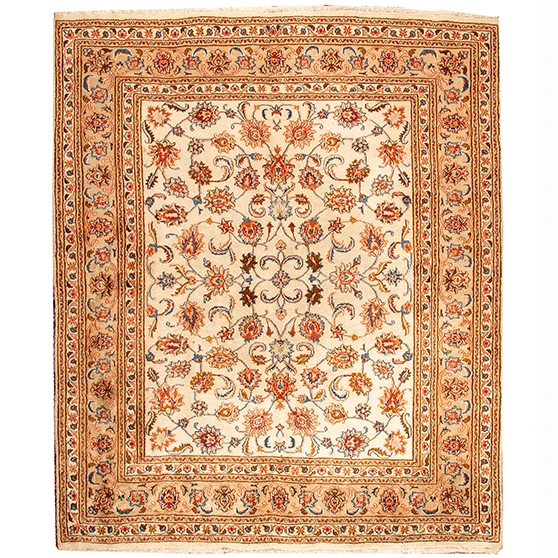
A Tabas rug of about 7.75 by 6.5 feet with an allover Afshan design in ivory, rust red, and antique gold - Tabas Persian Rug 7x6 ft - Afshan Semi Antique Wool Silk Hand Knotted
8
Choosing a Tabas
Measure the room and leave about 12 to 18 inches of floor between the rug and the walls. In a living room, place at least the front legs of the main furniture on the rug. In a dining room, let the rug extend about 24 inches beyond the table on every side. Because Tabas rugs often have light grounds, think about traffic: they are ideal for living rooms, bedrooms, and formal dining rooms, and need a little more care in busy entrances.
9
Placing a Light-Ground Rug
A cream or ivory Tabas brings light into a room. On a dark wood floor, it glows; in a room with little daylight, it lifts the mood. In a modern interior, its light palette and graceful drawing pair beautifully with white or soft gray walls, linen, pale wood, and brass. In a traditional home, it suits formal rooms with elegant furniture. Pick up the navy or rust for cushions or curtains, and keep the rest of the palette soft.
10
Tabas and Its Neighbors
Tabas and Yazd
Yazd, to the south-west, weaves city rugs with floral designs. See our Yazd collection.
Tabas and Kerman
Kerman, to the south, is famous for many-colored floral rugs. See our Kerman collection.
Tabas and Birjand
Birjand, to the east in Khorasan, weaves fine Herati rugs. See our Birjand collection.
Tabas and Ferdows
Ferdows, to the north-east, is another weaving town of the desert edge. See our Ferdows collection.
Tabas and Nain
Nain, to the west, weaves very fine rugs with light palettes. See our Nain collection.
11
Reading the Back
Turn a Tabas over and look at the knots. With the asymmetric knot, each knot shows as one larger loop and one smaller loop. In a well-woven piece, the design shows clearly on the back, with even rows. Check the cotton foundation and the condition of the sides and fringes.
12
Crossroads of the Desert
For centuries, caravans crossing the deserts of eastern Persia stopped at Tabas for water and rest. Routes linked it with Yazd and Isfahan to the west, Kerman to the south, and Mashhad and the towns of Khorasan to the north-east. Goods, ideas, and designs traveled these routes, and Tabas's craftspeople absorbed influences from all sides. The city-style floral designs of its rugs reflect this position: closer to the elegant traditions of Yazd, Kerman, and the Khorasan cities than to the tribal weaving of the mountains.
13
Light Grounds in Persian Weaving
Most Persian rugs have red or navy fields, which hide dust and wear and glow warmly in lamplight. Cream, ivory, and white grounds are less common, because they need more careful dyeing of the surrounding colors and more careful use. When they succeed, they are among the most elegant rugs of all: airy, bright, and full of light. Light-ground rugs became especially popular in the twentieth century with Western buyers who wanted to brighten their rooms, and weaving centers such as Nain, Isfahan, and Tabas produced many.
14
Reading an Afshan Field
To appreciate an Afshan Tabas, look at how the weaver arranged the flowers. Are they scattered freely, or do they follow a hidden lattice of thin vines? Are some flowers larger than others, creating a rhythm across the field? Do the colors repeat in a pattern, or change from flower to flower? Then step back and see how the whole field reads like a meadow or a garden bed. Our article on how to read a Persian rug's secret language offers more ways to look.
15
The Wool of the Desert Towns
The wool used in Tabas rugs comes from sheep raised in the hills and steppes around the desert. It is soft, with a good natural luster, and it takes dye well. In semi-antique rugs, the wool has developed a gentle sheen that makes light grounds glow. Read more in our article on Persian rug wool.
16
Large Rugs and Furniture
Heavy furniture can leave dents in the pile. Move pieces slightly every few months, and brush the pile back up with your fingers. Felt pads under furniture legs spread the weight. Rotate a room-size rug every six months or so, so that wear and sunlight are spread evenly.
17
Open Plans and Bright Rooms
In an open-plan home with large windows, a light-ground Tabas can define a living area while keeping the whole space bright. Place it so that the sofa and chairs sit on it, and let a darker rug, such as a red-ground village rug, take the busiest paths, such as the entrance or a hallway.
18
Matching a Tabas to Your Room
Pick up one or two of the rug's accent colors for cushions, curtains, or a lamp, and let the light ground tie in with white or cream walls. Navy and indigo accents pair with blue-gray textiles; rust and gold accents with warm wood, leather, and brass. In a traditional room, a cream Tabas brings a formal elegance; in a modern room, a fresh, airy calm.
19
Motifs in the Field
Around the medallion or across the Afshan field of a Tabas, you may find palmettes, rosettes, buds, leaves, and flowering branches linked by thin vines, sometimes with small birds. Each flower is drawn with fine outlines in a darker shade, so it stands out clearly on the light ground. Read more in our article on design motifs.
20
The Ends and Fringes
The fringes of a Tabas are the ends of its cotton warp threads. They take wear from vacuums and feet, and on a light rug they show dirt quickly. Vacuum across them gently, or not at all, and have them professionally cleaned with the rug. See our guide to maintaining rug fringes.
21
Workshop Weaving and Cartoons
Most city-style rugs like Tabas were woven from designs drawn on squared paper, called cartoons, where each square stands for one knot. A designer created the pattern, and weavers followed it knot by knot, which is why the medallions and borders are so balanced. Read more about how designs travel from paper to loom in our article on the craft from shepherd to dealer.
22
A Rug for Generations
With ordinary care, a semi-antique Tabas can serve a family for many more decades. Regular vacuuming, a good pad, rotation, and a professional wash every few years will keep its light ground fresh and its colors clear.
23
Grades and How to Judge Them
•
Drawing - Graceful, well-proportioned design.
•
Density - An even knot count.
•
Wool - Soft, lustrous wool.
•
Color - Clear colors without bleeding, especially on light grounds.
•
Condition - Even pile, clean field, intact sides and ends.
24
Questions to Ask Before You Buy
•
Is the light ground clean? - Check for stains or discoloration.
•
What is the material? - Ask about the pile and any highlights.
•
Is the pile even? - Check for worn areas.
•
Has it been repaired? - Especially along the sides and at the ends.
•
Has it been washed recently? - A fresh wash shows the true colors.
25
Semi-Antique Tabas Rugs
Our Tabas rugs are semi-antique, woven roughly forty to sixty years ago. They have settled colors, good wool, and many years of life ahead. See our semi-antique rugs.
26
What Affects the Price
•
Size - Larger rugs cost more.
•
Density - Finer rugs are worth more.
•
Drawing - Graceful, balanced designs add value.
•
Condition - Clean light grounds add value.
•
Wool - Soft, lustrous wool adds value.
27
The Persian Garden in the Desert
For people who live in the desert, a garden is the image of paradise: shade, water, and flowers in a land of sun and sand. Tabas's own gardens, with their palms, pools, and channels, show this ideal in real life. It is no surprise that the floral designs of Persian rugs, with their scattered blossoms, flowing vines, and central medallions like fountains, have always been loved in desert towns. A cream-ground Afshan Tabas is, in a sense, a garden in wool. Read more in our article on the Persian garden design.
28
Weavers of the Desert Edge
In Tabas and the villages of its oasis, weaving was traditionally the work of women, done at home on upright looms, often following designs from city workshops. Read more about the people behind rugs in our article on the craft from shepherd to dealer.
29
Reading the Borders
The borders of a Tabas frame its light field with classic city elegance. A typical piece has a main border of linked palmettes and rosettes, often on a navy or red ground that contrasts with the cream field, flanked by fine guard stripes. Look at how the border turns the corners: in a well-planned rug, the pattern resolves cleanly.
30
Abrash and Color Changes
Light grounds show abrash, gentle bands of changing shade, more clearly than dark grounds. In a cream field, abrash may appear as soft, warmer and cooler bands. It is a natural sign of hand-dyed wool, not a defect.
31
Combining a Tabas with Other Rugs
A Tabas pairs naturally with other light-ground city rugs, such as Nain, and with floral rugs from Kerman and Yazd. A cream Tabas in one room and a red-ground rug in another can work well together if they share navy or rust accents. Keep one or two colors in common and vary the scale of the patterns.
32
Caring for a Light-Ground Rug
Light grounds show dirt sooner than dark ones. Vacuum regularly without a beater bar, and keep outdoor shoes off the rug when you can. Blot spills at once with a clean, white cloth and cold water, working from the outside of the spot toward the center; never rub. Rotate the rug every six months. Use a good non-slip pad. Have it professionally washed every few years, or sooner if the cream areas look dull. Keep it out of strong direct sunlight. See our care instructions, our article on washing at home, and our article on professional washing.
33
Photographs and Real Color
Cream, ivory, and gold tones are easily distorted on screen: under warm light they look yellow, under cool light gray. Daylight from a north window shows the truest colors. If color matters for your room, ask us for extra photographs in daylight or close-ups of the pile.
34
Living with a Tabas
A good Tabas becomes a source of light in a room. Its graceful drawing invites a closer look, its colors settle further over the years, and its wool develops a soft sheen. Many families keep such a rug for decades, moving it from one home to the next.
35
Common Buying Mistakes
•
Putting a light rug in a heavy-traffic entrance - Choose a darker rug there.
•
Rubbing spills - Blot gently instead.
•
Skipping the pad - Rugs slip without one.
•
Judging cream on screen - Ask for daylight photos.
36
Frequently Asked Questions
Where is Tabas?
In an oasis on the edge of the deserts of eastern Persia, between Yazd and Khorasan.
What are Tabas rugs like?
City-style rugs with floral medallions and Afshan designs, often on light grounds.
What colors are typical?
Cream, ivory, and white grounds with navy, indigo, madder red, rust, and gold.
What is an Afshan design?
An allover pattern of scattered flowers and vines without a central medallion.
What knot is used?
The asymmetric (Persian) knot.
What sizes do you have?
About 13 by 9.5, 11.25 by 7.75, and 7.75 by 6.5 feet.
Are light-ground rugs hard to keep clean?
They need a little more care: vacuum often, blot spills, and wash professionally every few years.
Are Tabas rugs durable?
Yes, with care. They suit living rooms, bedrooms, and formal dining rooms.
Is abrash a defect?
No. It is a natural sign of hand-dyed wool.
How should I care for a Tabas rug?
Vacuum regularly, rotate it, use a pad, and have it professionally washed every few years.
Is a Tabas good for a modern home?
Yes. Its light palette and graceful drawing pair beautifully with modern interiors.
Will the colors fade further?
In a semi-antique rug the colors have largely settled. Keep it out of strong direct sunlight to protect them.
Does an Afshan rug need to be centered?
No. Its allover pattern looks good in many positions.
Can a Tabas go in a bedroom?
Yes. A bedroom is an ideal place for a light-ground rug.
Can a Tabas go in a dining room?
Yes, in a dining room used with care. Use a good pad and blot spills at once.
Is a Tabas suitable for a home with children or pets?
It can be, with care. A light ground shows marks sooner than a red one.
37
Choose Your Tabas Rug
Each Tabas rug in our collection is hand-knotted, one of a kind, and inspected before it is listed. Browse our Tabas collection, compare with our Nain, Kerman, and Yazd rugs, or ask our experts for help.