


On the edge of the great central deserts of Persia lies Yazd, one of the oldest living cities in the world. Its old quarter of mud-brick houses, covered lanes, and wind towers that catch the breeze and cool the rooms below is listed by UNESCO as a World Heritage site. For centuries, Yazd has been a city of craftspeople, and above all of textiles: silk and cotton weaving, the brocaded cloth called termeh, the cotton floor covering called zilou in nearby Meybod, the resist-dyed ikat cloth called darayi, and, of course, hand-knotted rugs.
This guide explains how Yazd rugs fit into the city's textile tradition, how to recognize one, how it compares with the rugs of its neighbors Kerman, Kashan, Ardakan, and Nain, and how to choose, place, and care for a room-size medallion rug like those in our collection. For more on weaving in the city, see our article on weaving in Yazd.
1
A City of Textiles
Yazd's textile tradition is one of the richest in Persia. Its workshops produced silk cloth for centuries, and its termeh, woven with intricate boteh patterns, was prized across the country. In Meybod, north of the city, weavers make zilou, a sturdy flat-woven cotton floor covering used in mosques and homes; read more in our article on the zilou of Meybod. Yazd is also known for darayi, a cloth dyed by the ikat method; see our article on ikat in Yazd. Hand-knotted rug weaving grew alongside these crafts and became an important industry in the city and its surrounding towns in the twentieth century.
Yazd is an ancient desert city of textiles in central Persia. Its rugs are city pieces with curving floral medallions, often in the manner of Kerman and Kashan.
2
How to Recognize a Yazd Rug
•
Floral medallion - A curving, lobed medallion with pendants and corner pieces.
•
City drawing - Curving vines, palmettes, and flowers drawn from a cartoon.
•
Balanced palette - Cream, navy blue, crimson, and soft Persian blue.
•
Double weft - A firm, flat weave.
•
Asymmetric knot - The Persian knot, common in city weaving.
•
Room sizes - Medium and room-size rugs.
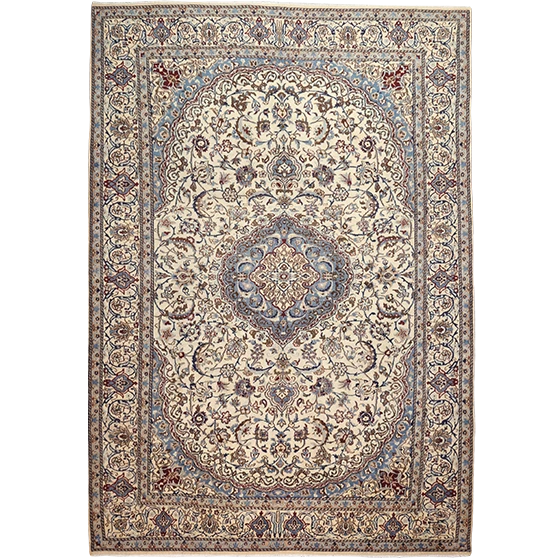
A Yazd rug of about 11.75 by 8.25 feet with a medallion design in cream, navy blue, and Persian blue - Yazd Persian Rug 11x8 ft - Medallion Semi Antique Wool Hand Knotted
3
Reading the Medallion
Yazd rugs use the classic city layout of central Persia. A large, lobed medallion sits at the center, often with a smaller medallion inside and pendants or crowns at each end. Corner pieces echo parts of the medallion. The field is filled with curving vines, palmettes, rosettes, and small leaves, drawn with smooth curves rather than steps. Because city rugs were woven from a full-size drawing, or cartoon, the design is usually symmetrical and carefully balanced. See our medallion designs.
4
Influences from Kerman and Kashan
Yazd lies between two of the great rug cities of Persia: Kerman to the south-east and Kashan to the north-west. Yazd weavers absorbed influences from both. Some Yazd rugs show the soft, many-colored floral style and cream grounds associated with Kerman; others show the dense, classical medallion layouts associated with Kashan. In the trade, Yazd rugs have sometimes been described as Kerman-type or Kashan-type, and attributions between these centers are not always sharp. When we describe a rug as Yazd, we base it on the rug's source, structure, and design, and we are happy to explain our reasons.
5
How Yazd Rugs Are Built
•
Knot - Usually the asymmetric (Persian) knot.
•
Foundation - Cotton warps and wefts.
•
Wefts - Usually two between each row of knots.
•
Pile - Wool, clipped to a medium height.
•
Density - Medium to fine.
•
Sides and ends - Overcast sides and fringes.
This construction gives a rug that lies flat, holds its shape, and shows the curves of the design clearly. If structure matters to you, ask us and we will check the back of a particular piece.
6
Colors of Yazd
Our Yazd rugs use balanced, elegant palettes. One has a cream field with navy blue and soft Persian blue, giving a light, airy look; the other combines crimson, cream, and navy blue in a warmer, classic scheme. In semi-antique rugs, these colors have softened into a harmonious whole. Read more in our articles on natural dyes and traditional dyeing.
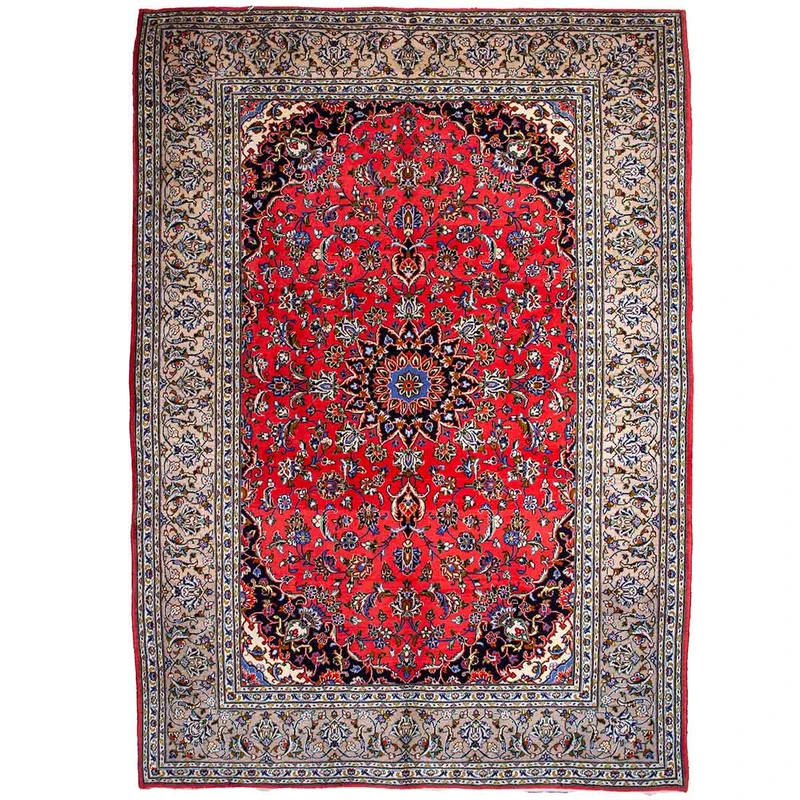
A Yazd rug of about 9.25 by 6.5 feet with a medallion design in crimson, cream, and navy blue - Yazd Persian Rug 9x6 ft - Medallion Semi Antique Wool Hand Knotted
7
Sizes in Our Collection
•
About 9.25 by 6.5 feet - A rug for a living room, dining room, or bedroom.
•
About 11.75 by 8.25 feet - A room-size rug for a large living or dining room.
8
Choosing a Room-Size Medallion Rug
A medallion rug works best when the medallion is visible and centered. In a living room, place it under the coffee table, with the front legs of the sofa and chairs resting on the rug. In a dining room, center the medallion under the table, and make sure the rug extends at least 24 inches beyond the table on each side so chairs stay on the rug when pulled out. In a bedroom, a rug of about 9 by 6 feet can sit under the lower two-thirds of a queen bed, leaving the medallion visible at the foot. Mark the outline on the floor with painter's tape before you decide.
9
Light or Dark?
Our two Yazd rugs show the choice many buyers face. A cream-ground rug lightens a room, makes it feel larger, and suits modern and coastal interiors, but it shows dirt more easily and is best in rooms with moderate traffic. A crimson-ground rug is warmer and more forgiving in busy rooms, and suits traditional interiors and rooms with wood and leather. Think about the light in your room, the color of your floor, and how much traffic the rug will see.
10
Placing a Yazd
A Yazd's balanced city design suits formal and relaxed rooms alike. In a living room, it anchors a seating group. In a dining room, its centered medallion frames the table. In a modern interior, its curving floral design softens clean lines. In a traditional home, it pairs naturally with dark wood, brass, and silk or velvet textiles.
11
Matching Colors in Your Home
A cream and blue Yazd pairs well with white, pale gray, and soft blue walls, light oak, and linen. A crimson and navy Yazd pairs well with warm whites, cream, walnut, leather, and brass. Pick one color from the rug, such as the Persian blue of the medallion, and repeat it in a cushion or a print to tie the rug into the room.
12
Yazd and Its Neighbors
Yazd and Kerman
Kerman, to the south-east, is famous for soft floral designs and many colors. See our Kerman collection.
Yazd and Kashan
Kashan, to the north-west, is a great center of classical medallion rugs. See our Kashan collection.
Yazd and Ardakan
Ardakan, north-west of Yazd in the same province, weaves rugs of its own. See our Ardakan collection.
Yazd and Nain
Nain, further north, is known for very fine rugs in cream and blue. See our Nain collection.
Yazd and Isfahan
Isfahan, to the north-west, is a great city of fine rugs. See our Isfahan collection.
13
Reading the Back
Turn a Yazd over. On a city rug, the design shows clearly on the back. Look at the knots: asymmetric knots show as one larger and one smaller loop. Count the wefts between each row of knots. Check the cotton foundation and the condition of the sides and fringes.
14
Life in a Desert City
Yazd has survived in a harsh climate for thousands of years through ingenuity. Water was brought from distant mountains through qanats, underground channels dug by hand that run for many miles beneath the desert. Houses were built around courtyards with pools and gardens, and wind towers drew cool air down into the rooms. Ice was made in winter and stored in tall domed ice houses for the summer. This careful, patient way of living shaped the city's crafts too: textiles that took months to weave, and rugs drawn with precision and finished with care.
The city is also known for its gardens, such as the Dowlatabad Garden with its tall wind tower, and for its historic mosques with tiled portals. The flowers, pools, and patterns of these gardens and buildings echo the floral medallions of Persian city rugs. Read more about garden imagery in rugs in our article on garden design.
15
From Cartoon to Rug
City rugs like those of Yazd were woven from a cartoon: a full-size drawing on squared paper, with each square representing one knot. A designer drew the medallion, corners, field, and borders, often only one quarter of the design, which the weaver then mirrored. The weaver read the cartoon row by row, tying each knot in the indicated color. This method allows smooth curves, careful symmetry, and fine details that would be hard to keep in memory. It also explains why two city rugs from the same workshop can look almost identical in design, while still differing in color and finish.
16
The Weavers of Yazd
In Yazd and the towns around it, rugs were woven in homes and in workshops. A large rug might be woven by two or three weavers sitting side by side at a wide loom, working from the same cartoon. Weaving often fitted around other work and family life, and skill was passed from one generation to the next. Read more about the people behind rugs in our article on the craft from shepherd to dealer.
17
Borders of a City Rug
The borders of a Yazd rug are part of the design, not just a frame. A main border of palmettes and rosettes linked by a flowing vine is flanked by narrow guard stripes with small repeating flowers. In a good city rug, the border turns the corners smoothly, with the vine continuing around the corner without a break. Look at the corners: well resolved corners are a sign of careful drawing and weaving.
18
Wool and Texture
Good Yazd rugs use soft, lustrous wool, clipped to a medium height so that the curves of the design stay crisp. When you run your hand over the pile, it should feel smooth and full rather than dry or brittle. Read more in our article on wool.
19
Where a Yazd Works Best
•
Living rooms - A room-size medallion rug anchors a seating group.
•
Dining rooms - A centered medallion frames the table.
•
Bedrooms - A rug under the bed with the medallion at the foot.
•
Studies and libraries - A city rug suits wood and books.
Wherever you place it, give the rug a little floor around it so the borders can be seen. A city rug's border is part of its beauty, and a margin of floor lets it frame the field as the designer intended.
20
Combining a Yazd with Other Rugs
A Yazd pairs naturally with other city rugs of central Persia, such as Kerman, Kashan, Isfahan, and Nain rugs. Our two Yazd rugs could work in neighboring rooms: the cream rug in a bright living room and the crimson rug in a dining room. Keep one or two colors in common and vary the scale of the patterns.
21
Keeping a Large Rug Healthy
A room-size rug needs a good pad to stay flat and to protect the floor. Rotate it every year or so, so that wear and light are spread evenly. Under chair and table legs, small felt cups help spread the weight. Vacuum across the fringes gently, or not at all. See our guide to maintaining rug fringes.
22
Light and Placement
Strong, direct sunlight can fade any natural fiber over many years. If your rug lies in a sunny spot, consider sheer curtains or UV filtering film, and rotate the rug so that light falls evenly. Avoid placing a rug where water may collect.
23
Motifs in the Field
The field of a Yazd rug is filled with the classic floral vocabulary of Persian city weaving: palmettes, large fan-shaped flowers seen from the side; rosettes, round flowers seen from above; curving vines that link them; and small leaves and buds that fill the spaces between. Some rugs add the Shah Abbasi palmette, named after the Safavid shah, or small cloud bands. Read more about these motifs in our article on design motifs, and on reading a rug's design as a whole in how to read a Persian rug.
24
Living with a Yazd
A good city rug becomes part of the house. Its colors settle further, its pile develops a soft sheen, and its medallion becomes the quiet center of a room. Many owners find that a rug bought for one room later moves to another and suits each in a different way. A rug from Yazd also carries the story of a city that has lived by its crafts for centuries, a story that adds something to a home that a new, mass-produced rug cannot.
25
Grades and How to Judge Them
•
Drawing - Smooth curves and a balanced medallion.
•
Density - An even, compact weave.
•
Wool - Soft, lustrous wool.
•
Color - Clear, harmonious colors without bleeding.
•
Condition - Even pile, intact sides and ends.
26
Questions to Ask Before You Buy
•
Which knot is used? - A clue to the weaving center.
•
What are the measurements at both ends? - Checks that the rug is straight.
•
Is the pile even? - Check for worn areas.
•
Has it been repaired? - Especially along the sides and at the ends.
•
Has it been washed recently? - A fresh wash shows the true colors.
Read our notes on what to know before you buy.
27
Semi-Antique Yazd Rugs
Our Yazd rugs are semi-antique, woven roughly forty to sixty years ago. They have settled colors, good wool, and many years of life ahead. See our semi-antique rugs.
28
What Affects the Price
•
Size - Larger rugs cost more.
•
Density - A finer weave adds value.
•
Drawing - Smooth, balanced drawing adds value.
•
Color - Harmonious colors add value.
•
Condition - Intact sides and ends.
29
Abrash and Color Changes
Some Yazd rugs show slight abrash, horizontal bands where one color shifts in shade, caused by wool dyed in different batches. In a city rug, abrash is usually subtle. It is a natural sign of hand-dyed wool, not a defect.
30
Caring for a Yazd Rug
Vacuum regularly without a beater bar. Rotate the rug every few months. Use a non-slip pad. Blot spills at once with a clean, white cloth and cold water. Have it professionally washed every year or two in busy areas; cream grounds may need it more often. See our care instructions and our article on professional washing.
31
Photographs and Real Color
Creams and blues can look different on screen depending on the light. Daylight from a north window shows the truest colors. If color matters for your space, ask us for extra photographs in daylight or close-ups of the pile.
32
Common Buying Mistakes
•
Choosing too small - A room-size rug should hold the furniture.
•
Hiding the medallion - Center it where it can be seen.
•
Choosing cream for a busy room - A darker ground forgives more.
•
Skipping the pad - Every rug needs one.
33
Frequently Asked Questions
Where is Yazd?
In central Persia, on the edge of the great deserts, between Isfahan and Kerman.
What kind of rugs are Yazd rugs?
City rugs with curving floral medallions.
What colors are typical?
Cream, navy blue, crimson, and Persian blue.
What sizes do you have?
About 9.25 by 6.5 feet and about 11.75 by 8.25 feet.
Are Yazd rugs durable?
Yes. Their firm, double-wefted build makes them durable.
How should I care for a Yazd rug?
Vacuum regularly, rotate it, use a pad, and have it professionally washed regularly.
How does a Yazd compare with a Kerman?
Both are city rugs with floral designs. Kerman rugs are often softer and use more colors; Yazd rugs absorbed influences from both Kerman and Kashan.
Is a cream rug practical?
Yes, in rooms with moderate traffic. It shows dirt more easily, so regular vacuuming and professional washing help.
How old are your Yazd rugs?
They are semi-antique, roughly forty to sixty years old.
Can I see more photographs?
Yes. Ask us for daylight photographs, close-ups of the pile, or pictures of the back.
Where should the medallion sit?
Centered under the main piece of furniture, such as a coffee table or a dining table, so that it stays visible.
What other crafts is Yazd known for?
Termeh brocade, darayi ikat cloth, and the zilou flatweaves of nearby Meybod.
Can a Yazd be used in a bedroom?
Yes. A rug of about 9 by 6 feet can sit under the lower part of a queen bed with the medallion visible at the foot.
Is abrash a defect?
No. It is a natural sign of hand-dyed wool.
34
Choose Your Yazd Rug
Each rug in our collection is hand-knotted, one of a kind, and inspected before it is listed. Browse our Yazd collection, compare with our Kerman, Kashan, and Ardakan rugs, or ask our experts for help.