


Most Persian rug designs are built around a center or a repeating grid. The Moharramat takes a different path. Its field is divided into stripes, parallel bands that run from one end of the rug to the other, each in its own color, and often each filled with a row of small motifs: flowers, botehs, stars, or tiny geometric figures. The effect is bold and rhythmic, like a woven textile or a striped fabric, and it feels surprisingly modern.
This guide explains what Moharramat means, how a striped rug is built, how to read its bands, where the design is woven, how it compares with related designs, and how to choose, place, and care for a striped rug like those in our collection. For the wider language of Persian patterns, see our articles on Persian rug design and design motifs.
1
What Moharramat Means
The Persian term moharramat is used in the rug trade for a striped design. The word is often explained as coming from a term for striped cloth, and the design has long been associated with striped textiles in Persian dress and furnishings. Some writers connect it with the month of Moharram, but that link is not well established. In practice, dealers use Moharramat for any rug whose field is divided into parallel stripes of different colors, usually running along the length of the rug.
Moharramat is the striped design: the field is divided into parallel bands of different colors, often filled with small flowers, botehs, or geometric motifs.
2
How to Recognize a Moharramat Rug
•
Parallel stripes - Bands running the length of the rug, sometimes diagonally.
•
Different colors - Each stripe in its own color, often alternating.
•
Rows of small motifs - Flowers, botehs, stars, or geometric figures inside the stripes.
•
No medallion - The stripes themselves are the design.
•
Narrow borders - Borders that frame the stripes without competing.
•
Strong rhythm - A repeating sequence of colors across the width.
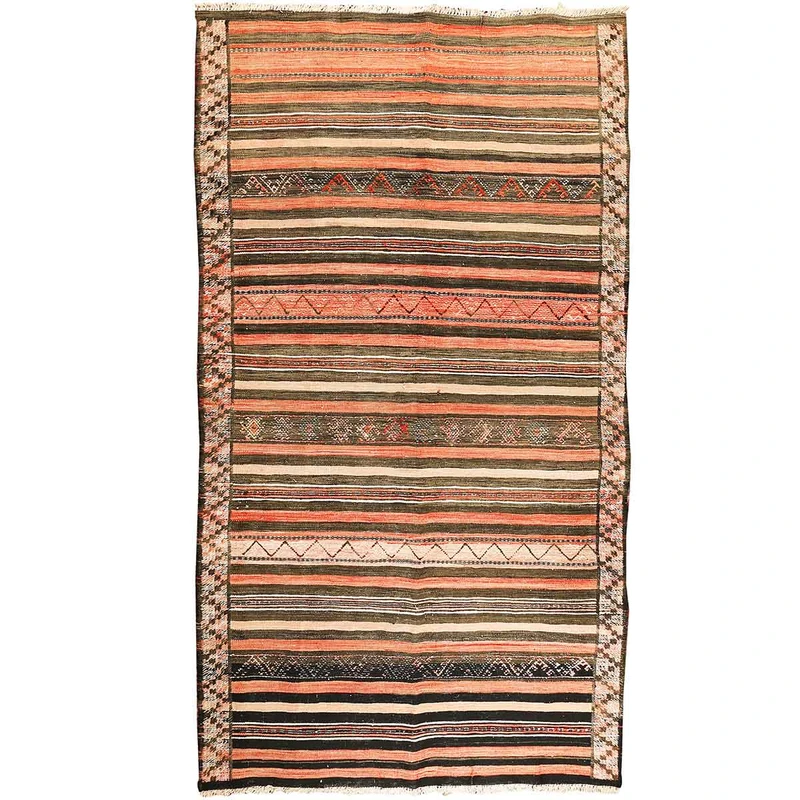
An Ardabil rug of about 8.75 by 4.75 feet with a Moharramat striped design in rust red, terracotta, and cream - Ardabil Persian Rug 8x4 ft - Moharramat Wool Silk Hand Knotted
3
Reading the Stripes
Start by counting the stripes across the width of the rug and noticing their order: do they follow a regular sequence of colors, such as red, cream, blue, red, cream, blue? Are they all the same width, or do wide stripes alternate with narrow ones? Then look inside each stripe: many Moharramat rugs fill each band with a row of small motifs, and the motif may change from stripe to stripe. Finally, look at the edges: some stripes are separated by thin lines; in others, the colors meet directly.
4
Stripes and Movement
Stripes give a rug a strong sense of direction. Stripes running along the length make a rug look longer and narrower, which suits runners and hallways. Diagonal stripes, found in some tribal rugs, add energy and movement. Because stripes lead the eye, think about how the rug will be seen: in a hallway, lengthwise stripes draw the eye toward the end of the passage; in a room, they can make a space feel longer.
5
Ardabil and North-Western Moharramat
Weavers in Ardabil and other parts of north-western Persia weave Moharramat designs, often in clear, bright colors with small geometric motifs in each stripe. These rugs share the bold, graphic feeling of the region's other weavings, and their stripes can look strikingly contemporary. See our Ardabil collection and our article on weaving in Ardabil.
6
Tribal Striped Rugs
Stripes are especially common in tribal weaving. Qashqai, Shiraz, and other Fars tribal weavers use stripes in pile rugs and above all in flatweaves such as kilims and in the long woven bands used in tents and on animals. Their stripes are often in warm reds, oranges, and burgundies, with small motifs in contrasting colors. Our small Shiraz piece shows this tribal striped style in a compact format. See our Shiraz and Qashqai collections and our article on kilim.
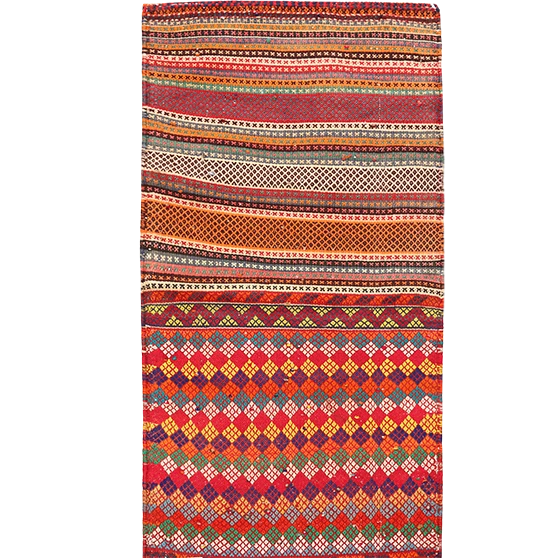
A Shiraz rug of about 5 by 2.25 feet with a striped design in red, orange, and burgundy - Shiraz Persian Rug 4x2 ft - Geometric Semi Antique Wool Hand Knotted
7
Stripes with Botehs and Flowers
In some Moharramat rugs, each stripe is filled with a row of botehs or small flowers, all facing the same way or alternating direction from stripe to stripe. These rugs combine the boldness of stripes with the delicacy of floral motifs, and they are among the most attractive striped rugs. Kurdish and north-western weavers in particular have woven such designs. See our Boteh designs.
8
Moharramat and Related Designs
Moharramat and Vaghireh
Banded designs, where the field is divided into horizontal bands of different patterns, are related to stripes but usually run across the width. See our Vaghireh designs.
Moharramat and Boteh
Stripes are often filled with rows of botehs. See our Boteh designs.
Moharramat and Tribal designs
Stripes are common in tribal pile rugs and flatweaves. See our Tribal and Nomadic designs.
Moharramat and Geometric
Striped rugs belong to the geometric family of designs. See our Geometric designs.
9
Colors of Moharramat Rugs
A striped rug lives by its colors. Our Ardabil rug uses rust red, terracotta, and cream, a warm, earthy palette; our Shiraz piece uses red, orange, and burgundy. Other Moharramat rugs alternate red, blue, ivory, green, and gold. Because each stripe is a block of color, the choice and order of colors defines the whole rug. Read more in our articles on natural dyes and the nine ranges of Persian colors.
10
Sizes in Our Collection
Our Moharramat rugs include an Ardabil rug of about 8.75 by 4.75 feet and a small Shiraz piece of about 5 by 2.25 feet, as well as small square pieces and cushion faces with striped designs. Browse by size: runners and 4x6.
11
Choosing a Striped Rug by Room
•
Hallways - Lengthwise stripes lead the eye along the passage.
•
Modern rooms - Stripes echo clean lines and contemporary textiles.
•
Bedrooms - A striped rug beside the bed adds color and rhythm.
•
Kitchens and entrances - A small striped rug is cheerful and practical.
•
Children's rooms - Bright stripes feel playful and fresh.
12
Matching a Striped Rug to Your Room
A striped rug pairs best with plain surroundings, where its bands of color can lead. Pick one stripe color and repeat it in a cushion, a throw, or a piece of art. Avoid other strong stripes or plaids nearby, which can compete. In a modern room, a Moharramat rug can be the main source of color and pattern; in a traditional room, it adds a fresh, graphic note among floral designs.
13
Stripes in Persian Textiles
Stripes have a long history in Persian cloth. The jajim, a flatwoven striped textile made on narrow looms in many villages and tribes, is used as a blanket, a cover, and a wrapping for bedding. Striped silks and cottons were woven in Kashan, Yazd, and other textile cities, and striped fabrics appear in the clothing of Qajar portraits. Tribal women weave long striped bands to tie tents and decorate animals. When a pile rug weaver chooses a Moharramat design, she draws on this long tradition of striped cloth. Read more in our articles on Persian handicrafts and the Persian gelim.
14
How Stripes Are Woven
In a pile rug, the direction of the stripes matters to the weaver. A rug is woven row by row across its width. Crosswise bands, running from side to side, are easy to weave: the weaver simply changes color at the end of a band. Lengthwise stripes, running from end to end, are more demanding: in every single row, the weaver must change color many times, once for each stripe, and keep every stripe the same width for hundreds of rows. A rug with long, straight lengthwise stripes is therefore a sign of careful, disciplined weaving. When you look at a Moharramat rug, check that the stripes run straight from one end to the other.
15
Wide and Narrow Stripes
The width of the stripes changes the whole feel of a rug. Wide stripes, a few per rug, look bold and graphic, almost like a modern painting. Narrow stripes, many per rug, create a finer, more textile-like surface that shimmers with color from a distance. Some rugs alternate wide and narrow stripes, creating a rhythm like music. Think about the scale of your room: wide stripes suit large spaces, narrow ones suit smaller rooms and closer viewing.
16
Diagonal Stripes
Some tribal and village rugs use diagonal stripes, bands of color running across the field at an angle, often filled with small motifs. Diagonal stripes are full of energy and movement, and they appear especially in Fars and Kurdish tribal weaving and in some north-western rugs. They are harder to weave neatly than straight stripes, and a well woven diagonal design is a sign of skill.
17
Living with a Striped Rug
A striped rug brings a sense of rhythm and clarity to a room. Its bands of color are easy to read and easy to match, and its geometry fits naturally with modern furniture and architecture. Many owners find that a Moharramat rug feels fresh and contemporary while still carrying the warmth and character of a hand-knotted Persian rug.
18
Combining a Striped Rug with Other Rugs
A striped rug pairs well with floral and medallion rugs nearby, where its simple geometry contrasts with their curves. A Moharramat runner in a hallway can lead into a room with an Afshan or medallion rug in similar colors. Keep one or two colors in common and vary the scale of the patterns.
19
Photographs and Real Color
Rusts, oranges, and terracottas can look different on screen depending on the light. Daylight from a north window shows the truest colors. If color matters for your space, ask us for extra photographs in daylight or close-ups of the stripes.
20
Motifs Inside the Stripes
•
Small flowers - Rosettes and buds in rows, common in village rugs.
•
Botehs - Rows of small paisleys, all facing one way or alternating.
•
Stars - Eight-pointed stars in tribal and north-western rugs.
•
Zigzags and hooks - Geometric fillers that add movement.
•
Plain bands - Some stripes are left plain, letting the color speak alone.
A rug may use the same motif in every stripe, or change the motif from stripe to stripe, creating a rich sampler of small designs within a simple framework. Read more in our article on design motifs.
21
Stripes and Abrash
Because each stripe is a long block of color, abrash, the natural variation in shade caused by wool dyed in different batches, is especially visible in striped rugs. A red stripe may shift from deeper to lighter along its length. Far from being a defect, abrash gives a striped rug depth and life, and many collectors look for it as a sign of hand-dyed wool. Read more in our article on traditional dyeing.
22
New and Older Striped Rugs
Striped designs are woven today as well as in the past. Our Ardabil rug is a new piece, with fresh, clear colors and a full pile. Older striped rugs, especially tribal pieces, may show softer, mellowed colors and more abrash. Both have their appeal: a new rug for crisp, bright stripes, an older one for gentle, aged harmony. Ask us about the age of any piece.
23
Small Striped Pieces
Striped designs work beautifully at small scale. Small mats and cushion faces with stripes add color to a chair, a bench, a bed, or a shelf, and they combine easily with other textiles. Several of the small square pieces in our collection use striped designs.
24
Stripes Across Cultures
Striped textiles are woven around the world, from the blankets of the American Southwest to the striped kilims of Anatolia and the woven bands of Central Asia. Persian Moharramat rugs belong to this universal tradition, which is one reason they feel familiar to people from many backgrounds. Their combination of a simple, universal layout with Persian colors and motifs gives them a special charm.
25
Placing a Striped Rug
Stripes are directional, so placement matters. In a hallway, lay lengthwise stripes along the passage, where they lead the eye toward the far end. In a room, lengthwise stripes can make the space feel longer; if the room is already long and narrow, consider turning the rug so the stripes run across it, which makes the room feel wider. Under a bed, a striped rug with stripes running toward the foot looks calm and orderly. Use a good non-slip pad, especially on smooth floors.
26
Borders of Striped Rugs
The borders of a Moharramat rug are usually simpler than the field, so they frame the stripes without competing. A narrow main border of repeating flowers or a reciprocal pattern, flanked by thin guard stripes, is common. In some rugs, the border is in a color that appears in one of the stripes, tying the frame and field together. Look at how the stripes meet the border at the ends: in a well woven rug, every stripe ends cleanly.
27
Why Choose a Striped Persian Rug
A Moharramat rug offers something unusual among Persian designs: simplicity. It has no complex medallion or busy floral field, just bands of color and small motifs, yet it is still a hand-knotted rug with natural wool and traditional colors. That makes it a bridge between traditional Persian weaving and modern taste, a rug that suits minimalist rooms as easily as traditional ones.
28
Wool and Texture
Striped rugs show the quality of their wool clearly, because each stripe is a broad area of color. Lustrous, well dyed wool gives each band a soft glow and a rich depth; dull or uneven wool shows at once. Hand-spun wool varies slightly in thickness, which gives the stripes a gentle, lively texture. When choosing a striped rug, look along the pile at a low angle: good wool will shimmer. Read more in our article on wool.
29
Stripes in Tribal Life
For tribal families, stripes were part of daily life. Striped bands held tents together, striped bags carried belongings, and striped flatweaves covered the floor and the bedding. A striped pile rug carries that heritage into the home, a reminder of the practical beauty of nomadic weaving. Read more in our article on Qashqai weaving.
30
How to Judge a Moharramat Rug
•
Straight stripes - Bands that run evenly from end to end.
•
Color order - A pleasing, consistent sequence of colors.
•
Motifs - Clear small motifs within the stripes.
•
Edges - Clean lines where stripes meet.
•
Condition - Even pile, intact sides and ends.
31
Questions to Ask Before You Buy
•
Are the stripes straight? - Wavy stripes may show an uneven weave.
•
What are the measurements at both ends? - Checks that the rug is straight.
•
Is the pile even? - Check for worn areas.
•
Has it been repaired? - Repairs are easy to see in a stripe.
•
New or older? - Our Ardabil is a new rug; ask about the age of any piece.
Read our notes on what to know before you buy and our guide on how to buy a Persian rug.
32
Caring for a Moharramat Rug
Vacuum regularly without a beater bar. Rotate the rug every few months so that wear and light are spread evenly. Use a non-slip pad. Blot spills at once with a clean, white cloth and cold water. Have it professionally washed every year or two in busy areas. See our care instructions and our article on professional washing.
33
Frequently Asked Questions
What is a Moharramat rug?
A rug whose field is divided into parallel stripes of different colors.
Where are striped rugs woven?
In north-western Persia, including Ardabil, and by Fars tribal weavers, among others.
Do stripes suit a modern interior?
Yes. Their bold, graphic look fits contemporary spaces well.
Do striped rugs make a hallway look longer?
Yes. Lengthwise stripes lead the eye along the passage.
What sizes do you have?
An Ardabil rug of about 8.75 by 4.75 feet and small pieces.
What is a jajim?
A flatwoven striped textile made on narrow looms, used as a blanket or cover in many villages and tribes.
Are lengthwise stripes harder to weave?
Yes. The weaver must change color many times in every row and keep each stripe the same width.
How should I care for a striped rug?
Vacuum regularly without a beater bar, rotate it, use a pad, and have it professionally washed regularly.
Is abrash a defect in a striped rug?
No. It is a natural sign of hand-dyed wool and gives the stripes depth.
Can I see more photographs?
Yes. Ask us for daylight photographs, close-ups of the stripes, or pictures of the back of any rug.
Which way should the stripes run?
Along a hallway, or across a long, narrow room to make it feel wider.
Are striped rugs hand-knotted?
Yes. Every rug in our collection is hand-knotted.
Are there diagonal striped rugs?
Yes. Some tribal and village rugs use diagonal stripes filled with small motifs.
Is your Ardabil striped rug new?
Yes, it is a new rug with fresh, clear colors.
34
Choose Your Moharramat Rug
Each rug in our collection is hand-knotted, one of a kind, and inspected before it is listed. Browse our Moharramat rugs, compare with our Vaghireh and Tribal and Nomadic designs, or ask our experts for help.