


Look at almost any Persian rug and you will find a rosette: a round flower, seen from directly above, with petals arranged evenly around a center. It may be tiny, filling the center of a Herati unit, or large, anchoring a Mina Khani lattice or crowning the center of a medallion. It may be smooth and naturalistic in a city rug or built of steps and squares in a tribal rug. In some rugs, the rosette is not just a detail but the main design: rows of rosettes cover the field, creating a calm, even pattern of flowers.
This guide explains what a rosette is, where the motif comes from, how to read a rosette rug, where rosettes appear in Persian weaving, how the design compares with related ones, and how to choose, place, and care for a rosette rug like those in our collection. For the wider language of Persian patterns, see our articles on Persian rug design and design motifs.
1
What Is a Rosette?
A rosette is a flower shown in plan view, from directly above, so that its petals form a circle around the center. It is different from a palmette, which shows a flower from the side, like a fan. Rosettes can have four, six, eight, or many petals; their petals may be round, pointed, or layered; and their centers may be plain or filled with a small star or another rosette. In Persian, such flowers are often called gol (flower), a word that also gives its name to the Turkmen gul.
A rosette is a round flower seen from above, with petals radiating from a center. Rosette rugs arrange these flowers in rows across the field.
2
An Ancient Motif
The rosette is one of the oldest ornaments in the art of the region. It appears on the stone reliefs of Persepolis, the ceremonial capital of the Achaemenid kings, where rows of rosettes frame processions of figures, and on ancient Mesopotamian and Persian objects long before that. From these beginnings, it passed into every period of Persian art: Sasanian silver, Islamic tilework, manuscript illumination, textiles, and rugs. Its long life comes from its simplicity: a round flower is easy to draw, fits any space, and always looks balanced. Read more in our article on weaving from the beginning to 1499.
3
How to Recognize a Rosette Rug
•
Rows of round flowers - Rosettes repeated across the field in a grid.
•
Radiating petals - Each flower seen from above, with petals around a center.
•
Even spacing - A calm, regular pattern without a dominant center.
•
Alternating colors - Rosettes often change color from row to row.
•
Small fillers - Tiny leaves or dots between the rosettes.
•
Framing borders - Borders that hold the even field together.
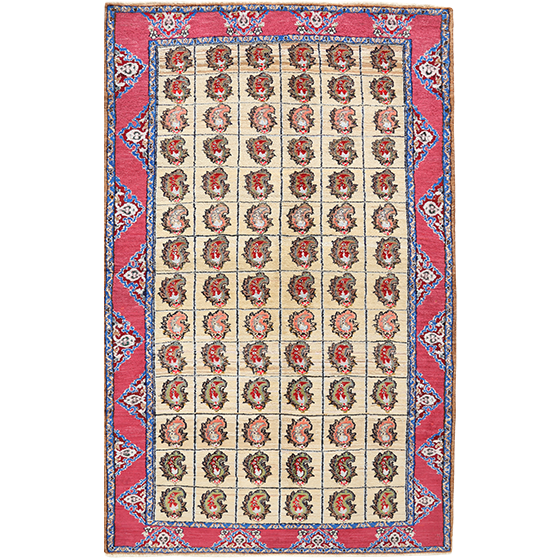
A Nain rug of about 5.25 by 3 feet with rows of small rosettes in cream, crimson, and navy blue - Nain Persian Rug 5x3 ft - Vaghireh Wool Silk Hand Knotted
4
Reading a Rosette Field
Start by finding the grid: rosettes are usually set in straight rows or offset rows, like bricks. Then look at the color sequence: do the rosettes alternate red and blue, change color along diagonals, or follow a more complex pattern? Finally, look closely at a single rosette: count its petals, look at its center, and notice whether it is drawn with smooth curves or with steps. These small details tell you a lot about where the rug was woven and how carefully it was made.
5
City Rosettes
In city rugs from centers such as Nain, Isfahan, and Kashan, rosettes are drawn with smooth, curving petals and fine detail, often with several shades in each flower. They may be arranged in neat rows on an ivory or cream field, as in our Nain rug, or used as accents among vines and palmettes. A field of small city rosettes has a delicate, textile-like quality. See our Nain and Isfahan collections.
6
Tribal Rosettes
In tribal and village rugs, the rosette becomes geometric: a square or octagon with stepped petals, or an eight-pointed star with a cross at its center. Baluch weavers, for example, use small geometric rosettes in rows, often in dark reds, navies, and cream. Tribal rosettes are bold and graphic, and they work beautifully on small rugs and mats. See our Baluch collection.
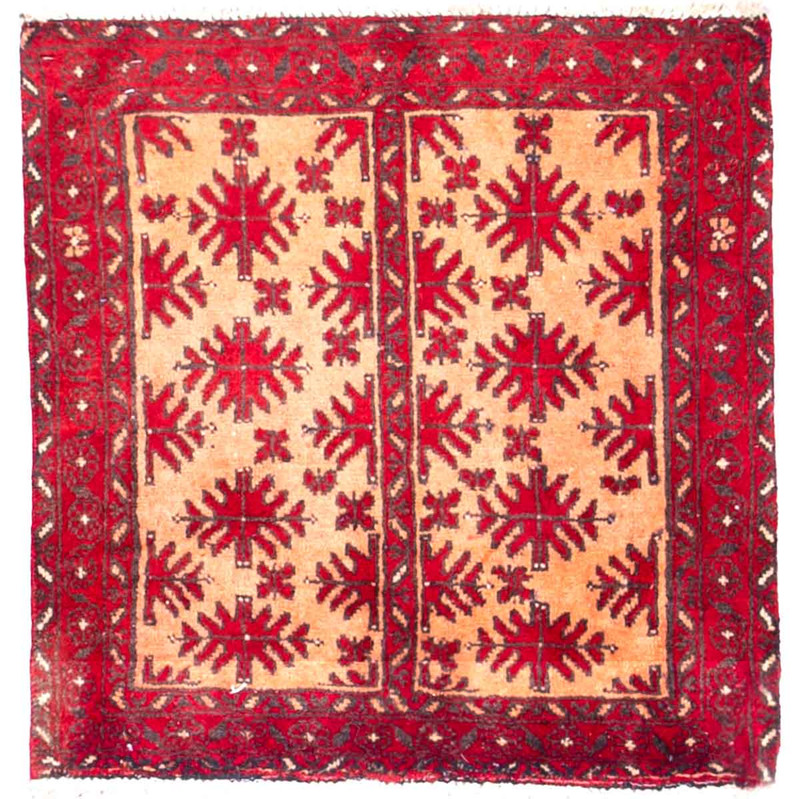
A small Baluch rug of about 2.5 by 2.25 feet with a rosette design in red, cream, and madder red - Baluch Persian Rug 2x2 ft - Rosette Semi Antique Wool Camel Hair Hand Knotted
7
Rosettes Inside Other Designs
Even when a rug is not a rosette rug, rosettes are often at its heart:
•
Herati - A small rosette sits at the center of every Herati unit. See our Herati designs.
•
Mina Khani - Large and small rosettes linked by stems form the lattice. See our Mina Khani designs.
•
Medallions - Many medallions have a rosette at their center. See our Medallion designs.
•
Borders - Rows of rosettes often fill the main border or guard stripes.
•
Lattices - Diamond lattices often hold a rosette in each compartment. See our Diamond Lattice designs.
8
Rosette and Related Designs
Rosette and Gol Farang
A rosette is a stylized flower seen from above; a Gol Farang rose is realistic and shaded. See our Gol Farang designs.
Rosette and Turkmen Gul
The Turkmen gul is a geometric medallion, sometimes described as a stylized flower. See our Turkmen Gul designs.
Rosette and Vaghireh
Rows of rosettes are a classic repeating design. See our Vaghireh designs.
Rosette and Afshan
Rosettes are among the flowers scattered in an Afshan field. See our Afshan designs.
9
Colors of Rosette Rugs
Rosette rugs often use color to create rhythm. Our Nain rug sets crimson and navy rosettes on a cream ground, a light, elegant palette; our Baluch piece uses red, cream, and madder red in a warm tribal scheme. Alternating rosette colors create diagonal lines across the field, and a contrasting border frames the whole. Read more in our articles on natural dyes and the nine ranges of Persian colors.
10
Sizes in Our Collection
Our Rosette rugs include a Nain rug of about 5.25 by 3 feet and small Baluch pieces of about 2.5 by 2.25 feet, along with small square pieces. Browse by size: 3x5 and 2x3.
11
Choosing a Rosette Rug by Room
•
Entrances - A small rosette rug makes a calm, pretty welcome.
•
Bedrooms - Rows of flowers feel restful beside a bed.
•
Studies - A fine rosette field suits a quiet room.
•
Walls and tables - Small rosette pieces work as textile art.
•
Modern rooms - The regular grid suits clean, simple spaces.
12
Matching a Rosette Rug to Your Room
A rosette rug has a gentle, even pattern that pairs well with many styles. A cream-ground rosette rug lightens a room and suits modern and coastal interiors; a red tribal rosette rug warms a room with wood and leather. Pick one color from the rosettes and repeat it in a cushion or a throw.
13
The Rosette at Persepolis
Visitors to Persepolis often notice the rosettes before anything else. Along the great staircases of the Apadana, rows of twelve-petaled rosettes frame the famous processions of tribute bearers and guards, marking borders and dividing scenes. Carved more than two and a half thousand years ago, they show how deeply the round flower is rooted in Persian art. When a modern weaver places a row of rosettes in a border, she is continuing a tradition that stretches back to the Achaemenid kings. Read more about early Persian art and weaving in our article on the Pazyryk rug, whose borders also include rosette-like motifs.
14
Petals and Centers
Rosettes come in many forms, and looking closely at their petals and centers is one of the pleasures of a rosette rug:
•
Four-petaled - A simple cross-shaped flower, common in small fillers and borders.
•
Six- and eight-petaled - Balanced, star-like flowers, often in tribal rugs.
•
Many-petaled - Layered flowers with rings of petals, typical of city rugs.
•
Star-centered - A small star or cross at the heart of the flower.
•
Nested - A rosette within a rosette, like a flower within a flower.
Each form gives the rug a different character, from the crisp geometry of a tribal star-rosette to the soft fullness of a city flower. Read more about floral motifs in our article on garden design.
15
Rosette Borders
Some of the most beautiful rosettes in Persian rugs are in the borders. A row of rosettes alternating with small leaves or palmettes is one of the most common border designs, framing medallion, Herati, and floral fields alike. Guard stripes often hold tiny rosettes in a continuous chain. Once you start looking for rosettes in borders, you will find them in a great many rugs, often unnoticed at first glance.
16
How Rosettes Are Woven
A rosette is a natural repeating motif for the weaver. In a rosette field, she needs only one or two flower patterns and the rule for spacing and coloring them, which she can carry in memory or follow from a small sample. In city rugs, where rosettes are drawn with smooth curves and shading, a cartoon guides the weaver; in tribal rugs, the geometric rosette is woven from memory, counting knots. Either way, keeping the rows straight and the flowers even across the field takes skill and care. See our Vaghireh designs for more on repeating designs.
17
Living with a Rosette Rug
A rosette rug brings a quiet, gentle pattern to a room. Its flowers are calm and evenly spaced, so the rug never feels busy, yet up close each rosette rewards a closer look. Small rosette rugs are especially easy to live with: they can move from an entrance to a bedside, from a study to a wall, and always look at home.
18
Combining a Rosette Rug with Other Rugs
A rosette rug pairs well with larger rugs in neighboring rooms. A small rosette rug at an entrance can lead into a living room with a medallion or Herati rug in similar colors, where the same round flowers appear at a different scale. Keep one or two colors in common.
19
Photographs and Real Color
Creams, crimsons, and navies can look different on screen depending on the light. Daylight from a north window shows the truest colors. If color matters for your space, ask us for extra photographs in daylight or close-ups of the rosettes.
20
The Nain Rosette Rug
Our featured rosette rug comes from Nain, a desert town east of Isfahan famous for some of the finest rugs in Persia. Nain weavers are known for cream and ivory grounds with navy and soft blue designs, and for very fine knotting. Our Nain rug sets rows of small rosettes in crimson and navy on a cream field, framed by a strong border, a design sometimes described in the trade as a repeating or banded field. It shows how a simple motif, repeated with care, can create a rug of quiet elegance. Read more on our Nain collection page and in our article on weaving in Nain.
21
Baluch Rosettes
Our small Baluch rosette pieces come from the tribal weaving of eastern Persia. Baluch weavers use dark reds, navies, browns, and touches of cream and camel, and their rosettes are geometric, built from steps and small squares. On a small rug, a few bold rosettes fill the field, giving a strong, graphic look. These small pieces are often made as mats or bag faces, and they show tribal drawing at its most concentrated. Read more in our article on weaving in Baluchestan.
22
Rosettes in Persian Tilework
Rosettes are everywhere in Persian architecture: in the star-and-cross tile patterns of mosques and palaces, at the centers of tiled domes, and in the carved stucco of mihrabs. Many tile patterns are built around a central rosette surrounded by geometric shapes, a design idea that also appears in rugs. Seeing these tiles helps explain why the rosette feels so at home in Persian weaving. Read more in our article on Isfahan rugs and Safavid architecture.
23
Wool and Fineness
A field of small rosettes shows the quality of a rug clearly. Fine knotting allows small, crisp flowers with clear petals; coarse knotting turns the same flowers into simple geometric shapes. Good wool gives the colors a soft sheen. When comparing rosette rugs, look closely at a single flower: crisp petals and clear colors are signs of a well made rug. Read more in our article on wool.
24
Rosettes and Meaning
Many writers have suggested meanings for the rosette. Its circular form and radiating petals have been linked with the sun, with light, and with the cycle of life, and in ancient Persian art it may have carried royal or sacred associations. In later rugs, the rosette is often simply a flower, a reminder of the gardens that Persians have always loved. These meanings are interpretations rather than fixed rules, but they help explain why the round flower has remained so popular for so long. Read more in how to read a Persian rug.
25
Placing a Small Rosette Rug
Small rosette rugs need a little care in placement. On smooth floors, use a thin non-slip pad cut slightly smaller than the rug, so it stays flat and does not slide. If a corner curls, lay the rug flat with a light weight on the corner for a few days. A small rug looks best with some floor around it, so its border can be seen; avoid tucking it under furniture.
26
Rosettes in Small Pieces
The rosette is perfect for small rugs and mats. A single large rosette, or a small grid of four or six, fills a compact space with a complete, balanced design. Tribal weavers wove many small pieces with rosettes as bag faces, saddle covers, and mats, and city weavers made small rosette rugs for tables and walls. Today these small pieces work beautifully on a chest, a bench, a shelf, or a wall, adding a touch of Persian weaving to any corner of a home.
27
How to Judge a Rosette Rug
•
Regularity - Rosettes evenly spaced in straight rows.
•
Drawing - Clear, well formed petals and centers.
•
Color rhythm - A pleasing sequence of colors across the field.
•
Fineness - Smaller, crisper rosettes usually mean finer knotting.
•
Condition - Even pile, intact sides and ends.
28
Questions to Ask Before You Buy
•
Where was it woven? - City and tribal rosettes differ greatly.
•
How old is it? - Our Nain rug is about 25 to 40 years old.
•
What are the measurements at both ends? - Checks that the rug is straight.
•
Is the pile even? - Check for worn areas.
•
Has it been washed recently? - A fresh wash shows the true colors.
Read our notes on what to know before you buy and our guide on how to buy a Persian rug.
29
Caring for a Rosette Rug
Vacuum regularly without a beater bar. Rotate the rug every few months so that wear and light are spread evenly. Use a non-slip pad, especially under small rugs. Blot spills at once with a clean, white cloth and cold water. Have it professionally washed every year or two in busy areas; cream grounds may need it more often. See our care instructions and our article on professional washing.
30
Frequently Asked Questions
What is a rosette?
A round flower seen from above, with petals radiating from a center.
How is a rosette different from a palmette?
A rosette is seen from above; a palmette shows a flower from the side, like a fan.
Where do rosettes appear in Persian rugs?
In rows across the field, in medallions, in borders, and at the center of Herati and Mina Khani designs.
How old is the rosette motif?
Very old; it appears on the reliefs of Persepolis and in much earlier art.
What sizes do you have?
A Nain rug of about 5.25 by 3 feet and small Baluch pieces.
Are rosettes found in borders?
Yes. Rows of rosettes are among the most common border designs in Persian rugs.
Can a small rosette rug hang on a wall?
Yes, mounted on a fabric sleeve or a strip of Velcro, never nailed.
How should I care for a rosette rug?
Vacuum regularly without a beater bar, rotate it, use a pad, and have it professionally washed regularly.
Do rosettes have a meaning?
They have been linked with the sun, light, and life, but meanings are interpretations rather than fixed rules.
Can I see more photographs?
Yes. Ask us for daylight photographs, close-ups of the rosettes, or pictures of the back of any rug.
Are rosette rugs hand-knotted?
Yes. Every rug in our collection is hand-knotted.
Is a rosette rug good for a modern room?
Yes. The regular grid of round flowers suits clean, simple spaces.
Which rugs have rosettes at their center?
Herati and Mina Khani designs, and many medallions, are built around a central rosette.
Do rosette rugs hide wear?
Yes. The even, repeating pattern hides small marks well.
What is the Persian word for a rosette?
It is usually simply called gol, the Persian word for flower.
31
Choose Your Rosette Rug
Each rug in our collection is hand-knotted, one of a kind, and inspected before it is listed. Browse our Rosette rugs, compare with our Herati and Mina Khani designs, or ask our experts for help.