


Khorasan Rugs: Mashhad, Birjand, Kashmar, and Baluch Weaving
Los Angeles Home of Rugs on Nov 17th 2026
Stretching across the vast northeast of Persia, from the Caspian lowlands to the deserts that border Afghanistan, the historic province of Khorasan - "the land where the sun rises" - is one of the oldest and most varied rug-weaving regions in the world. Its name has been attached to some of the most famous designs in Persian weaving, its cities have hosted great workshops for centuries, and its villages and tribal camps still produce rugs of remarkable character.
Khorasan is not one weaving tradition but many. Within its borders you will find the fine city carpets of Mashhad, the refined village rugs of Birjand and the Qaen region, the large decorative carpets of Kashmar and Sabzevar, the dark, glowing rugs of the Baluch tribes, and the bold weavings of the Kurmanj Kurds in the north. This article introduces the history of Khorasan weaving, its main centers and peoples, its designs and colors, and the practical points that help you recognize and choose a Khorasan rug.
1
The Land Where the Sun Rises
Historically, Khorasan was much larger than today's provinces of the same name. It included great cities such as Nishapur, Merv, Balkh, and Herat, and for many centuries it was one of the cultural heartlands of the Persian world - the home of poets such as Ferdowsi and Omar Khayyam, of scholars, mystics, and some of the finest artists of their time. Since 2004 the area within Persia has been divided into three provinces: North Khorasan, Razavi Khorasan, and South Khorasan.
The landscape is one of contrasts: fertile valleys and orchards around Mashhad and Nishapur, high mountains in the north, and wide deserts in the south and east. This variety supported many ways of life - city craftsmen, settled farmers, and nomadic herders - and each contributed its own style of weaving. Khorasan is also famous for saffron, barberries, and pistachios, crops that, as we describe in our article on the hidden palette of Persian rug dyes, found their way into the dye house as well as the kitchen.
2
A Weaving History Reaching Back Centuries
Early Foundations
Carpet weaving in Khorasan has very old roots. Historical sources describe fine textiles and carpets from the region as early as the medieval Islamic period, and some scholars connect Khorasan's weaving traditions with the much older art of the Sasanian era. Because so few early carpets survive, much of this early history is known from written accounts rather than from the rugs themselves.
Herat and the Timurid Age
In the fifteenth century, under the Timurid ruler Shah Rukh and his successors, the city of Herat - then part of greater Khorasan - became one of the most brilliant artistic centers in the world. Its painters, calligraphers, and designers developed the refined floral style that later shaped Safavid court art, and the famous Herati pattern, a rosette within a diamond flanked by curving leaves, is traditionally connected with the city's designers. Today the Herati is one of the most widely woven patterns in all of Persian weaving, as we explain in our guide to Persian rug design.
The Safavid Period
Under the Safavids in the sixteenth and seventeenth centuries, Khorasan remained an important weaving region. A group of large, finely drawn carpets with dense floral fields and red grounds, once commonly labeled "Herat carpets" by scholars, illustrates the high standard of weaving associated with the region in this period, although the exact place of manufacture of many such carpets is still debated.
The Commercial Revival
As in other regions, the great modern expansion came in the late nineteenth and early twentieth centuries, when merchants from Tabriz and elsewhere organized production for the growing export market. Workshops in Mashhad flourished, and village weaving across the region increased. Some of the finest Khorasan carpets of this era came from the famous Mashhad workshops, which produced large carpets of very high quality for wealthy clients at home and abroad.
3
The Main Weaving Centers of Khorasan
Mashhad
Mashhad, the provincial capital and home of the holy shrine of Imam Reza, is the largest city in eastern Persia and one of its most important weaving centers. Mashhad carpets are typically woven with the Persian knot on cotton foundations, often in large room sizes, with curvilinear medallion and all-over designs. Classic Mashhad rugs are known for a rich palette of deep red - often a distinctive purplish red - with navy blue and ivory, and for soft, lustrous wool.
Mashhad has also been home to master workshops whose rugs are prized by collectors. The best-known name is Amoghli, a workshop active in the late nineteenth and early twentieth centuries whose finely knotted carpets, often with complex floral designs and signed in the border, are among the most admired Persian carpets of their era. The shrine complex of Imam Reza also houses an important museum collection of carpets, a testament to the city's long weaving heritage. Read more in our article on weaving in Mashhad.
Birjand and the Qaen Region
In South Khorasan, Birjand and the surrounding district of Qaen (Qainat) produce some of the most refined rugs in the region. Birjand rugs often use the Herati and boteh designs, beautifully drawn on soft wool, with madder reds, deep blues, and ivory. The villages of this area, including Dorokhsh (Darakhsh), are known for their long tradition of natural dyeing; field studies of these villages have documented twenty-six stable colors made from local plants and other natural sources. See our article on weaving in Birjand and our Birjand collection.
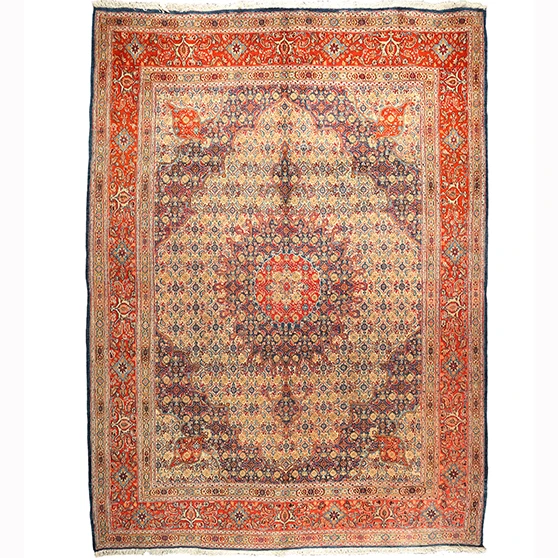
A Birjand rug with a Shah Abbasi medallion in madder red, cream, and navy blue - Birjand Persian Rug 9x7 ft - Medallion Semi Antique Wool Hand Knotted
Kashmar
Kashmar, southwest of Mashhad, is known for producing large numbers of carpets, often in room and oversized dimensions. Kashmar weavers borrow freely from other traditions - Kashan, Kerman, Tabriz, and Varamin designs all appear - and many Kashmar rugs feature elaborate pictorial or garden borders, Shah Abbasi palmettes, and dense medallions. Their palettes are rich, with reds and dark blues complemented by beige, green, and ivory. See our article on weaving in Kashmar and our Kashmar collection.
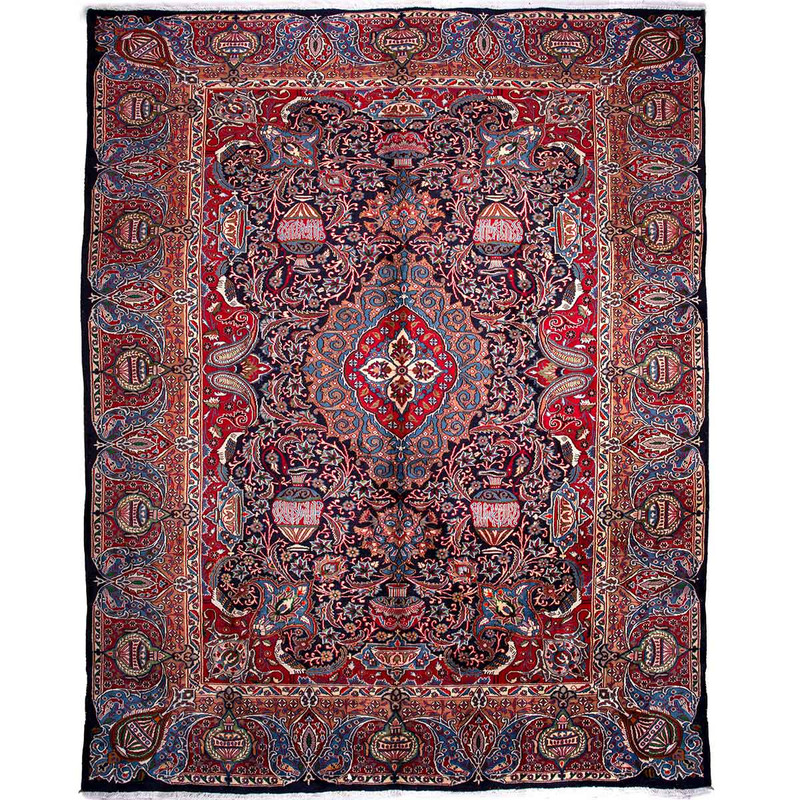
An antique Kashmar medallion rug in madder red, navy blue, and ivory - Kashmar Persian Rug 13x9 ft - Medallion Antique Wool Hand Knotted
Sabzevar and Nishapur
West of Mashhad, the towns of Sabzevar and Nishapur have their own weaving traditions. Sabzevar rugs are usually sturdy, medium-to-fine carpets with medallion and Shah Abbasi designs, often in crimson, navy blue, and ivory, while Nishapur, the city of Omar Khayyam, has historically supplied both city-style carpets and village rugs. Explore our Sabzevar collection.
Other Centers
Many other towns and villages across Khorasan weave rugs, including Gonabad, Ferdows, Torbat-e Heydarieh, Quchan, and Torbat-e Jam. Some, like Ferdos, have given their names to recognizable local styles, while others contribute to the broad category of Khorasan village rugs.
4
Mashhad - A City of Pilgrims and Carpet Merchants
Mashhad's role as one of the great pilgrimage cities of the Shia world has shaped its carpet trade for centuries. Millions of pilgrims visit the shrine of Imam Reza every year, and many traditionally bought carpets to take home, so the city's bazaars have long been filled with rug dealers offering everything from small prayer rugs to grand room-size carpets. The shrine itself has received carpets as gifts from rulers, merchants, and ordinary believers over many generations, and these donations helped build one of the most important collections of Persian carpets in the region.
This constant flow of visitors also made Mashhad a meeting point for weavers and merchants from across Khorasan. Baluch rugs from the south and east, Kurdish weavings from the north, and village rugs from Birjand, Kashmar, and Sabzevar all passed through its markets, which is one reason the name "Mashhad" has sometimes been used loosely in the trade for rugs that were actually woven elsewhere in the province.
5
The Tribal Weavers of Khorasan
The Baluch
Some of the most distinctive rugs of Khorasan are woven by the Baluch tribes who have lived in the region, particularly around Torbat-e Heydarieh and Torbat-e Jam, for centuries. Baluch rugs are usually small to medium in size - prayer rugs, bag faces, and scatter rugs are typical - and they are instantly recognizable by their dark, glowing palette of deep reds, browns, aubergine, and navy, often brightened by small touches of ivory or camel. Natural camel hair is frequently used, sometimes for the field of prayer rugs.
Baluch weavers favor geometric designs: small repeated motifs, tree-of-life prayer niches, and patterns related to Turkmen guls. Their wool is soft and lustrous, and fine old Baluch rugs develop a beautiful, almost silky sheen. Read more in our article on weaving in Baluchestan and explore our Baluch collection.
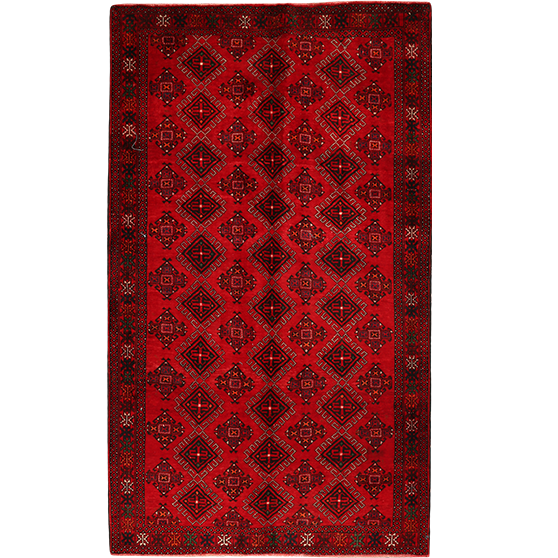
A Baluch rug in red, burgundy, and black, woven with wool and natural camel hair - Baluch Persian Rug 9x5 ft - Geometric Semi Antique Wool Camel Hair Hand Knotted
The Kurmanj Kurds
In North Khorasan, around Quchan, Shirvan, and Bojnurd, live the Kurmanj Kurds, whose ancestors were resettled in the region several centuries ago to guard the frontier. Their rugs are bold and colorful, with large geometric medallions, strong reds, blues, yellows, and greens, and sturdy wool foundations. Kurmanj weavers also produce kilims, bags, and other flatwoven textiles. Our article on the Kurmanj tribes tells their story, and you can explore their related styles in our Quchan collection.
Turkmen Neighbors
Along the northern border, Turkmen weavers have long produced their own famous rugs, characterized by repeated gul motifs on deep red grounds. Their influence can be seen in some Baluch and Khorasan village designs. See our Turkmen collection.
6
Kilims, Bags, and Flatweaves
Pile rugs are only part of Khorasan's textile heritage. The region's tribal and village weavers have also produced a wide range of flatwoven textiles: kilims for floors and tent dividers, saddlebags and storage bags, salt bags, animal trappings, and decorative bands for tents. Baluch and Kurmanj weavers are particularly skilled in these forms, combining pile and flatweave techniques with great inventiveness.
These pieces were made for daily use, so relatively few old examples survive in good condition, and collectors value them highly for their authenticity and their bold, personal designs. Smaller bag faces and kilims also make beautiful wall hangings, pillows, and accents in modern homes. Explore our kilim collection for flatwoven pieces.
7
Designs of Khorasan
Across all these traditions, several designs appear again and again in Khorasan weaving:
•
Herati - the region's signature pattern, woven in many scales from the fine all-over Heratis of Birjand to bold versions in village rugs. See our Herati designs.
•
Boteh - rows of teardrop motifs, especially popular in Birjand and Qaen rugs. See our boteh designs.
•
Shah Abbasi - the grand palmettes of the Safavid court style, common in Mashhad, Kashmar, and Sabzevar carpets. See our Shah Abbasi designs.
•
Medallion and corner - large central medallions on floral fields, a staple of city and town production.
•
Garden and panel - garden-style compartments appear in some Khorasan rugs, as in the example below. Read more in our article on Persian garden rugs.
•
Tribal geometric and prayer designs - small repeated motifs and tree-of-life prayer niches in Baluch and Kurdish rugs.
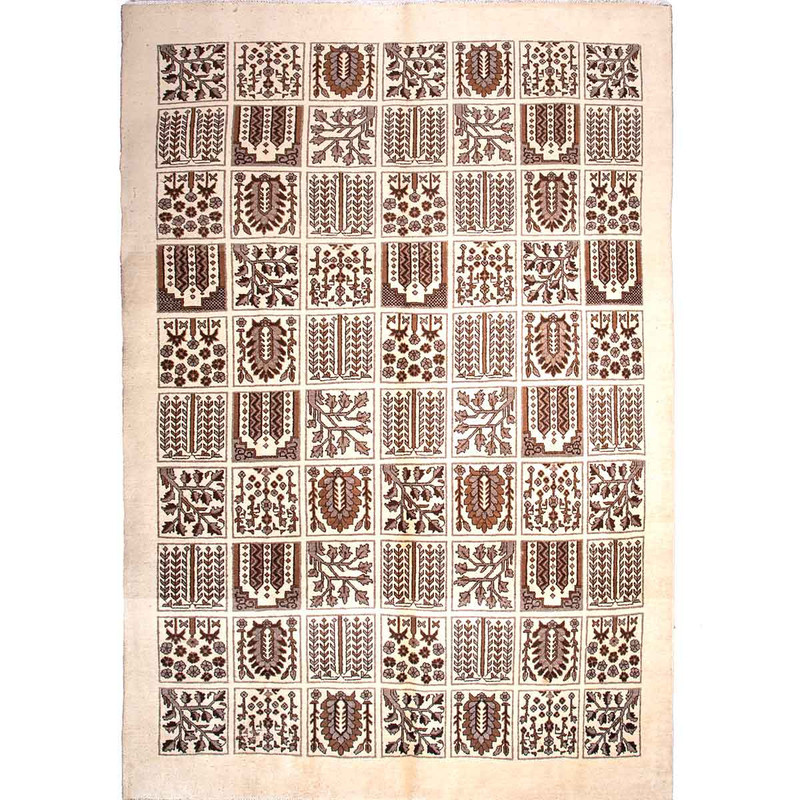
A Khorasan rug with a kheshti garden design in cream, brown, and madder red - Khorasan Persian Rug 10x7 ft - Kheshti Semi Antique Wool Silk Hand Knotted
8
Colors and Materials
Khorasan rugs are known for soft, lustrous wool, especially in the finer city and village pieces. Classic palettes are built on madder reds - in Mashhad often a deep, slightly purplish red - with navy blue, ivory, and touches of green, gold, and pink. In Birjand and Qaen, natural dyeing traditions using local plants have produced some especially harmonious colors, while Baluch rugs favor deep, dark tones.
Foundations are usually cotton in city and town rugs and wool in tribal rugs. Both the Persian (asymmetrical) and Turkish (symmetrical) knots are used in Khorasan, with the Persian knot more common in city workshops. Our article on how a Persian rug is made explains these structural differences.
A note for buyers: in the twentieth century, some Khorasan workshops used the jufti or "false" knot, tied over four warps instead of two. It speeds weaving but halves knot density and reduces durability. Well-made Khorasan rugs avoid it, and a specialist can easily check the back of a rug for this.
9
How to Recognize a Khorasan Rug
Rugs from Khorasan vary widely, but these clues will help you place them:
•
Soft wool and a supple handle - many Khorasan rugs feel softer and more flexible than rugs from western Persia.
•
Herati and boteh designs - especially finely drawn in Birjand and Qaen rugs.
•
Purplish-red tones - a characteristic shade in many Mashhad carpets.
•
Ornate borders - Kashmar rugs often have very wide, elaborate borders with pictorial or garden scenes.
•
Dark, glowing palettes and camel hair - the signature of Baluch rugs.
•
Bold geometry and bright colors - typical of Kurmanj Kurdish weaving in the north.
Inspecting the back of the rug, the number of wefts, and the type of knot can further narrow down the origin. Our article on reading a Persian rug's secret language explains how specialists use these details.
10
Khorasan Rugs in Your Home
The variety of Khorasan weaving makes it easy to find a rug for almost any room. Large Mashhad, Kashmar, and Sabzevar carpets, with their classic medallions and rich reds, suit formal living and dining rooms and traditional interiors. Birjand rugs with fine Herati and boteh patterns bring quiet elegance to bedrooms, studies, and transitional spaces. Baluch rugs, small and richly colored, are perfect for entryways, beside a bed, or as wall hangings, and they work beautifully with wood, leather, and modern furniture. Kurmanj and other tribal rugs add warmth and color to relaxed, contemporary, or rustic interiors.
Because many Khorasan rugs have soft wool, they are particularly comfortable underfoot. In very high-traffic areas, a sturdier village or tribal piece may be the more practical choice. Our rug size guide will help you choose the right dimensions.
11
Collecting Khorasan Rugs
For collectors, Khorasan offers some exceptional opportunities. Antique Mashhad carpets from the great workshops, especially signed Amoghli pieces, are among the most sought-after Persian carpets of the late nineteenth and early twentieth centuries. Fine antique Birjand and Qaen rugs with natural dyes are increasingly appreciated, and old Baluch rugs, once overlooked, now have an enthusiastic following for their deep colors, wool quality, and tribal character.
When evaluating a Khorasan rug, pay attention to the quality of the wool and dyes, the fineness and confidence of the drawing, the condition of the pile and foundation, and the type of knot used. Antique and semi-antique pieces in good condition, with natural dyes and proper knotting, offer the best long-term value. Our article on investing in hand-knotted rugs explores these factors in more detail.
12
Caring for Khorasan Rugs
The soft wool that makes many Khorasan rugs so pleasant underfoot also means they benefit from a little care. Rotate them once or twice a year so they wear evenly, vacuum gently without a beater bar, and keep them out of strong, direct sunlight, especially older pieces with natural dyes. Baluch rugs, which often contain dark iron-mordanted browns, may show natural wear in those areas over time, as we explain in our article on mordants. For cleaning, see our guides to washing a Persian rug at home and professional rug washing.
13
Khorasan Weaving Today
Weaving remains an important part of life in Khorasan. Mashhad continues to produce large city carpets, and many towns and villages across the three provinces weave rugs for domestic and international markets. In South Khorasan in particular, researchers from local universities have documented the region's traditional dyeing knowledge and called for training young dyers and reviving the market for naturally dyed rugs, so that skills held by the last generation of master dyers are not lost.
At the same time, the tribal traditions of the Baluch and the Kurmanj continue, though often in settled villages rather than nomadic camps. For buyers, this means that Khorasan offers both a rich heritage of antique and semi-antique rugs and a living tradition of new weaving, with the best contemporary pieces once again using hand-spun wool and natural dyes.
14
Frequently Asked Questions
Is Khorasan a city or a region?
Khorasan is a region in northeastern Persia, today divided into three provinces. Its main city is Mashhad.
What is the most famous Khorasan rug design?
The Herati, traditionally connected with the city of Herat in historic Khorasan, is the region's most famous contribution to Persian design.
Are Baluch rugs from Khorasan?
Many are. Baluch tribes live in Khorasan as well as in Sistan and Baluchestan and neighboring countries, and many of the Baluch rugs on the market were woven in Khorasan.
Are Khorasan rugs durable?
Well-made Khorasan rugs with proper knots and good wool are durable and comfortable. Rugs woven with the jufti knot are less hard-wearing, so it is worth checking construction.
15
The Living Tradition of Khorasan
From the court designers of Herat to the master workshops of Mashhad, from the natural-dye villages of Birjand to the tents of the Baluch and the Kurmanj, Khorasan has given the world an extraordinary range of rugs. Its weavers continue to work today, keeping alive a tradition that has shaped Persian design for more than five centuries.
At Los Angeles Home of Rugs, you can explore authentic rugs from across Khorasan, including our Birjand, Kashmar, Sabzevar, Mashad, and Baluch collections. Every rug comes with a Certificate of Authenticity documenting its origin, materials, and age. If you have questions, please ask our experts.
Explore Khorasan Rugs
Birjand Rugs
Kashmar Rugs
Sabzevar Rugs
Mashad Rugs
Baluch Rugs
Khorasan Rugs
Herati Designs
Persian Rug FAQ