


Sarab Rugs: Camel-Colored Runners of Azerbaijan
Los Angeles Home of Rugs on Nov 18th 2026
If you need a long, narrow rug that is beautiful, durable, and full of character, a Sarab runner is one of the best choices in the world of Persian weaving. The original text of this article described Sarab as one of the leading rug-producing centers of Azerbaijan, famous for thick, long-wearing runners with bold geometric medallions. For generations, Sarab runners have graced hallways, staircases, and narrow rooms, combining strong design with remarkable toughness.
This guide explains where Sarab is, what makes its rugs distinctive, the story of camel-wool Sarabs, the designs and colors of Sarab runners, and how to choose and care for one. Our articles on Azerbaijan rugs, Heriz rugs, and Ardabil rugs cover the neighboring weaving centers.
1
Where Is Sarab?
Sarab is a town in East Azerbaijan Province in northwestern Persia, on the high plateau between Tabriz and Ardabil, south of the great volcanic peak of Mount Sabalan. It is a land of cold winters, mild summers, high pastures, and farming villages. The town and its surrounding villages have long been home to weavers, and their rugs are sold in Sarab and in the great bazaar of Tabriz.
The original text of this article made an interesting observation: although Sarab is located near the Heriz region, its rugs greatly resemble those of the more distant Meshkin Shahr. This reflects the region's weaving heritage, which includes the tribal and village traditions of the Shahsavan peoples, whose rugs are woven across the area between Sarab, Meshkin, and Ardabil.
2
Mount Sabalan and Its Pastures
Mount Sabalan, an extinct volcano rising to more than 4,800 meters, dominates the landscape north of Sarab. Its slopes provide rich summer pastures, and for centuries herders have brought their flocks up the mountain each year. These pastures produce strong, lustrous wool, the raw material of the region's durable rugs. The mountain is also known for its hot springs and its snow-covered summit, visible from far across the plateau, and it has long been a symbol of the region.
3
The Shahsavan Heritage
The weaving traditions around Sarab, Meshkin, and Ardabil are closely linked to the Shahsavan, a confederation of tribes who historically migrated between winter pastures in the Moghan plain to the north and summer pastures on the slopes of Sabalan. Shahsavan weavers are famous for bold geometric pile rugs, flatwoven kilims, soumak bags, and bedding covers decorated with hooked medallions, stars, and stylized animals. Many settled villages in the region inherited these designs, which helps explain why Sarab rugs resemble those of Meshkin, as the original text of this article noted. See our article on Persian kilims.
4
Runners: The Sarab Specialty
The original text explained that Sarab and its surrounding villages are known for thick, long-wearing runners. Their typical dimensions, according to the original text, are lengths of about six to twenty feet and widths of approximately three feet. Very long Sarab runners are especially prized, as few weaving centers produce runners of such length with such consistent quality.
Runners were traditionally woven for the long, narrow rooms of Persian houses, where they were laid along the sides of a room or used in pairs. Today they are ideal for hallways, staircases, galleries, and long kitchens. Explore our runners.
Sarab is famous for thick, durable runners, typically about three feet wide and six to twenty feet long, with bold lozenge medallions on red or camel-colored fields.
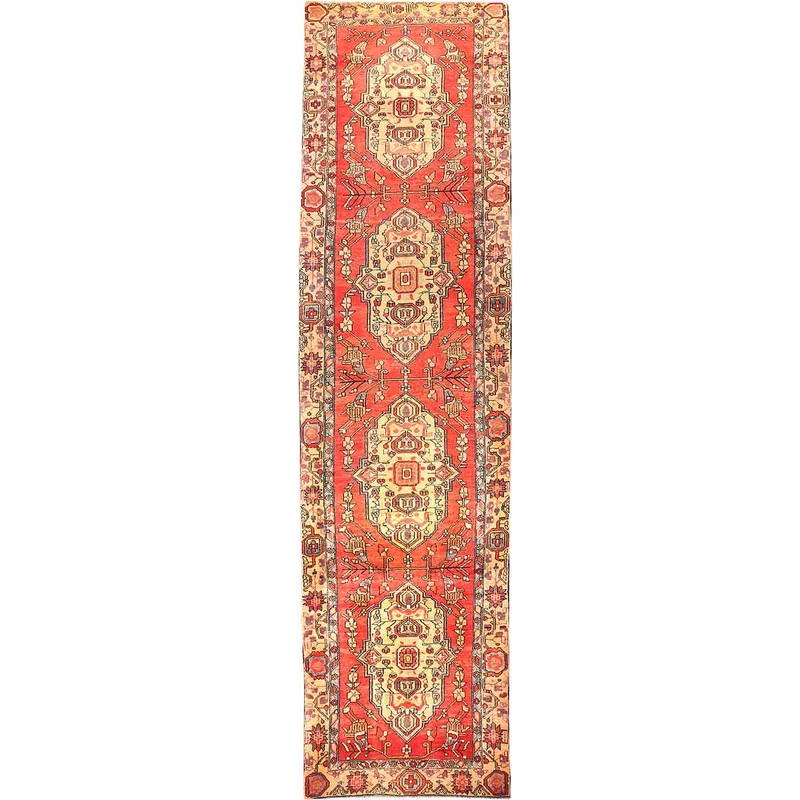
A long Sarab runner with a series of geometric medallions - Sarab Persian Rug 13x3 ft - Medallion Semi Antique Wool Hand Knotted
5
Why Runners? The Persian Room
To understand why runners were so important in Sarab, it helps to know how traditional Persian rooms were furnished. A classic arrangement used several rugs together: a main carpet in the center, called the *mian farsh*; a rug across the top of the room, called the *kelleh*; and two long, narrow runners along the sides, called *kenareh*. Family and guests sat on cushions along the runners, leaving the center open. This arrangement created a great demand for long, narrow rugs, and weavers in Sarab became specialists in producing them.
Today, the kenareh tradition lives on in the popularity of runners for hallways and long spaces. A pair of matching runners can also be used beside a bed or along both sides of a long room, echoing the old Persian arrangement.
6
The Camel-Wool Tradition
One of the most distinctive features of antique Sarab rugs is their use of camel wool. The original text noted that rugs were formerly woven with camel wool, while today sheep wool is used. Antique Sarab runners with fields of natural camel-colored wool - in shades of tan, honey, and golden brown - are among the most admired village rugs of Persia.
Camel wool has a soft, warm color and a natural luster, and it was often left undyed, so that the field of the rug shows the natural tone of the fiber. Against this warm ground, the medallions and borders stand out in red, blue, and ivory. Over time, as camel wool became scarce and expensive, weavers turned to sheep wool, sometimes dyed in camel tones to recreate the classic look. Our article on Persian rug wool explains the differences between fibers.
7
Camel Wool and Sheep Wool
Camel wool and sheep wool each have their own qualities. Camel wool is soft, warm, and lustrous, with beautiful natural tones ranging from pale sand to rich honey and brown. It was traditionally collected from the underbelly and neck of the camel and was valued for its color and softness. Sheep wool is more widely available, takes dye easily, and is very resilient, making it excellent for durable floor rugs. Antique Sarabs with camel-wool fields combine the warmth of camel color with the strength of sheep wool in the knotted designs. When buying, ask whether a camel-colored field is natural camel wool or dyed sheep wool; both can be beautiful, but natural camel wool is rarer.
8
Runners on Stairs
A Sarab runner can look wonderful on a staircase, but fitting it properly is important. The runner should be secured with stair rods or carefully placed fasteners that do not damage the rug, and a thin, firm underlay helps protect the pile on the edges of the steps. Because stairs receive concentrated wear on the nosing of each step, it is worth having a professional installer fit the runner and adjust its position from time to time so that wear is spread evenly. Never nail or glue directly through a valuable rug.
9
Colors of Sarab
The original text described the colors of modern Sarab runners: a red background with borders in white and red. Other typical colors include:
•
Camel and tan - the classic field color of antique pieces and many newer ones.
•
Brick and madder red - for fields and medallions. See our red rugs.
•
Navy and dark blue - for outlines, medallions, and borders.
•
Ivory and white - for borders and highlights. See our ivory rugs.
The combination of warm camel or red fields with ivory borders gives Sarab runners a bold, graphic look that suits both traditional and modern interiors. Our article on natural dyes explains how these colors are made.
10
A Short History of Sarab Weaving
Weaving in the Sarab region has deep roots in the village and tribal life of Azerbaijan. In the nineteenth century, as Tabriz merchants organized the export of Persian rugs to Europe and America, Sarab runners found an eager market. Their durability and bold designs suited Western homes, and their long formats filled hallways and corridors that few other rugs could. Many antique Sarab runners found in Western homes today were exported during this period. Throughout the twentieth century, weaving continued in Sarab and its villages, adapting colors and materials while keeping the classic runner format and lozenge medallions. See our articles on Persian rug history from 1722 to 1925 and Tabriz carpet history.
11
Village Life and Weaving
In the villages around Sarab, weaving has traditionally been done at home, mostly by women, on vertical looms set up in the main room of the house. Families keep sheep, and wool may be spun at home or bought locally. Long winters, when farm work stops, are the busiest time at the loom. A long runner can take many months to complete, and families often weave on commission from merchants in Sarab or Tabriz. The skills and designs are passed down from mother to daughter, keeping the regional style alive.
12
The Designs of Sarab
The original text explained that the fields of Sarab runners usually have lozenge and geometric medallions. A typical Sarab runner has a series of connected medallions - diamonds or stepped lozenges with hooked edges - running down the length of the field, often linked by short poles or bars. Each medallion may contain smaller geometric motifs, stars, or stylized flowers.
The borders are usually wide and bold, with a white or ivory ground and geometric motifs such as stylized flowers, rosettes, or reciprocal patterns. Corners may echo the medallion shapes. The overall effect is strong and rhythmic, like a series of beats along the length of the rug. See our medallion designs and geometric designs, and our guide to Persian rug motifs.
13
How Sarab Rugs Are Made
Sarab rugs are woven with the symmetrical (Turkish) knot, the knot used throughout much of Azerbaijan, typically on cotton foundations. They have a thick, dense pile and a heavy, firm structure. This construction makes them exceptionally durable - perfect for the heavy foot traffic of hallways and stairs. Our article on how a Persian rug is made explains knots and structure.
Weaving a long runner presents special challenges. The weaver must keep the width and tension even over many feet, so that the runner lies straight and flat. Experienced Sarab weavers are masters of this skill.
14
Sarab and Its Neighbors
•
Sarab vs Heriz - Heriz, nearby, is famous for room-size rugs with large angular medallions; Sarab specializes in runners with series of lozenge medallions. See our article on Heriz rugs.
•
Sarab vs Meshkin - as the original text noted, Sarab rugs greatly resemble those of Meshkin Shahr; both share bold geometric designs rooted in Shahsavan weaving. Explore our Meshkin rugs.
•
Sarab vs Ardabil - Ardabil rugs are finer, often with Caucasian-style geometric designs and lighter palettes. See our article on Ardabil rugs.
•
Sarab vs Serapi - the antique trade name "Serapi," used for the finest old Heriz-region rugs, may be connected to the name Sarab, though it now refers to a quality label rather than a place. See our article on Heriz rugs and our Serapi collection.
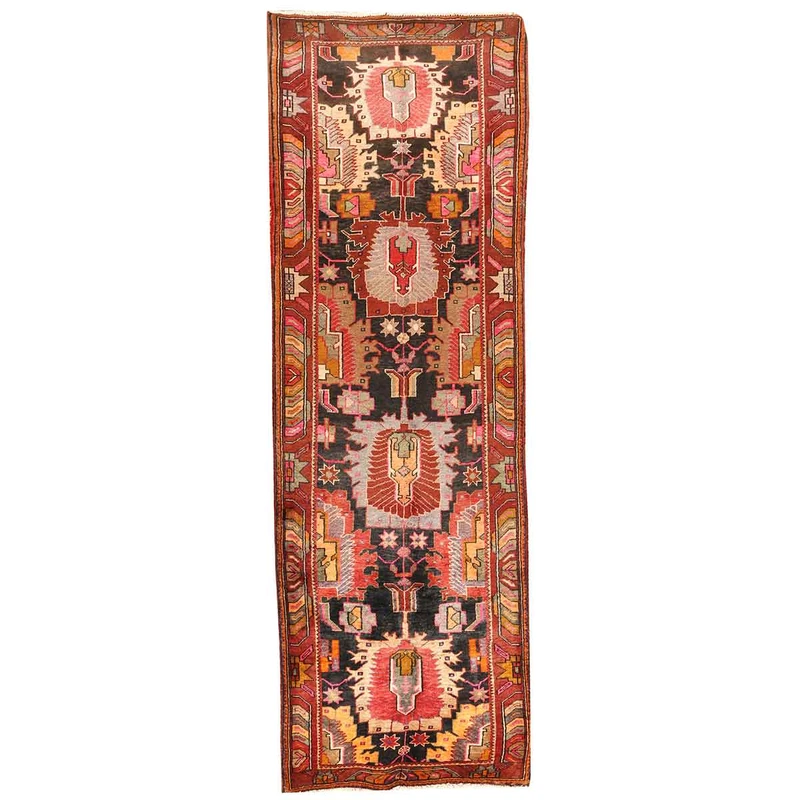
A Sarab runner with lozenge medallions and ivory borders - Sarab Persian Rug 12x3 ft - Medallion Semi Antique Wool Hand Knotted
15
Antique Sarab Runners
Antique Sarab runners, especially those with natural camel-wool fields, are highly sought after by collectors and designers. Their soft, warm tones, bold medallions, and lustrous wool give them a beautiful, timeless appearance. Over decades of use, their colors have mellowed and their pile has developed a gentle patina. Because they were built to last, many antique Sarab runners are still in excellent condition and can be used on floors today. Explore our antique and semi-antique collections.
16
How to Recognize a Sarab Rug
•
Long, narrow format - runners about three feet wide and up to twenty feet long.
•
Series of lozenge medallions - connected geometric medallions along the field.
•
Camel or red field - with ivory or white borders.
•
Thick, dense pile - and a heavy, firm handle.
•
Symmetrical knots - typical of Azerbaijan weaving.
Our article on how to read a Persian rug's secret language explains how to examine a rug's back and materials.
17
Sarab Runners in the Home
•
Hallways - a Sarab runner adds warmth and color while standing up to daily traffic.
•
Staircases - its durability makes it ideal for stairs, when properly fitted by a professional.
•
Kitchens - a long runner softens hard floors and adds character.
•
Beside beds - a pair of shorter runners on each side of a bed.
•
Modern interiors - the bold geometric designs look striking against clean, minimal spaces.
Our rug size guide will help you choose the right length, and our article on giving your home timeless elegance with a Persian rug has more decorating ideas.
18
Styling Tips for Sarab Runners
Sarab runners are wonderfully versatile. In a traditional home, a red Sarab runner in a hallway with wood paneling or framed artwork creates a warm, welcoming entrance. In a modern home, a camel-colored Sarab adds texture and warmth to white walls and concrete or light wood floors. In a kitchen, a durable runner adds comfort underfoot and a splash of pattern between cabinets. Pair a runner with a larger rug in a related palette in an adjoining room to create a sense of flow through the house.
19
How Long Should a Runner Be?
Choosing the right length is the key to a beautiful runner. In a hallway, aim to leave about six to twelve inches of floor at each end, and a few inches of floor on each side. If doors open across the hallway, make sure they clear the pile. For long corridors, a single long Sarab runner looks more elegant than several short rugs, and Sarab's long formats make this possible. In a kitchen, a runner should cover the main working area in front of the counters. Our rug size guide offers more advice.
20
Choosing a Sarab Runner
•
Measure carefully - leave a little floor visible at each end and along the sides of a hallway.
•
Field color - camel for a warm, natural look; red for richness and drama.
•
Condition - check the edges, ends, and pile, especially in older pieces.
•
Straightness - a well-made runner should lie straight and flat.
•
Age - antique camel-wool Sarabs are collector pieces; semi-antique Sarabs offer excellent value.
Our complete buyer's guide explains how to evaluate any Persian rug.
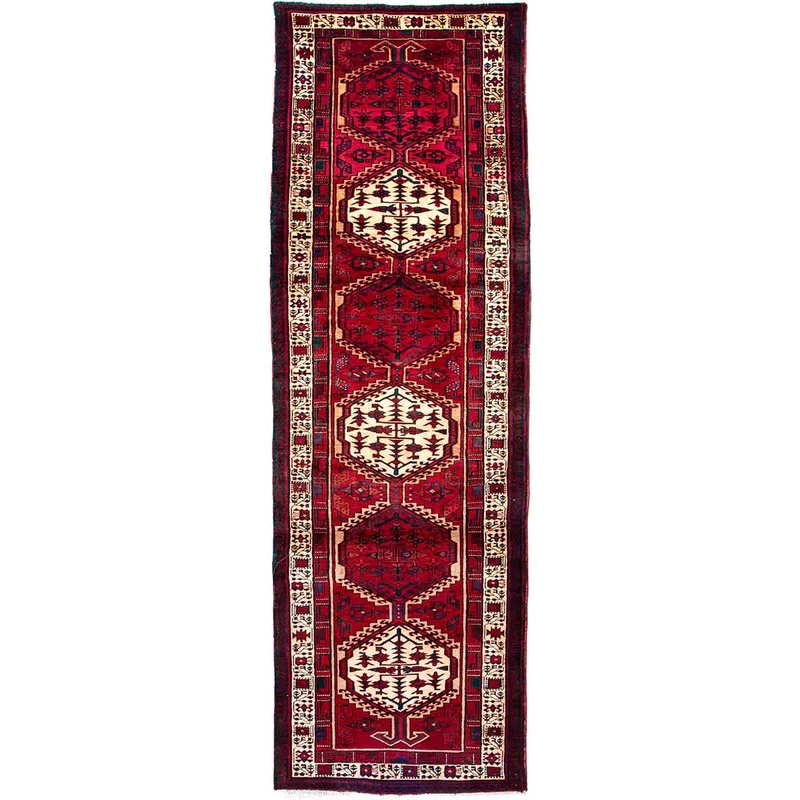
A Sarab runner in warm colors, ideal for a hallway - Sarab Persian Rug 10x3 ft - Medallion Semi Antique Wool Hand Knotted
21
Questions to Ask When Buying
•
Is the field natural camel wool or dyed sheep wool? - both can be beautiful, but natural camel is rarer.
•
How old is the runner? - antique, semi-antique, or new.
•
Does it lie straight and flat? - important for long runners.
•
Have the ends or edges been repaired? - check carefully on older pieces.
•
What are the exact dimensions? - measure your space before you buy.
Ask for close-up photos of the back, the ends, and any worn areas. A trusted seller and a certificate of authenticity will help you buy with confidence.
22
Common Misunderstandings
"Runners are less valuable than room-size rugs."
Fine antique Sarab runners are prized by collectors, and their value depends on age, condition, color, and design, not only size.
"All camel-colored rugs are camel wool."
Many are dyed sheep wool. Natural camel wool has a distinctive softness and luster.
"Geometric rugs are always tribal."
Sarab rugs are village rugs whose geometric designs come from regional and tribal traditions, but they are woven in settled communities.
23
Caring for a Sarab Runner
Runners in hallways and on stairs receive heavy traffic, so regular care is important. Vacuum often without a beater bar, and rotate the runner end to end every few months to even out wear. Use a quality rug pad to keep it from slipping, especially on hard floors. Blot spills quickly with cold water. Have the runner professionally washed every few years. Our guides to cleaning a Persian rug at home and professional rug cleaning explain these steps.
24
Frequently Asked Questions
Where is Sarab?
In East Azerbaijan Province, northwestern Persia, between Tabriz and Ardabil, south of Mount Sabalan.
What are Sarab rugs known for?
Thick, long-wearing runners with series of lozenge medallions on red or camel-colored fields.
How big are Sarab runners?
Typically about three feet wide and six to twenty feet long.
Are Sarab rugs made of camel wool?
Antique pieces often used camel wool; today sheep wool is used, sometimes in camel tones.
Are Sarab runners durable?
Very. Their thick pile, symmetrical knots, and firm construction make them ideal for hallways and stairs.
What is a kenareh?
A long, narrow side runner in the traditional Persian room arrangement, laid along the sides of a room around a central carpet.
Can a Sarab runner be used on stairs?
Yes, when fitted properly by a professional with stair rods or suitable fasteners and a firm underlay.
How long should my hallway runner be?
Leave about six to twelve inches of floor at each end and a few inches along each side of the hallway.
Do Sarab runners come in matching pairs?
Sometimes. Pairs were woven for the traditional Persian room arrangement and look lovely on both sides of a bed or a long room.
How are Sarab rugs related to Meshkin rugs?
They share bold geometric designs rooted in the weaving traditions of the region between Sarab, Meshkin, and Ardabil.
25
The Long Road of Sarab
From the high plateau beneath Mount Sabalan come some of the most beautiful and durable runners in the Persian tradition. With their camel and red fields, bold lozenge medallions, and crisp ivory borders, Sarab runners bring warmth and character to the long spaces of a home - and they are built to last for generations.
At Los Angeles Home of Rugs, you can explore our Sarab collection, our runners, and rugs from Heriz and Meshkin. If you have questions about any rug, please contact us.