


Some rug names point to more than one place. Mehraban, a Persian word that means "kind," is one of them. In the rug trade, it is best known as the name of village rugs from the Hamadan region of western Persia, sturdy single-wefted rugs with bold medallions and strong colors. There is also a town called Mehraban in East Azerbaijan, between Sarab and the Heriz weaving district, whose weavers make rugs close to the Heriz style.
Our Mehraban rugs are of the Hamadan kind. This guide explains both meanings of the name, how to recognize a Mehraban rug, how it compares with its neighbors, and how to choose, place, and care for one. For the wider story, see our articles on weaving in Hamadan and weaving in Heriz, and our Hamadan rug guide.
1
Two Places Called Mehraban
Mehraban of the Hamadan Region
In the Hamadan weaving region, rugs sold as Mehraban come from villages that weave in the classic Hamadan way: the symmetric knot, a single cotton weft, a thick wool pile, and bold medallion or allover designs. They are known for strong, clear colors and confident drawing.
Mehraban of East Azerbaijan
In East Azerbaijan, the town of Mehraban lies in the hill country between Sarab and the villages of the Heriz district. Rugs from there are often grouped with Heriz-type weaving, with large angular medallions and earthy reds. See our Heriz and Sarab collections.
Mehraban is a name used for village rugs of the Hamadan region and for a town near Sarab and Heriz in East Azerbaijan. Our Mehraban rugs are of the Hamadan kind.
2
How to Tell Them Apart
•
Wefts - Hamadan Mehrabans are single-wefted; Azerbaijan Mehrabans are usually double-wefted, like Heriz.
•
Medallion - Hamadan Mehrabans often have a diamond or lobed medallion; Azerbaijan pieces a large, angular Heriz-style medallion.
•
Colors - Hamadan pieces often use clear madder red and navy; Azerbaijan pieces often use brick red, rust, and ivory.
•
Handle - Hamadan pieces are flexible; Heriz-type pieces are stiffer and heavier.
As always, the rug itself, its wool, drawing, and condition, matters more than the name. If you are unsure which kind a rug is, ask us.
3
How to Recognize a Hamadan Mehraban
•
Bold medallion - A diamond or lobed medallion with corner pieces.
•
Herati or floral field - Often a small Herati pattern around the medallion.
•
Clear colors - Madder red, navy, and ivory.
•
Symmetric knot - The Turkish knot typical of Hamadan village rugs.
•
Single weft - One thick cotton weft after each row of knots.
•
Thick wool - A full, resilient pile.
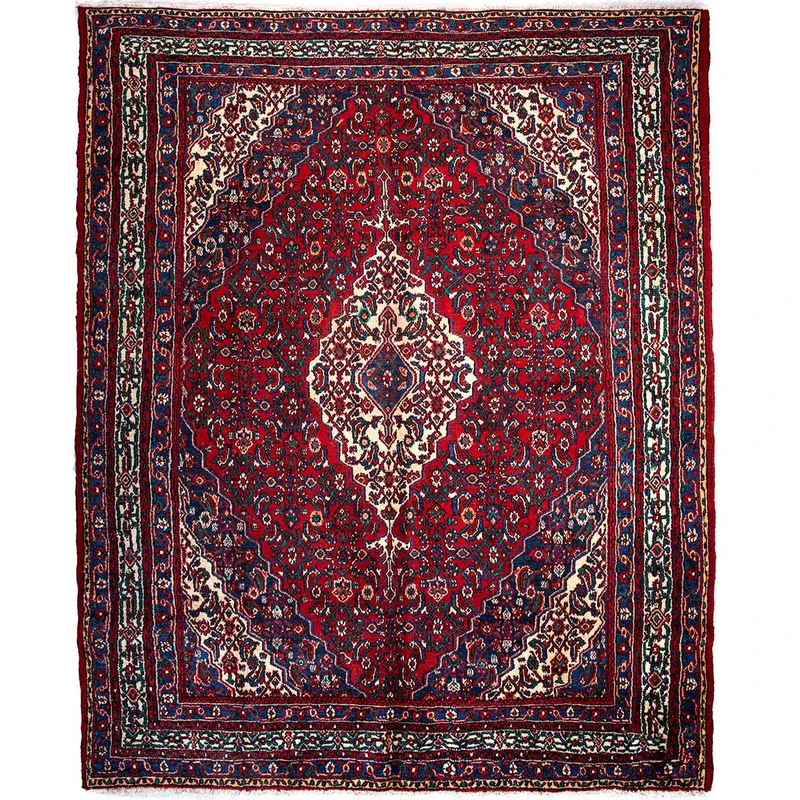
A Mehraban rug of about 11.75 by 9 feet with a medallion on a Herati field in madder red, navy blue, and ivory - Mehraban Persian Rug 11x9 ft - Medallion Semi Antique Wool Hand Knotted
4
The Medallion and Herati Field
Our room-size Mehraban combines two classic elements. At the center is a medallion, a large diamond or lobed form with smaller motifs inside and corner pieces that echo its shape. Around it, the field is filled with a Herati pattern, the small repeating unit of a rosette inside a diamond surrounded by curved leaves. In Hamadan village rugs, the Herati is drawn in a bolder, more angular way than in city rugs, giving the field a lively texture. The medallion gives the rug a focal point; the Herati keeps the field busy and forgiving. See our Herati design and medallion design pages.
5
How Mehraban Rugs Are Built
•
Knot - The symmetric (Turkish) knot.
•
Foundation - Cotton warps and wefts.
•
Wefts - Single, the classic Hamadan structure.
•
Pile - Thick, resilient wool, clipped to a medium height.
•
Density - Coarse to medium.
•
Sides and ends - Overcast sides and fringes.
This construction makes a rug that is flexible, durable, and comfortable underfoot. It lies flat, and it stands up well to heavy foot traffic.
6
Colors of Mehraban
Our Mehraban rugs use clear, classic palettes: madder red for the field, navy blue for the medallion and borders, and ivory for highlights, with touches of green, gold, and light blue. These colors give Hamadan village rugs their characteristic warmth. In semi-antique rugs, the reds have softened and the navies deepened into a rich, harmonious whole. Read more in our articles on natural dyes and traditional dyeing.
7
Sizes in Our Collection
•
About 11.75 by 9 feet - A living room, a dining room for six to eight, or a large bedroom.
•
About 9.75 by 3.5 feet - A runner for a hallway, a kitchen, or the side of a bed.
8
Choosing a Room-Size Mehraban
Measure the room and leave about 12 to 18 inches of floor between the rug and the walls. In a living room, all the main furniture can sit on the rug, or at least the front legs. In a dining room, let the rug extend at least 24 inches beyond the edge of the table on every side. In a bedroom, a rug of about 11.75 by 9 feet can sit under a king bed with plenty of rug on each side. Mark the outline on the floor with painter's tape before you decide.
9
The Mehraban Runner
Our Mehraban runner, about 9.75 by 3.5 feet, suits a hallway about 4.5 feet wide. Leave about 6 to 12 inches of floor at each end. Its red field and navy medallions bring warmth to a passage. A runner of this length also works well beside a bed, along a kitchen counter, or in front of a long sideboard. See our runners.
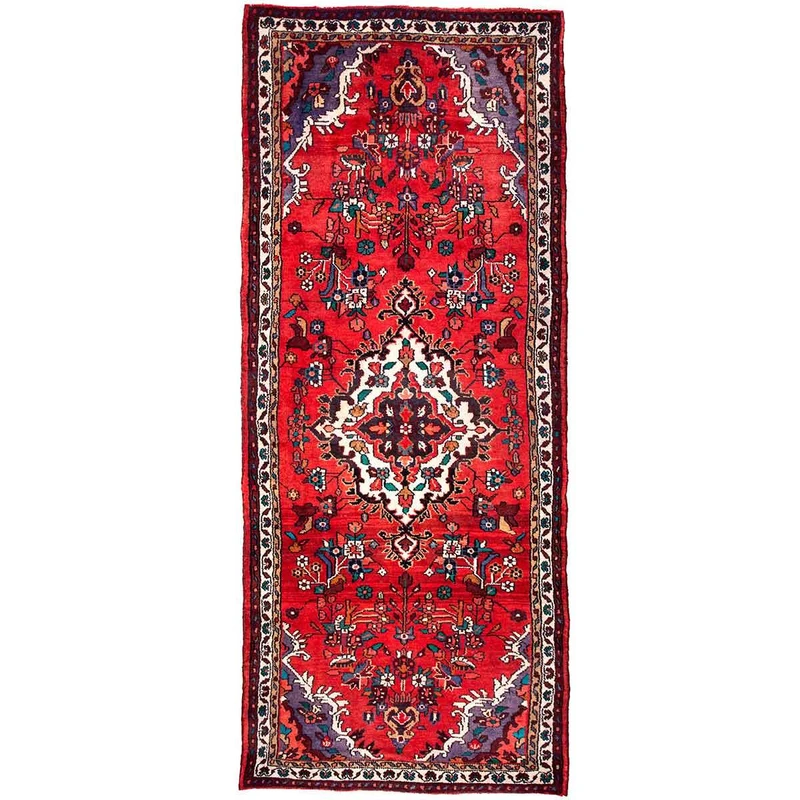
A Mehraban runner of about 9.75 by 3.5 feet with medallions in madder red, ivory, and navy blue - Mehraban Persian Rug 9x3 ft - Medallion Semi Antique Wool Hand Knotted
10
Placing a Mehraban
A Mehraban brings warmth and energy to a room. On a pale wood or stone floor, its reds and navies glow. In a modern interior, its bold medallion adds pattern and history to clean lines. In a traditional or rustic home, it pairs naturally with dark wood, leather, and woven textiles. Pick up the navy for cushions or curtains, and let the ivory tie in with pale walls or upholstery.
11
The Hamadan Single-Weft Tradition
The single weft is the key to understanding Hamadan village rugs, including Mehrabans. After each row of knots, the weaver passes one thick cotton weft across the loom and beats it down. Because only one weft is used, the warps lie side by side on the same level, and the knots on the back form a slightly offset, zigzag pattern. The rug is flexible and comfortable, with a pile that springs back well. Double-wefted rugs, such as Heriz, Bijar, or Sarouk, have two wefts after each row, which pushes alternate warps to a lower level and makes a stiffer, denser rug. Neither is better in every way: single-wefted rugs are lighter and softer, double-wefted rugs heavier and firmer.
12
Reading the Corners
After the medallion, look at the corners. In a Mehraban, the corner pieces usually repeat part of the medallion's shape or color, so that the field feels framed from all four sides. In some pieces, the corners are filled with the same Herati pattern as the field, but in a different ground color, which creates a subtle second frame inside the border. Comparing the four corners is also a quick way to judge a rug: in a well-woven piece, they are balanced, even if not perfectly identical.
13
The Hill Country of Sarab and Heriz
The other Mehraban, in East Azerbaijan, lies in high, open country between the town of Sarab and the villages of the Heriz district, on the slopes around Mount Sabalan. This is a region of cold winters and strong wool, where weavers have long made heavy, durable rugs with large angular medallions. Rugs from this Mehraban are often sold under Heriz or Sarab names. If you are drawn to bolder, heavier rugs of this kind, see our Heriz collection and our article on weaving in Sarab.
14
Matching a Mehraban to Your Room
The warm madder red of a Mehraban suits rooms with pale or neutral walls, where it becomes the main source of color. Pick up the navy for cushions, curtains, or a painted wall to tie the room together, and let the ivory link with upholstery or linen. In a darker room, a Mehraban adds warmth without feeling heavy, because its reds are clear rather than brown. In a modern interior, a room-size Mehraban softens hard lines and brings a sense of history.
15
Motifs in the Field
Around the medallion of a Mehraban, you may find many small motifs besides the Herati: rosettes, small palmettes, stars, leaves, and stylized flowers, sometimes with a tiny animal or bird added by the weaver. In the more geometric pieces, these motifs float freely; in the more floral pieces, they are linked by thin vines. Look closely at them when you compare rugs: they show how the weaver handled detail, and they give the field much of its texture when seen from a few steps away. Read more in our article on design motifs.
16
A Practical Rug for Everyday Rooms
Hamadan village rugs were made for daily use in village homes, and that practical spirit makes a Mehraban a good choice for the busiest rooms of a modern house. Its thick wool cushions footsteps, its warm colors and busy Herati field hide small marks, and its flexible single-weft structure lies flat without fuss. For a family room, a dining room, or a hallway that sees heavy traffic, a Mehraban offers the beauty of a hand-knotted Persian rug without the worry that comes with a very fine piece.
17
Mehraban and Its Neighbors
Mehraban and Hamadan
Mehraban rugs are part of the Hamadan family. See our Hamadan collection.
Mehraban and Heriz
Heriz rugs, from East Azerbaijan, are denser and heavier, with large angular medallions. See our Heriz collection.
Mehraban and Bibikabad
Bibikabad rugs, another Hamadan village name, share the Herati and medallion layouts. See our Bibikabad collection.
Mehraban and Borchelu
Borchelu rugs, also from the Hamadan region, are more floral. See our Borchelu collection.
Mehraban and Malayer
Malayer rugs, from the south-east of the region, are often denser and double-wefted. See our Malayer collection.
18
Reading the Back
Turn a Mehraban over. You should see the symmetric knots as two equal bumps, and a single weft between each row of knots, which gives the back a slightly offset, zigzag look. Compare it with a Heriz, whose double weft gives a stiffer back with knots in straight rows. Check the sides and fringes.
19
Grades and How to Judge Them
•
Wool - Thick, springy, lustrous wool.
•
Drawing - A clear, balanced medallion and an even Herati field.
•
Color - Clear colors without bleeding.
•
Straightness - Straight sides and square corners.
•
Condition - Even pile, intact sides and ends.
20
Questions to Ask Before You Buy
•
Single or double weft? - A clue to which Mehraban it is.
•
What are the measurements at both ends? - Checks that the rug is square.
•
Is the pile even? - Check for worn areas.
•
Has it been repaired? - Especially along the sides and at the ends.
•
Has it been washed recently? - A fresh wash shows the true colors.
21
Semi-Antique Mehraban Rugs
Our Mehraban rugs are semi-antique, woven roughly forty to sixty years ago. They have settled colors, good wool, and many years of life ahead. See our semi-antique rugs.
22
What Affects the Price
•
Size - Larger rugs cost more.
•
Wool - Lustrous wool adds value.
•
Drawing - Well-drawn medallions and fields add value.
•
Color - Clear, harmonious colors add value.
•
Condition - Intact sides and ends.
23
Village Life and the Loom
In the villages of the Hamadan region, weaving was traditionally the work of women, done at home on upright looms alongside farming and raising sheep. Girls learned at their mothers' side. Many designs were kept in memory, which is why each Mehraban has small personal variations: a medallion slightly off center, a border that changes rhythm, a color changed midway. These details are part of the charm of a village rug. Read more about the people behind rugs in our article on the craft from shepherd to dealer.
24
The Wool of the Hamadan Villages
The wool of Hamadan village rugs comes from sheep raised on the plains and hills of western Persia. It is strong and springy, with a good natural luster, and it takes dye well. In semi-antique rugs, the wool has developed a gentle sheen. Read more in our article on Persian rug wool.
25
Abrash and Color Changes
Many Mehraban rugs show abrash, horizontal bands where one color shifts slightly in shade. This happens when the weaver runs out of one batch of dyed wool and starts another. It is a natural sign of hand-dyed wool, not a defect, and it gives the field a gentle movement.
26
The Borders
The borders of a Mehraban frame the field like a picture frame. A typical rug has a main border with a chain of geometric flowers or rosettes, or a simplified turtle border, flanked by narrow guard stripes. In a well-woven rug, the border turns each corner cleanly. Small irregularities are common in village rugs and are part of their charm.
27
Combining a Mehraban with Other Rugs
A Mehraban pairs naturally with other Hamadan village rugs and with Heriz, Bijar, and Kurdish rugs, which share its bold geometry and warm reds. With a finer city rug, it adds a rustic contrast. Our room-size Mehraban and runner share a palette, so they can work together in neighboring spaces, such as a living room and the hallway beside it.
28
Large Rugs and Furniture
Heavy furniture can leave dents in the pile. Move pieces slightly every few months, and brush the pile back up with your fingers. Felt pads under furniture legs spread the weight. Rotate a room-size rug every six months or so, so that wear and sunlight are spread evenly.
29
Keeping a Runner Flat and Safe
A runner in a busy hallway needs a good pad. A felt-and-rubber pad keeps it from slipping and helps it lie flat. Turn the runner end to end every few months so that wear is spread evenly. Vacuum across the fringes gently, or not at all, and have worn ends secured by a professional. See our guide to maintaining rug fringes.
30
Caring for a Mehraban Rug
Vacuum regularly without a beater bar. Rotate or turn the rug every few months. Use a non-slip pad. Blot spills at once with a clean, white cloth and cold water. Have it professionally washed every few years, or every year or two in busy areas. Keep it out of strong direct sunlight. See our care instructions and our article on professional washing.
31
Photographs and Real Color
Reds and navies can look different on screen depending on the light. Daylight from a north window shows the truest colors, while warm lamps make reds look deeper. If color matters for your room, ask us for extra photographs in daylight or close-ups of the pile.
32
Living with a Mehraban
A good Mehraban becomes part of the house. Its colors settle further, its pile develops a soft sheen, and its medallion becomes a familiar center to the room. Many families keep such a rug for decades, moving it from one room or home to another as their lives change.
33
Common Buying Mistakes
•
Assuming one origin - Mehraban can mean the Hamadan villages or the town near Sarab.
•
Choosing the wrong size - Measure carefully.
•
Skipping the pad - Rugs slip without one.
•
Ignoring the ends - Fringes need regular checks.
34
Frequently Asked Questions
What does Mehraban mean?
"Kind" in Persian.
Which places are called Mehraban?
Villages of the Hamadan region whose rugs are sold under this name, and a town near Sarab and Heriz in East Azerbaijan.
Which kind are your Mehraban rugs?
Hamadan village rugs with the symmetric knot and a single weft.
How can I tell the two apart?
Look at the wefts: Hamadan Mehrabans are single-wefted, Azerbaijan pieces usually double-wefted.
What designs are typical?
Medallions, often on a Herati field.
What colors are typical?
Madder red, navy, and ivory.
What sizes do you have?
A room-size rug of about 11.75 by 9 feet and a runner of about 9.75 by 3.5 feet.
Are Mehraban rugs durable?
Yes. Their thick wool and sturdy construction make them very durable.
Is abrash a defect?
No. It is a natural sign of hand-dyed wool.
Can the rug and runner be used together?
Yes. They share a palette and work well in neighboring spaces.
Is a Mehraban suitable for a home with children or pets?
Yes. Its thick wool, warm colors, and sturdy build stand up well to daily life.
How should I care for a Mehraban rug?
Vacuum regularly, rotate it, use a pad, and have it professionally washed regularly.
Is a single-wefted rug less durable?
No. Single-wefted Hamadan rugs are very durable; they are simply more flexible than double-wefted rugs.
Can a Mehraban go in a dining room?
Yes. At about 11.75 by 9 feet, it suits a table for six to eight, and its Herati field hides small marks well.
Will the colors fade further?
In a semi-antique rug the colors have largely settled. Keep it out of strong direct sunlight to protect them.
35
Choose Your Mehraban Rug
Each Mehraban rug in our collection is hand-knotted, one of a kind, and inspected before it is listed. Browse our Mehraban collection, compare with our Hamadan, Heriz, and Bibikabad rugs, or ask our experts for help.