


For thousands of years, much of Persia's countryside belonged to herders. Tribal families moved with their flocks of sheep and goats between winter pastures in the warm lowlands and summer pastures in the cool mountains, carrying their homes, black goat-hair tents, and belongings on horses, donkeys, and camels. Along the way, the women wove: rugs for the floor of the tent, bags to carry belongings, covers for bedding, and decorations for animals. These tribal and nomadic rugs are among the most vivid and personal of all Persian weavings.
This guide explains who the tribal weavers are, how their rugs are made, how to recognize tribal design, how to read its motifs, and how to choose, place, and care for a tribal rug like those in our collection. For the wider story of the tribes, see our articles on the Qashqai tribes and Qashqai, Bakhtiari, and Shahsavan migrations.
1
The Tribes of Persia
•
Qashqai - A Turkic confederation of Fars, famous for lively rugs and gabbehs.
•
Khamseh - A confederation of Arab, Turkic, and Persian tribes in Fars.
•
Bakhtiari - Lor-speaking tribes of the central Zagros, known for garden rugs.
•
Lors - Tribes of the western Zagros, weaving bold, dark rugs.
•
Baluch - Tribes of the east, known for dark, finely drawn rugs and prayer rugs.
•
Shahsavan - Tribes of the north-west, famous for sumak bags and flatweaves.
•
Afshar - A Turkic people, especially around Kerman, with colorful rugs.
•
Turkmen - The tribes of the north-east, weavers of gul rugs.
Many of these groups have settled in villages over the past century, but their weaving traditions continue. See our Qashqai, Bakhtiari, Lori, Baluch, Shahsavan, and Afshar collections.
Tribal and nomadic rugs are woven by Persia's herding peoples, often on portable looms. Their designs are bold, geometric, and drawn from memory, in strong, glowing colors.
2
How to Recognize a Tribal Rug
•
Geometric drawing - Straight lines, steps, hooks, and angles.
•
Medallions and stars - Stepped diamonds, often in chains, and eight-pointed stars.
•
Small animals and figures - Goats, dogs, birds, horses, and people scattered in the field.
•
Strong colors - Madder reds, indigo blues, ivory, with orange, green, and gold.
•
Wool foundation - Often wool warps and wefts rather than cotton.
•
Irregular shape - Sides that may wave slightly, from portable looms.
•
Personal touches - Changes in color and motif that reveal the weaver's hand.
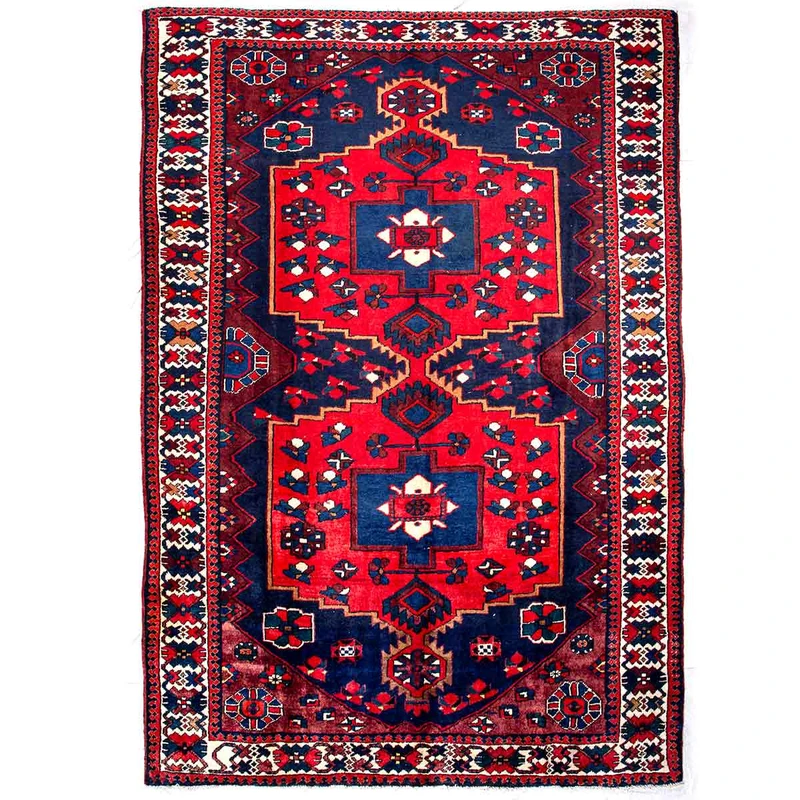
A Bakhtiari rug of about 10.5 by 6.75 feet with a medallion design in navy blue, madder red, and crimson - Bakhtiari Persian Rug 10x6 ft - Medallion Semi Antique Wool Hand Knotted
3
The Horizontal Loom
Nomadic weavers traditionally used a horizontal ground loom: two wooden beams held apart by stakes driven into the ground, with the warps stretched between them. When the family moved, the stakes were pulled up, the unfinished rug was rolled onto the beams, and the whole loom was packed onto an animal. At the next camp, it was set up again and weaving continued. This portable loom explains some features of tribal rugs: slight differences in tension can make the sides wave or the width change a little, and rugs are usually small to medium in size, because a large loom is hard to move. Read more in our article on Qashqai weaving.
4
Designs from Memory
Tribal weavers rarely used paper drawings. A woman learned her family's and tribe's designs as a girl, by watching her mother and grandmother, and wove them from memory, counting knots as she went. This is why tribal rugs are full of small variations: a medallion that grows a little wider, a motif that changes halfway along the field, a color that appears only once. These are not mistakes but the signature of a living, personal tradition, and they are much of the reason collectors love tribal rugs.
5
Reading Tribal Motifs
•
Stepped diamond medallion - The most common tribal medallion, often in a chain of two or three.
•
Hooks and latches - Small hooks along edges, adding movement.
•
Eight-pointed star - A star found across Persian tribal weaving.
•
Animals - Goats, deer, dogs, horses, birds, and lions, often small and scattered.
•
Human figures - Small stick figures, sometimes riders.
•
Trees and plants - Stylized cypresses, flowering shrubs, and combs.
•
Botehs and rosettes - Small floral fillers.
Some writers attach symbolic meanings to these motifs; others see them as decoration drawn from the weaver's world. Both views help us look more closely. Read more in how to read a Persian rug and our Geometric designs guide.
6
Fars Tribal Rugs and the Shiraz Market
Many tribal rugs of Fars province, woven by Qashqai, Khamseh, and other groups, were sold in the bazaar of Shiraz and are known in the trade simply as Shiraz rugs. They often have stepped medallions in chains, scattered animals and flowers, and warm madder reds, navies, and ivories. Our Shiraz rugs show this lively Fars style at medium size. See our Shiraz collection and our article on weaving in Fars.

A Shiraz rug of about 8.75 by 6 feet with a tribal medallion design in madder red, burgundy, and cream - Shiraz Persian Rug 8x5 ft - Geometric Semi Antique Wool Hand Knotted
7
Lori and Zagros Tribal Rugs
The Lors of the western Zagros weave bold, often darker rugs, with large geometric medallions, stars, and lattices in dark reds, browns, and ivory. Their rugs have a strong, earthy character and sturdy wool. Our Lori rug shows this weighty, graphic style. See our Lori collection and our article on the folk music of Lorestan.
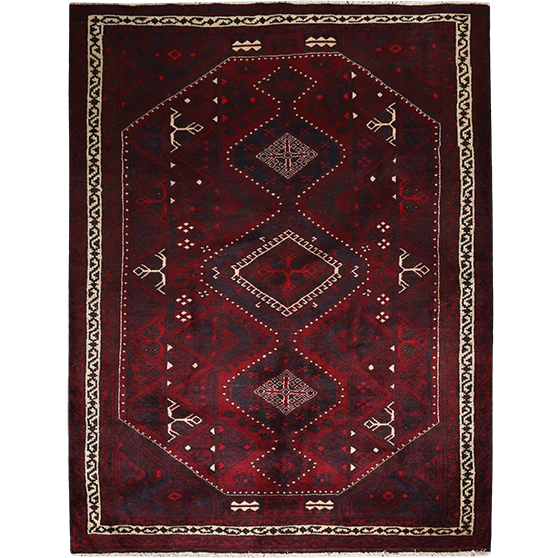
A Lori rug of about 9.75 by 7.5 feet with a geometric tribal design in dark red, burgundy, and ivory - Lori Persian Rug 9x7 ft - Geometric Semi Antique Wool Hand Knotted
8
Tribal Rugs Today
Over the twentieth century, most tribal families settled, and many now live in villages and towns while keeping some of their flocks. Tribal weaving continues, sometimes on upright village looms, sometimes for the market, often with traditional designs and natural colors. Our collection includes both older tribal rugs and later pieces, mostly semi-antique, woven roughly forty to sixty years ago, when many weavers still used local wool and traditional dyes. See our semi-antique rugs.
9
Tribal and Related Designs
Tribal and Geometric
Tribal rugs belong to the geometric family of designs. See our Geometric designs.
Tribal and Turkmen Gul
Turkmen rugs are a great tribal tradition with their own gul designs. See our Turkmen Gul designs.
Tribal and Moharramat
Stripes are common in tribal weaving. See our Moharramat designs.
Tribal and Mihrab
Tribal weavers wove many small prayer rugs. See our Mihrab designs.
10
Colors of Tribal Rugs
Tribal rugs are known for strong, glowing colors from natural dyes: madder red from the root of the madder plant, indigo blue, ivory from undyed wool, and touches of orange, green, gold, and brown. Because wool was dyed in small batches, many tribal rugs show abrash, bands of slightly different shades, which give the field depth and life. Read more in our articles on natural dyes and traditional dyeing.
11
Sizes in Our Collection
Our Tribal and Nomadic group includes hundreds of rugs: small mats and bag faces, scatter rugs, long rugs, medium rugs of about 8 by 5 to 10 by 7 feet, and some larger pieces. Browse by size: 4x6, 5x8, 6x9, and 8x11.
12
Choosing a Tribal Rug by Room
•
Living rooms - A bold tribal rug brings warmth and character.
•
Family rooms - Sturdy wool suits everyday use.
•
Modern rooms - Geometric drawing suits contemporary spaces.
•
Bedrooms - A tribal rug adds color and personality.
•
Walls - Small tribal pieces work as textile art.
13
Matching a Tribal Rug to Your Room
Tribal rugs are bold and colorful, so they pair well with plain walls and simple furniture. Natural materials such as wood, leather, linen, and wool suit their hand-made character. Pick one or two colors from the rug, such as its madder red or indigo, and repeat them in textiles. A tribal rug can be the main source of color and pattern in a modern room.
14
The Year of Migration
The rhythm of tribal life followed the seasons. In spring, families left their winter grounds in the warm lowlands and set out on the long migration, called kuch, toward summer pastures in the mountains, crossing rivers and passes with their flocks. In autumn they returned. Migration routes could stretch for hundreds of miles and take weeks. Weaving fitted around this life: looms were set up at camps where the family stayed for a while, and rolled up again when it was time to move. The wool came from the family's own flocks, and dye plants were gathered along the way or bought in the towns. Read more in our article on Qashqai, Bakhtiari, and Shahsavan migrations and in the folk songs of the nomads.
15
More Than Floor Rugs
Tribal weavers made far more than floor rugs. They wove bags of every size to store grain, bedding, and belongings; saddle bags and animal covers; long bands to tie tents; flatweaves such as gelims and sumaks for floors and covers; and small mats and cushions. Many of the small tribal pieces on today's market began as the faces of such bags. Each object had a purpose in the life of the tent, and each was decorated with care. See our Shahsavan collection for their famous sumak and mafrash bags.
16
Tribal Wool
The wool of tribal rugs comes from sheep that graze on mountain pastures, and it is often among the best in Persia: long, springy, and rich in natural lanolin, which gives the pile a soft sheen and helps it resist dirt and moisture. Tribal women traditionally washed, carded, and hand-spun the wool themselves. Hand-spun wool varies slightly in thickness, which gives the surface of a tribal rug its lively, slightly uneven texture and makes the colors glow. Read more in our article on wool.
17
Wool Foundations
Many nomadic rugs are woven on wool warps and wefts, because wool was what the family had, while village and city rugs usually use cotton. Turn a tribal rug over: wool warps often show as darker, slightly hairy threads at the fringes, and the rug may feel softer and more flexible in the hand. A wool foundation is one clue that a rug was woven by nomads or recently settled tribal families.
18
Living with a Tribal Rug
A tribal rug has a strong personality. Its bold colors and lively motifs bring warmth to any room, and its small irregularities give it a sense of the human hand. Many owners find that a tribal rug feels more personal than a perfectly regular workshop rug, as if it carried the voice of the woman who wove it. Over time, they discover its small details: a tiny animal in a corner, a change of color, a motif that appears only once.
19
Combining Tribal Rugs
Tribal rugs combine beautifully with each other. A Qashqai rug in the living room, a Shiraz runner in the hallway, and a small Baluch mat at the door can feel like a collection rather than a mix, especially when they share madder reds and indigo blues. Tribal rugs also pair well with a single fine city rug in another room, where the contrast between bold and delicate drawing makes both look better.
20
Photographs and Real Color
Madder reds and indigos can look different on screen depending on the light. Daylight from a north window shows the truest colors. If color matters for your space, ask us for extra photographs in daylight, close-ups of the motifs, or pictures of the back.
21
Gabbeh and Long-Pile Rugs
Among the best known tribal weavings of Fars is the gabbeh, a thick, long-piled rug with a simple, often abstract design and large areas of plain color. Gabbehs were woven by Qashqai and Luri families for their own use, as warm, soft floor coverings and bedding. Their bold simplicity has made them popular in modern interiors. Our collection focuses on knotted tribal rugs with more traditional designs, but the gabbeh shows how varied tribal weaving can be.
22
Women and the Loom
In tribal society, weaving was women's work, and a woman's skill at the loom was respected. Girls learned young, and a bride's dowry often included rugs, bags, and covers she had woven herself. Weaving was also social: women sat together at the loom, talking and singing, and designs and color recipes passed from one generation to the next. Read more about the people behind the rugs in our article on the craft from shepherd to dealer.
23
Animals in Tribal Rugs
Animals are everywhere in tribal rugs, because animals were everywhere in tribal life. Goats and sheep, the family's wealth; dogs that guarded the flocks; horses and camels that carried the tents; birds overhead; and sometimes lions or deer from stories and the wild. Weavers scattered these small figures through the field, often wherever there was space, giving tribal rugs their lively, storytelling charm. Look closely and you may find animals you missed at first.
24
Tribal Rugs in Modern Interiors
Designers often choose tribal rugs for modern homes. Their bold geometry echoes contemporary architecture and art, their strong colors bring warmth to white walls and concrete floors, and their hand-made irregularities soften clean, minimal spaces. A tribal rug can be the main source of color in a modern room, or a vivid accent in a hallway or bedroom. Read more in our article on choosing a rug for your home.
25
Keeping a Tribal Rug Flat
Because tribal rugs were often woven on portable looms, some do not lie perfectly flat, or their sides may wave slightly. A good felt-and-rubber pad helps a tribal rug settle and stay in place. Over time, on the floor, most tribal rugs relax and lie flatter. If a corner curls, lay the rug flat with a light weight on the corner for a few days.
26
Small Tribal Pieces
Some of the most appealing tribal weavings are small: bag faces, mats, and cushion covers, often with a single medallion or a few stars and animals in a compact space. These pieces show tribal drawing at its most concentrated, and they work beautifully on a wall, a bench, a chest, or a chair. They are also an affordable way to begin a collection of tribal weaving.
27
How to Judge a Tribal Rug
•
Drawing - Confident, lively motifs.
•
Wool - Lustrous, springy wool.
•
Color - Clear, glowing natural colors.
•
Character - Personal touches that give the rug life.
•
Condition - Even pile, intact sides and ends.
28
Questions to Ask Before You Buy
•
Which tribe or region? - Each tradition has its own character.
•
Wool or cotton foundation? - A clue to nomadic or village weaving.
•
What are the measurements at both ends? - Tribal rugs may vary slightly.
•
Is the pile even? - Check for worn areas.
•
Has it been repaired? - Especially along the sides and at the ends.
Read our notes on what to know before you buy and our guide on how to buy a Persian rug.
29
Caring for a Tribal Rug
Vacuum regularly without a beater bar. Rotate the rug every few months so that wear and light are spread evenly. Use a non-slip pad, which also helps a tribal rug lie flat. Blot spills at once with a clean, white cloth and cold water. Have it professionally washed every year or two in busy areas. See our care instructions and our article on professional washing.
30
Frequently Asked Questions
What is a tribal rug?
A rug woven by Persia's herding peoples, often on portable looms, with bold geometric designs drawn from memory.
Which tribes weave rugs?
Among others, the Qashqai, Khamseh, Bakhtiari, Lors, Baluch, Shahsavan, Afshar, and Turkmen.
Why are tribal rugs not perfectly straight?
Portable looms and weaving from memory create small irregularities, a natural part of tribal weaving.
Are tribal rugs durable?
Yes. Their lustrous wool and sturdy build suit everyday use.
What sizes do you have?
From small mats to medium and some larger rugs.
What is the kuch?
The seasonal migration of tribal families between winter and summer pastures.
How should I care for a tribal rug?
Vacuum regularly without a beater bar, rotate it, use a pad, and have it professionally washed regularly.
Can I see more photographs?
Yes. Ask us for daylight photographs, close-ups of the motifs, or pictures of the back of any rug.
What is a wool foundation?
Wool warps and wefts, common in nomadic rugs, as opposed to the cotton used in most village and city rugs.
Do tribal rugs suit modern rooms?
Yes. Their bold geometry and strong colors suit contemporary spaces well.
Are tribal rugs hand-knotted?
Yes. Every rug in our collection is hand-knotted.
Why are there animals in tribal rugs?
Animals were central to tribal life, and weavers scattered goats, dogs, horses, and birds through the field.
Is abrash a defect in a tribal rug?
No. It is a natural sign of hand-dyed wool and gives the field depth.
Did tribal weavers use paper drawings?
Rarely. Most wove from memory, which gives each rug its own character.
31
Choose Your Tribal Rug
Each rug in our collection is hand-knotted, one of a kind, and inspected before it is listed. Browse our Tribal and Nomadic rugs, compare with our Geometric designs and Qashqai collection, or ask our experts for help.