


Kashan Rugs: History, Mohtasham and Kurk Kashans
Los Angeles Home of Rugs on Nov 17th 2026
Few names carry as much prestige in the world of Persian rugs as Kashan. For collectors, the word evokes deep crimson fields, finely drawn medallions, lustrous wool, and silk rugs of jewel-like brilliance. For historians, Kashan is one of the great craft cities of Persia, home to master potters, silk weavers, and carpet makers for more than a thousand years. Its weavers have helped shape the image of the Persian rug around the world, and in 2010 UNESCO recognized the traditional skills of carpet weaving in Kashan as part of the Intangible Cultural Heritage of Humanity.
This article explores Kashan as a weaving city: its long history of crafts, its role in the Safavid golden age, the celebrated Mohtasham, Manchester, and Kurk Kashans of the late nineteenth and early twentieth centuries, its silk rugs, the characteristics that help you recognize a Kashan rug, and how to choose and care for one. For a step-by-step look at how a Kashan rug is made, see our companion article on the artistry of Kashan rugs.
1
A Desert City of Craftsmen
Kashan lies in central Persia, on the edge of the great salt desert Dasht-e Kavir, between Tehran and Isfahan. Its history is extraordinarily long: the nearby archaeological site of Tepe Sialk shows that people have lived in the area for some seven thousand years, making it one of the oldest settlements on the Persian plateau.
Kashan has always been a city of craftsmen. In the medieval period it was famous for ceramics, especially lusterware and glazed tiles; the Persian word for tile, kashi, is often traced to the city's name. Kashan potters decorated mosques and palaces across the Persian world. The city is also known for its rose water, distilled each spring from the damask roses of nearby Qamsar and Niasar, and for its beautiful traditional houses with courtyards, gardens, and windcatchers. The Fin Garden, with its spring-fed channels and ancient cypresses, is one of the finest examples of the Persian garden and is inscribed on UNESCO's World Heritage List as part of the Persian Garden.
Kashan's love of beauty runs through all its crafts. The same eye for color, pattern, and precision that produced its tiles, textiles, and gardens shaped its carpets.
2
Silk and Carpets in the Safavid Age
Under the Safavid dynasty in the sixteenth and seventeenth centuries, Kashan became one of the most important centers of luxury textiles in Persia. Its workshops produced silk velvets, brocades woven with gold and silver thread, and fine carpets for the court and for export. Many scholars associate some of the most luxurious Safavid carpets - including silk carpets and small silk animal rugs - with Kashan workshops.
Kashan's importance in this period is reflected in the most famous Persian carpet of all. The great Ardabil Carpet, completed in 1539 to 1540, carries the name of Maqsud Kashani - "Maqsud of Kashan" - in its woven inscription. Whether he was the designer or the master in charge, his name links Kashan forever with the golden age of Persian weaving. See our articles on the Safavid golden age and the conservation of the Ardabil carpet.
3
Decline and Revival
After the fall of the Safavids in 1722, Kashan, like the rest of Persia, suffered decades of instability, and its luxury weaving declined. For much of the eighteenth and early nineteenth centuries, carpet production in the city was limited.
In the late nineteenth century, Kashan's weavers returned to carpet making on a larger scale. According to the traditional account, the revival was linked to the decline of the city's silk textile industry, which suffered from foreign competition and disease in the silkworms. Skilled textile workers turned to carpets, bringing with them a deep knowledge of fine weaving, dyeing, and design. Within a few decades, Kashan rugs had regained their place among the finest in Persia.
4
The Great Kashan Rugs of the Revival
Mohtasham Kashans
The most celebrated Kashan rugs of the revival are those associated with Mohtasham, a name traditionally linked with a master weaver or workshop active in Kashan around the late nineteenth and early twentieth centuries. Mohtasham Kashans are prized for their exceptionally fine weave, soft and lustrous wool, harmonious natural colors, and beautifully drawn designs, often with medallions on deep red or blue grounds or all-over floral compositions. Genuine Mohtasham pieces are rare and highly valued by collectors, though the name is sometimes used loosely in the trade for fine Kashans of the period.
Manchester Kashans
In the early twentieth century, some Kashan workshops used fine merino wool imported from England, often spun in Manchester, for their rugs. These so-called Manchester Kashans are known for their remarkably soft, silky wool and rich, deep colors. Though imported wool was used, the weaving, dyeing, and design remained entirely Persian.
Kurk Kashans
Kurk Kashans were woven with kurk wool, the finest grade of wool from the first shearing of young lambs or from the softest parts of the fleece. Kurk Kashans have a silky, lustrous surface and glowing colors, and the finest examples are among the most admired Persian rugs of their era. Our article on Persian rug wool explains what makes kurk wool special.
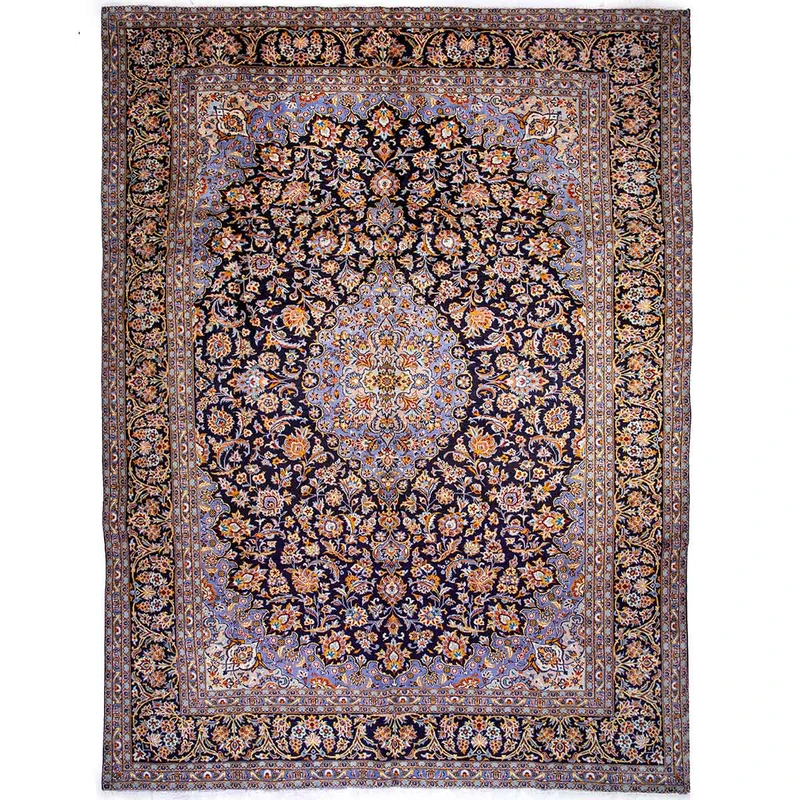
A Kashan medallion rug in wool with silk highlights - Kashan Persian Rug 13x9 ft - Medallion Semi Antique Wool Silk Hand Knotted
5
The Weavers of Kashan
Carpet weaving in Kashan has long been a household craft as well as a workshop industry. In many families, women weave at home on vertical looms set up in a room of the house, working on a single rug over many months, often with the help of daughters or other relatives. The UNESCO recognition of Kashan's carpet weaving specifically honored these traditional skills: the knowledge of design, dyeing, and the fine asymmetrical knot passed down through families, and the patience required to produce rugs of great fineness.
Alongside home weaving, Kashan has workshops where master designers, dyers, and weavers work together, as well as merchants who supply materials and buy finished rugs. This combination of home weaving and organized workshops has allowed Kashan to produce both everyday rugs and exceptional masterpieces. Our article on Isfahan's women weavers describes a similar tradition in a neighboring city.
6
Kashan Silk Rugs
Kashan has a long tradition of silk weaving, and silk rugs are among its most famous products. Kashan silk rugs, usually small, are extremely finely knotted, with brilliant colors and a natural sheen that changes as you move around the rug. Prayer rug designs, vase designs, and small medallion compositions are common, and some Kashan silk rugs closely follow Safavid models.
A special Kashan technique, sometimes called souf, combines a flatwoven silk or metal-thread ground with areas of raised silk pile, so that the design stands out in relief. These rare pieces show the inventiveness of Kashan's weavers. See our article on Persian silk rugs.
7
Pictorial and Prayer Kashans
Beyond its classic medallion rugs, Kashan has produced many special designs. Prayer rugs with a mihrab (arch) at one end, often filled with flowering trees, vases, or hanging lamps, were woven in both wool and silk. Pictorial rugs depicting kings, poets, hunting scenes, and stories from Persian literature such as the Shahnameh became popular in the late nineteenth and early twentieth centuries, and Kashan weavers excelled at rendering faces and figures in fine detail. Vase and garden designs, echoing Safavid models, also appear in fine Kashans. See our articles on pictorial rugs and Persian garden rugs, and our mihrab designs.
8
Characteristics of Kashan Rugs
Structure
Kashan rugs are woven with the asymmetrical (Persian) knot on cotton foundations, usually with two wefts after each row of knots. In many older Kashans, the wefts are dyed blue, which shows on the back. The warps are often depressed, which gives the rug a firm, dense structure, and the pile is usually clipped short so that every detail of the design is crisp. Our article on how a Persian rug is made explains these terms.
Designs
The classic Kashan design is a medallion and corner composition: a central medallion, often lobed or star-shaped with pendants, on a field filled with scrolling vines, palmettes, and flowers, framed by matching corner pieces and a wide main border. Kashan weavers also produce all-over designs, vase designs, prayer rugs, and pictorial rugs with scenes from Persian literature. Their drawing is fluid and precise, a hallmark of city weaving from detailed cartoons. Browse our medallion designs and Shah Abbasi designs.
Colors
The traditional Kashan palette is rich and deep: crimson or madder red fields, deep navy or indigo borders, and ivory, with accents of green, gold, rose, and light blue. Some Kashans use navy or ivory fields instead. Older Kashans with natural dyes show beautifully mellowed colors, while mid-century pieces often have a slightly brighter red. Our series on Persian rug color, beginning with the master dyer, explains how these colors were made.
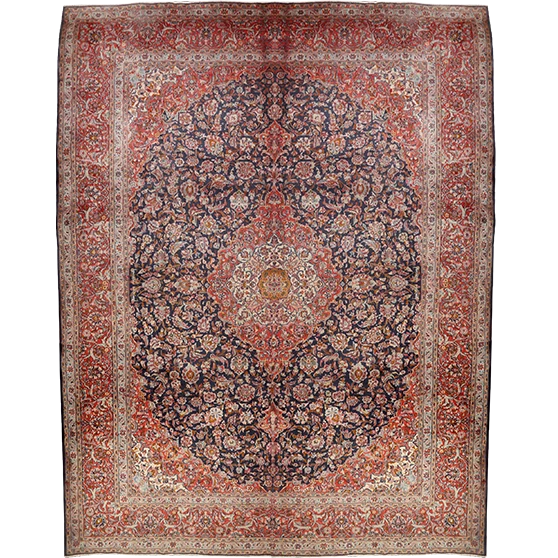
A Kashan medallion rug from our collection - Kashan Persian Rug 13x9 ft - Medallion Semi Antique Wool Silk Hand Knotted
9
Roses, Gardens, and the Kashan Palette
Every spring, the valleys around Kashan bloom with damask roses, and the villages of Qamsar and Niasar celebrate the rose harvest with the traditional distillation of rose water, known as golabgiri. Visitors come from across the country to watch the petals being gathered at dawn and distilled in copper pots, and the scent of roses fills the air.
It is tempting to see this world of roses and gardens reflected in Kashan's carpets: in the soft pinks and roses that appear in many Kashans, in the flowering vines that fill their fields, and in the garden and vase designs woven in the city. Whether or not weavers consciously drew on the landscape around them, Kashan's carpets share the same love of flowers, color, and order that defines its gardens and its famous rose harvest.
10
Wool, Silk, and Dyes in Kashan
Kashan weavers have always been particular about materials. For wool rugs they sought soft, lustrous wool, using imported merino in the Manchester period and kurk wool for their finest pieces, while silk was used for highlights in wool rugs and for the pile and foundation of pure silk rugs. Kashan's dyers were known for their deep, stable reds from madder and insect sources and their rich indigo blues. Older Kashans dyed with natural materials have mellowed into especially harmonious colors that collectors prize.
In the twentieth century, as in other centers, synthetic dyes came into use alongside natural ones, and many mid-century Kashans have slightly brighter, more uniform colors. Both can be beautiful; natural-dyed pieces simply have more depth and variation. Our article on natural dyes explains how to tell the difference.
11
Kashan's Neighbors
Several towns near Kashan have their own weaving traditions:
•
Josheghan - a town known for its distinctive diamond lattice design filled with stylized flowers, woven since at least the eighteenth century. See our article on weaving in Joshaqan.
•
Aran and Bidgol - towns just north of Kashan with many weavers, producing rugs in Kashan style.
•
Natanz - a town southeast of Kashan with its own weaving and a long history of crafts.
•
Abyaneh - a picturesque village of red mud-brick houses in the mountains near Natanz, known for its preserved traditions and textiles.
12
Kashan Compared With Its Neighbors
Kashan sits among several of Persia's great fine-weaving centers, and comparing them helps clarify its character:
•
Kashan - deep red and navy palettes, classic medallions, firm structure, and lustrous wool; classic and rich.
•
Isfahan - often lighter grounds (ivory, soft blue), very fine knotting with silk foundations in top pieces, and designs echoing Safavid architecture. See our Isfahan collection.
•
Nain - very fine wool-and-silk rugs on ivory and blue grounds with silk highlights. See our Nain collection.
•
Qom - extremely fine silk rugs in many designs, a center that rose in the twentieth century. See our article on weaving in Qom.
All four share the asymmetrical knot and curvilinear city designs, but their colors, materials, and structures differ in ways that experienced eyes can recognize quickly.
13
How to Recognize a Kashan Rug
•
Classic medallion and corner design - finely drawn, with flowing curves.
•
Deep crimson field and navy border - the traditional palette.
•
Asymmetrical knot and cotton foundation - often with blue wefts in older pieces.
•
Firm, dense structure - with depressed warps and a short, even pile.
•
Lustrous wool - especially soft in Manchester and Kurk Kashans.
Kashan designs have been widely copied by other weaving centers, so structure and drawing are important clues. Our article on how to read a Persian rug's secret language explains how specialists attribute rugs.
Finally, the back of a Kashan often tells its story most clearly: a crisp, even grid of knots, firm wefts, and, in many older pieces, a hint of blue between the rows.
14
Kashan Rugs in Your Home
Kashan rugs bring elegance and warmth to formal living rooms, dining rooms, libraries, and studies. Their classic medallion designs create a natural focal point under a coffee table or dining table, and their rich reds and navies pair beautifully with warm woods, leather, brass, and traditional furniture. Lighter Kashans with ivory or soft blue grounds also work well in transitional interiors. Smaller Kashan rugs and silk pieces are lovely in bedrooms, entryways, or as wall hangings. Our rug size guide will help you choose the right dimensions.
A Kashan rug also makes a classic heirloom. Its timeless design and strong construction mean it can move from home to home and generation to generation, always looking appropriate and refined.
15
Caring for Kashan Rugs
Kashan wool rugs are durable but should be treated with care: vacuum them regularly without a beater bar, rotate them to even out wear and sun exposure, and blot spills promptly. Silk Kashans should be placed in low-traffic areas and cleaned only by specialists experienced with silk. Older Kashans with natural dyes should be kept out of strong direct sunlight. See our guides to cleaning a Persian rug at home and professional rug cleaning.
16
Collecting Kashan Rugs
Kashan rugs are among the most collected Persian rugs. Antique Mohtasham, Manchester, and Kurk Kashans from the late nineteenth and early twentieth centuries are highly prized for their wool, dyes, and craftsmanship, and fine silk Kashans are sought by collectors worldwide. Semi-antique Kashans from the mid-twentieth century offer classic designs and solid quality at more accessible prices. When evaluating a Kashan, look at the softness and luster of the wool, the quality of the dyes, the fineness and precision of the drawing, and the condition of the pile and foundation. See our article on investing in hand-knotted rugs.
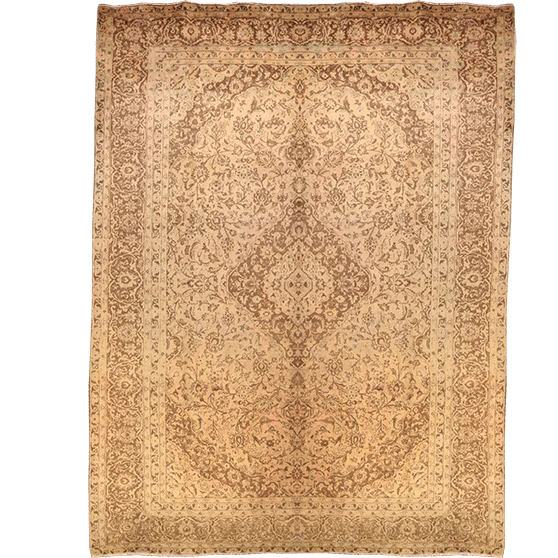
A Kashan medallion rug in wool and silk - Kashan Persian Rug 12x9 ft - Medallion Semi Antique Wool Silk Hand Knotted
17
A Timeline of Kashan Weaving
•
Around 7,000 years ago - early settlement at Tepe Sialk near Kashan.
•
12th to 14th centuries - Kashan becomes famous for ceramics and tiles.
•
16th to 17th centuries - Safavid Kashan produces silk textiles and fine carpets; the Ardabil Carpet bears the name of Maqsud Kashani.
•
18th century - decline after the fall of the Safavids.
•
Late 19th century - revival of carpet weaving; the era of Mohtasham Kashans.
•
Early 20th century - Manchester and Kurk Kashans.
•
2010 - UNESCO recognizes the traditional carpet weaving skills of Kashan.
18
Kashan Weaving Today
Kashan remains an active weaving center. Weavers in the city and in nearby towns such as Aran and Bidgol continue to produce wool and silk rugs in classic Kashan designs, while workshops also create new designs for modern markets. Local universities and institutes study and teach carpet design and technology, helping to train new generations of designers and weavers. The UNESCO recognition of 2010 has also encouraged efforts to document and preserve Kashan's traditional skills.
For buyers, this means Kashan rugs are available across a wide range of ages and prices, from rare antique Mohtasham pieces to semi-antique mid-century Kashans and fine new rugs, all carrying forward one of the most distinguished weaving traditions in Persia.
19
Frequently Asked Questions
What is a Mohtasham Kashan?
A fine Kashan rug associated with the Mohtasham name from the late nineteenth and early twentieth centuries, prized for its weave, wool, and colors.
What is a Manchester Kashan?
A Kashan rug woven with fine merino wool imported from England in the early twentieth century, known for its soft, silky wool.
Are Kashan rugs durable?
Yes. Their dense structure and good wool make wool Kashans durable. Silk Kashans are more delicate and best used in low-traffic areas.
Are Kashan silk rugs suitable for floors?
Fine silk Kashans are best in low-traffic areas or as wall hangings, where their delicate pile and sheen can be enjoyed without heavy wear.
Do older Kashans have blue wefts?
Many older Kashans have blue-dyed cotton wefts visible on the back, which is one of the structural clues specialists use.
Why is Kashan important in Persian rug history?
Kashan was a major center of Safavid luxury weaving, the Ardabil Carpet bears the name of a Kashan master, and its revival rugs are among the finest of their era.
20
The Spirit of Kashan
From the potters of Sialk to the tile makers of the Middle Ages, from the silk weavers of the Safavid court to the master workshops of the revival, Kashan has given the world a remarkable legacy of beauty. Its rugs continue that tradition, combining refined design, rich color, and outstanding craftsmanship.
At Los Angeles Home of Rugs, you can explore our Kashan collection, with every rug accompanied by a Certificate of Authenticity documenting its origin, materials, and age. If you have questions, please ask our experts.
Explore the Collection
Kashan Rugs
Josheghan Rugs
Medallion Designs
Silk Rugs
Crimson
Antique Rugs
Persian Rug FAQ