


Persian Rug Wool: Why It Matters and How to Judge Quality
Los Angeles Home of Rugs on Nov 17th 2026
Every great Persian rug begins with a fleece. Before the designer draws a single line, before the dyer prepares a single bath, and before the weaver ties a single knot, the quality of the rug has already been shaped by the wool. Wool determines how deeply a rug takes its colors, how it shines in the light, how soft it feels underfoot, and, above all, how long it will last. It is no exaggeration to say that the wool is the soul of a Persian rug.
This article explores the remarkable fiber at the heart of Persian weaving: what wool is and why it suits rugs so well, the sheep and regions that produce the best Persian wool, the difference between fine "kurk" wool and inferior "skin" wool, how wool is prepared and spun, the role of camel and goat hair, and how you can judge the quality of the wool in a rug yourself.
1
Why Wool Is Ideal for Rugs
Sheep and goats have been kept on the Persian plateau for thousands of years, and wool has always been the most common and most important rug fiber in the region. This is not only because it was available. Wool has a unique combination of properties that make it almost perfect for floor coverings.
The Structure of a Wool Fiber
Under a microscope, a wool fiber looks like a stack of overlapping scales, a little like the tiles on a roof. These scales help fibers cling to one another, which makes wool easy to spin into strong yarn. Inside, the fiber is made of keratin, the same family of proteins found in hair and nails, arranged in a structure that gives wool a natural crimp or wave. This crimp makes the fiber springy and elastic, so that wool pile bounces back after being pressed down by furniture or footsteps.
Lanolin - Nature's Protection
Wool is coated with lanolin, a natural wax produced by the sheep. Lanolin repels water and dirt, protects the fiber, and gives good wool its characteristic luster. When wool is washed for rug making, some lanolin is deliberately left in place, which is one reason a well-made Persian rug resists stains and develops a beautiful sheen with age.
The Practical Advantages
•
Durability - wool fibers can bend tens of thousands of times without breaking, so wool pile resists wear for decades.
•
Resilience - the natural crimp lets wool recover its shape after compression.
•
Stain resistance - lanolin and the fiber's structure help spills bead on the surface, giving you time to blot them.
•
Dye affinity - wool takes natural and synthetic dyes deeply and evenly, producing rich, lasting colors. Our series on color, beginning with the master dyer, explains why.
•
Fire resistance - wool is naturally slow to ignite and tends to self-extinguish.
•
Comfort - wool insulates against cold floors, absorbs sound, and helps regulate humidity in a room by absorbing and releasing moisture.
2
A Very Old Partnership
The relationship between people and sheep in this part of the world is extraordinarily old. Archaeologists believe that sheep and goats were among the first animals domesticated, roughly ten thousand years ago or more, in the uplands of the Zagros and Taurus mountains - a region that includes western Persia. Early sheep were kept mainly for meat, milk, and skins; over thousands of years, breeders selected animals with more and better wool, and wool became one of the foundations of textile making across the Near East.
Weaving with wool soon followed. The famous Pazyryk carpet, made around the fifth century BCE, is a fully developed knotted-pile wool carpet, which shows that the techniques of spinning, dyeing, and knotting wool had already reached a high level more than two and a half thousand years ago. For the nomadic peoples of the Persian plateau, flocks of sheep and goats provided food, shelter, clothing, and the materials for rugs, bags, and tents - a way of life that continues in some tribal communities today.
3
Persian Sheep and Their Wool
Persia is home to many breeds of sheep, a large number of them fat-tailed breeds adapted to the dry plateau and the mountains, which store energy in their tails for lean seasons. Different breeds, raised in different climates and pastures, produce wool of very different qualities. Generally, sheep raised in cold, high mountain pastures grow longer, stronger, more lustrous wool to protect themselves from the winter, while sheep in hot, dry lowlands tend to produce shorter, coarser wool.
The quality of a fleece depends on many factors:
•
Breed - some breeds are prized for fine, soft wool, others for strong, coarse wool.
•
Climate and altitude - cold mountain climates produce longer, more lustrous fibers.
•
Pasture and nutrition - well-fed sheep produce healthier, stronger wool.
•
Age of the animal - the wool of young lambs, especially from the first or second shearing, is softer and finer.
•
Part of the body - wool from the shoulders, sides, and back is generally longer and finer than wool from the legs and belly.
•
Season of shearing - spring wool, grown during the cold months, is usually longer and stronger than autumn wool.
4
Regional Wools of Persia
Rug experts often recognize a rug's origin partly by the feel and appearance of its wool. A few regional characteristics are especially well known:
•
Kurdish rugs - the cold Zagros pastures produce some of the strongest and most lustrous wool in Persia, a key reason for the legendary durability of Bijar and Kurdish village rugs.
•
Bakhtiari and Qashqai - tribal flocks grazing the mountain pastures of the Zagros give thick, springy, lustrous wool, ideal for durable tribal and village rugs. See our article on Qashqai weaving.
•
Kerman - Kerman has long been famous for soft, fine wool, well suited to the city's delicate floral designs.
•
Khorasan - many Khorasan rugs are known for very soft wool, comfortable underfoot though sometimes less hard-wearing than mountain wool.
•
Heriz - the mountain wool of the Heriz area helps explain why Heriz rugs are among the most durable room-size rugs available.
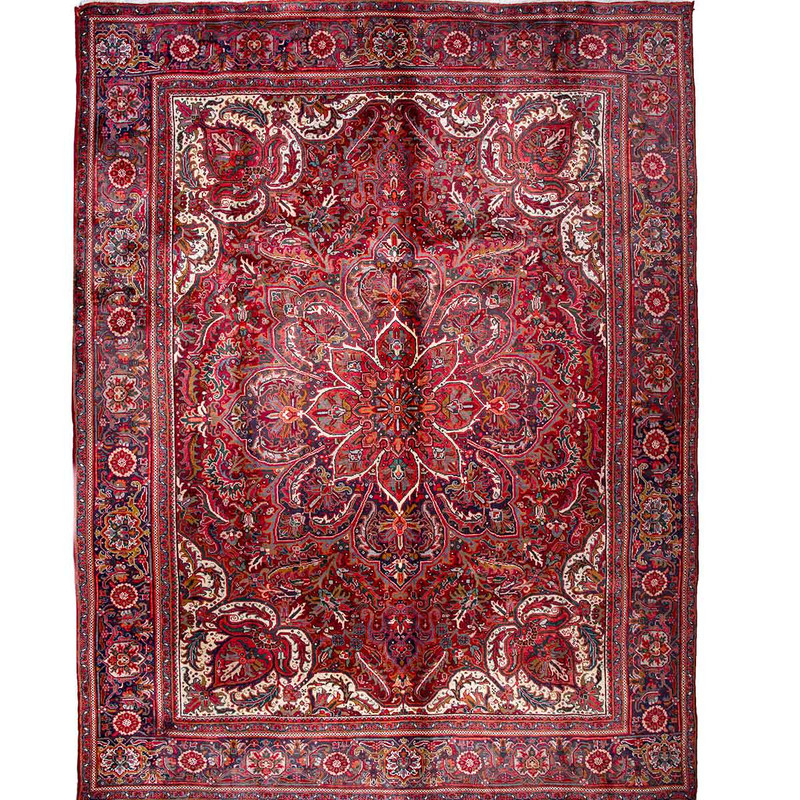
A Heriz in madder red, crimson, and navy blue, woven with sturdy mountain wool - Heriz Persian Rug 13x10 ft - Medallion Semi Antique Wool Hand Knotted
5
Kurk Wool - The Finest of All
The most prized wool in Persian weaving is kurk (sometimes written korkwool). Kurk wool comes from the first shearing of young lambs, or from the softest parts of the fleece around the neck and shoulders. It is exceptionally fine, soft, and lustrous, and it takes dye beautifully.
Because kurk wool is limited in quantity, it was traditionally used for the finest rugs. Antique "Kurk Kashan" rugs, woven in Kashan with this special wool, are among the most admired Persian rugs of the nineteenth and early twentieth centuries, famous for their silky texture and glowing colors. Explore our Kashan collection and our article on the artistry of Kashan rugs.
6
Skin Wool - A Quality to Avoid
At the other end of the scale is so-called skin wool or dead wool, known in Persian as tabachi. This wool is not sheared from living sheep but removed from the skins of slaughtered animals, traditionally by treating the skins with lime or other chemicals. The process damages the fibers, leaving them dull, dry, and brittle.
Rugs made with skin wool may look acceptable when new, but they wear out much faster, lose their pile, and never develop the luster of good wool. Skin wool also tends to take dye less evenly. This is why experienced buyers always pay attention to the feel and sheen of a rug's wool.
A quick test of wool quality: run your hand firmly across the pile. Good wool feels soft but springy, with a slightly oily smoothness from its lanolin. Poor wool feels dry, harsh, or brittle, and may leave loose fibers on your hand.
7
From Fleece to Yarn
Shearing and Sorting
Sheep are usually sheared once or twice a year, most often in spring. The fleece is then sorted by hand into grades: the longest, finest, and cleanest wool is set aside for the best rugs, while coarser wool may be used for foundations, kilims, or less expensive rugs.
Washing and Carding
The sorted wool is washed to remove dirt, sweat, and plant matter, while keeping enough lanolin to protect the fiber. It is then dried and carded or combed, opening the locks and aligning the fibers so they can be spun. Traditionally, this was done with hand cards or a large bow-like tool, whose vibrating string fluffed and cleaned the wool.
Spinning
Spinning twists the fibers into a continuous yarn. For centuries, Persian wool was spun entirely by hand, usually by women, using a drop spindle or a spinning wheel. Hand-spun yarn varies slightly in thickness along its length, and this irregularity is part of the charm of traditional rugs: it creates subtle variation in texture and color, especially when the yarn is naturally dyed. Most rug yarn is then plied - two or more strands twisted together - for strength. Our article on spinning in Persian rug making describes this craft in detail.
Today, many rugs are woven with machine-spun wool, which is more uniform and less expensive. Machine-spun wool can make excellent rugs, but hand-spun wool remains prized for its character, and many of the finest contemporary tribal and natural-dye rugs, including many Gabbeh rugs, return to hand spinning.
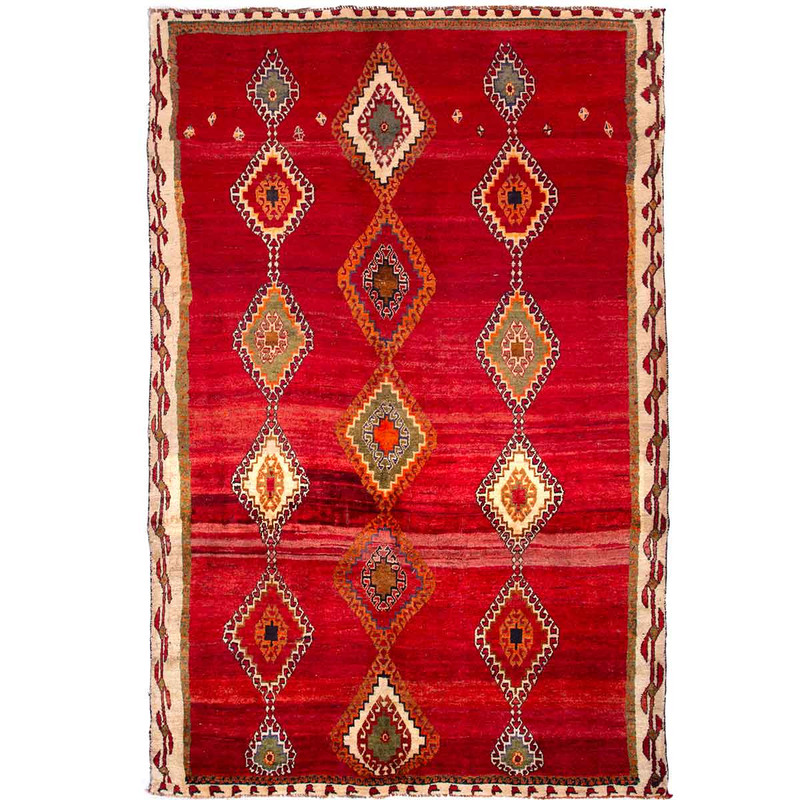
A Qashqai rug with a diamond lattice, woven with lustrous tribal wool - Qashqai Persian Rug 8x5 ft - Geometric Semi Antique Wool Hand Knotted
8
Wool and Pile Height
The length and character of wool also influence how a rug is designed and finished. Long, strong fibers suit rugs with a deeper pile, such as many tribal and village pieces and Gabbeh rugs, where a thick, soft surface is part of the appeal. Fine, shorter-stapled, lustrous wool suits closely clipped city rugs with intricate designs, where a short pile keeps every detail crisp. A skilled workshop chooses wool to match the design: a delicate floral Kashan or Isfahan needs a very different wool from a bold Qashqai or Heriz.
Pile height affects how a rug feels and wears. Deeper pile is softer and warmer underfoot but can show footprints and furniture marks more readily; a short, dense pile is crisp and very hard-wearing. Neither is better in itself; the right choice depends on the room, the traffic, and the look you want.
9
Camel Hair and Goat Hair
Wool is not the only animal fiber in Persian rugs. Camel hair, gathered when camels naturally shed their undercoat, is soft, warm, and has a natural golden-tan color. It has been used in the pile of tribal rugs, especially by Baluch weavers, often undyed, as well as in some Hamadan-region and tribal pieces. Camel-colored fields in many rugs, however, are made from dyed sheep's wool rather than real camel hair.
Goat hair is strong, coarse, and naturally dark. It is rarely used for pile but is valued for edges and selvages of tribal rugs and kilims, for tent cloth, and for bags, because it is extremely durable and resists wear and water. Explore our Baluch collection for rugs that combine wool and camel hair.
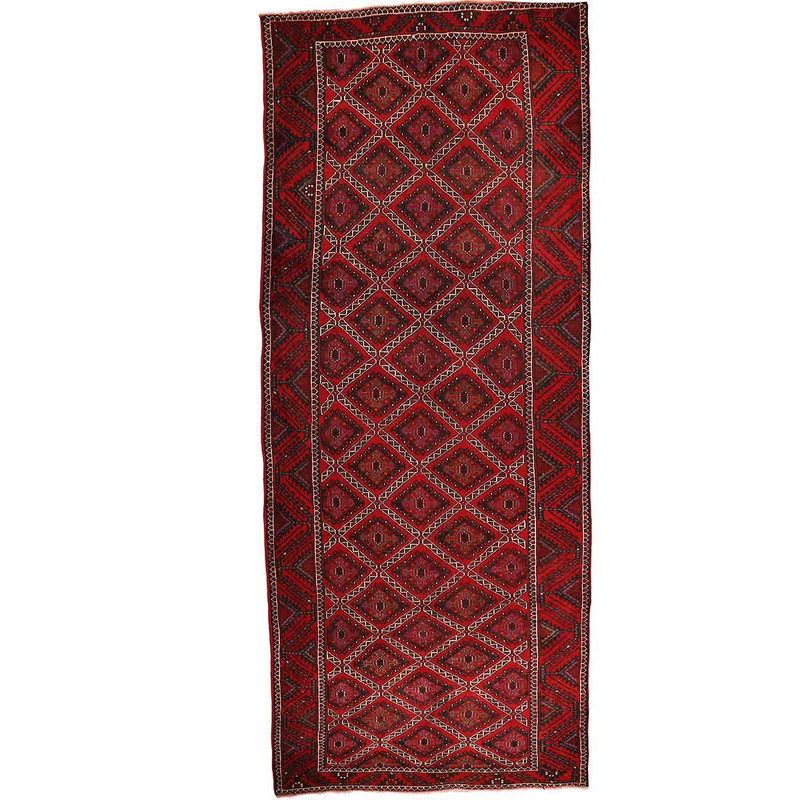
A Baluch runner woven with wool and natural camel hair - Baluch Persian Rug 12x4 ft - Diamond Lattice Semi Antique Wool Camel Hair Hand Knotted
10
Wool, Cotton, and Silk - How the Fibers Work Together
Most Persian rugs combine more than one fiber. Wool usually forms the pile, the visible surface you walk on. The foundation - the warps and wefts that hold the knots - is often cotton in city and town rugs, because cotton is strong, stable, and does not stretch, allowing fine and even knotting. Tribal and many village rugs use wool for the foundation as well, which suits portable looms and gives the rug flexibility.
Silk is used for the pile of the finest rugs, especially from Qom, Kashan, Isfahan, and Tabriz, or for highlights in wool rugs, where it adds sparkle to details such as outlines and flowers. Silk allows extremely fine knotting and brilliant color, but it is more delicate and more expensive than wool. Our article on Persian silk rugs explores this fiber, and our guide to how a Persian rug is made explains how all these materials come together on the loom.
11
Wool and Color
Wool's affinity for dye is one of the main reasons Persian rugs are so colorful. The protein structure of wool offers many places for dye molecules and mordants to bond, so colors penetrate deep into the fiber rather than sitting on the surface. Natural dyes such as madder and indigo produce especially rich effects on wool, and the slight variations in hand-spun, naturally dyed wool create the gentle color shifts known as abrash. Our articles on natural dyes and mordants explain this partnership in detail.
The natural color of the fleece also matters. White and cream wool gives the clearest, brightest colors when dyed, while naturally brown, gray, or black wool can be used undyed for outlines, fields, and borders, especially in tribal rugs.
12
Wool in Persian Weaving Today
Wool remains the heart of Persian rug making today. Many workshops use machine-spun wool for consistency and efficiency, and some blend local wool with imported wool to achieve particular textures. At the same time, there has been a strong revival of hand-spun, naturally dyed wool, especially among tribal weavers in Fars and in workshops that specialize in traditional methods. For buyers, this means a wide choice: from consistent, high-quality modern rugs to pieces with the irregular charm of hand-spun yarn, and antique rugs whose wool has developed decades of patina.
13
How Wool Ages
Good wool improves with age. Over years of use, the surface fibers are gently polished by foot traffic, and the lanolin and fibers develop a soft, glowing sheen that collectors call patina. Colors mellow and soften, and the pile wears down slowly and evenly. This is why a well-made antique Persian rug can look more beautiful than when it was new.
Poor wool, by contrast, simply wears out: it becomes dull, thin, and patchy. The difference between the two is one of the clearest illustrations of why wool quality matters so much for long-term value. See our antique and semi-antique collections for examples of wool that has aged gracefully.
14
How to Judge Wool Quality in a Rug
You do not need special tools to evaluate the wool in a rug. A few simple checks will tell you a great deal:
•
Look at the luster - good wool has a natural sheen that catches the light, especially when you look across the pile toward a window.
•
Feel the pile - it should feel soft, smooth, and slightly springy, not dry or harsh.
•
Press the pile - push your hand into the rug and release. Good wool springs back quickly.
•
Check for loose fibers - excessive shedding beyond the normal light shedding of a new rug can indicate short or poor-quality fibers.
•
Look at the colors - good wool takes dye richly and evenly, producing deep, clear colors.
•
Examine the wear - in an older rug, good wool wears down evenly and develops patina; poor wool looks thin and dull.
Combined with the checks in our article on how to buy a Persian rug, these observations will help you choose a rug that will last.
15
Caring for Wool Rugs
Wool is naturally resilient, but it rewards good care. Vacuum regularly to remove grit that can cut the fibers, blot spills quickly with cool water, rotate the rug to even out wear, and keep it out of strong, direct sunlight. Avoid harsh detergents, bleach, and hot water, which strip lanolin and damage fibers, and watch for signs of moths, which feed on wool in dark, undisturbed places. Our guides to cleaning a Persian rug at home and professional rug washing explain the details.
16
Frequently Asked Questions
Why does my new wool rug shed?
Light shedding is normal in a new wool rug, as short fibers left from spinning and shearing work their way out. It decreases with regular vacuuming.
Is a wool rug good for allergy sufferers?
Wool rugs trap dust in the pile until it is vacuumed, rather than releasing it into the air, and wool is naturally resistant to dust mites. Regular vacuuming and cleaning are important.
Is camel hair better than wool?
Camel hair is soft and beautiful, but it is not necessarily more durable than good sheep's wool. Its value lies in its natural color and character.
What is kurk wool?
Kurk wool is the finest grade of wool, from the first shearing of young lambs or the softest parts of the fleece, prized for its softness and luster.
Does wool fade in sunlight?
Wool itself is stable, but the dyes in any rug can soften in strong, direct sunlight over time. Rotating the rug and using curtains or UV-filtering film helps it age evenly.
Can a wool rug be used in a busy home?
Yes. Good wool is one of the most durable rug fibers available, and a well-made wool rug can handle daily family life for generations.
17
The Soul of a Persian Rug
From the mountain pastures where sheep graze to the spinner's hands and the dyer's vats, wool connects a Persian rug to the land and people who made it. Its strength, softness, and luster are the foundation of everything we admire in these rugs: their colors, their designs, and their remarkable ability to last for generations.
At Los Angeles Home of Rugs, our collection of wool rugs includes city, village, and tribal pieces from across Persia, each with a Certificate of Authenticity documenting its origin, materials, and age. If you have questions about the wool in any rug, please ask our experts.
Explore by Material
Wool Rugs
Silk Rugs
Baluch Rugs
Bakhtiari Rugs
Heriz Rugs
Gabbeh Rugs
Antique Rugs
Persian Rug FAQ